


It is incredibly frustrating to pour your heart into a blog post only to see it buried on the tenth page of Google. It hurts to see your work go unnoticed when you know your content is great.
I have optimized countless WordPress sites, and I know exactly how confusing search engine rules can feel at first. Thankfully, the Yoast SEO plugin turns that complex process into a simple, easy-to-follow checklist.
This popular tool sits right inside your WordPress editor and guides you through optimizing every post. It takes the guesswork out of ranking higher and getting the traffic you actually deserve.
In this tutorial, I will show you exactly how to install and configure Yoast SEO on your website.
You can use the quick links below to quickly navigate through this article:
- Why Install Yoast SEO on Your WordPress Site?
- Step 1: Install and Activate Yoast SEO Plugin
- Step 2: Import Your SEO Data (If Needed)
- Step 3: First-Time Setup
- Step 4: Connect Yoast SEO to Search Engines
- Step 5: Setting Up Yoast Preferences
- Step 6: Using Yoast SEO Tools
- Step 7: Integrating with Other Platforms
- Step 8: Refining Content With Yoast SEO
- Step 9: Monitoring and Measuring SEO Success
- Frequently Asked Questions About Setting Up and Using Yoast SEO
- Additional Resources for WordPress SEO
Why Install Yoast SEO on Your WordPress Site?
Yoast SEO is one of the most popular WordPress plugins because it helps you improve your website’s search engine rankings. It turns complicated search engine optimization (SEO) tasks into simple, actionable steps, making it perfect for beginners.
Here are the main benefits of using Yoast:
- Optimize for search engines: Yoast helps you optimize your page titles and meta descriptions to improve your visibility in search results.
- Get real-time feedback: The plugin gives you actionable tips and analysis right inside the WordPress editor, so you know exactly what to fix.
- Improve readability: It also checks your content’s readability, helping you write posts that are easy for both visitors and search engines to understand.
- Automate technical SEO: Yoast automatically handles technical tasks like creating XML sitemaps and adding structured data, which helps search engines crawl your site more effectively.
- Track your progress: The plugin uses simple red, orange, and green lights to show you how well each page is optimized.
A Quick Note on Our SEO Setup: While Yoast SEO is a great tool for beginners, we use All in One SEO (AIOSEO) on WPBeginner.
As our site grew, we found that AIOSEO’s more advanced features gave us the extra control and performance we needed. We believe in being transparent about the tools that power our own business.
- Learn about why we switched to All in One SEO for our own sites.
- See our detailed comparison between Yoast SEO and AIOSEO.
Step 1: Install and Activate Yoast SEO Plugin
First things first, let’s install the plugin. The great news is that the free version of Yoast SEO is incredibly powerful and offers many features to significantly improve your site’s SEO.
In this guide, I’ll be walking you through the setup using this free version.
As your website grows, you can always upgrade to Yoast SEO Premium to unlock advanced features like multiple focus keywords, internal linking suggestions, and 24/7 support. But for now, let’s get the free version up and running.
Important Note: If you’re currently using another WordPress SEO plugin (such as RankMath or SEOPress), it’s important to deactivate it before installing Yoast. Running two SEO plugins at the same time can cause conflicts and harm your site’s SEO.
You can deactivate your old plugin from the Plugins » Installed Plugins page in your WordPress dashboard. Don’t worry, deactivating your old plugin for a few minutes while you set up Yoast won’t harm your search engine rankings.
Once that is done, you can install and activate Yoast SEO. The process takes just a few minutes, and you will find detailed guidance in our beginner’s guide to installing WordPress plugins.
Step 2: Import Your SEO Data (If Needed)
If you were using another SEO plugin before installing Yoast, you’ll want to import your existing SEO data (like post titles and descriptions). However, if this is your first time using an SEO plugin on this site, you can safely skip this step and move on to step 3.
This import process makes sure you don’t lose months or years of SEO work you’ve already done. Yoast will transfer your existing titles, meta descriptions, and other optimization settings.
Backing Up Before Import
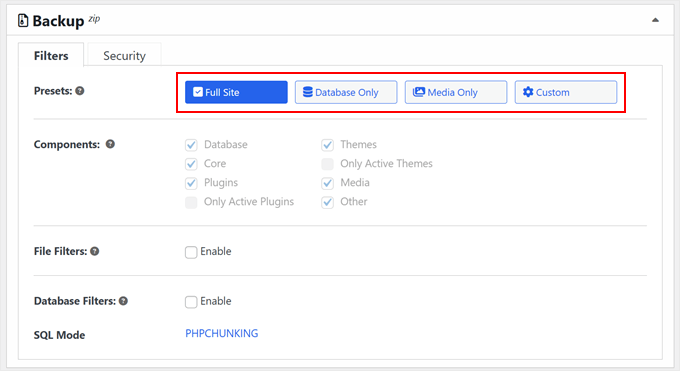
Before importing any data, make sure you create a backup of your WordPress database using a plugin like Duplicator or UpdraftPlus. This gives you a safety net in case anything goes wrong during the transfer process.
Since your SEO data is saved in your site’s database, creating a quick backup gives you a safety net in case anything goes wrong during the transfer process.
Here at Awesome Motive, we use Duplicator across many of our partner companies for reliable site backups and migrations. It provides great peace of mind.
I always recommend this step when making significant changes to SEO settings. It takes just a few minutes, but it can save you hours of work if something goes wrong.
For step-by-step instructions, see our ultimate guide on how to back up your WordPress site.
Running the Import Process
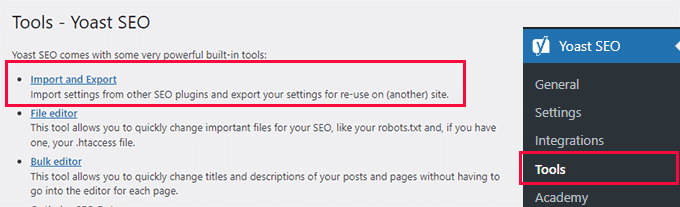
After creating the backup, you need to navigate to Yoast SEO » Tools in your WordPress dashboard. This new menu item appeared after activating the plugin in the previous step.
Next, click on the ‘Import and Export’ link to access Yoast’s data transfer options. Here you’ll find a list of supported SEO plugins that Yoast can import data from.
Then you can select your current SEO plugin from the available options and click the ‘Import’ button.
Yoast supports importing from popular plugins, including RankMath, SEOPress, and others.
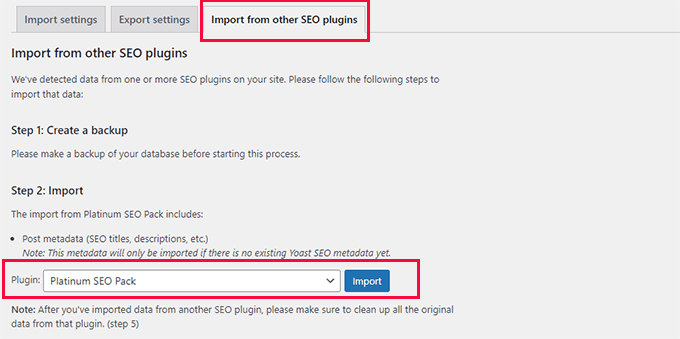
The import process typically takes just a few minutes, depending on how much content you have. You’ll see a progress bar showing the transfer status, and Yoast will tell you when the import is complete.
Keep your old SEO plugin installed but deactivated until you’ve verified everything has imported correctly. This way, you can easily switch back if needed without losing any data.
Cleaning Up the Old Plugin’s Data
Once you’re sure that everything looks good, you can return to the ‘Import’ tab.
You’ll need to select your previous SEO plugin under ‘Step 5: Clean up’ and then click the ‘Clean up’ button.
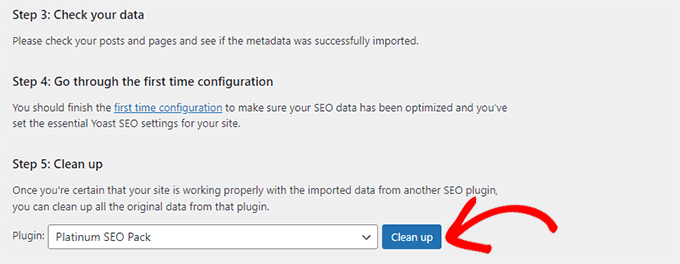
This will clean up the database and delete the old plugin’s data. After that, you can safely deactivate and delete your old SEO plugin.
Step 3: First-Time Setup
With Yoast SEO installed, it’s time to configure the basic settings that will optimize your entire website.
Unlike older versions of Yoast that launched an automatic setup wizard, the current version uses a First-time Configuration page that you need to access manually.
This process sets up the foundation for your site’s SEO. It only takes about 10-15 minutes, but it makes a huge difference in how search engines understand and display your content.
Navigate to Yoast SEO » General » First-time Configuration in your WordPress dashboard. This page contains several sections that help Yoast understand your website and optimize it properly.
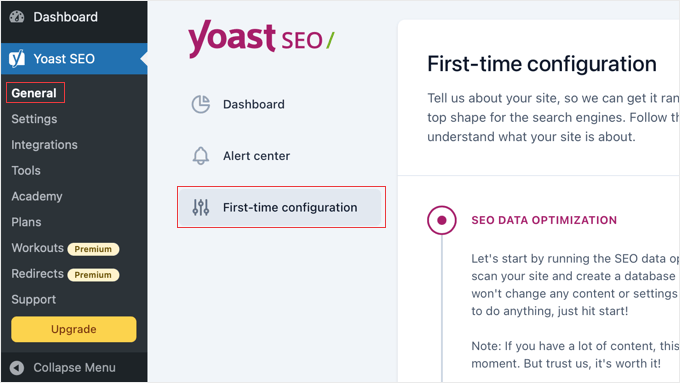
SEO Data Optimization
The first step is to click the ‘Start SEO data optimization’ button. This allows Yoast to crawl your existing content and analyze your site’s current SEO status.
Be patient during this process. It can take several minutes if you have a lot of content. Yoast is reviewing your posts, pages, and other content to provide more targeted optimization suggestions.
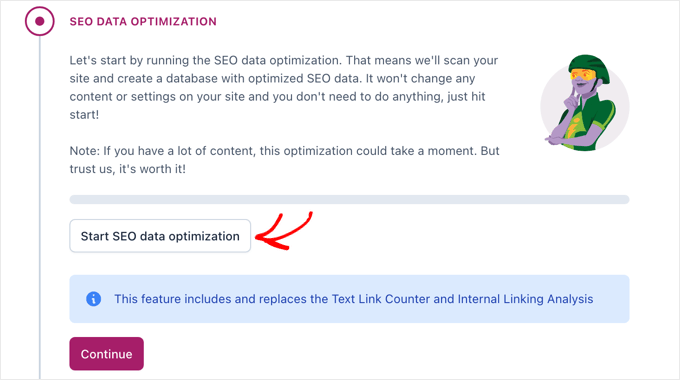
You’ll see a progress indicator while Yoast works.
Once complete, you can click the ‘Continue’ button. The plugin will better understand your site’s content and can provide more accurate SEO recommendations.
Site Representation
Next, you’ll specify whether your site represents a person or an organization.
This choice affects how search engines display your site in search results and helps with structured data.
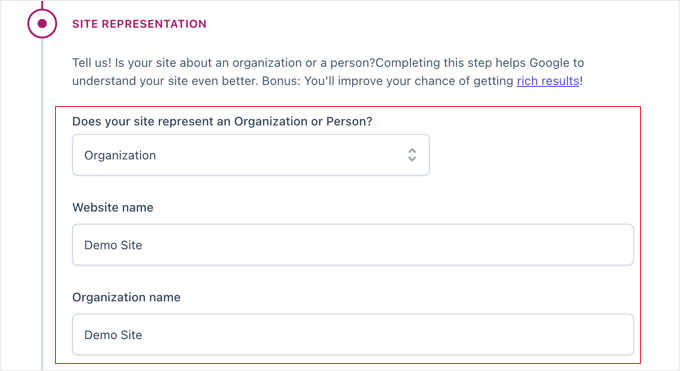
If you’re a business, freelancer, or company, select ‘Organization’ and enter your business name. If it’s a personal blog or portfolio, choose ‘Person’ and select your user profile from the dropdown menu.
Upload your company logo or personal photo when prompted. This image can appear in search results and social media shares, so choose something professional and recognizable.
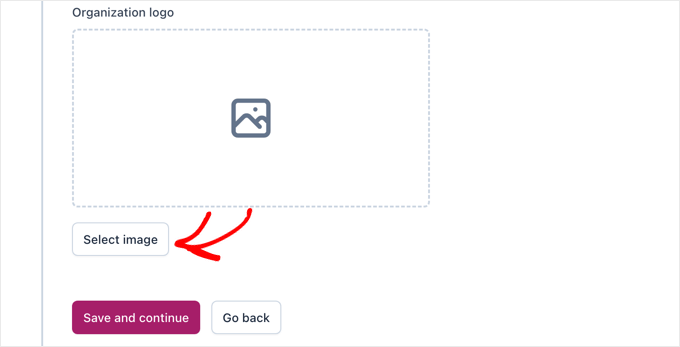
When you’re finished, you can click the ‘Save and continue’ button to save your settings and move on to the next section.
Social Media Profiles
You can add links to your social media profiles in this section.
Yoast uses these links to create structured data that helps search engines connect your website to your social presence.
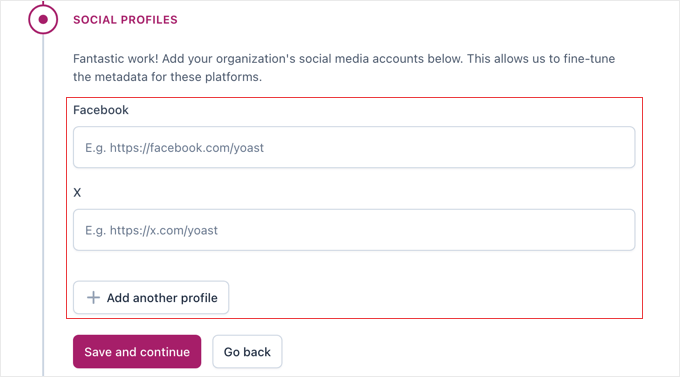
Include your main social profiles like Facebook, Twitter, Instagram, LinkedIn, or YouTube. You don’t need to add every social account. Focus on the platforms where you’re most active.
Once this is done, click the ‘Save and continue’ button.
Personal Preferences
Finally, choose your data tracking preferences.
Yoast offers to collect anonymous usage data to improve their plugin, but this is entirely optional.
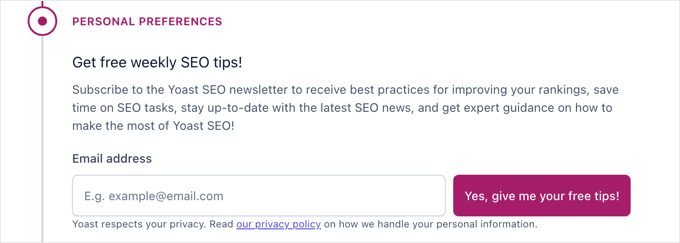
I recommend reviewing these privacy settings carefully and choosing what you’re comfortable with.
You can always change these preferences later in the main settings.
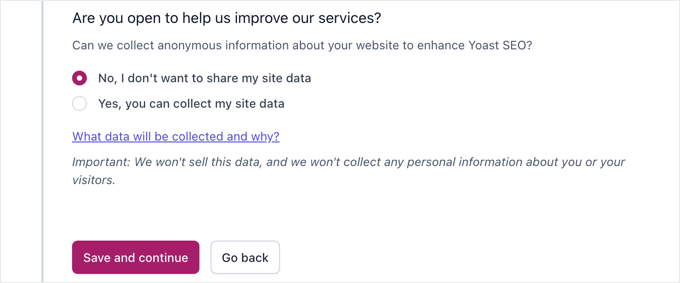
Don’t forget to save your settings once you have finished. After this, you will see a confirmation that the first-time configuration process is complete.
Step 4: Connect Yoast SEO to Search Engines
Connecting Yoast SEO to search engines like Google and Bing helps verify that you own your website and can access valuable SEO data. This connection also enables additional features and more accurate tracking of your site’s performance.
These connections are optional but highly recommended. They unlock insights about how your content performs in search results and can help identify SEO issues early.
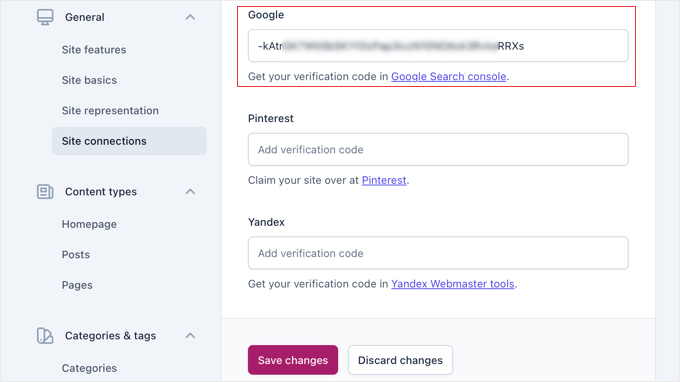
Navigate to Yoast SEO » Settings in your WordPress dashboard. Look for the ‘Site Connections’ section, where you can add verification codes from various search engines.
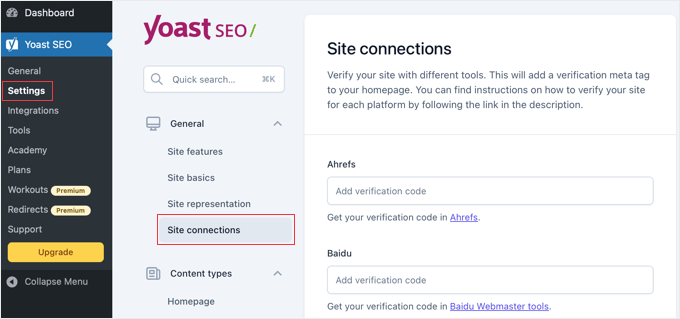
Connecting to Google Search Console
Google Search Console is the most important connection to set up. It shows you which keywords bring visitors to your site, identifies crawling errors, and provides performance data.
If you don’t already have a Google Search Console account, visit Google Search Console and add your website. During the setup process, Google will provide you with a verification code.
If you already have a Search Console account, then you can find your existing verification code by logging into your Google Search Console account.
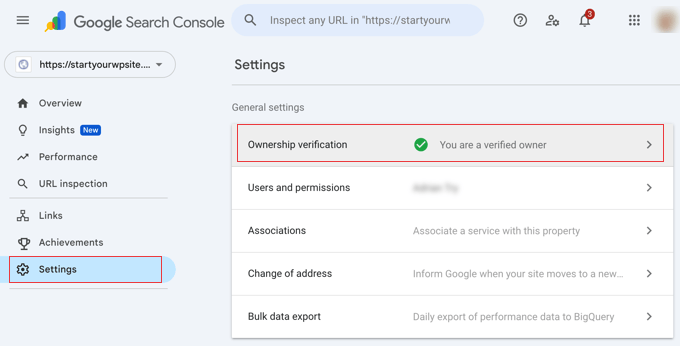
From the left-hand menu, navigate to Settings » Ownership verification.
Click on the ‘HTML tag’ method to reveal your code. It’s the string of letters and numbers inside the content="" attribute.
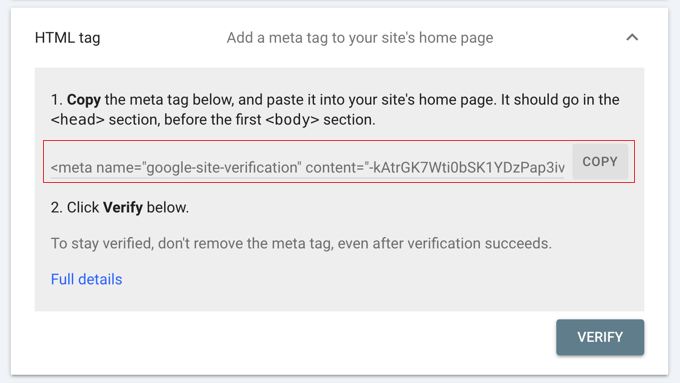
Copy this verification code and paste it into the appropriate field in Yoast’s Site Connections section. Click ‘Save Changes’ to establish the connection.
You can verify if a new connection is working by returning to Google Search Console. It should show your site as verified within a few minutes.
Adding Other Search Engines
While Google is the most important, you can also connect to Bing Webmaster Tools for additional search engine coverage. The process is similar: get your verification code from Bing and add it to Yoast’s settings.
Some users also connect to Yandex if they have international traffic, particularly from Russia. Again, the process involves getting a verification code and adding it to the appropriate field.
These connections confirm that you own your website and allow Yoast to provide better SEO insights.
Step 5: Setting Up Yoast Preferences
Now it’s time to configure Yoast’s core settings to match your website’s needs. These settings control how your content appears in search results and which SEO features are active on your site.
This section contains several important tabs that affect your entire website. Take your time here. Getting these settings right from the start saves you from having to fix issues later.
General Site Features
Navigate to Yoast SEO » Settings » Site Features to access the main feature controls.
This is where you’ll enable or disable Yoast’s various SEO tools.
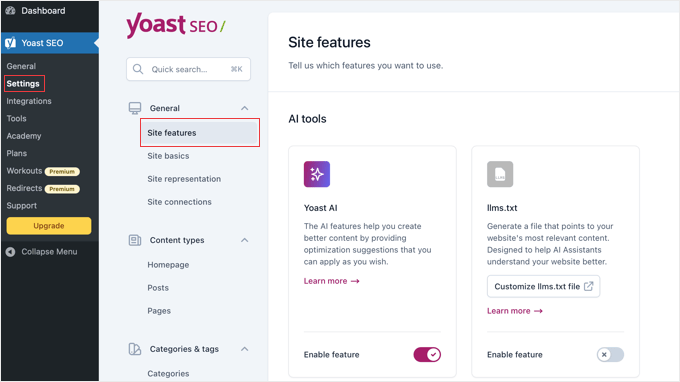
I recommend enabling the following features:
- SEO Analysis: Gives you real-time feedback and suggestions to improve your content for search engines.
- Readability Analysis: Helps make your content easier for both visitors and search engines to read and understand.
- Inclusive Language Analysis: Offers tips to make your writing more accessible to a wider audience.
- XML Sitemaps: Automatically creates a map of your website to help search engines find and index your content.
- AI optimization (llms.txt): This feature creates a special file on your site, similar to a
robots.txtfile, but specifically for AI crawlers like ChatGPT. It tells these AI bots whether they can use your content for training, giving you more control. We strongly recommend keeping this enabled.
Content Types & Search Appearance
This is a super important step. Here, you’ll create templates for how your content looks in Google search results and on social media. By setting smart defaults now, you save a ton of time later.
In the WordPress menu, navigate to Yoast SEO » Settings. Find the Content Types section and click on it to expand the options.
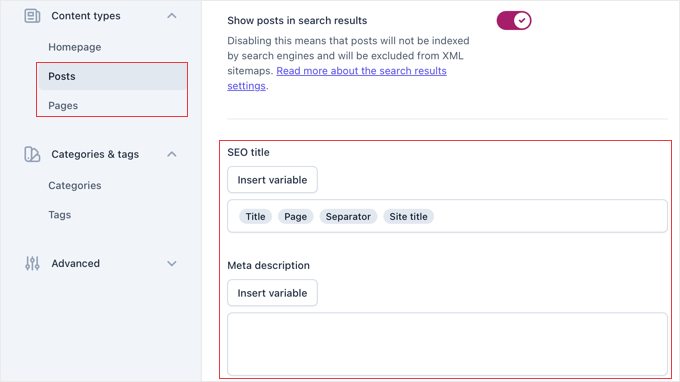
This will reveal settings for your Homepage, Posts, Pages, and any other custom post types you have. Let’s focus on the most important ones.
Click on ‘Posts’ to set the global defaults for every new blog post you write. You’ll see a section for ‘Search appearance’.
- SEO title: This is the template for your article titles on Google. Yoast uses variables like
Title,Separator, andSite titleto automatically build this. The default setting is usually perfect to start with. - Meta description: We recommend using the
Excerptvariable here as a safe fallback. However, you should still aim to write a unique, custom meta description in the Yoast metabox for every post you publish.
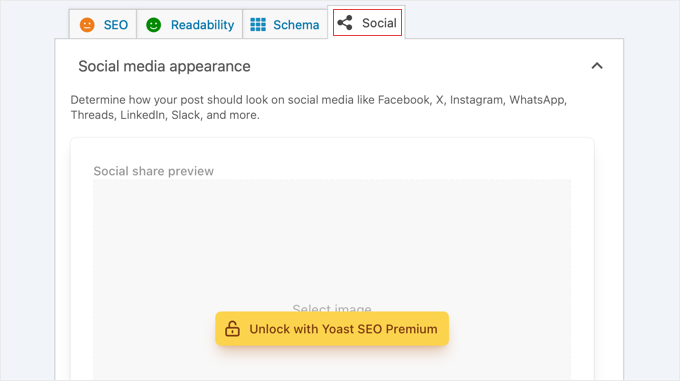
If you have the premium version of Yoast SEO, you can also scroll down to the ‘Social appearance’ section to set a default template for how your posts look when shared on platforms like Facebook and X (formerly Twitter).
The ‘Pages’ settings are identical, and the Yoast defaults are a great choice for most sites.
Categories & Tags
The ‘Categories & Tags‘ section controls how your taxonomy pages appear in search results.
These are the archive pages that show all posts in a specific category or with a particular tag.
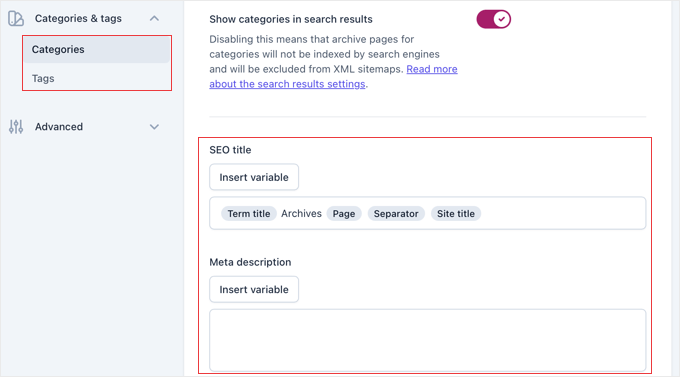
For most websites, I recommend keeping categories visible in search results. However, you should consider hiding your tag pages from search engines if you use lots of different tags.
This is because multiple tag archive pages can sometimes show the exact same list of posts, which search engines might see as duplicate content.
Customize the meta titles and descriptions for these taxonomy pages using Yoast’s variable system. This ensures each category page has unique, descriptive information in search results.
Advanced Settings
In the ‘Advanced’ section, you’ll find settings for more technical SEO elements.
The ‘Crawl optimization’ configuration here lets you control how search engines crawl your site.
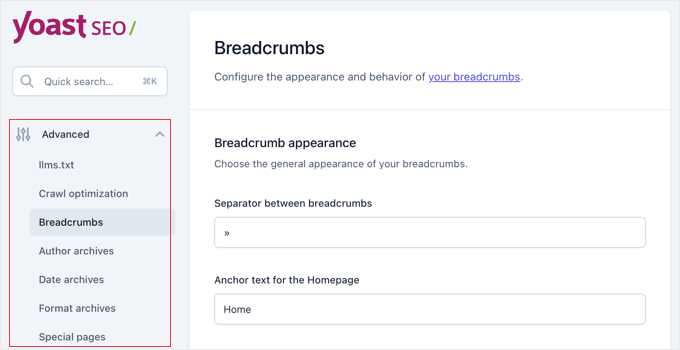
I also recommend enabling breadcrumbs if your theme supports them. They improve site navigation and help search engines understand your content structure. Breadcrumbs also appear in search results, making your listings more informative.
Review the other advanced options, but be cautious about changing settings you don’t fully understand. The default configurations work well for most WordPress sites.
Step 6: Using Yoast SEO Tools
Yoast SEO includes several powerful tools that help you manage your site’s SEO more efficiently. These tools save time and give you direct access to important files that affect search engine crawling and indexing.
You can access these tools by navigating to Yoast SEO » Tools in your WordPress dashboard. This section contains utilities that would otherwise require FTP access or technical knowledge to use.
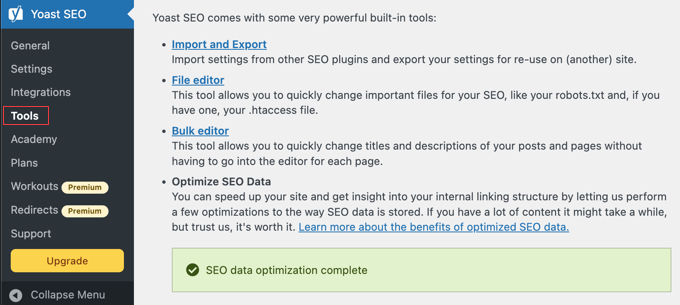
Bulk Editor
The Bulk Editor is a huge time-saver when you need to update SEO titles and meta descriptions for multiple posts or pages. Instead of editing each piece of content individually, you can make changes from one central location.
This tool displays all your content in a searchable table format. You can filter by content type, search for specific posts, and edit titles or descriptions directly in the interface.
The Bulk Editor is especially helpful when optimizing an existing website with a lot of content. You can quickly identify pages with missing meta descriptions or titles that need improvement.
In the ‘Title’ tab, you will find a blank field in the ‘New Yoast SEO Title’ column where you can add your new SEO title for that blog post.
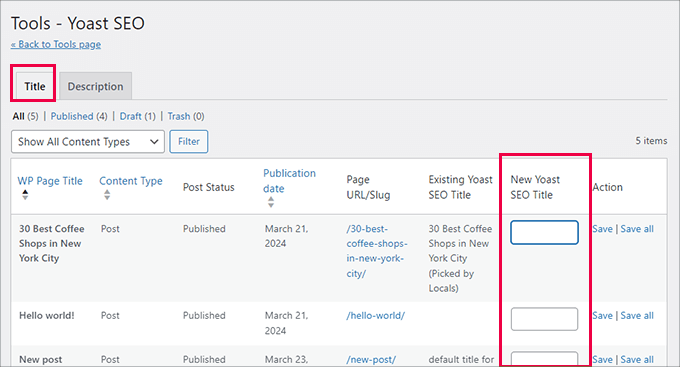
For example, if you need to add ‘Holiday Sale’ to the end of 10 different blog post titles, you can use the Bulk Editor to update them all from a single screen. It is a huge time-saver!
To add descriptions, you must switch to the ‘Description’ tab.
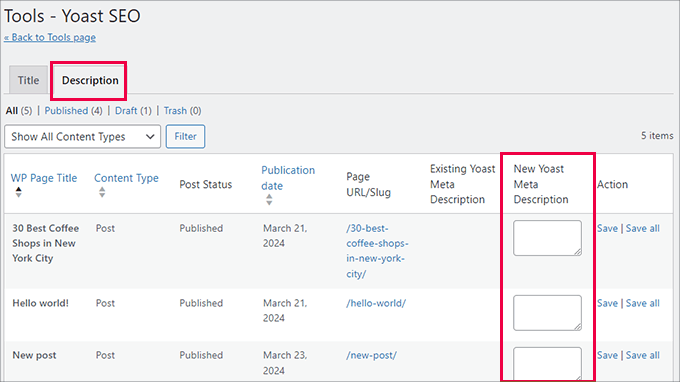
Changes made in the Bulk Editor save automatically, so you can work through your content efficiently without constantly clicking save buttons.
Import and Export
We already used the Import feature in Step 2, but this section also includes export options. You can export your Yoast settings to use on other websites or create backups of your configuration.
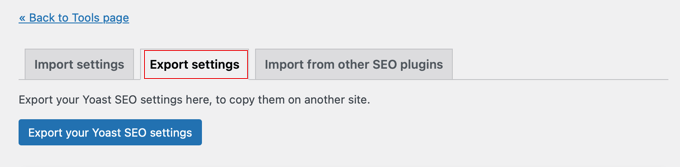
This is particularly useful if you manage multiple websites and want to maintain consistent SEO settings across all of them. Export your settings from one site and import them to others for quick setup.
File Editor
The File Editor tool is a powerful feature that lets you modify important SEO files directly from your WordPress dashboard, without using FTP or your hosting control panel.
Note: If you don’t see the File Editor option, don’t worry! Many managed WordPress hosting providers disable this feature for security reasons, or you may be on an NGINX server that doesn’t use .htaccess files.
The File Editor tool is a powerful feature that lets you modify important SEO files directly from your WordPress dashboard, without using FTP or your hosting control panel.
The two main files you can edit here are:
- robots.txt: This file gives instructions to search engine crawlers about which pages on your site they should or shouldn’t crawl.
- .htaccess: This is a server configuration file. Advanced users can edit it to create redirects, block bad bots, and more.
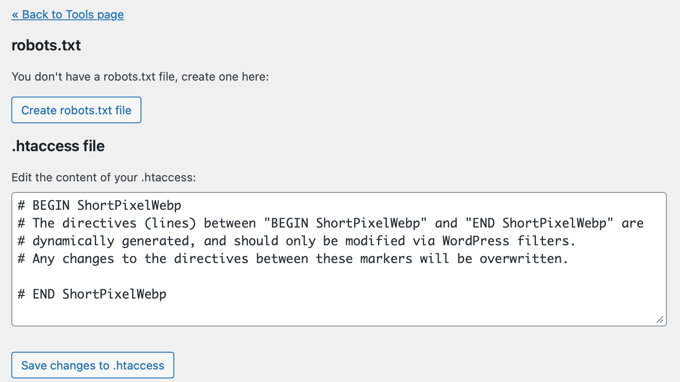
Warning: Be extremely careful when using the File Editor. A small mistake, especially in the .htaccess file, can make your entire website inaccessible. We recommend that beginners avoid editing this file unless following a specific, trusted tutorial.
Always make a full backup of your site before making any changes here.
Step 7: Integrating with Other Platforms
Yoast SEO works seamlessly with many popular tools and platforms to improve your SEO. These integrations can help you research keywords, track rankings, and get deeper insights into your website’s performance.
Setting up these connections is optional, but they can significantly improve your SEO workflow and results. Most integrations are straightforward to configure and provide immediate value.
Recommended SEO Integrations
Navigate to Yoast SEO » Integrations to see available connections.
Here you’ll find options to connect with professional SEO tools that complement Yoast’s built-in features.
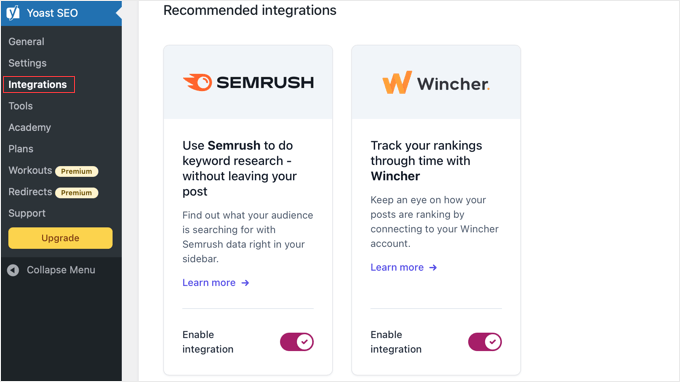
- Semrush: Helps with keyword research by showing you related keywords and search data right in the WordPress editor.
- Wincher: Tracks your keyword rankings, so you can see how your content is performing in search results over time.
Each integration requires you to connect your account to that service. Just follow the on-screen instructions to authorize the connection and start using the service.
Plugin-Specific Integrations
Yoast SEO also offers enhanced integrations with popular WordPress plugins to extend functionality beyond basic SEO.
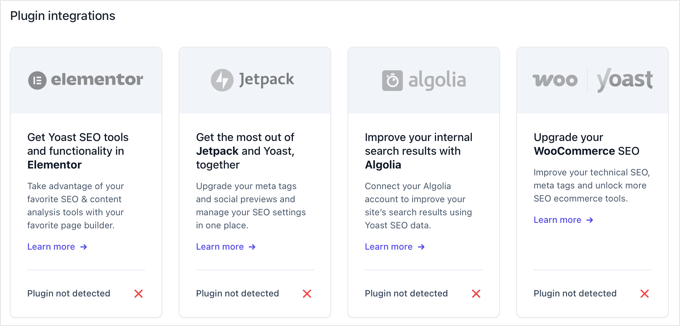
If you run an online store, the WooCommerce SEO integration provides specialized optimization for product pages, categories, and shopping-related schema markup.
For page builder users, Yoast integrates smoothly with Elementor and other visual builders. You can access Yoast’s SEO features while designing pages, making sure optimization doesn’t get forgotten.
Plus, many membership, eCommerce, and content management plugins have specific Yoast integrations. Check the Integrations tab to see if any of your existing plugins offer enhanced Yoast functionality.
Schema API Connections
Yoast’s Schema API allows other plugins to add structured data that integrates with Yoast’s schema output. This prevents conflicts and ensures clean, valid, structured data on your pages.
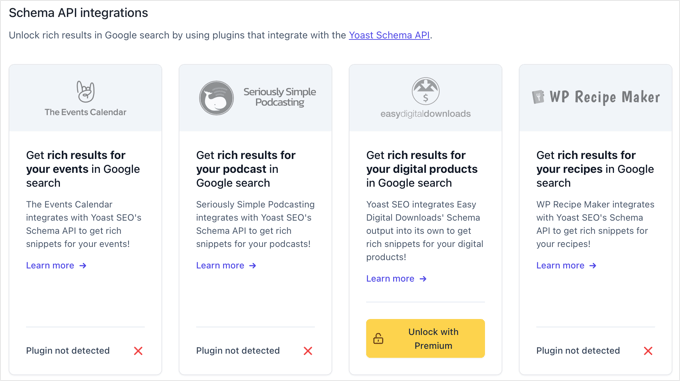
Popular plugins like recipe cards, event managers, and review systems often connect through Yoast’s Schema API. This integration happens automatically when you install compatible plugins.
You don’t need to configure these schema connections manually. They work behind the scenes to improve your search results with rich snippets and additional information.
Step 8: Refining Content With Yoast SEO
Now that your site-wide settings are configured, it’s time to optimize individual posts and pages using Yoast’s powerful content analysis tools.
This is where you can turn good content into search engine-optimized content that ranks better.
Every time you create or edit content in WordPress, you’ll use Yoast’s SEO metabox to fine-tune your optimization. This process becomes second nature once you understand the key elements.
When you edit a post or page, you’ll find the Yoast SEO settings in a panel. If you’re using the modern Block Editor (Gutenberg), the Yoast settings will appear in the right-hand sidebar.
If you’re using the older Classic Editor, you’ll find a ‘Yoast SEO’ metabox below your main content area.
Using the Yoast SEO Metabox
When editing any post or page, scroll down below the content editor to find the Yoast SEO metabox. If you’re using the Gutenberg editor, you might find it in the sidebar panel instead.
The metabox contains several tabs, but you’ll primarily work with the SEO tab for basic optimization. This is where you’ll input your focus keyphrase, the main keyword you want this content to rank for.
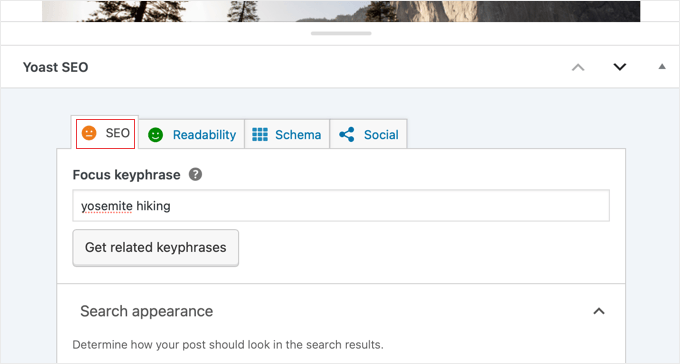
Choose your focus keyphrase carefully. It should be something people actually search for, relevant to your content, and not too competitive for your site’s authority level.
After entering your focus keyphrase, Yoast will analyze your content and provide a traffic light system: red means needs improvement, orange means good, and green means excellent.
SEO Analysis Features
You can find the SEO analysis tool by scrolling down the SEO tab. This examines dozens of factors to help you optimize your content.
It checks if your focus keyphrase appears in important places like the title, headings, and throughout the content.
The free version provides a powerful analysis based on a single focus keyphrase. If you upgrade to Yoast Premium, you can unlock advanced features like analyzing your text for multiple keyphrases, synonyms, and related terms.
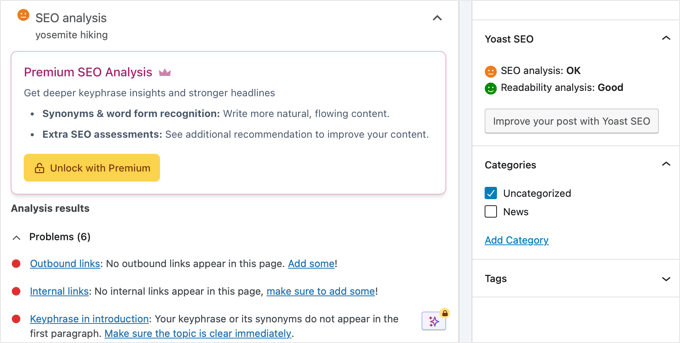
You’ll see specific suggestions for improvement, such as ‘Add your focus keyphrase to the SEO title’ or ‘Use your keyphrase in a subheading.’ You can address these suggestions to improve your optimization score.
Don’t worry too much about achieving a perfect green light. Focus on the suggestions that make the most sense for your content. Sometimes, a good orange score is better than forcing keywords where they don’t belong naturally.
The analysis also checks technical elements like title length, meta description length, and internal linking. These factors help search engines understand and display your content properly.
Readability and Accessibility
Switch to the Readability tab to access Yoast’s readability analysis.
This tool helps make your content more accessible and easier to understand for your audience.
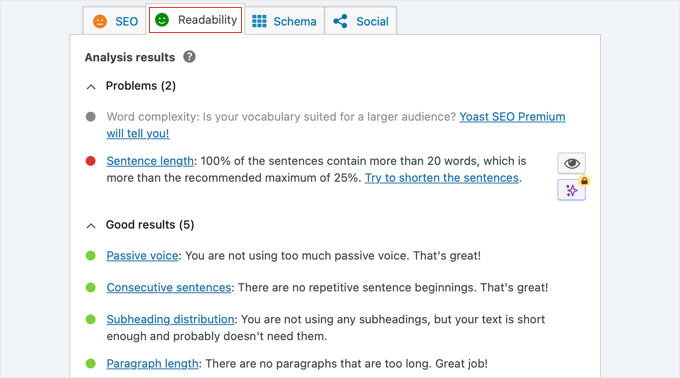
The readability analysis checks factors such as sentence and paragraph length, the use of transition words, and the use of the passive voice. These elements affect how easily people can read and understand your content.
Improving readability often leads to better user engagement metrics, which can indirectly help your search rankings. People stay on pages longer when the content is easy to read and understand.
Just remember, you are writing for humans first! It is okay to have an orange readability score if changing the text would make it sound robotic or unnatural.
If you enabled the Inclusive Language analysis feature in Step 5, you’ll also see suggestions for making your content more inclusive and accessible to diverse audiences.
Social and Schema Optimization
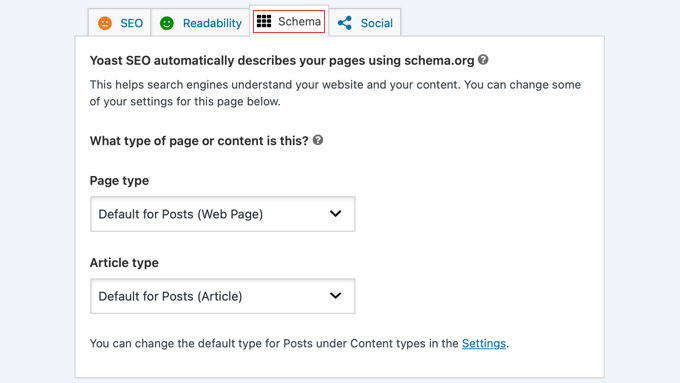
The Schema tab allows you to override default structured data settings for individual posts.
Most users won’t need to adjust these settings, but they’re available for advanced customization when needed.
The Social tab lets you customize how your content appears when shared on social media platforms. You can write specific titles and descriptions for Facebook and Twitter. Premium users can also upload custom images.
These social media optimizations don’t directly affect search rankings, but they can increase click-through rates and social engagement, which may have indirect SEO benefits.
Step 9: Monitoring and Measuring SEO Success
After setting up and optimizing your content with Yoast SEO, you will need to track your progress and measure the results. Monitoring your SEO performance helps you understand what’s working and where you need to make improvements.
The key is setting up the right tracking tools and knowing which metrics actually matter. Let’s look at the easiest ways to track your site’s success! 📈
Google Search Console Integration
Google Search Console is your most important SEO monitoring tool, and it works perfectly with Yoast SEO. If you connected it in Step 4, you should now start seeing valuable data about your site’s search performance.
Visit Google Search Console and select your website to access performance reports. The Performance section shows which keywords bring visitors to your site and how often people click on your search results.
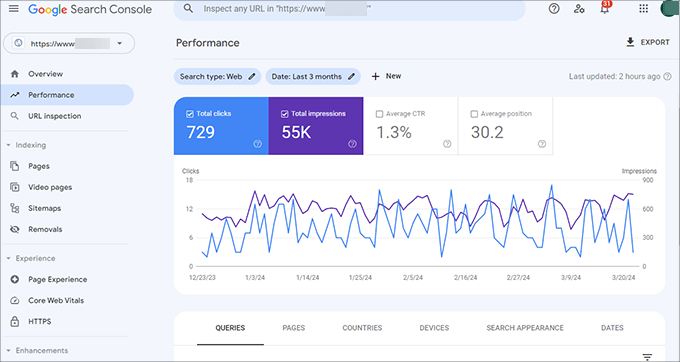
Pay attention to your click-through rates (CTR) for different pages. If you see pages with high impressions but low CTR, those are good candidates for optimizing titles and meta descriptions.
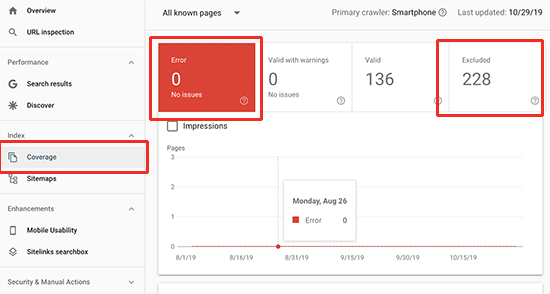
The Coverage section will show you any indexing problems, crawl errors, or pages that search engines can’t access. You will need to address these issues quickly to make sure that all your optimized content can be found in search results.
I also recommend submitting your XML sitemap to Google Search Console if you haven’t already.
Yoast automatically generates this at /sitemap_index.xml. Just paste this URL into the Sitemaps section of Search Console.
WordPress Analytics Setup
While Search Console shows how people find your site, Google Analytics reveals what they do after they get there. For WordPress users, I recommend installing MonsterInsights to view analytics data directly in your dashboard.
We use MonsterInsights here on WPBeginner because it makes analytics easy. It brings the most important data from Google Analytics right into our WordPress dashboard.
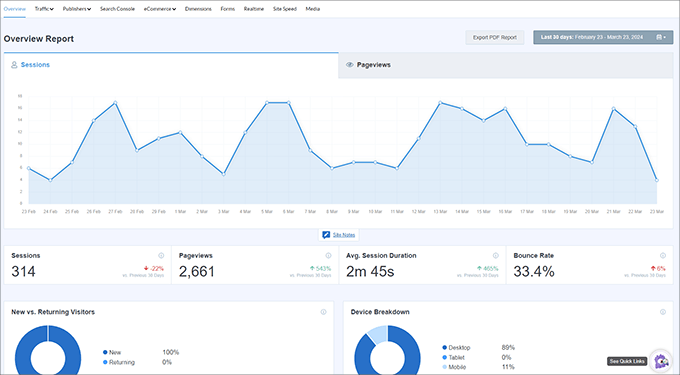
Track metrics like organic traffic growth, time on page, and bounce rate for your optimized content. These engagement signals help you understand if your SEO efforts are attracting the right audience.
You can also set up goals in Google Analytics to track conversions from organic search traffic. This helps you measure the business impact of your SEO work, not just traffic increases.
Rich Results Validation
You can use Google’s Rich Results Test tool to make sure that your schema markup is working correctly.
Simply enter any page URL from your site to see what structured data Google can detect.
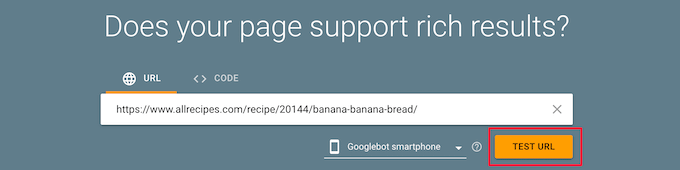
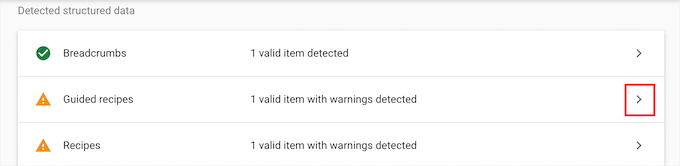
Yoast SEO automatically generates schema markup for different content types, but it’s worth checking that everything appears correctly. Proper schema can lead to rich snippets in search results, which improve click-through rates.
If you notice schema errors in the Rich Results Test, you will need to review your Yoast settings or check for conflicts with other plugins that might be adding duplicate structured data.
Ongoing SEO Maintenance
SEO isn’t a one-time setup. Instead, it requires ongoing attention and optimization.
I recommend reviewing your Search Console data every month to identify new opportunities and potential issues.
You should also update your content regularly based on performance data. If certain pages aren’t ranking as well as expected, you may need to optimize them again.
I also recommend keeping Yoast SEO updated to the latest version to ensure you have access to new features and improvements. The plugin team regularly releases updates that can enhance your site’s SEO performance.
Finally, consider running quarterly SEO audits. This process will allow you to review your most important pages, update outdated content, and refresh optimization based on new keyword opportunities you discover in Search Console.
Frequently Asked Questions About Setting Up and Using Yoast SEO
Even after following this complete setup guide, you might have questions about how Yoast SEO works or run into specific situations that need clarification.
These frequently asked questions address the most common concerns beginners have when getting started with Yoast SEO.
How do I install Yoast SEO plugin in WordPress?
You can install Yoast SEO by going to Plugins » Add New in your WordPress dashboard, searching for ‘Yoast SEO’, and clicking ‘Install Now’ followed by ‘Activate’.
The plugin will then appear as a new ‘Yoast SEO’ menu item in your dashboard, where you can configure all the settings.
Is the Yoast SEO plugin free?
Yoast SEO offers a comprehensive free version that includes all the essential SEO features most websites need. The free version provides SEO analysis, readability checking, XML sitemaps, and basic optimization tools that work perfectly for beginners and small websites.
How do I know if Yoast SEO is working correctly?
You can verify Yoast SEO is working by checking that the SEO metabox appears when editing posts or pages, confirming your XML sitemap is accessible at /sitemap_index.xml, and seeing SEO titles and meta descriptions display properly in search results. Google Search Console will also show indexing data if your sitemap is submitted correctly.
Why should I disable author archives on a single-author blog?
On a single-author blog, the author archive page is often identical to your main blog page, which can create duplicate content issues for search engines.
You can prevent this by going to Yoast SEO » Settings » Advanced » Author archives and disabling the feature. This tells search engines not to index these pages, resolving the duplication problem.
Additional Resources for WordPress SEO
I hope this article helped you to fully configure and optimize Yoast SEO.
Just remember that Yoast SEO is a tool, not a magic solution. Focus on creating high-quality, valuable content that genuinely helps your audience. This remains the foundation of good SEO.
Now, you may be ready to learn about additional resources and strategies that can take your WordPress SEO to the next level:
- For a deeper dive into WordPress SEO beyond just plugin setup, check out our comprehensive Ultimate WordPress SEO Guide for Beginners (Step by Step). This guide covers advanced SEO strategies. While it’s aimed at AIOSEO users, many of the principles work hand-in-hand with your Yoast setup.
- Our guide on the Best Yoast SEO Alternatives For WordPress explores other powerful SEO solutions you might consider for different needs.
- For transparency about our own SEO plugin choice, read about the Reasons Why We Switched From Yoast to All in One SEO. This detailed case study explains our decision-making process and might help you evaluate your long-term SEO strategy.
- You can also check out our comprehensive Yoast Review: Is It The Right WordPress SEO Plugin For You? for an in-depth analysis of the plugin’s strengths and limitations.
- Finally, our detailed comparison Yoast SEO vs All in One SEO – Which is the Best WordPress SEO Plugin? will help you decide if it’s the right fit for your needs.
If you liked this article, then please subscribe to our YouTube Channel for WordPress video tutorials. You can also find us on Twitter and Facebook.


Ahmed Omar
nice post, I was using Yoast for long time, since I started my site.
after reading the post, I found many points which I was unaware of it and it is importance.
any how now I am moving to use AIOSEO which considered the best SEO plugin
Thank you
WPBeginner Support
You’re welcome
Admin
CAMILLE
You don’t know how many of your articles have saved me!!! So thankful. Keep up the good work!
WPBeginner Support
Glad our guides have been helpful!
Admin
Sonia
Is seo plugin slow down the speed of a WordPress website ?
WPBeginner Support
SEO plugins should not cause a noticeable change in site speed.
Admin
Jiří Vaněk
I have practical experience on many websites with Yoast Seo and AIO SEO, including speed measurement. Both plugins are absolutely great and have never affected site speed in a negative way.
Gary Phillips
I do not have the search console. Do I need to install it with Webmaster Tools or how?
WPBeginner Support
You would want to take a look at our guide on Google’s Search console below:
https://www.wpbeginner.com/beginners-guide/google-search-console-ultimate-guide/
Admin
Gary Phillips
Hi – I cannot find the screen at the top of page 7 (Homepage – SEO Title – Meta description) on my Yoast installation when I try to follow along this tutorial. How do I access this screen? Thank you! Gary
WPBeginner Support
Yoast may have updated their interface for this, we will be sure to take a look and update our article when able.
Admin
Sammantha
Just wanted to say thank you for the help. I couldn’t (and wouldn’t have known how) to set this up on my own. Appreciate the advice – and for free too! xx
WPBeginner Support
You’re welcome, glad our guide could be helpful
Admin
Amruta Mohite
Thank you so much.
This one article my all doubts about yoast seo.
And also i found some important post links.
WPBeginner Support
Glad our article was able to help
Admin
Mohd Tabish Haleem
thank for the article..almost all doubt clear
WPBeginner Support
Glad our article could be helpful
Admin
Elena Whitehead
Thank you so much for so detailed instructions, so helpful!
WPBeginner Support
Glad our article could help
Admin
Srinath
This is really useful. I installed and activate Yoast as per your guidelines but XML sitemaps menu is not displaying. What should I do ?
WPBeginner Support
Yoast has updated and the setting is under General>Features for your sitemap
Admin
Andie Pas de Deux
Any chance of updating this, folks? So much of it no longer applies since the big Yoast update last year.
WPBeginner Support
We will certainly look into updating this article as we are able
Admin
Matt Robson
Thank you for sharing this fantastic article. This is very useful for me. Keep sharing.
WPBeginner Support
Glad our article was helpful
Admin
Kia Roberts
My yoast SEO does not have a tab named ‘your info’, nor does it have an option under features for ‘advanced settings’. Why not?
WPBeginner Support
Yoast has likely updated their interface since our last update of this article.
Admin
rachana
I have been reading a lot of your posts now. I’m actually starting out with a new blog and your articles really helped me a lot to understand the basics. thankx fr sharing this useful information.
WPBeginner Support
You’re welcome, glad our guides could help
Admin
Richard Ramirez
I came across your post doing a google search. Took the time, followed the instructions (which was very easy). Overall I had a very productive day. I just have to thank you all. This was very helpful.
WPBeginner Support
Glad our guide could help
Admin
moscotech
while google verification number on the webmaster tools verification number .It keeps give me this “Oops! That page can’t be found.”
what happened
WPBeginner Support
If your pages are returning that error you may want to take a look at: https://www.wpbeginner.com/wp-tutorials/how-to-fix-wordpress-posts-returning-404-error/
Admin
ADR
Hello,
As already mentioned by the two comments posted before mine, your article refers to an outdated version of Yoast. I was still able to install the plugin and adjust the basic settings as desired, however it turned out to be quite time consuming as I had to look for explanations elsewhere on the net.
Any chance you could update this tutorial?
Thanks!
WPBeginner Support
Thank you for letting us know, we are looking into updating this article.
Admin
Susanna
My dashboard does not show all the seo tags and information as shown in the above instructions…half seem to be missing….so unable to do most of the seo plug in work.
Stephanie
Is there any reason that when I go to my Yoast plugin, and click on SEO, that I only have 3 tabs – Dashboard, Features, and Webmaster Tools? No Your Links, Security, etc.
Sylver
What’s the best way to add Google Analytics? should i add the code using Yoast or using the plugin Insert Headers and Footers? since I’m using this for Google Adsense?
WPBeginner Support
Hi Sylver,
Please see our article on how to install Google Analytics in WordPress.
Admin
Bikramjit
Hi Wpbegginer
I have missed the Data Transfer part before setting Yoast SEO. Can I go for Data transfer at this moment. Wiil it create any problem?
Please guide
I am using genesis framework
WPBeginner Support
Hi Bikramjit,
Yes you can import SEO data later.
Admin
Bikramjit
Many thanks
Lulu
Most of the menu items don’t exist in the plugin I just downloaded 3 hours ago. Nothing matches this tutorial. Why?
Editorial Staff
Hi Lulu,
Yoast recently updated the plugin. We’ve added this article in our queue to update.
Admin
vickie
canonical URL vanished from my website.how does yoast free put it back ?
Ernest Darko
is it advisable to very all kinds of webmaster tools?
Kumar Mritunjay
Great post..! I’ve been using Yoast and was wondering: how important is it to have the exact keyword phrase density in the blog post?
For instance, if my focus keyword is ‘Weight Loss’ and I also use ‘Lose weight’ in my blog post, should I change ‘lose weight’ to ‘weight loss’ in order to fall under Yoast’s recommended keyword density?
WPBeginner Support
Hi Kumar,
The analysis tool in Yoast SEO are gives you a basic idea. You should feel free to use exact focus keyword along with keyword variations in your articles.
Admin
Kumar Mritunjay
Thank You…
Ashley
This is an awesome article and was SO helpful in setting up Yoast. There are a few things that have been added/removed so I would love to see an updated version of this. Please let me know if you decide to do one. I love this site and have used it many times while learning the Wordpress Monster
Tim
The XML Sitemap link generates a broken page. Help!
Muhammed Bakry
the user site map tab doesn’t appear for me is it a premium feature?
Kristina Bressler
Do I need to add SSL certificate as well when I install the Yoast plugin?
WPBeginner Support
Hi Kristina,
No, you do not need an SSL certificate to use Yoast SEO.
Admin
Juan Valdez
Hi! I’m having a problem with the YOAST Plugin. Even old versions. Every time I activate the plugin, I get the 500 Internal Error. It seems a problem with the theme, because if I use other theme, the plugin works fine.
Bhavin
Very good article.
Very easy understanding for non tech person.
I have one question that yoast increase page loading time or not ?
Because before installing yoast pages are loading in 0.45 sec. but after yoast time increased and it’s 0.95 sec so is it due to yoast ?
Aditya singh
This is my favorite plugin. You have done a good job of explaining every part of it.
Please be noted that this plugin has been updated and there are a few changes to it. I am waiting to read the updated version of this guide.
Thank you and great work guys.
Vishal Sahani
I want to buy wordpress seo tool please guide me
WPBeginner Support
Hi Vishal,
You can try Yoast SEO’s premium version. You can also check out other SEO tools that you can try.
Admin
Vishal Sahani
मुझे priuaum yosat seo tool क्या खरीदना चाहिये या नहीं
Penelope
Hi, useful article, thanks. I am trying to follow step 12, for the Google Search Console, but each time I enter the authentication code it comes back saying “no profiles found, reauthenticate”. I must be missing something but for the life of me I can’t work out what it is. Any help would be great.
Tara C
Great article! Love the step by step for unsavvy website people like me!
Jessica
I am using YOAST SEO plug-in for my wordpress site. Under Social – Yoast SEO I am able to enter the URL for my Instagram page.
However, every time I click on my Instagram logo on my website I get an error saying
“Sorry, this page isn’t available.
The link you followed may be broken, or the page may have been removed. Go back to Instagram.”
Somehow the very last character of my Instagram URL gets deleted.
The URL shows up correctly in my Yoast social page but once I click the social button the last character gets deleted and therefore I get a error message.
Please help me.
Thank you
Carolin
My WordPress Yoast SEO plugin stopped working and I don’t know why. How do I get it to work again? Any assistance would be greatly appreciated.
Madhu
Thank you for this post. It has helped me setup my SEO well .
Gaurav
Hi, I have my personal blog. In my Google search results, the article link is shown and not the breadcrumbed link like in case of wpbeginner. For example if your article is how to install and setup yoast, in google the link would be w, where as in my case it is
i want breadcrumb link in all my google results, is it possible through yoast or some other means?
Mohamad
Thank you for the great article.
I followed your tutorial to setup yoast from my woocommerce store. I still have 1 little problem: How can I set a default focus keyword template to all my products at once the way you do for SEO titles and meta description? setting them individually is a real hassle. I just want the search keyword to include %%title%% followed by the name of my country.
Orya Michael Durham
Hi, i created a hotel site for my company using wordpress. I have also installed the Yoast SEO but i have no knowledge of what to do so as to get my site search friendly on search engines. Please is there any way you can help me with this problem because i have zero knowledge on this. I have tried all the directions i found on the internet but i have no clue what to do or what the issue is.
Aman
Sir i have most common problem with seo yoast….seo yoast someday working fine. But today some that seo yoast all setting not show.. Only show “save changes” button..i mean no option show to change settings . Only show “save change”…plz help me
WPBeginner Support
Hey Aman,
Try switching off all other plugins except Yoast SEO. After that connect to your site using an FTP client. Next, backup and delete the .htaccess file from the root /public_html/ folder. Check if this resolves the issue. If it does, then reactivate plugins one by one, each time refresh Yoast SEO settings page until you find out the plugin that caused the issue.
Admin
bhaskar dhiman
Thank you. I got some work now for the next couple of days.
Godden
I followed your steps as outlined above. So far all works well except for one thing. When I share a specific page on Facebook, what appears is the the information from my FB open graph meta tags of my homepage instead of the specific page I shared.
How can fix this?
Fouad Sa
Hi. I installed SEO Data transporter like you said, But I can’t see Yoast in the given options. Also I already have Premium SEO Pack installed, But that also is not in the given options. Can you please help me? I’ve been looking for a way for to install yoast for a while, but had no success yet.
Dusan
Hi there,
Is this Yoast SEO free to use?
WPBeginner Support
Hi Dusan,
Yes, it is free to use.
Admin
Ramana
Dear Syed Balkhi,,
I have gone through this post, it was splendid. I have a doubt you are showing meta robots in index. where as shoutmeloud shows it as noindex.
Since both the blogs are authority blogs for the world, how do we come to a conclusion with these two variations?
Ramana
Yes, This was in deed a great information. I have few doubts on Nofollow,no index Etc., those were cleared with your post.
Herb
Perhaps you should reconsider your objection to the bulk editor in tools. You can edit titles and descriptions of your posts and pages without having to go into the editor for each page. This saves you a lot of time when entering titles and meta descriptions.
Lara
Hi, thesis 2 won’t work with the plugin – is there another you now recommend? Thanks in advance