


Over a decade ago, we started using surveys on WPBeginner to learn what our readers truly wanted. This helped us focus on the topics that mattered most and create more valuable content.
Back then, we experimented with everything – from costly survey platforms to simple contact forms. Through trial and error, we found the best WordPress survey tools: easy to set up, mobile-friendly, and designed to boost responses.
WPForms is our top recommendation for building detailed, in-page surveys and polls. For creating quick and interactive survey popups, the UserFeedback plugin is an excellent option.
In this guide, we’ll show you 2 ways to create a survey in WordPress. Whether you’re gathering feedback, conducting research, or just want to understand your audience, you’ll be able to get started in minutes. 🧑💻

Why Create a Survey in WordPress?
Creating a survey in WordPress lets you collect feedback and insights from your visitors, so you can understand their interests and make better decisions for your site.
You can use surveys in many ways. For example, you can use it to learn what features customers want next in your products or how you can improve their user experience.
Similarly, if you run a WordPress blog, surveys can help you gather feedback on your articles. You can ask readers if the content was helpful and what topics they’d like to see next.
You can also use online surveys in WordPress for internal purposes, such as gathering feedback from your team members. For instance, setting up an employee engagement survey can help you understand their issues and uncover ways to improve your team.
Let’s look at some WordPress survey tools you can use to get started.
Choosing the Best Survey Tool for WordPress
There are many online services that allow you to create survey forms and embed them in WordPress websites. The downside of these forms is that the data is stored on third-party servers, and you have limited customization options.
In addition to that, these services often limit how many responses you can collect. They may also require an additional payment to unlock more features or responses, which can result in high monthly costs.
A better option is to run surveys directly on your own WordPress website, rather than relying on third-party services.
WPForms – Best for Creating All Kinds of WordPress Forms
This is where WPForms comes in. It is the best WordPress form builder plugin on the market, used by over 6 million websites. The plugin includes a powerful drag-and-drop form builder and smart survey fields, such as Ratings, Likert Scales, and more.
We actually use WPForms to run our annual reader surveys, and it’s been performing exceptionally well. Learn more about what it can do in our full WPForms review.
Then there’s WPForms AI that lets you create forms instantly. Just type a short description of the form you need, and the AI will generate it for you – no manual setup required.
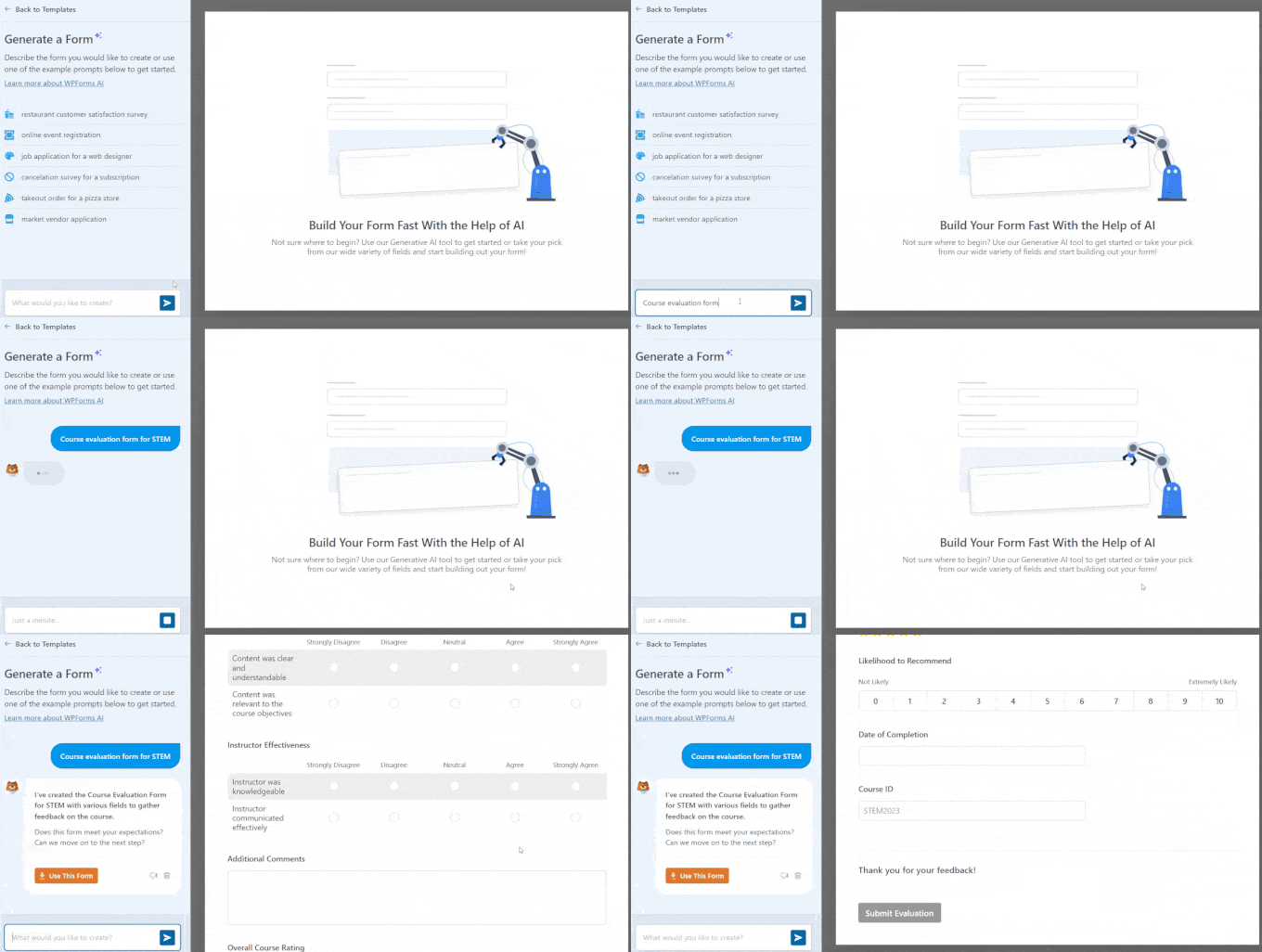
Another helpful feature is AI Choices, which can automatically generate options for multiple-choice fields, radio buttons, dropdowns, and checklists.
WPForms also offers conditional logic for personalizing questions based on users’ answers, along with interactive survey reports featuring charts, graphs, and tables.
Plus, you can export survey charts as JPEG, PDF, or print formats, and export survey results as CSV files for use elsewhere.
UserFeedback – Best for Creating Short Survey Popups
Another way to create surveys in WordPress is with the UserFeedback plugin, the best user survey and feedback plugin for WordPress.
UserFeedback comes with all the features you need, including multiple question types, pre-made question templates, built-in reporting, and more. Plus, you can create unlimited surveys and receive unlimited responses.
We used UserFeedback to create interactive surveys that gave us clear insights into what our web design customers were looking for. It was easy to use and worked well for our goals. Check out our complete UserFeedback review for details about the plugin.
Now, let’s look at how to create and add surveys to your WordPress website:
- Method 1. Creating a Survey in WordPress with WPForms (Recommended)
- Method 2. Creating a Survey in WordPress with UserFeedback (Interactive Popup)
- Bonus Tip: Track and Reduce Form Abandonment in WordPress
- FAQs: Creating Survey Forms in WordPress
- Bonus Resources to Improve Your WordPress Forms and Surveys
Method 1. Creating a Survey in WordPress with WPForms (Recommended)
The first thing you need to do is create a WPForms account. On the WPForms website, you can go ahead and click the ‘Get WPForms Now’ button to get started.
Then, you can just select a plan and follow the on-screen instructions to complete the checkout process.
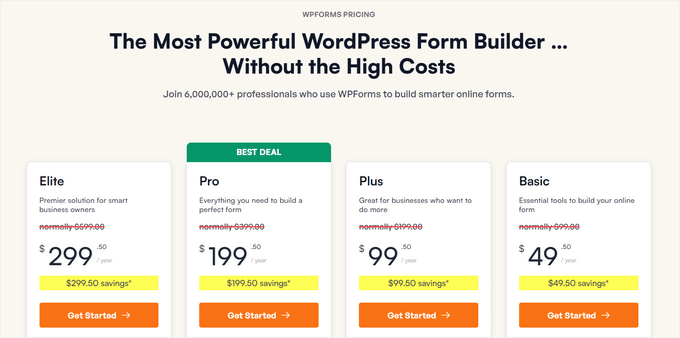
📌 Note: WPForms surveys and polls addon is part of their Pro plan. WPBeginner users can use our WPForms coupon to get 50% OFF on all WPForms licenses.
That said, there’s a free version of WPForms you can use to get started.
Once you’ve finished registration, you’ll arrive in your own WPForms dashboard, where you can find your license key. Go ahead and copy this key, as you’ll need it in the next step.
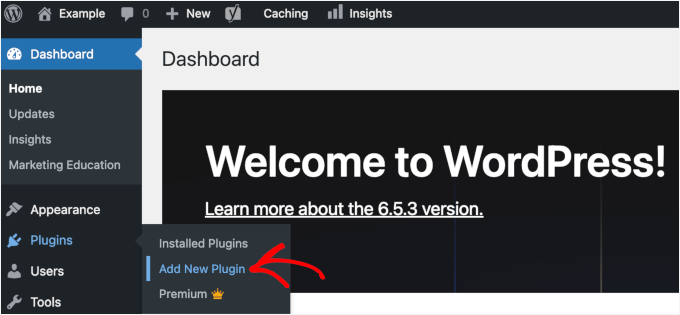
With that done, you can install and activate the WPForms plugin. To do this, go to Plugins » Add New Plugin in your WordPress admin area.
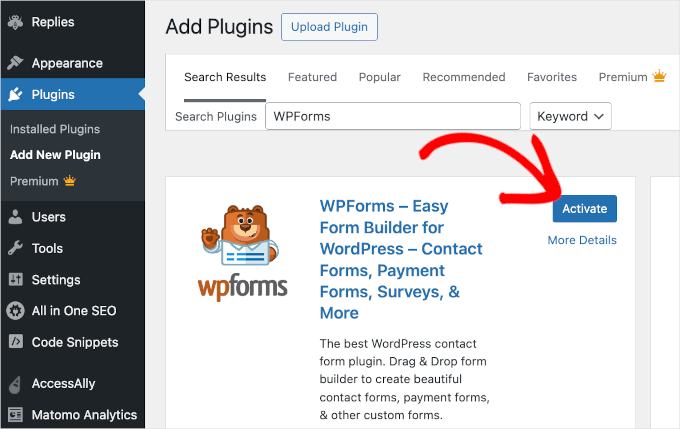
On the next screen, use the search bar to quickly find the WPForms plugin.
Then, you can click the ‘Install Now’ button and then ‘Activate’ when it appears.
For more details, see our step-by-step guide on how to install a WordPress plugin.
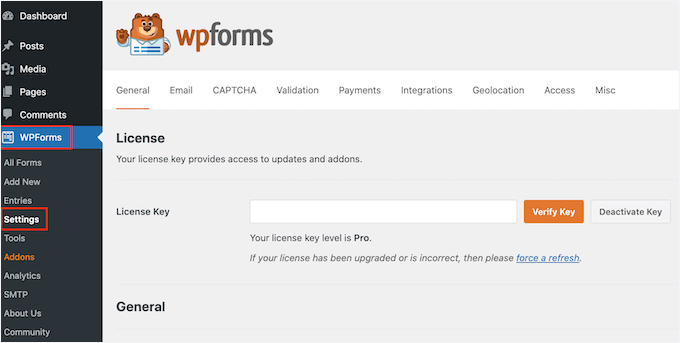
Once the plugin is activated, you need to head over to the WPForms » Settings page to enter your license key. (You can find this information in your account on the WPForms website.)
Then, click the ‘Verify Key’ button.
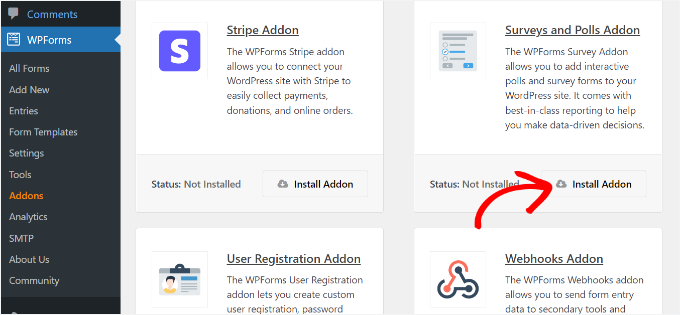
Next, you need to visit the WPForms » Addons page and scroll down to the Surveys and Polls addon.
Go ahead and click on the ‘Install’ addon button to install and activate the survey addon.
Creating Your First Survey Form in WPForms
Now, you are ready to create a survey form.
You need to visit the WPForms » Add New page to create a new form. On the next screen, go ahead and provide a title for your survey form.

Then, you’ll choose how you’ll build your form.
In general, WPForms gives you three options:
- Blank Canvas – Start from scratch with a completely empty form. This is perfect if you want full control and want to customize every field according to your needs.
- Pre-Made Templates – Choose from a library of ready-made templates for common forms like surveys, feedback, or registration. These templates help you get started quickly and save time on design.
- WPForms AI – Use the built-in artificial intelligence tool to generate a complete form for you.
If you want to use the AI form builder, all you have to do is just describe what you need (for example, “customer satisfaction survey”). WPForms AI will then create the form, including relevant questions and field types.
For beginners, we recommend starting with a pre-made Template because it provides a great foundation that you can easily customize.
On the Setup page, you can use the search feature to narrow down your template options. When you find a template you want to use, just hover over it and click on the ‘Use Template’ button.
Here, we’re going to use the ‘Survey Form’ template.
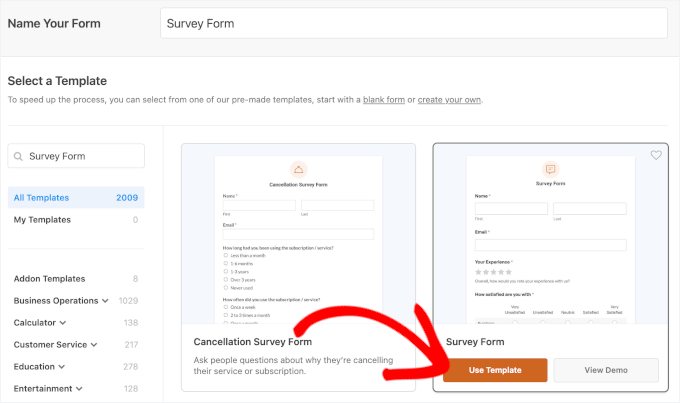
This will load a sample customer feedback form template with several fields already added to the form.
You can just point and click to edit any field, rearrange them with drag and drop, or remove them from the form. You can also add new form fields from the left column.
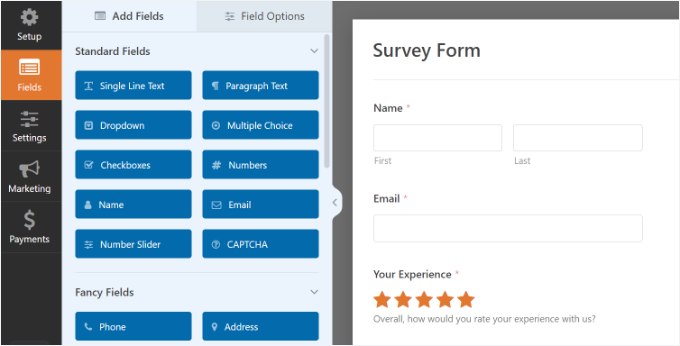
WPForms supports all commonly used form fields, including dropdowns, radio buttons, checkboxes, Likert scales, text input, rating scales, and many more. This makes it super easy for you to build highly interactive survey forms.
WPForms also includes conditional logic, which means you can personalize your survey questions based on user input in one of the previous fields.
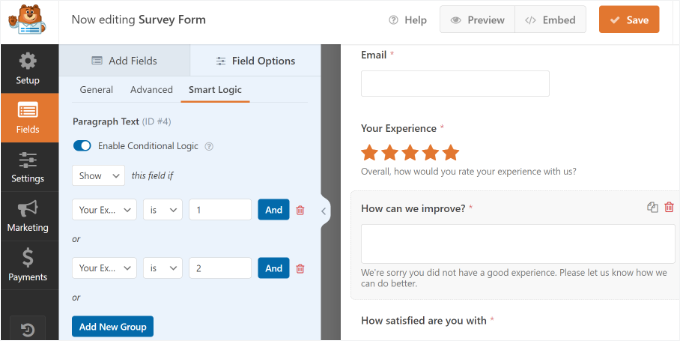
Once you have created the form, you need to click the ‘Save’ button to store your form settings.
Next, you can go to the ‘Settings’ tab and select ‘Confirmations’ in the WPForms form builder.
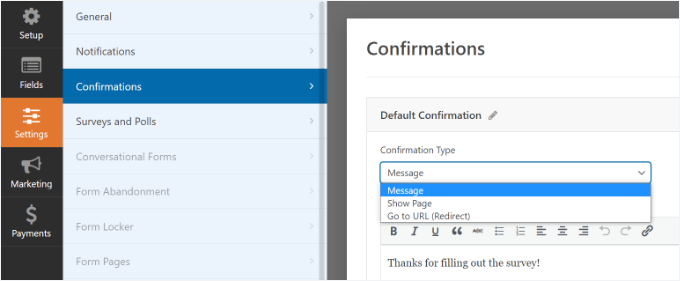
Here, you can choose whether to show a message or a page, or even redirect users to a URL when they submit the survey form.
Besides that, WPForms also lets you edit the notification settings, so you get email alerts when a user fills out your survey.
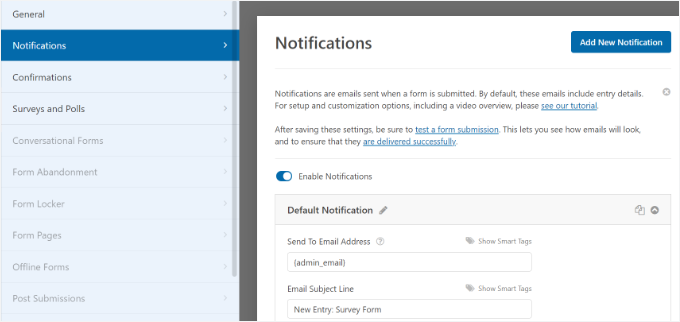
By default, WPForms sends email notifications to the site admin. If you want to add more recipients, simply separate the email addresses with commas.
For step-by-step instructions, see our guide on how to create forms with multiple recipients.
If everything looks good already, you can click the ‘Save’ button to store your setups.
Adding the Survey Form to Your WordPress Website
WPForms makes it very simple to add your forms anywhere on your website. You can easily add your survey form to any WordPress post, page, custom post type, or sidebar.
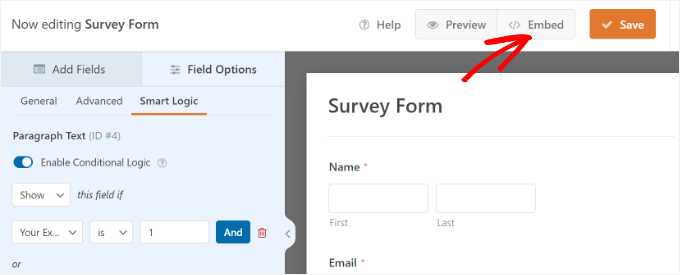
It gives an option in the form builder to embed the form in a new or existing page. Simply click the ‘Embed’ button at the top.
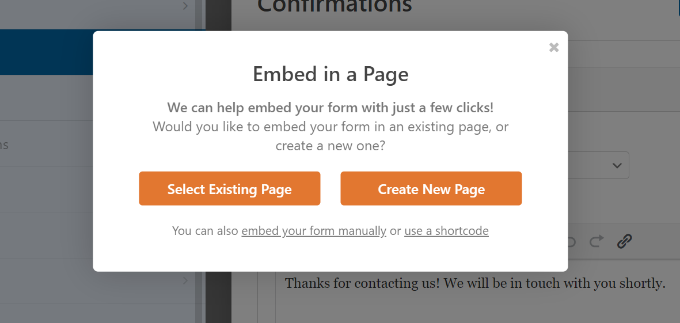
Next, a popup window will open, where you can select whether you’d like to create a new page or select an existing page.
We’ll choose the ‘Create New Page’ for this tutorial.
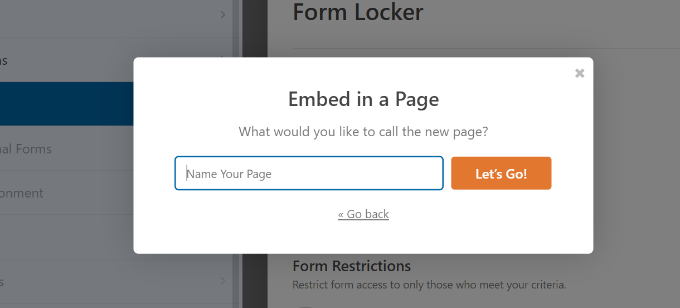
In the next step, you’ll need to enter a name for your new page.
After naming your survey form page, click the ‘Let’s Go’ button.
The plugin will now embed your survey form on the new page.
Alternatively, you can add a WPForms block in the content editor and select your survey form from the dropdown menu.
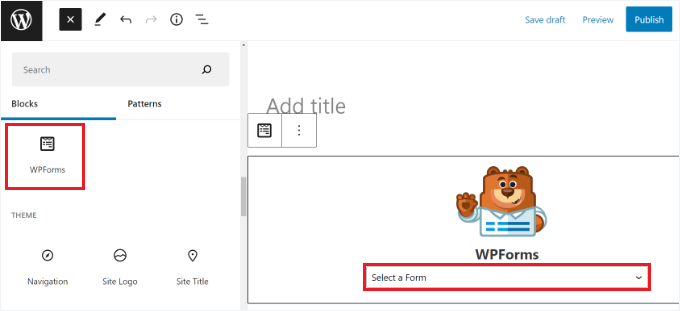
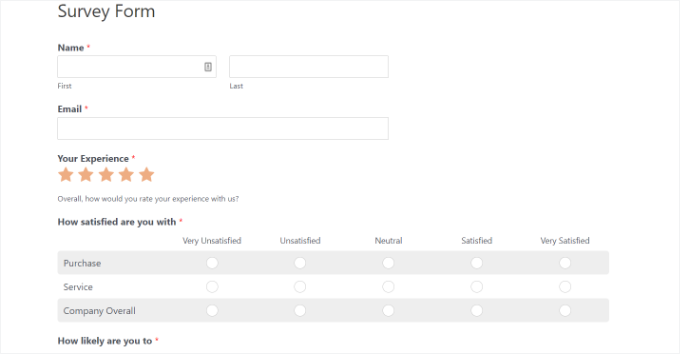
You will now see the form added to the content editor.
Once you are done editing, go ahead and publish it. You can visit your website to see your survey form live in action.
Embedding your survey on a dedicated page works perfectly for in-depth feedback. But what if you want to ask a question on every page of your site? That’s where a sidebar widget comes in handy.
To do this, simply head over to the Appearance » Widgets page in your WordPress admin area and add a WPForms widget block to any sidebar.
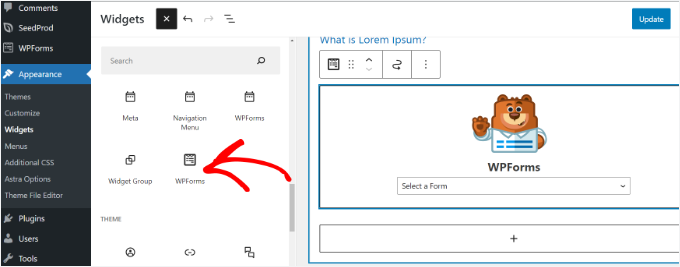
In the widget settings, select the survey form you created earlier from the dropdown menu, and don’t forget to click on the ‘Update’ button to store your changes.
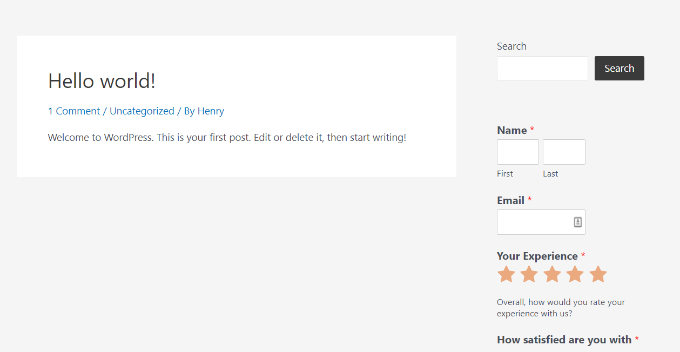
You can now visit your website to see your survey form displayed in the sidebar.
Viewing Your Survey Form Results
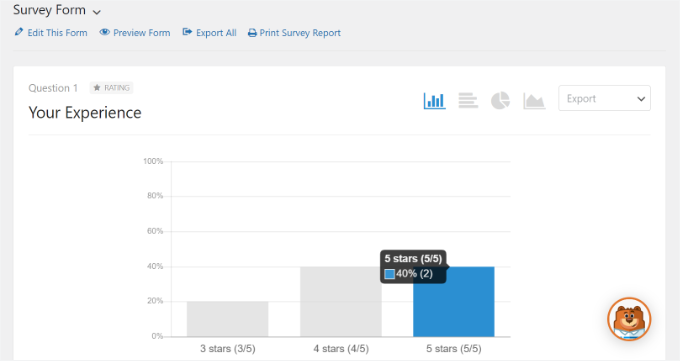
WPForms shows survey results in beautiful charts and graphs. You can also print survey results and export them to your favorite spreadsheet software.
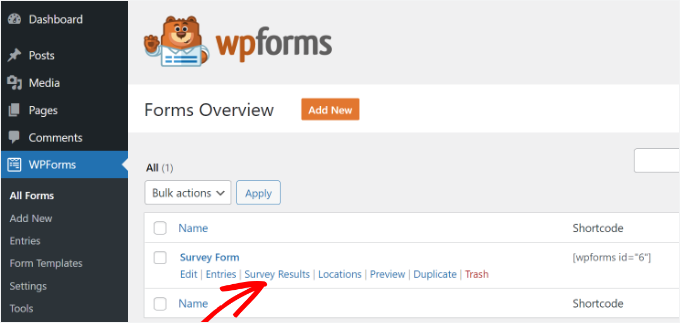
To view your survey results, you need to visit the WPForms » All Forms page and click on the ‘Survey Results’ link below your survey form.
On the results page, your survey responses appear in interactive charts and tables.
You can export results for individual questions or the entire survey in JPEG, PDF, or print-friendly formats to share in presentations, blog posts, or on social media.
That’s it — your survey form is all set. But before you go, we have one more tip worth checking out below.
Pro Tip: Converting Any Form into a Survey
WPForms also allows you to convert any form into a survey and display past results as a survey. You can even select specific form fields to be treated as survey fields.
This is particularly useful if you want to gather data through other forms like a contact form, user registration, or newsletter sign-up form.
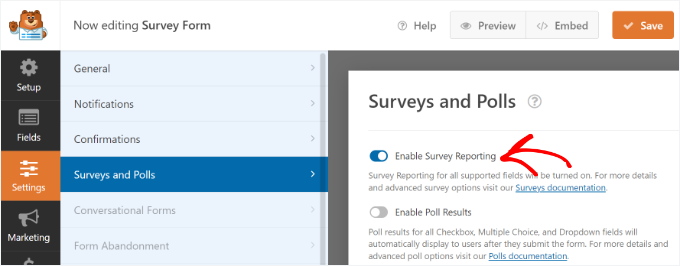
To convert an existing WPForms form into a survey, simply edit the form in WPForms and go to the Settings » Surveys and Polls section. You need to check the box next to the ‘Enable Survey Reporting’ option and save your changes.
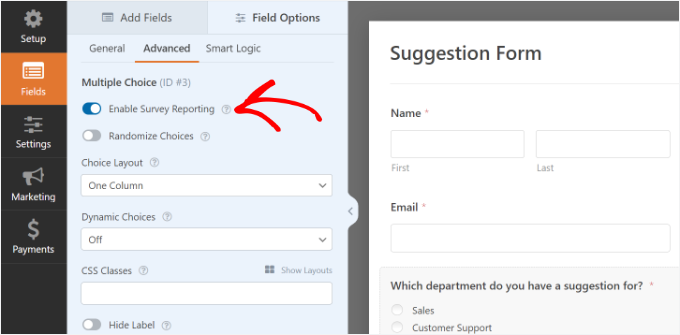
To enable survey reporting for a specific field, you can simply select the field from the drag-and-drop form builder.
Then, go to the ‘Advanced’ tab and check the ‘Enable Survey Reporting’ option.
Method 2. Creating a Survey in WordPress with UserFeedback
First, let’s get your UserFeedback account. To do this, simply click on the ‘Get UserFeedback Now’ button on their website, select a plan, and complete the checkout.
📌 Note: There is actually a free version of UserFeedback that you can use to get started. But the Pro version comes with more powerful features like page-level targeting, additional question types, premium templates, and more.

With that done, you’ll get your own UserFeedback dashboard. From here, go ahead and copy your license key to unlock all the Pro features in the next step.
Now, let’s install and activate the UserFeedback plugin. From your WordPress dashboard, go to Plugins » Add New Plugin.
Next, you can use the search bar to look for the UserFeedback plugin.
On the search results, click ‘Install Now’ and then ‘Activate’ when it appears.
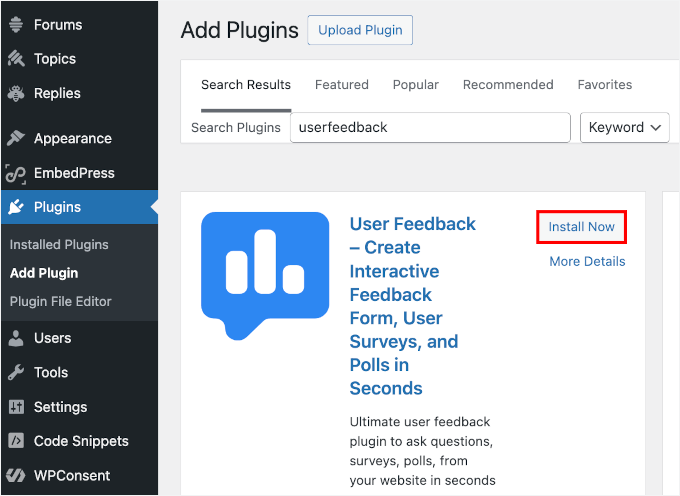
For step-by-step instructions, follow our tutorial on how to install a WordPress plugin.
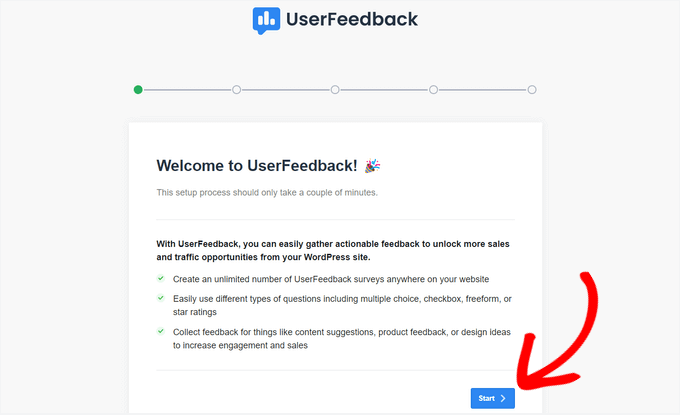
Once the plugin is activated, the setup wizard will automatically launch. Go ahead and click the ‘Start’ button to begin the setup.
Next, you’ll be prompted to choose what type of question you want to ask your website visitors.
You can choose from a few pre-written questions or create your own question.
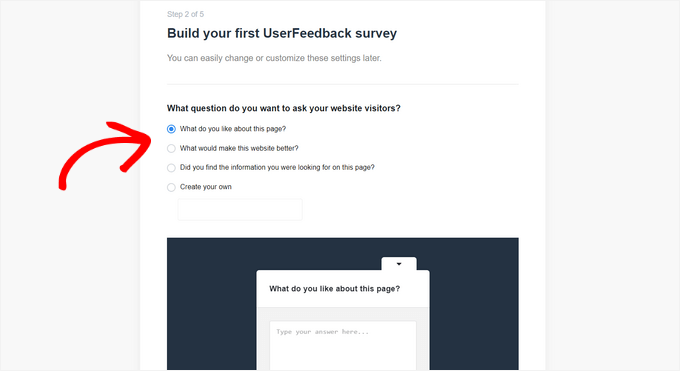
Don’t worry. You can change your questions at any time.
After choosing a question or writing your own, click the ‘Next Step’ button to continue.

Now, you’ll have the option to enable specific UserFeedback features, depending on your license level.
Go ahead and enable the features you want or that your license level allows.
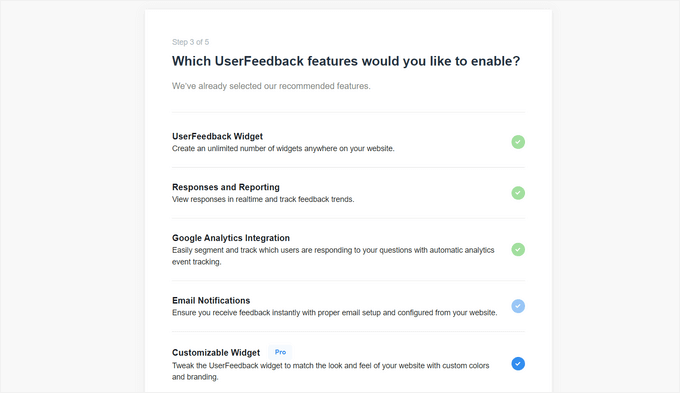
Now, click the ‘Next Step’ button at the bottom of the page.
Next, you can enter the email address where you want the survey responses to be sent.
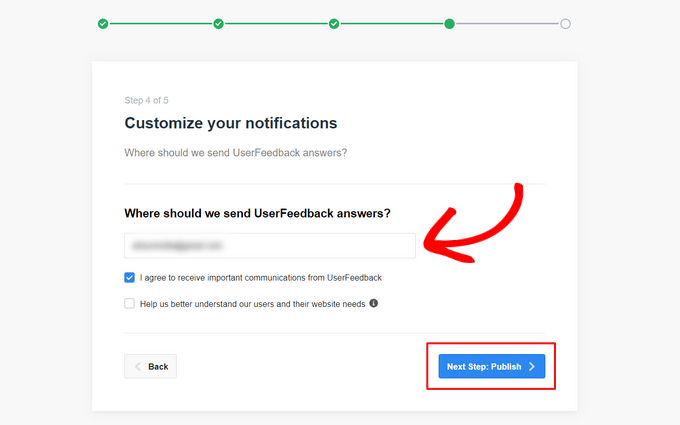
You can also check the boxes to allow UserFeedback to send you important communications and help the UserFeedback team better understand users and their websites. Then, click the ‘Next Step’ button to continue.
In the final step of the setup wizard, the features and addons you enable will be installed.
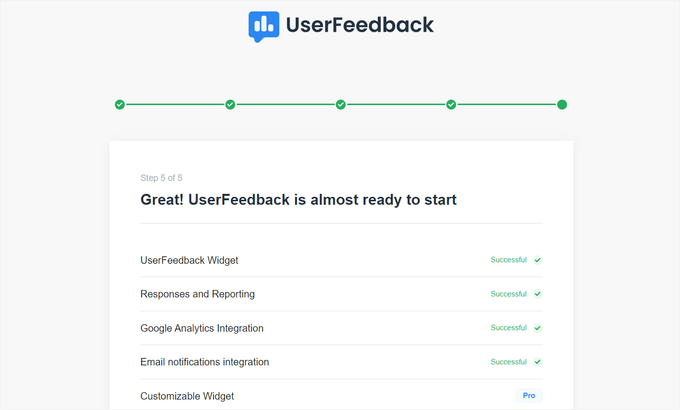
Then, you can click on the ‘Exit to dashboard’ button at the bottom of the page.
After that, you can change the survey settings.

Editing Your Survey in the UserFeedback Dashboard
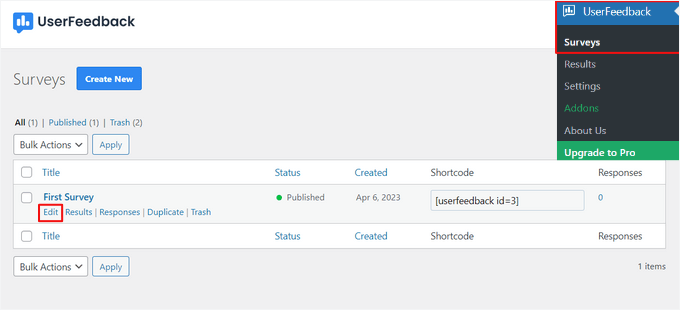
From the UserFeedback dashboard, you can now edit the survey you just created. To do that, hover over your survey and click the ‘Edit’ link.
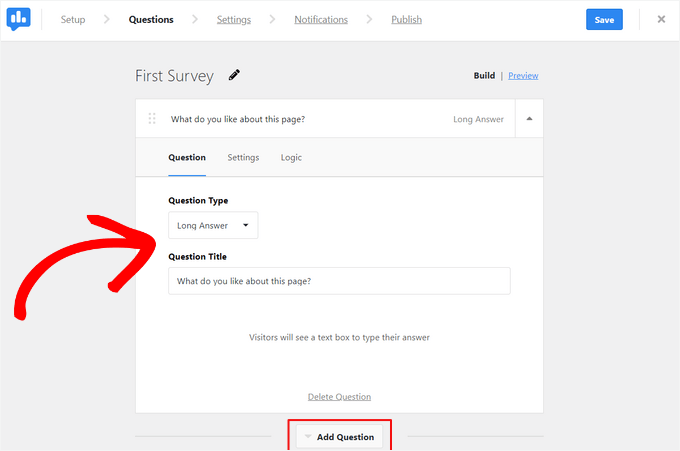
Now, you can change the question type and the question title by simply pointing and clicking.
You can add additional questions to your survey by clicking the ‘Add Question’ button.
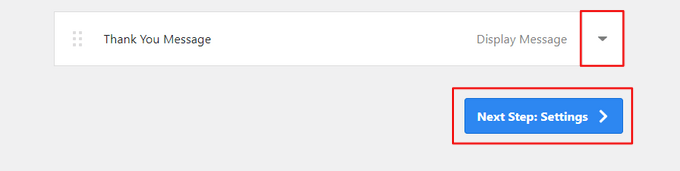
You can also create a custom thank-you message and redirect users after their submission.
When you’re finished editing your survey questions, hit the ‘Next Step’ button.
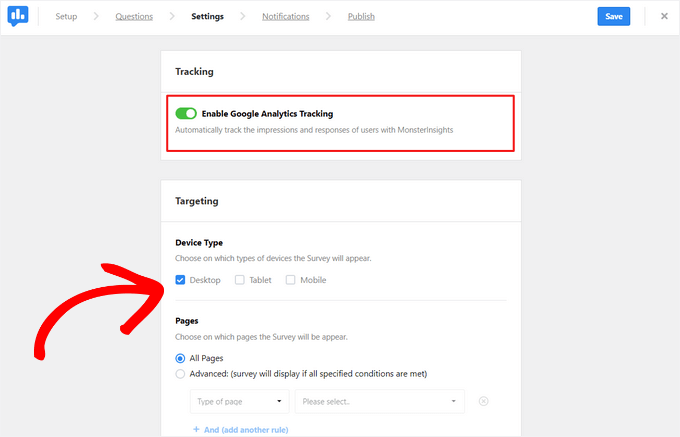
On the Settings page, you can further customize your survey.
In the ‘Tracking’ section, you can enable Google Analytics tracking with MonsterInsights. This is a powerful feature that lets you see how your surveys impact user behavior directly in your analytics reports.
Then, in the ‘Targeting’ section, you can select what type of devices and pages you want your survey to appear on.
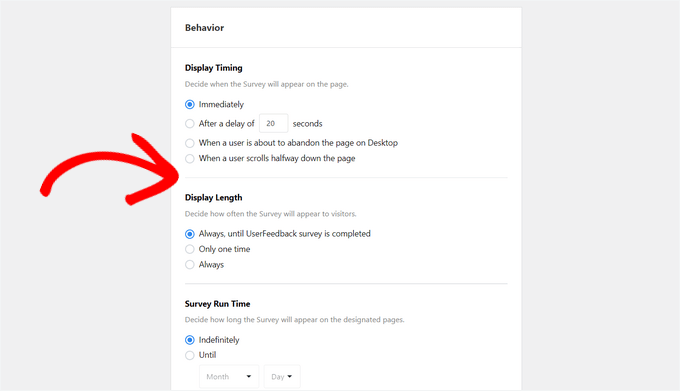
You can also scroll down to the ‘Behavior’ section. Here, you can configure settings like:
- Display Timing – When the survey will appear on the page
- Display Length – How often the survey will appear to website visitors
- Survey Run Time – How long the survey will appear on the designated pages
For example, you might set your survey to display 20 seconds after a visitor lands on your pricing page, show it only once per visitor, and run the survey for two weeks to collect targeted feedback during your campaign.
In addition, you can enable or disable the ‘Start Survey Minimized’ option.
This displays a less visible version of your survey instead of automatically opening the first question.
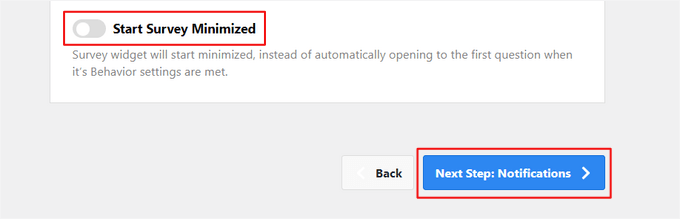
Once you’re done changing the settings, you can press the ‘Next Step’ button.
On the ‘Notifications’ page, you can enable conditional logic to trigger email notifications when visitors respond to your questions a certain way.
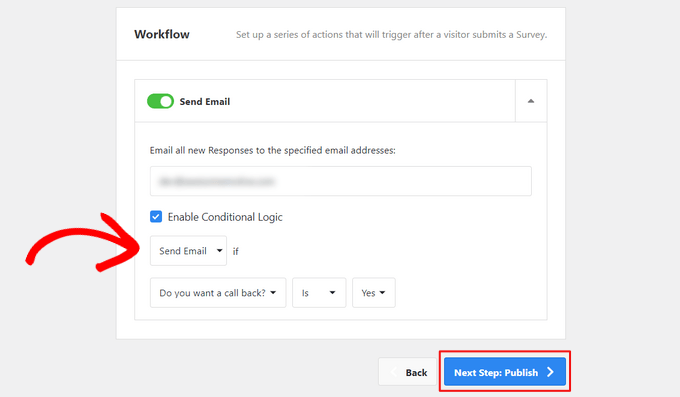
After that, click on the ‘Next Step’ button to continue.
Publishing Your UserFeedback Survey
Lastly, there’s an option to schedule the survey to appear at a later date and time.
If you’re ready to publish your survey immediately, go ahead and click the ‘Save and Publish’ button.
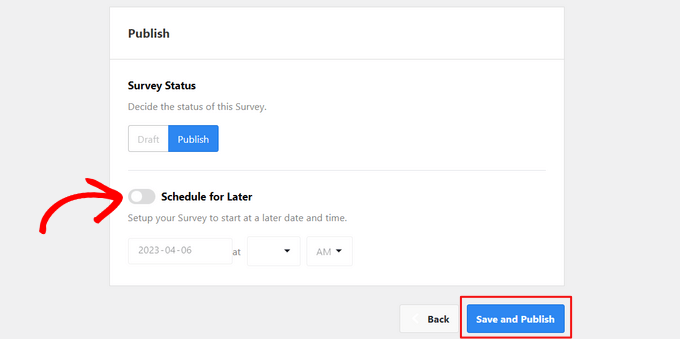
That’s it! You’ve successfully created a survey form.
Now, you can visit your WordPress website to see your survey widget live and in action.
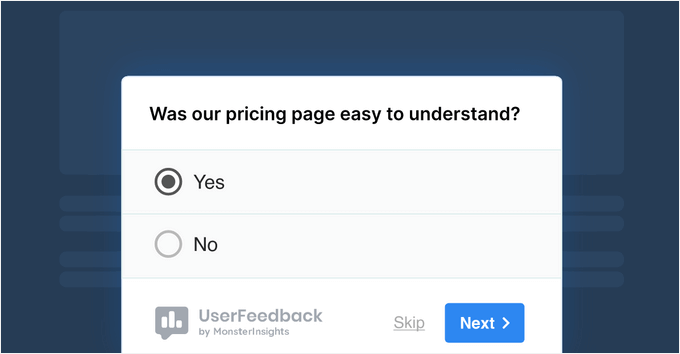
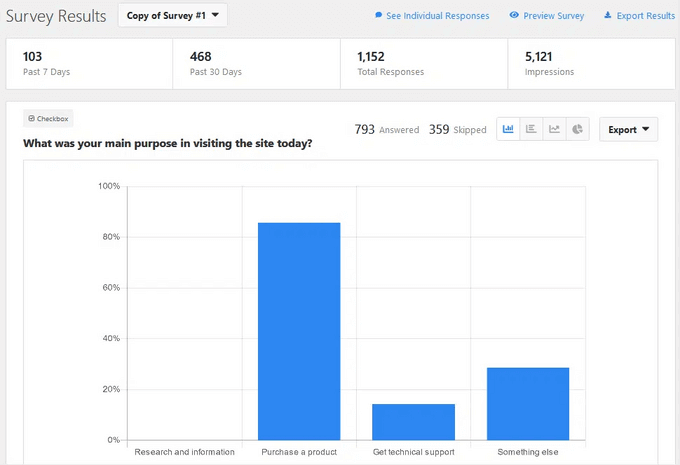
Once you start getting responses, you can analyze them right from your WordPress admin dashboard using easy-to-read reports.
The survey result report shows total responses, impressions, and more details.
Bonus Tip: Track and Reduce Form Abandonment in WordPress
Even with a well-designed survey, some users will start filling it out but never finish. This is called form abandonment, and it can affect feedback surveys, lead magnet optin forms, and checkout forms.
By tracking form abandonment, you can identify where users drop off and make improvements to boost completions.
For example, your form might be too long, confusing, or not mobile-friendly. Sometimes, fields don’t load properly, or users simply get frustrated and leave.
The easiest way to track form abandonment in WordPress is with MonsterInsights. It’s the #1 Google Analytics plugin for WordPress and makes it super simple to track form performance – all from your WordPress dashboard.
We actually use MonsterInsights for various tracking tasks on our site, including form tracking. It really helps in measuring form performance and uncovering areas for improvement.
Check out our full MonsterInsights review to see why we recommend it.
With the Forms addon, MonsterInsights can automatically detect your WordPress forms and show you which ones are most frequently abandoned.
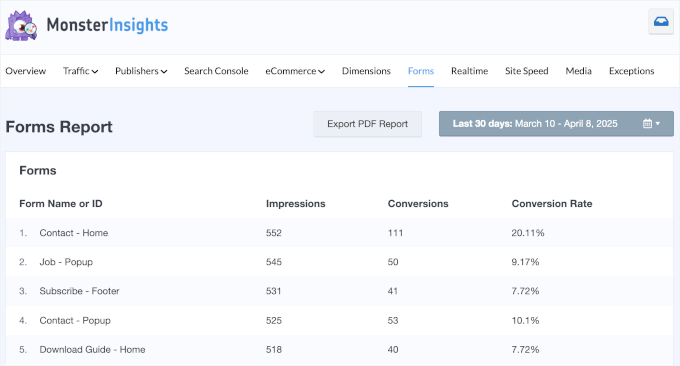
To dig deeper, the Form Abandonment addon from WPForms lets you view incomplete submissions. Plus, you can see the data that users entered before leaving the form.
To get started, check out our step-by-step guide on how to track and reduce form abandonment in WordPress.
FAQs: Creating Survey Forms in WordPress
If you’re new to creating surveys in WordPress, you might have some questions. Here are answers to some of the most common ones we hear:
Does WordPress have survey functionality?
WordPress doesn’t have built-in survey features. But you can easily add surveys using plugins like WPForms and UserFeedback.
Does WordPress have a form builder?
While WordPress itself doesn’t come with a native form builder, many contact form builders, like WPForms, Formidable Forms, and Gravity Forms, make it easy to create all kinds of forms, including surveys.
Can ChatGPT make surveys and quizzes?
ChatGPT can help you come up with survey questions and quiz ideas. But you’ll want to use WordPress plugins or third-party tools to easily create and publish surveys on your website.
What is the biggest problem with creating surveys in WordPress?
The biggest challenge is often getting enough responses. Choosing user-friendly plugins and keeping your surveys short can help encourage more people to participate.
Bonus Resources to Improve Your WordPress Forms and Surveys
We hope this article helped you learn how to create survey forms in WordPress.
For further reading, check out these guides:
- User Experience Feedback Questions to Ask Your Site Visitors
- How to Customize and Style Your WordPress Forms
- Tips To Create More Interactive Forms in WordPress (and Increase Conversions)
- How to Fix WordPress Form Does Not Work (Troubleshooting Tips)
- Ultimate Guide to Using WordPress Forms
If you liked this article, then please subscribe to our YouTube Channel for WordPress video tutorials. You can also find us on Twitter and Facebook.


Moinuddin Waheed
Users feedback give real insights about what the users want out of our website business and services.
This is a very effective tool to get their points of view and optimise the content accordingly.
I am using wpforms and it has user feedback add-on.
I have used it to make user feedback forms to get insights about different topics.
Mrteesurez
Definitely, the users feedback can be used to better optimize, organize and adjust website for better user’s experience.
Some users might even suggest new features or posts ideas which are helpful to make an informed decision.
Jiří Vaněk
Thank you for the article. I use, for instance, a statistics plugin as one form of online survey. I can see which article has what readership and visitation. I can sort articles by popularity, which gives me immediate feedback on what resonates and what doesn’t. An online survey is a great tool even when, for instance, you’re not sure what to write about. You can ask your readers what they would like to see on the blog using one of the aforementioned methods, and once you receive topic suggestions through feedback, you can start writing. This is a great thing even for creativity.
Mrteesurez
Thanks for your addition and your recommendation. The use case you have mentioned are all good in making most of the form. Also, I like the idea of statistics plugin to track every users movement.
Moinuddin Waheed
Thanks Jiri for sharing your experience regarding using statistics to get to know what is working and what doesn’t.
Also, getting an idea about the topics from the audience itself is good approach to content creation because you already know the recipe and you just have to make it better.
I will use this method to get audience feedback regarding topics and classes for my coaching institute.
Moses
Can a link of the survey be shared to other social network.
WPBeginner Support
If you wanted to, you can share a link to the site.
Admin
mary doherty
is it possible to have a survey on the site that is only accessible by a link sent to specific people. I don’t want people who land on the site to take the survey, just certain clients.
Ruth T
Is it possible to create private surveys using this tool? i.e a page that needs a log in or password to access? This would allow the capture of information from a select group who have been directed there? Thanks!
Trey
How do you prevent people from taking surveys over and over again that so but have accounts in the website?
That seems to be the hard part with all surveys.
WPBeginner Support
Hi Trey,
There is no easy way to do this at the moment. However, we do have it as a feature request.
Admin