


Want to know what your readers really think about your website? A survey lets you ask them directly, whether you’re looking for feedback on your content, ideas for new features, or ways to improve their experience.
We’ve been running surveys on WPBeginner for more than a decade. In this guide, we’ll show you how to create your own survey step by step and turn the responses into clear, visual reports.
How to Create a Survey With WPForms
WordPress survey plugins make it easy to create any type of survey on your website. We use WPForms on WPBeginner so we’ll be showing you how to create a survey with WPForms.
WPForms is used by over 5 million sites, and it generates beautiful interactive reports automatically, like bar charts, pie charts, and more as you receive survey responses.
First, you need to install and activate WPForms Pro, since the Surveys and Polls addon is only available with the Pro plan. See our guide on installing a WordPress plugin if you’re new to this.
Once you’ve activated the plugin and verified the license key, it’s time to activate the Surveys and Polls addon.
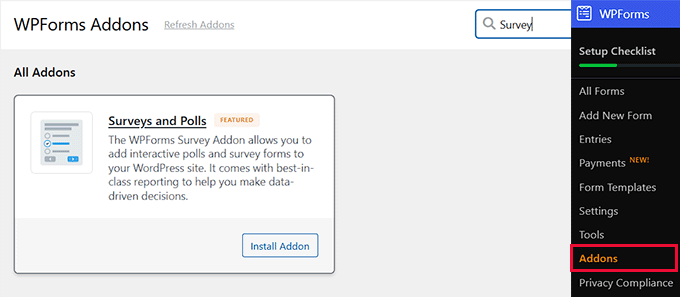
Simply go to WPForms » Addons, find Surveys and Polls, and click ‘Install Addon’.
Next, you can go ahead and create a survey form. Simply go to WPForms » Add New Form. Search for ‘survey’ and select the Survey Form template.
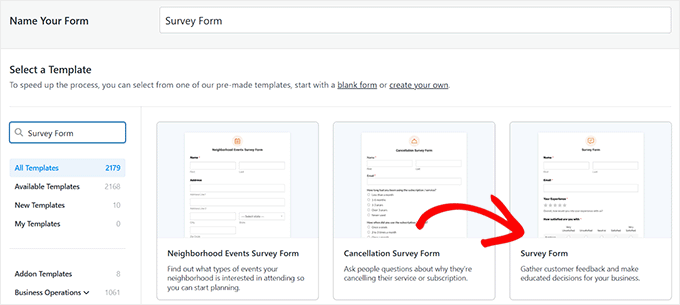
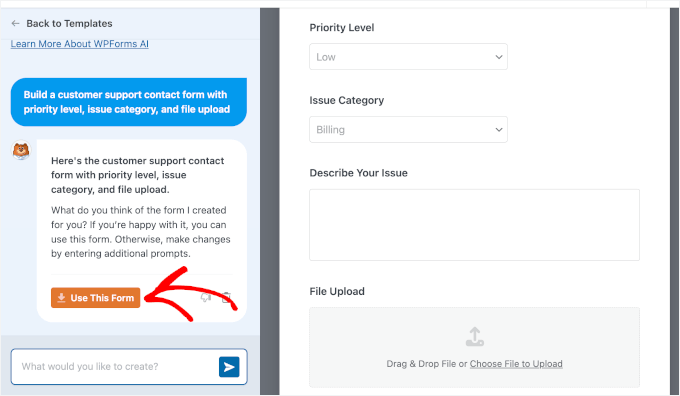
Alternatively, you can also describe the survey you want and let WPForms AI create it for you by choosing the ‘Generate with AI’ template instead.
As you select the template, WPForms will prompt you to install the ‘WPForms AI’ addon if you haven’t enabled the addon yet. Once the form is created, you can click ‘Use This Form’.
Either way, WPForms comes with several form fields that are designed specifically for surveys.
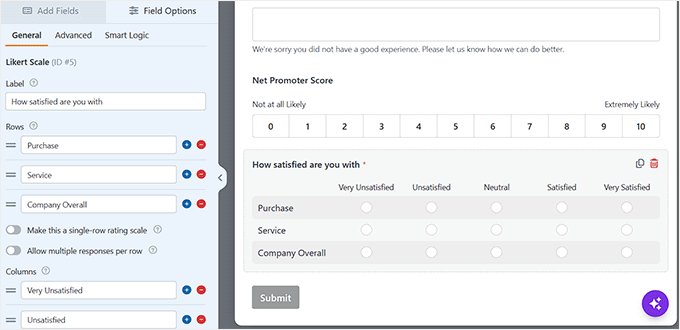
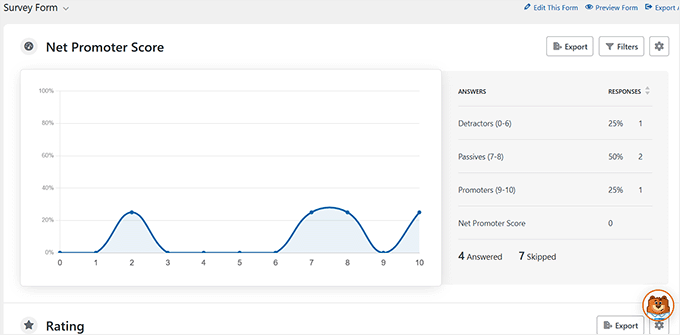
For example, the Net Promoter Score (NPS) field lets respondents rate your business from 0 to 10 and calculates your NPS automatically.
It is useful for measuring how likely customers are to recommend your business and for tracking that sentiment over time.
The Likert Scale field measures agreement or satisfaction across several statements, with choices such as ‘Strongly Disagree’ and ‘Strongly Agree’.
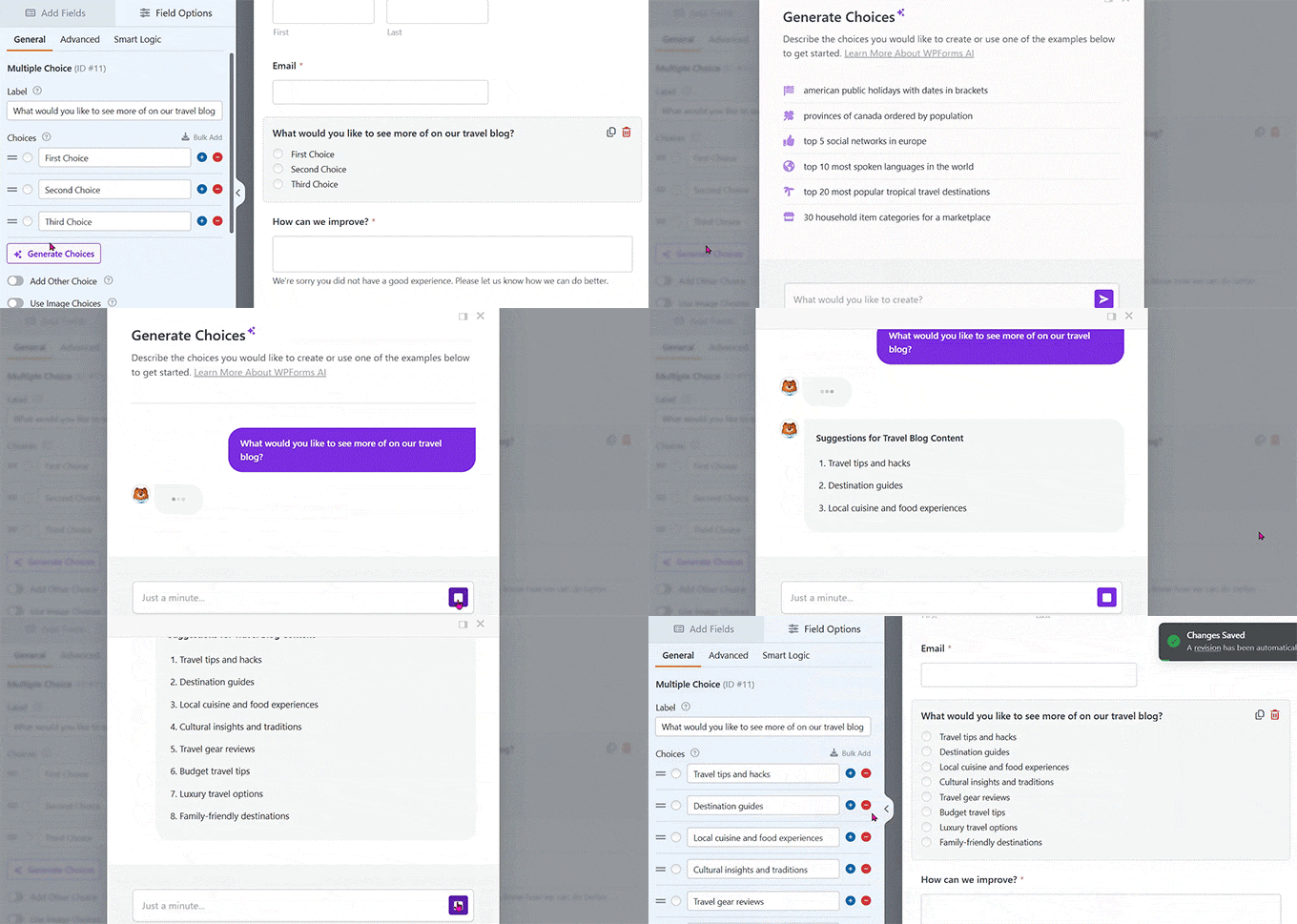
You can also use Generate Choices option to generate answer options with AI for multiple-choice and dropdown fields. Just describe the choices you need.
Not every question will be relevant to every respondent, and showing unnecessary questions can make your survey feel longer and less relevant.
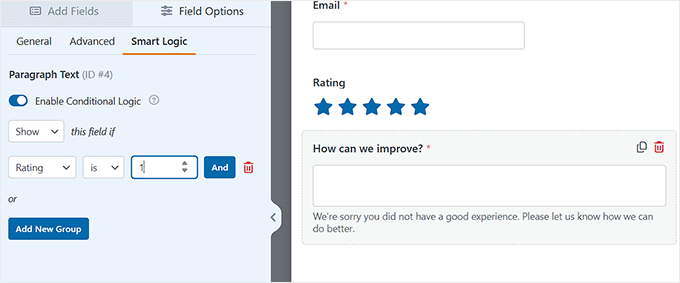
You can use conditional logic to show different questions based on a respondent’s answers, so nobody gets stuck on a question that doesn’t apply to them.
Click on the field where you want to enable conditional logic. This will open the Field options on the right. Go to its ‘Smart Logic’ settings, enable conditional logic, and set your rule.
For example, you could show a ‘How can we improve?’ question only when someone gives your service a low rating.
Before moving on, preview the survey and test it yourself so you catch any broken questions or logic before real responses start coming in.
Publish Your Survey
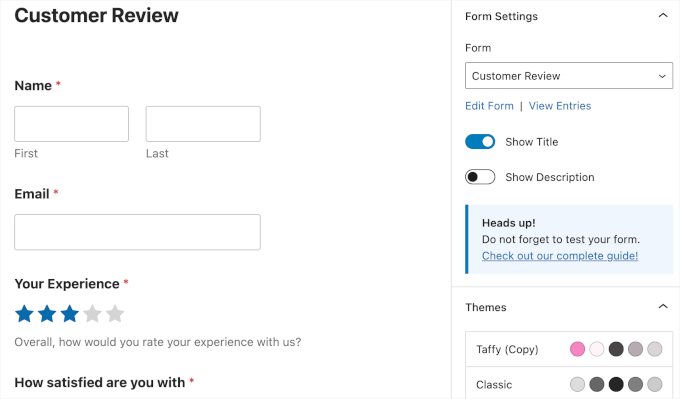
If you have a short, one-question survey, you can embed it directly on a page or post. Add the WPForms block and choose your survey from the dropdown.
For a longer survey, WPForms lets you create a standalone page, so you can share a direct link in an email, newsletter, or social media post.
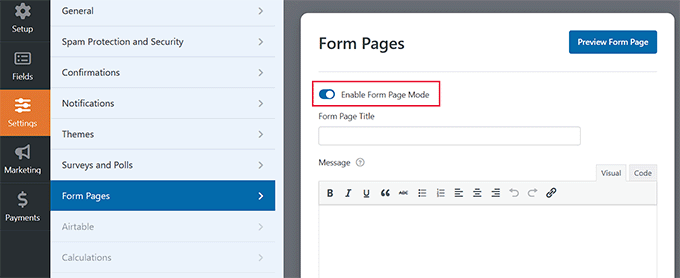
To turn it on, go to Settings » Form Pages. WPForms will prompt you to install the addon if it isn’t active yet. Then, check the ‘Enable Form Page Mode’ toggle.
Set a title and message, and choose how the page looks. WPForms generates the page’s permalink automatically, and you can preview it before you publish.
If you’re sending the survey to people whose information you already have, you can automatically fill in certain form fields with data you already know about them.
For example, if you’re sending a survey through your newsletter, you can pre-fill fields like their name or email address so they don’t have to enter them again.
For the full setup, see our guide on how to use dynamic field population in WordPress.
Once everything looks right, click ‘Save’ in the form builder to publish your survey page.
Pro Tip: If a plain survey form isn’t what you have in mind, WPForms offers Conversational Forms, which show one question at a time in a chat-like layout. See our guide on conversational forms for details.
View Your Survey Reports
Once responses start coming in, head to WPForms » All Forms and click ‘Survey Results.’
WPForms turns your responses into visual reports, including bar charts, pie charts, and word clouds for open-text answers. It also calculates your NPS score and updates it live.
You can filter the results, then export a single question or the entire survey as a JPG, PDF, or print-ready file. If you want the raw responses, you can export entries as a CSV from the Entries page instead.
Survey Results only include completed submissions. To see where people drop off before submitting, head to WPForms » All Forms and click ‘Analytics.’
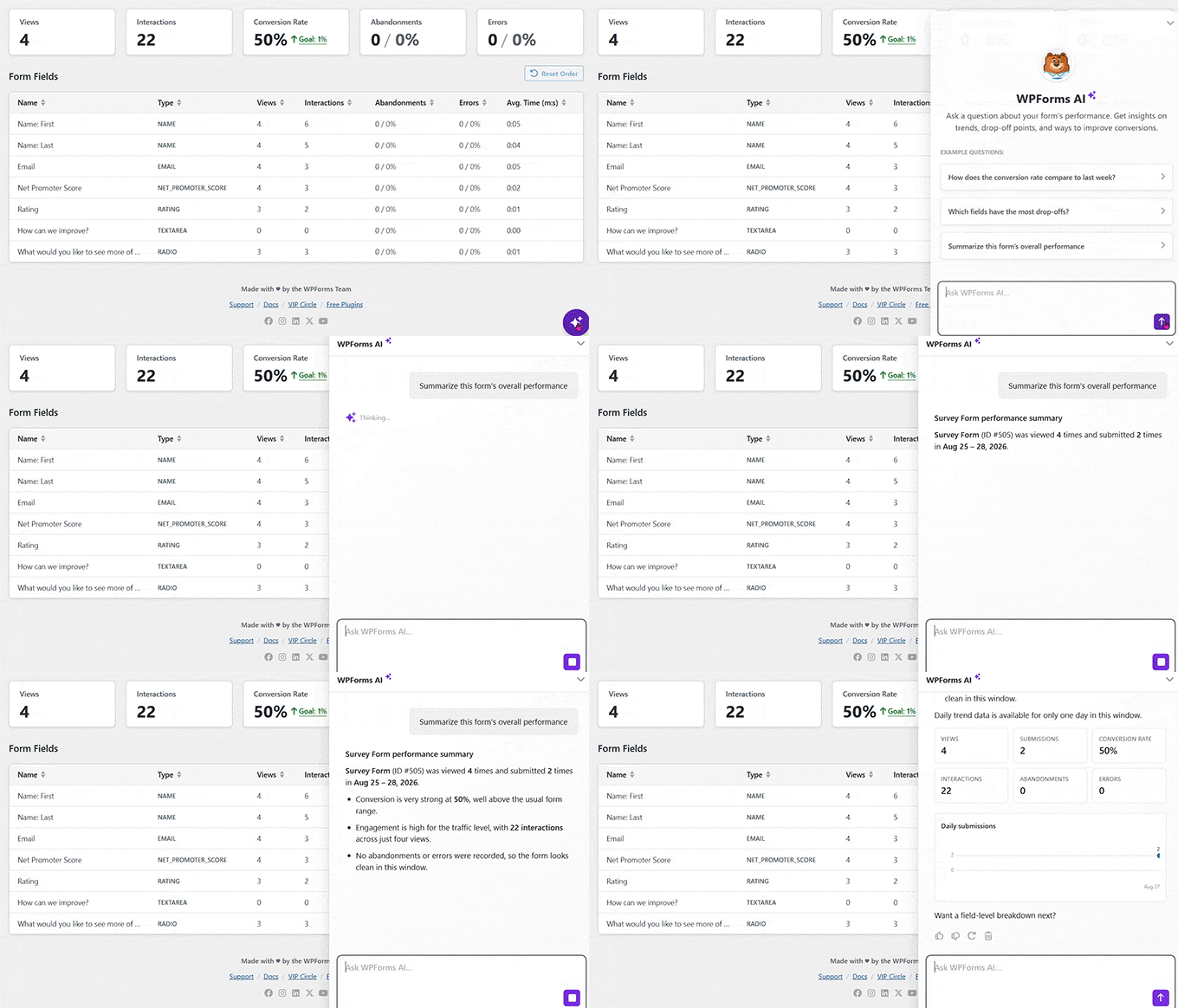
WPForms Analytics tracks each field individually, showing how long respondents spend on every question and exactly where they abandon the survey.
On the Analytics page, you can also ask WPForms AI questions about your results in plain language.
However, Analytics doesn’t save what people entered before leaving.
If you see a lot of drop-offs, the Form Abandonment addon can capture partial survey data, such as a respondent’s name or email, so you can follow up.
For more details, see our guide on tracking and reducing form abandonment in WordPress.
Bonus: Collect Quick Feedback with UserFeedback
A full survey form works well for in-depth feedback, but sometimes you want a quick reaction from someone already on the page.
For that, we recommend the UserFeedback plugin. It’s free to start with, and it shows a small popup or slide-in poll while visitors browse your site.
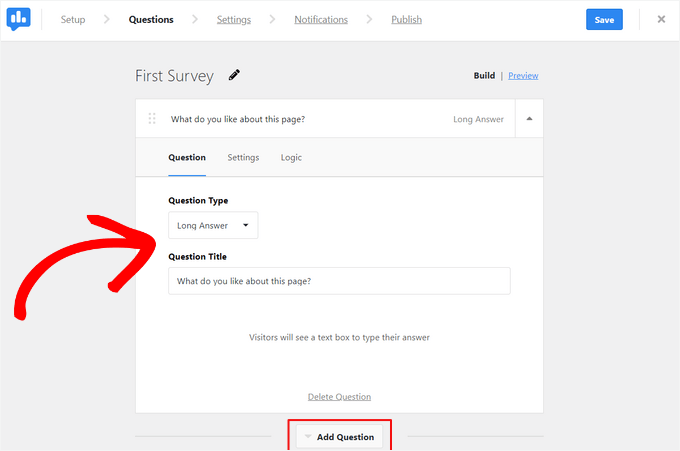
UserFeedback comes with templates for common questions, like what stopped someone from buying or how to improve a page, along with rating, NPS, and short-answer fields.
You can target these popups to specific pages or devices, or trigger them when someone’s about to leave, so you’re asking at the right moment instead of guessing.
Responses show up in real time on your dashboard, and the Pro plan can even generate an AI summary of customer feedback.
For the full walkthrough, see our complete UserFeedback review.
FAQs: Creating Survey Forms in WordPress
Does WordPress have a form builder?
While WordPress doesn’t come with a native form builder, plugins like WPForms, Formidable Forms, and Gravity Forms make it easy to create all kinds of forms, including surveys.
Can ChatGPT make surveys and quizzes?
ChatGPT can help you write survey questions and quiz ideas, but it can’t publish them. You’ll still need a WordPress plugin like WPForms to create and publish the survey on your site.
What is the biggest problem with creating surveys in WordPress?
The biggest challenge is getting enough responses. Use a user-friendly plugin and keep your surveys short to encourage more people to participate.
We hope this article helped you learn how to create survey forms in WordPress. You may also want to see our troubleshooting guide for WordPress forms and our top picks for the best WordPress poll plugins.
If you liked this article, then please subscribe to our YouTube Channel for WordPress video tutorials. You can also find us on Twitter and Facebook.


Moinuddin Waheed
Users feedback give real insights about what the users want out of our website business and services.
This is a very effective tool to get their points of view and optimise the content accordingly.
I am using wpforms and it has user feedback add-on.
I have used it to make user feedback forms to get insights about different topics.
Mrteesurez
Definitely, the users feedback can be used to better optimize, organize and adjust website for better user’s experience.
Some users might even suggest new features or posts ideas which are helpful to make an informed decision.
Jiří Vaněk
Thank you for the article. I use, for instance, a statistics plugin as one form of online survey. I can see which article has what readership and visitation. I can sort articles by popularity, which gives me immediate feedback on what resonates and what doesn’t. An online survey is a great tool even when, for instance, you’re not sure what to write about. You can ask your readers what they would like to see on the blog using one of the aforementioned methods, and once you receive topic suggestions through feedback, you can start writing. This is a great thing even for creativity.
Mrteesurez
Thanks for your addition and your recommendation. The use case you have mentioned are all good in making most of the form. Also, I like the idea of statistics plugin to track every users movement.
Moinuddin Waheed
Thanks Jiri for sharing your experience regarding using statistics to get to know what is working and what doesn’t.
Also, getting an idea about the topics from the audience itself is good approach to content creation because you already know the recipe and you just have to make it better.
I will use this method to get audience feedback regarding topics and classes for my coaching institute.
Moses
Can a link of the survey be shared to other social network.
WPBeginner Support
If you wanted to, you can share a link to the site.
Admin
mary doherty
is it possible to have a survey on the site that is only accessible by a link sent to specific people. I don’t want people who land on the site to take the survey, just certain clients.
Ruth T
Is it possible to create private surveys using this tool? i.e a page that needs a log in or password to access? This would allow the capture of information from a select group who have been directed there? Thanks!
Trey
How do you prevent people from taking surveys over and over again that so but have accounts in the website?
That seems to be the hard part with all surveys.
WPBeginner Support
Hi Trey,
There is no easy way to do this at the moment. However, we do have it as a feature request.
Admin