


When you know exactly what people type into Google, you can use that information to make better content, improve SEO, and bring more visitors to your WordPress site.
The good news is that Google Search Console keeps a list of the search terms people use to discover your website, and you can view that report for free in just a few clicks.
In this guide, we’ll show you how to see the keywords people use to find your WordPress site and how to use those insights to attract more organic traffic.

What Is Keyword Tracking and Why Is It Important?
Keyword tracking means monitoring which search terms bring visitors to your WordPress site and how well your pages rank for those terms in Google. Without tracking, you may not notice that an important page has started losing visibility until your traffic drops significantly.
By monitoring your keywords, you can:
- Spot ranking drops early: Find pages that are losing visibility and investigate what may have changed.
- Discover new content opportunities: See the search terms people use to find your site, including keywords you may not have targeted yet.
- Improve existing content: Identify pages that rank for relevant searches but could perform better with updated information, stronger headings, or better on-page SEO.
How to Track the Keywords People Use to Find Your Site
We recommend Google Search Console, a free tool from Google that shows exactly which searches your site appears for and where it ranks. The data comes straight from Google, and it covers every keyword your site already ranks for.
Semrush is the second method, and it’s the one to choose when you also want to see the keywords your competitors rank for.
Method 1: Track Website Keywords in Google Search Console
To get started, you need to add your website to Google Search Console (GSC), if you haven’t already. You can follow our tutorial on how to add your WordPress site to Google Search Console for step-by-step instructions.
Once Google verifies your site, open the ‘Performance’ report in your Google Search Console dashboard. Then, scroll down and click the ‘Queries’ tab.
Here, you’ll find the exact search terms people entered into Google before clicking on your website. Each search query includes data such as:
- Clicks: The number of times people clicked your website from Google search results
- Impressions: The number of times your website appeared in search results for that query
- Average CTR: The percentage of impressions that resulted in a click
- Average position: Your website’s average ranking position for that keyword
Now let’s take a look at how to make informed decisions based on the keywords report.
First, filter the keywords list by specifying a seed keyword you want to track. Simply click the ‘+ Add filter’ button above the table, choose ‘Query’, select ‘Queries containing’, and type a word such as ‘dog food’.
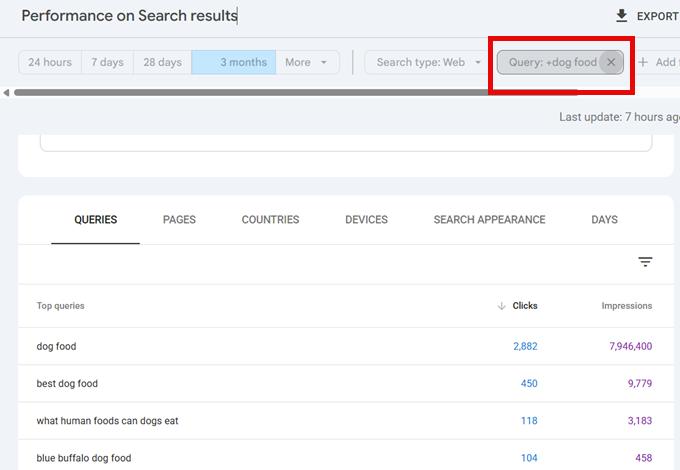
This report tells you which keyword related to ‘dog food’ brings in traffic to your site. It also gives you a general overview of how your site has been performing in terms of driving targeted traffic. For example, if you’re selling dog foods on your site, ideally, you’ll need more people finding your site through transactional keywords.
If you find irrelevant keywords are driving traffic, then it tells you that you might have to change your content strategy.
Next, we’ll need to find which pages are ranking on Google for your preferred keyword. Click on any keyword and you’ll be directed to the ‘Pages’ tab where you can see a list of articles that are ranking for that particular keyword.
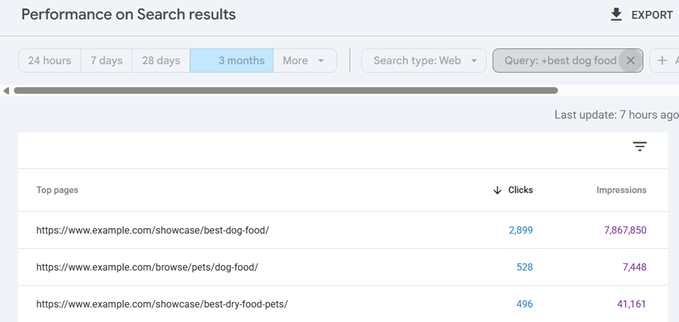
Figure out whether the right pages are ranking for the given keyword and if there is any keyword cannibalization.
By default, the report only shows the last 3 months. To see how a keyword performed before and after a change, keep the keyword filter on.
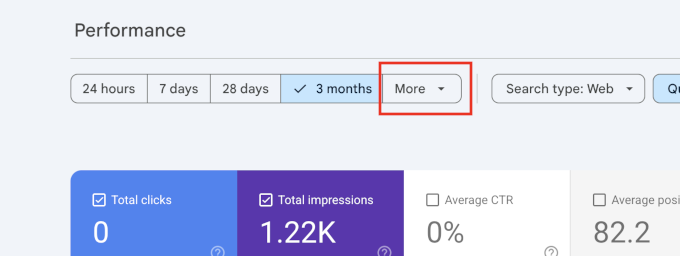
Then click the ‘More’ button in the date range box and switch to the ‘Compare’ tab.
Pick two periods, like the last 3 months against the previous 3 months, and click ‘Apply’.
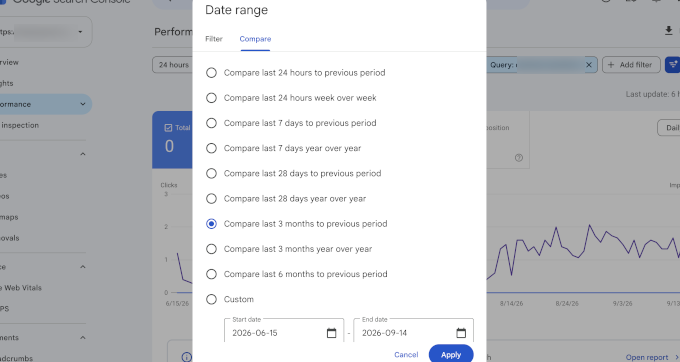
This report shows how your rankings changed during the selected period, helping you identify which keywords moved and what may have caused those changes.
The ‘+ Add filter’ button also lets you narrow the report by page, country, or device. That is useful when you want to see how one blog post performs, or which keywords bring in mobile visitors.
ℹ️ Note: The numbers in this table won’t perfectly match the totals in the graph above it. Google hides rare search terms, called ‘anonymized queries’, to protect user privacy, though their clicks and impressions still count toward your totals.
Google also keeps this data for a maximum of 16 months before deleting it, and the table shows at most 1,000 rows.
Optional: Track Keywords Inside WordPress With AIOSEO
Google Search Console gives you all of this keyword data for free. But did you know that you can access the same data on your WordPress dashboard?
That’s where All in One SEO (AIOSEO) comes in. We use it on WPBeginner, and its Search Statistics feature pulls your Search Console data directly into your WordPress admin area.
ℹ️ Note: Search Statistics is part of AIOSEO Elite, which starts at $299.50 for the first year. Aside from tracking the keywords, you’ll also get access to content decay report as well.
Once you install and activate the AIOSEO plugin and connect it to your Search Console account, go to All in One SEO » Search Statistics. You’ll see the same clicks, impressions, and keyword positions, sorted into reports you can act on.
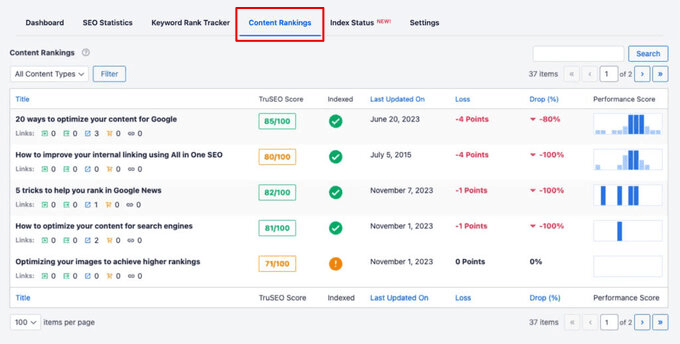
The report worth opening first is ‘Content Rankings’. It flags when a post you already rank for starts slipping, which is a sign of content decay.
The table shows each post’s loss or gain in points, its drop percentage, and when it was last updated.
For a full tour of every report, see our detailed AIOSEO review.
Method 2: Track Competitor Keywords Using Semrush
Google Search Console only shows data for your own site. If you also want to see the keywords your competitors rank for, you need an SEO tool like Semrush.
It lets you look up any domain and see the exact keywords it ranks for, how much traffic they send, and how hard each one is to win.
ℹ️ Note: Semrush’s SEO plan costs $139.95 per month, or $117.33 per month billed annually. A free account gives you 10 reports a day and lets you track 10 keywords, and you can use our Semrush coupon to get a better deal.
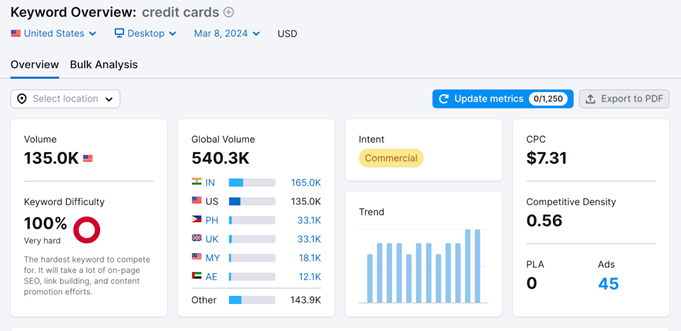
To get started, sign up for a Semrush account. Then, click ‘Keyword Overview’ under Keyword Research in the left sidebar, type a keyword you want to rank for, choose your country, and click ‘Search’.
The top of the report shows the keyword’s monthly search volume, difficulty, and search intent.
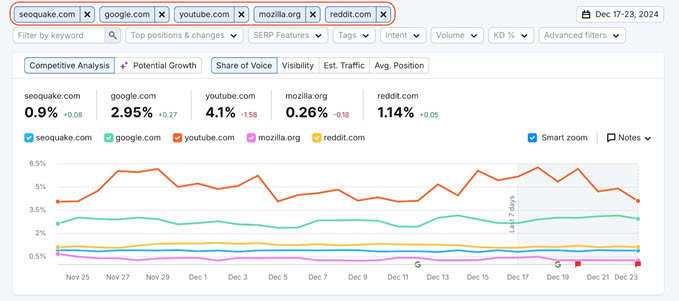
Another important report is Position Tracking. Unlike Keywords reports, Position Tracking lets you pick a keyword and helps you monitor its progress over time and compare it with your competitors ranking.
This report helps you understand whether your SEO efforts are paying off in the long run.
Beyond traditional rankings, Semrush’s AI Visibility Toolkit shows whether AI tools like ChatGPT and Google’s AI Overviews mention your brand at all. Its ‘Competitor Research’ report lists the topics where a competitor keeps coming up in AI answers and you don’t appear at all.
Frequently Asked Questions About Tracking Keywords
We get a lot of questions about keyword tracking from our readers. Here are answers to some of the most common ones.
1. How do I check what keywords my site ranks for, for free?
Google Search Console is free and shows every keyword your site ranks for, along with the clicks, impressions, and average position for each one.
2. How do I find what keywords a website is using?
For your own site, use Google Search Console. For a competitor’s site, you need a tool like Semrush, where you can enter their domain and see their full keyword list.
3. What does Google Search Console show?
Search Console shows which queries bring traffic to your site, with the clicks, impressions, CTR, and position for each one. It also shows which pages Google has indexed and any crawling or structured data issues affecting your rankings.
4. How do I see search terms in Google Search Console?
Go to the Performance report and scroll down to the ‘Queries’ tab. To narrow the list to one topic, click ‘+ Add filter’, choose ‘Query’, and enter the word.
We hope this guide helped you learn how to see what keywords people use to find your website. You may also want to see our ultimate WordPress SEO guide and our expert picks of the best keyword research tools for SEO.
If you liked this article, then please subscribe to our YouTube Channel for WordPress video tutorials. You can also find us on Twitter and Facebook.


Mrteesurez
This is definitely a great article.
although I usually use Google for checking it, I don’t know I can also use AIOSEO, this will be easier and access directly from WP dashboard.
Thanks.
WPBeginner Support
Glad we could share a simpler method for you
Admin
Jiří Vaněk
Thank you for the article. I recently started using SEMRUSH. However, the more I discover what AIOSEO is capable of, the more I feel like I should switch from Yoast SEO to your tool. Your features look really great.
WPBeginner Support
You’re welcome, we hope you find AIOSEO helpful if you do decide to swap
Admin
Vivi
So well written, so clear. Thank you for this article, it is very helpful.
WPBeginner Support
Glad you like our article
Admin