


If you’re using HubSpot for marketing and sales, then you already know how powerful it is.
HubSpot gives you data about leads and customers. But without proper tracking, it doesn’t show the full story of how people interact with your WordPress website. 🤷
That makes it harder to see which blog posts bring in your best leads, which pages cause visitors to leave, or how your content supports your sales funnel. And when you don’t have the complete view, you’re making decisions on partial data.
The good news? Connecting HubSpot analytics with WordPress is quick and easy.
In this guide, we’ll walk you through the simple steps to bring everything together, allowing you to track the entire customer journey – from the first click to the final sale.
📝 TL;DR: Connecting HubSpot to WordPress requires installing the official HubSpot WordPress plugin, following the setup wizard to link the accounts, and using the new HubSpot dashboard within WordPress to view analytics.
Why Connect WordPress to HubSpot Analytics?
Whether you run a WordPress blog, an online store, or a service-based website, HubSpot insights and analytics data can help you make smarter business decisions.
It’s a comprehensive customer relationship management (CRM) and marketing automation platform that helps you understand your audience and improve your marketing efforts.
Once you connect WordPress to HubSpot, you’ll be able to:
- See traffic sources, pageviews, keyword rankings, and more.
- Send leads directly to the HubSpot CRM so that you can track customer data there.
- Track form submissions to identify drop-off points and reduce form abandonment.
- Optimize email campaigns for better open and click-through rates.
- Use live chat to assist visitors in real time and improve customer experience.
- Monitor sales and payments to refine your eCommerce strategy.
Best of all, this data integrates seamlessly with your existing HubSpot analytics. You’ll get a complete picture of how visitors interact with your WordPress website alongside your other marketing metrics.
This means you can make better decisions about your content, optimize your sales funnels, and improve user experience – all from the HubSpot dashboard.
💡 Insider Tip: While HubSpot Analytics is powerful, we usually recommend that our readers use Google Analytics instead. It’s a free analytics platform that gives you access to a wide range of data for understanding more about your visitors.
Plus, it’s super easy to use Google Analytics by installing MonsterInsights. It creates user-friendly reports about visitor behavior, plus advanced tracking for eCommerce, forms, and affiliate links directly in your WordPress dashboard.
We use this setup ourselves because it provides deep data insights in beginner-friendly charts. Just check out our full MonsterInsights review to see all the benefits.
With that said, we’ll show you how to set up HubSpot analytics on WordPress. Here’s a quick look at all the steps you’ll take:
- Step 1: Sign Up for a HubSpot Account
- Step 2: Install and Activate the HubSpot WordPress Plugin
- Step 3: Connect Your HubSpot Account to Your WordPress Website
- Step 4: Explore the HubSpot Analytics Features
- Step 5: Monitor and Analyze Your HubSpot CRM Regularly
- Bonus Tip: Boost Your Website Performance with HubSpot Alternatives
- FAQ About Setting Up HubSpot Analytics
- Additional WordPress Analytics Guides
Ready? Let’s jump right in!
Step 1: Sign Up for a HubSpot Account
First, you’ll need to sign up for an account on the HubSpot website. Just click on the ‘Get started free’ button.
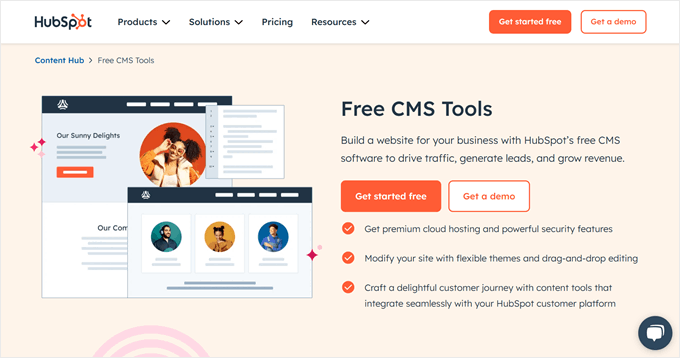
HubSpot will now ask you to create an account using your email address, Google account, Microsoft account, or Apple account.
In the following popups, you’ll be asked to provide some details about your business, such as your company name, industry, size, and more.
You can just fill in the required fields and then click ‘Next’ to continue.
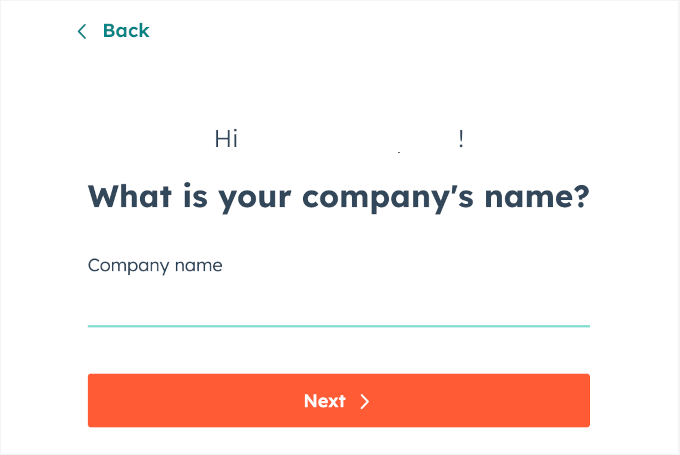
Just follow the onscreen instructions to sign up for an account.
Keep in mind that HubSpot offers a free plan that includes: lead generation forms, limited email marketing features, web analytics, live chat, and other free features.
Just be aware that these free tools will have HubSpot branding on them, like a small “Powered by HubSpot” logo on your chat widget.
Upgrading to a paid plan will give you access to more features like marketing automation, the removal of HubSpot branding, and higher limits for email marketing.
Step 2: Install and Activate the HubSpot WordPress Plugin
To allow HubSpot to track analytics on your WordPress website, you’ll need to connect the services with a tracking code.
Luckily, the free HubSpot – CRM, Email Marketing, Live Chat, Forms & Analytics plugin automatically installs the tracking codes for you.
This means that once you’ve set up your email marketing campaign, HubSpot will automatically assign tracking codes. These codes help monitor user interactions, email engagement, and conversion rates.
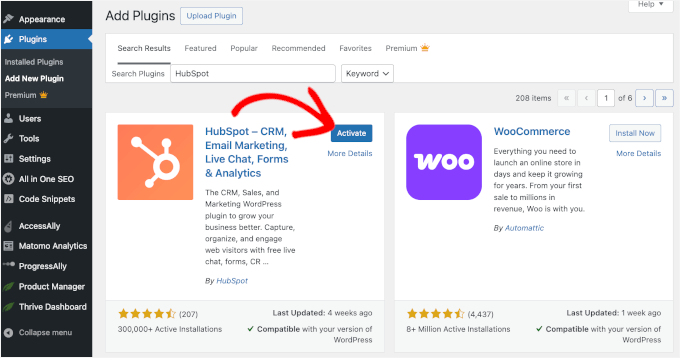
The first step here is to install and activate the HubSpot – CRM, Email Marketing, Live Chat, Forms & Analytics plugin.
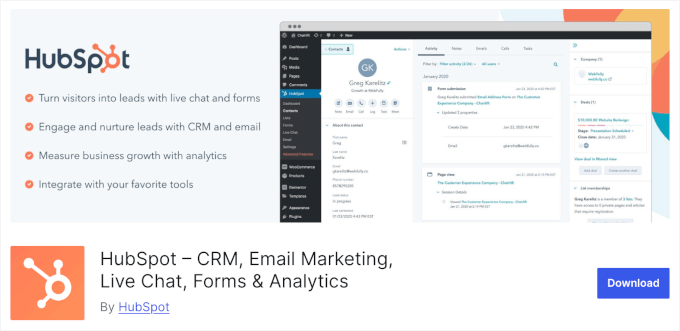
To do this, you’ll need to navigate to Plugins » Add New Plugin from the WordPress dashboard. Then, you can use the search feature to look for the HubSpot plugin.
After that, just click ‘Install Now’ on the search result, then ‘Activate.’
For step-by-step instructions, you can check out our guide on how to install a WordPress plugin.
Add Tracking Code Manually
Sometimes, compatibility issues, plugin conflicts, or restrictions on your WordPress hosting might prevent you from using the official plugin. If that happens, you will need to add the HubSpot tracking code to your website manually.
Under Settings » Account Management, you’ll need to find the ‘Tracking Code’ option.
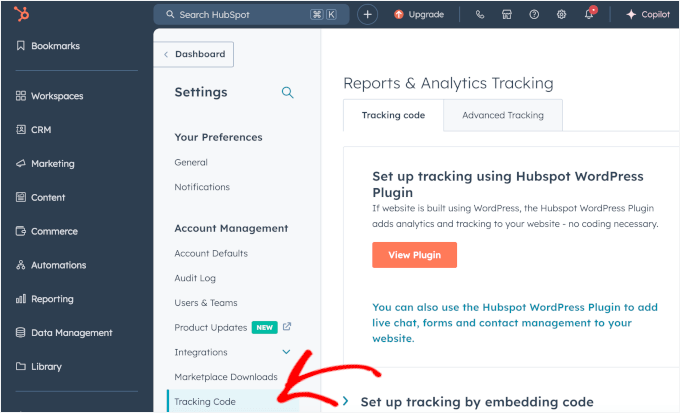
On the right-hand panel, you can click ‘Set up tracking by embedding code’ to expand the section.
From here, you can go ahead and click the ‘Copy’ button.
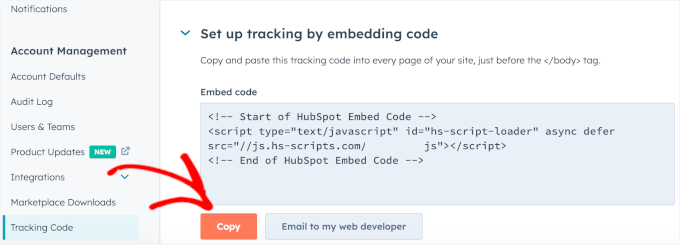
Now, you can paste this tracking code right before the closing </body> tag on every page of your website.
Alternatively, you can add the code across all pages through the common footer file in your theme files. However, modifying theme files is not very beginner-friendly – one tiny mistake can break your WordPress website.
This is why we always recommend using WPCode, which is the best code snippet plugin on the market.
It allows you to add custom code in WordPress without the risk of breaking your site. It also ensures your tracking script won’t be erased if you ever update or change your WordPress theme.
We use WPCode across our partner websites to create and manage custom code snippets easily. If you’re interested in learning more, check out our detailed WPCode review.
So, let’s go ahead and install and activate the WPCode plugin. If you need help, you can read our guide on how to install a WordPress plugin.
💡 Note: You can use the free WPCode version to do this, but upgrading to WPCode Pro gives you access to full code history, the ability to schedule your code, and more!
Upon activation, simply head over to Code Snippets » Header & Footer. Then, you can paste your HubSpot tracking code into the ‘Footer’ field, which automatically places the script right before the closing </body> tag to fulfill HubSpot’s placement requirement.
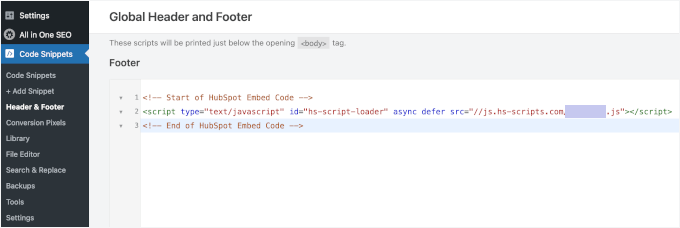
Go ahead and click ‘Save Changes’ to complete the process.
Step 3: Connect Your HubSpot Account to Your WordPress Website
After activating the HubSpot plugin, you will be prompted to connect it to your WordPress website.
If you’re new to HubSpot, you can choose a sign-up method with Google, Microsoft, or Apple. If you already have an account, simply enter your email address and click ‘Verify email.’
In this tutorial, we’ll walk through the HubSpot sign-up and setup process.
On the HubSpot page in your WordPress dashboard, we’ll select the ‘Sign up with Google’ option, for example.
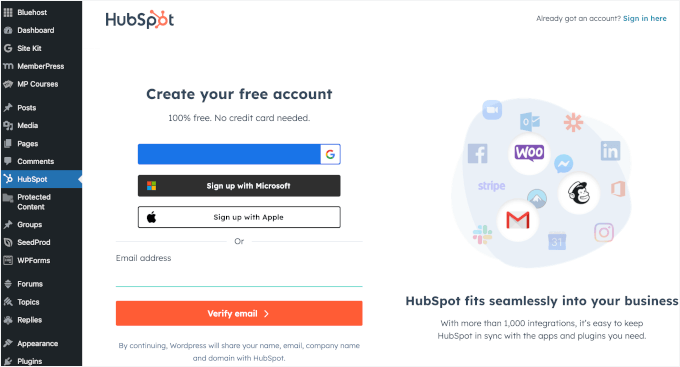
HubSpot will then confirm your Google account and request permission to access your basic profile details. Simply click to authorize the connection, and once you’ve gone through the setup wizard, you’ll be redirected back to your WordPress admin area.
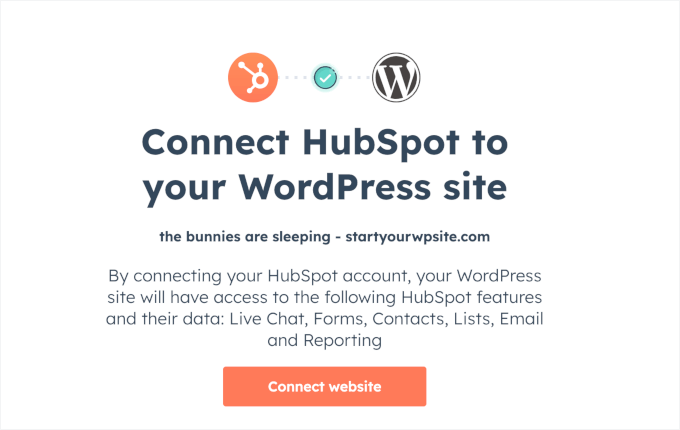
Here, you’ll find the ‘Connect website’ button. Just click on it to finish the sign-up process.
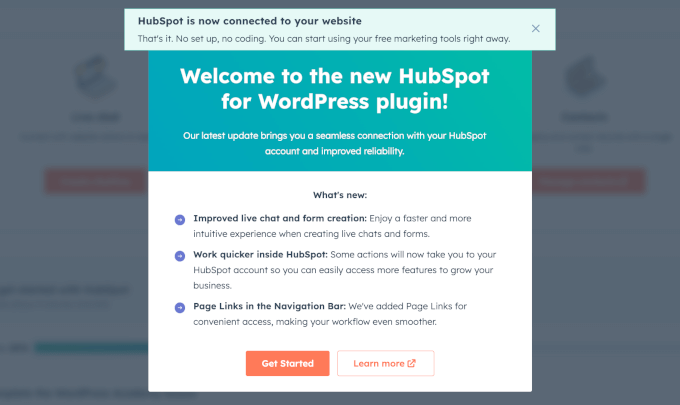
After that, a welcome popup will appear.
You can choose to ‘Get started’ right away or click the ‘Learn more’ button to access the tool’s documentation.
We’ll explore the HubSpot plugin’s features in a minute, so you can go ahead and click ‘Get Started.’
You might notice that all the HubSpot menus are now unlocked.
In the ‘User Guide’ panel, you’ll see that one of the five setup tasks is already checked off.
Simply complete the remaining tasks one by one, or skip any that aren’t relevant.
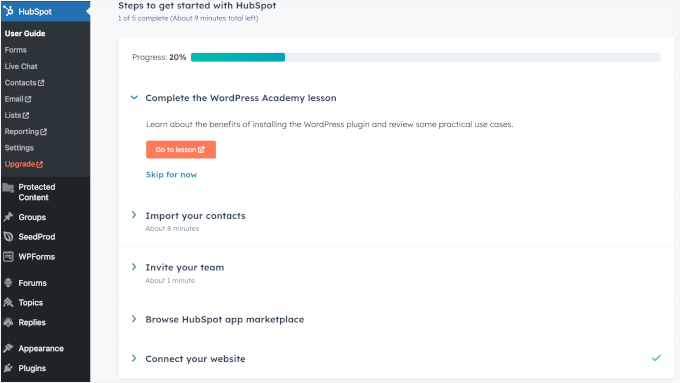
For example, let’s try importing user contacts to HubSpot.
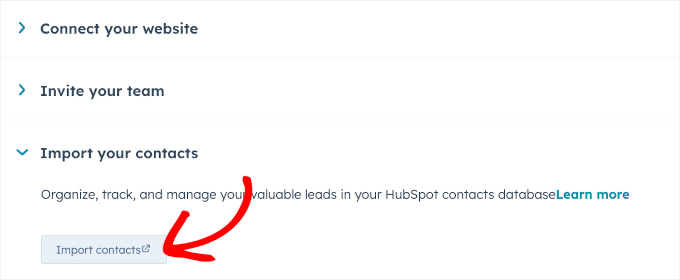
You can click on the ‘Import your contacts’ accordion menu to expand it, then select ‘Import contacts.’
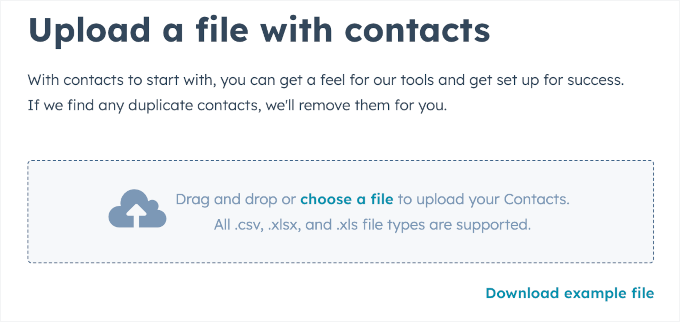
A new tab will open for uploading your contacts. Here, you’ll see that HubSpot supports file types such as .csv, .xlsx, and .xls.
Simply click ‘Choose a file’ or drag and drop it from your computer.
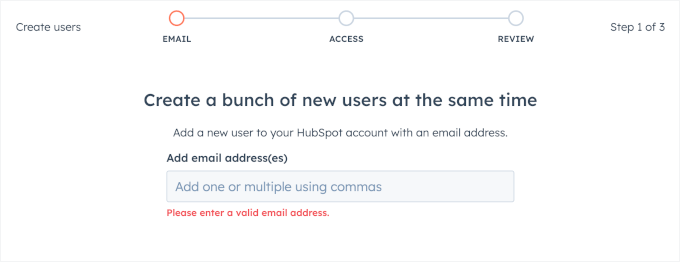
You can also upload a .csv file to add your team members. But if you have a smaller team, it is usually faster to type in their email addresses manually.
Luckily, HubSpot allows you to easily add team members by entering their email addresses.
Now, you can choose to complete all the steps, including taking courses in the HubSpot Academy. These courses will help you understand the benefits of installing the HubSpot WordPress plugin and explore practical use cases.
You can also purchase additional tools from the HubSpot App Marketplace to connect with your favorite tools, such as Google Ads, WooCommerce, and Constant Contact.
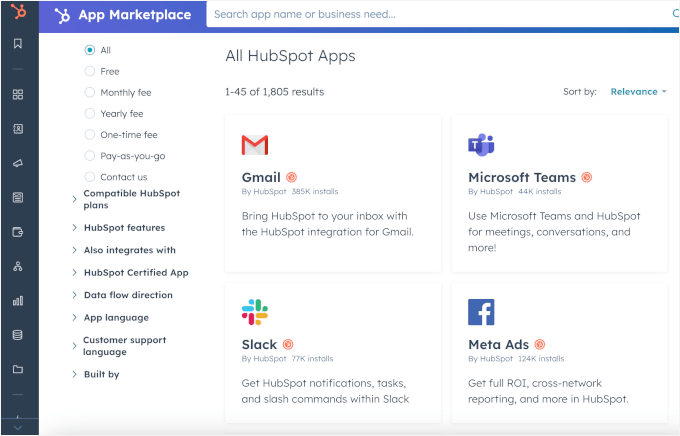
You are now ready to use HubSpot analytics to grow your WordPress site.
Step 4: Explore the HubSpot Analytics Features
With HubSpot connected, you can now track key marketing metrics from your WordPress site. That said, do note that the detailed reports are available on your main HubSpot dashboard.
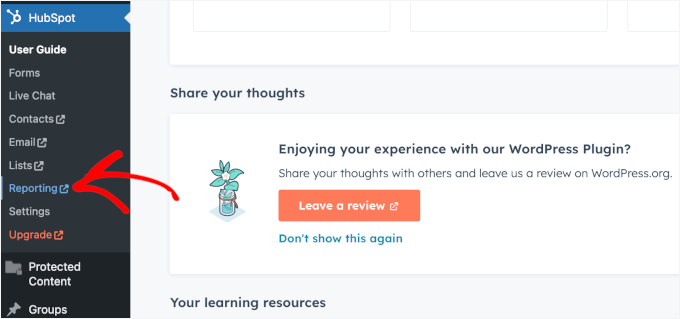
To access them, go to HubSpot » Reporting in your WordPress admin dashboard. Don’t worry if the interface looks a bit different. This simply opens your HubSpot account in a new tab, where you’ll see all your detailed analytics dashboards on the main HubSpot website.
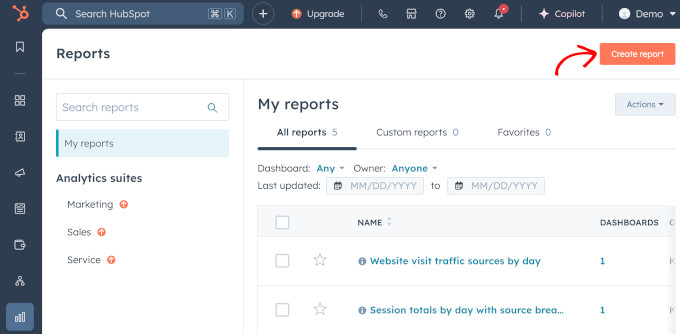
If you want more control, you can also create custom reports.
Just click the ‘Create report’ button at the top to get started.
For example, HubSpot has a library of analytics reports that you can select, including:
- Page views and bounce rate
- Sessions and traffic sources
- Visitor engagement rates
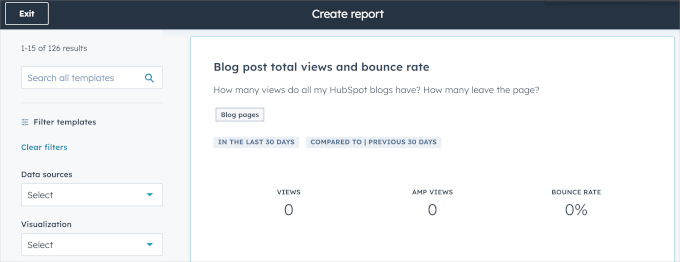
Simply click to add the reports you want, and HubSpot will start collecting data from your WordPress website.
Let’s take a look at some of the key reports you can explore. Keep in mind that the exact reports you see may depend on your HubSpot subscription plan.
Popups Reporting Dashboard
HubSpot lets you design custom popups and slide-ins that engage users at the perfect moment.
Here are a few popup use cases to inspire you:
- ✍️ Showing a registration form to visitors before they leave your site.
- 🏷️ Display discounts or limited-time deals to boost conversions.
- 🔖 Suggest relevant content or product recommendations based on behavior.
- 💬 Use quick surveys to gather insights about user experience.
In your HubSpot account, you can find the performance of your popups and forms by navigating to Reporting » Dashboards.
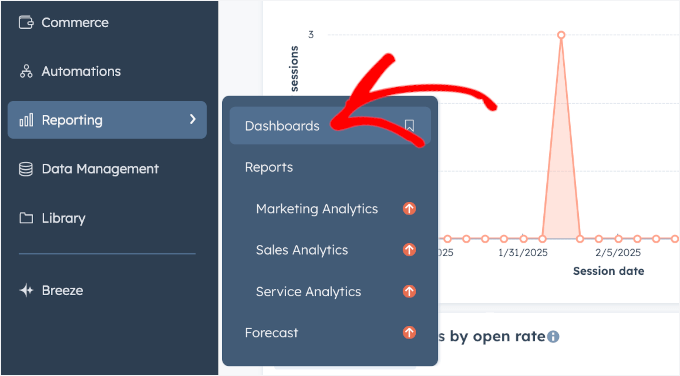
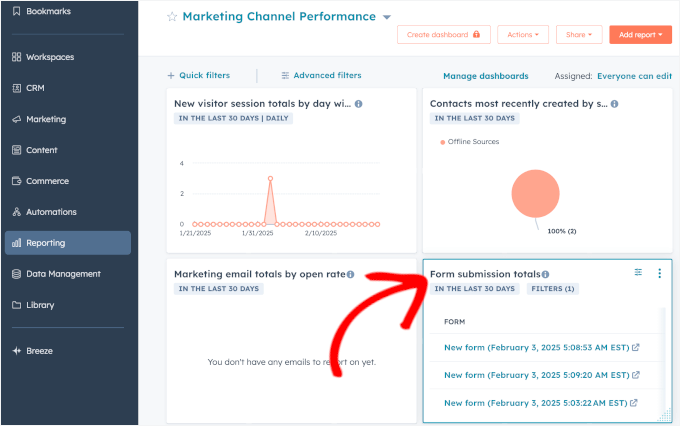
Next, simply click on the dropdown to expand it and choose ‘Marketing Channel Performance’ analytics.
And that’s it! You’ll find the dedicated section for tracking form submissions:
Live Chat Reporting Dashboard
Live chat is a great way to connect your website visitors with your team in real time. When you set it up on HubSpot, a chat widget will appear on your site. It allows visitors to click to start a conversation with someone from your team.
In addition to greeting visitors and offering assistance, here are some other live chat use cases for inspiration:
- 🛒 Set up live chat on your sales page that connects visitors directly to your team.
- 🎯 Use live chat on your landing pages to engage potential leads and provide personalized assistance.
- 📈 Add live chat on your pricing page to address any questions visitors might have about pricing or features before making a decision.
- 📑 Offer another live chat option to your knowledge base articles to assist with support questions.
To track how your live chat performs, go to Reporting » Dashboards in your HubSpot account.
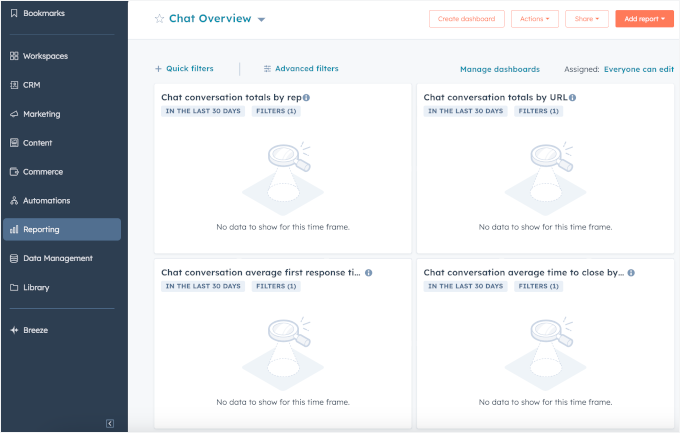
Go ahead and click on the ‘Chat Overview’ option from the dropdown.
Here, you can track key metrics to review chat performance and team efficiency:
- Chat conversation totals by rep – See how many chat conversations each team member has handled.
- Chat conversation totals by URL – Identify which landing pages generate the most chat interactions.
- Chat conversation average first response time by rep – Track how quickly each team member responds to incoming chat messages.
- Chat conversation average time to close by rep – Measure how long it takes each team member to resolve a chat conversation.
- Chat conversation close totals by rep – View the total number of chat conversations successfully closed by each team member.
These insights make it easy to see how your team is doing and how you can improve the experience for customers.
Email Overview Dashboard
HubSpot’s email marketing tool allows you to create and send different types of emails to your audience.
For example, you can:
- 📧 Send one-time campaigns to specific groups of contacts, which is perfect for announcements or promotions.
- 🔄 Set up automated emails when contacts take certain actions, like filling out a form.
- 📝 Keep subscribers engaged by automatically sending them your new blog posts.
To see how your email campaign performs, you can navigate to Reporting » Dashboard from your HubSpot account.
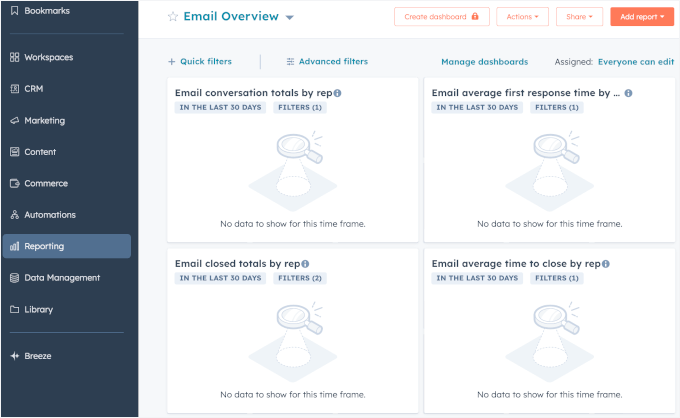
Next, you’ll want to click ‘Email Overview’ from the dropdown.
Once inside, you can track key metrics to measure team performance and response times:
- Email conversation totals by rep – See the number of email conversations handled by each team member or customer service representative.
- Email average first response by rep – Track how quickly each rep responds to incoming emails.
- Email closed totals by rep – View the total number of email conversations successfully resolved by each rep.
- Email average time to close by rep – Measure how long it takes each rep to close an email conversation.
With these numbers, you can spot top performers, identify bottlenecks, and make sure customers are getting timely responses.
eCommerce Analytics Dashboard
HubSpot’s Commerce Hub makes it easy to collect payments and track revenue. Whether you’re selling one-time products, subscriptions, or even on a free HubSpot plan, you can:
- 💳 Use payment links to collect one-time or recurring payments.
- 📠 Track payments in your CRM, just like contacts and deals.
- 💭 Create branded quotes or bill customers with invoices.
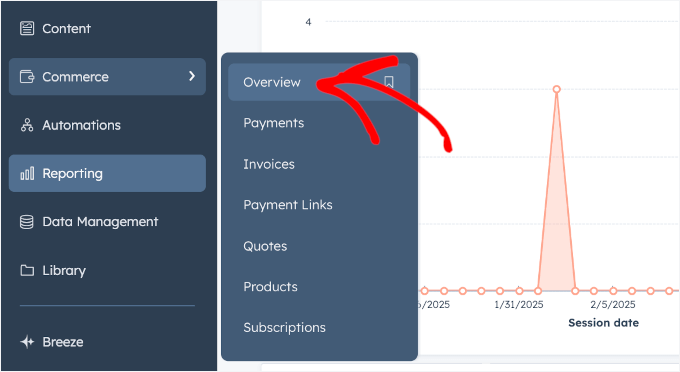
To access your commerce analytics, navigate to the Commerce » Overview in your HubSpot account.
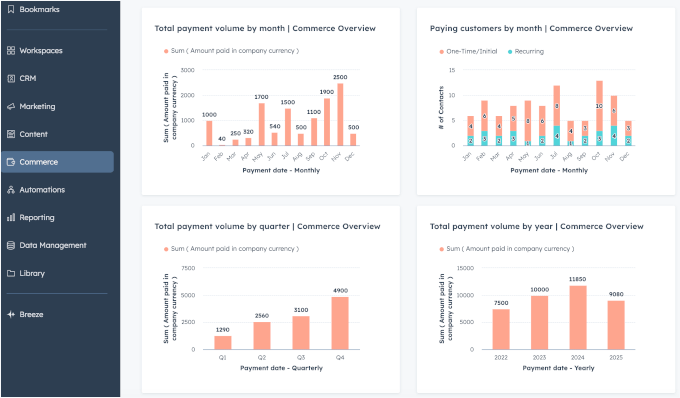
In the ‘Commerce Overview’ analytics section, you’ll find:
- Total payment volume by month – See how much revenue you’ve collected each month to spot trends and seasonality in sales.
- Paying customers by month – Monitor the number of unique customers making purchases each month to gauge customer loyalty and acquisition.
- Total payment volume by quarter – Get a broader view of your sales performance over three-month periods.
- Total payment volume by year – Review annual revenue to assess long-term growth and make informed business decisions.
These metrics help you understand your revenue patterns and make smarter decisions about growing your business.
Step 5: Monitor and Analyze Your HubSpot CRM Regularly
Now that you know where to access your analytics, you’ll want to keep an eye on your results.
By regularly reviewing your data, you can make adjustments to your strategy. For example, you can look at your campaign performance metrics, like click-through rates and conversion rates.
If certain campaigns aren’t performing as expected, then you might need to adjust your messaging or call-to-action to make them more effective.
You can also evaluate how well your email newsletter, ads, or social media posts connect with your audience.
Doing A/B testing is an easy way to see what gets the best response. Then, simply adjust your strategy to build stronger connections. For details, you can check out our guide on how to do A/B split testing in WordPress.
Bonus Tip: Boost Your Website Performance with HubSpot Alternatives
HubSpot is a solid platform, but it’s not the best fit for all WordPress users. A lot of its features work best when you’re all-in on its ecosystem, which can feel a bit limiting.
Another downside to HubSpot is that its SEO tools are only available on paid plans.
If you pay, you will have access to powerful SEO audits, keyword tracking, and optimization suggestions. However, it also means that if you’re on a free plan, you’ll miss out on these features.
For now, if SEO is a key focus for your website, you might need to consider upgrading to unlock these valuable tools. If you’re just starting out, though, you can check out our ultimate WordPress SEO guide for beginners.
There are also plenty of other HubSpot alternatives for WordPress websites, depending on what you’re trying to achieve:
- MonsterInsights – MonsterInsights is the best analytics plugin for WordPress, and it brings all your Google Analytics data right into the WordPress dashboard. It also provides advanced tracking for online stores, affiliate marketing links, digital downloads, and more.
- Constant Contact – If you’re looking for an email marketing platform, then we recommend Constant Contact. It’s affordable, beginner-friendly, and has all the tools you need to set up email campaigns, segment your audience, and more.
- OptinMonster – Need more leads? OptinMonster is a powerful lead-generation tool that helps you create high-converting popups, slide-ins, and optin forms to build your email list and boost conversions.
- AIOSEO – If SEO is your priority, then All in One SEO (AIOSEO) makes it very easy to optimize your site. It provides on-page analysis, keyword research tools, and technical SEO features to improve rankings and drive organic traffic. You can also check out the AIOSEO free version.
- LiveChat – For real-time customer support, LiveChat allows you to engage visitors instantly. It is an easy-to-use live chat solution that helps boost conversions, answer customer questions, and improve the user experience.
Each of these tools focuses on a specific area, giving you more control and customization for your website.
By choosing the right combination of these specialized plugins, you can build a lightweight, “best-of-breed” stack right inside your WordPress dashboard.
This gives you access to powerful, advanced features without the bloat of an external CRM, and keeps you from being locked into the expensive premium tiers of a single all-in-one platform like HubSpot.
For more information, see our expert list of the best HubSpot alternatives.
FAQ About Setting Up HubSpot Analytics
If you’re new to HubSpot or wondering how it fits into your WordPress site, here are answers to some common questions that we get from our readers.
What can I use HubSpot for?
HubSpot is a powerful all-in-one marketing platform. It helps you manage a lot of things, including customer relationships, analytics, and email campaigns. This tool can also help you engage visitors through live chat and forms.
Can I integrate HubSpot with WordPress?
Yes! HubSpot offers a WordPress plugin that seamlessly integrates with your site. This makes it easier to track and manage everything without leaving your dashboard.
How do I set up tracking using the HubSpot WordPress plugin?
Once you install and activate the HubSpot – CRM, Email Marketing, Live Chat, Forms & Analytics plugin, it automatically adds the tracking code to your site. You can then access insights like page views, conversions, and user behavior directly in your HubSpot account.
What analytics tools should I use for my WordPress site or blog?
Other than HubSpot, we recommend using MonsterInsights. It’s the best Google Analytics plugin that allows you to gain deeper insights into traffic, engagement, and conversions.
Which plugin is best for WordPress marketing automation?
We recommend Uncanny Automator for WordPress marketing automation. This powerful tool allows you to link all your software and set up automated workflows. For more details, see our guide on how to create automated workflows in WordPress with Uncanny Automator.
Additional WordPress Analytics Guides
We hope this article has helped you set up HubSpot Analytics on your site.
Next up, you might want to check out our guides on:
- How to Track Website Visitors to Your WordPress Site
- How to Add WordPress Analytics Without Cookies (Easy Methods)
- How to Keep Personally Identifiable Info Out of Google Analytics
- How to Block WordPress Referrer Spam in Google Analytics
- The Best Analytics Solutions for WordPress Users
If you liked this article, then please subscribe to our YouTube Channel for WordPress video tutorials. You can also find us on Twitter and Facebook.




Have a question or suggestion? Please leave a comment to start the discussion.