


By default, WordPress doesn’t make it easy to display all your blog authors in one place.
As a result, your writers often stay hidden behind individual posts, even when they’re regularly publishing great content. This can hold your blog back.
When readers only see single posts, they miss the bigger picture of who is creating your content.
Showing your authors helps you highlight the people behind your blog and adds a more personal touch to your site. It also helps visitors connect with writers they enjoy and find more of their work.
To help you out, I’ll show you two simple ways to list all your blog authors in WordPress. Both methods are beginner-friendly and don’t require any coding.
💡Quick Answer: How to Display a List of Blog Authors in WordPress
If you’re in a hurry, here’s a quick overview of both methods:
- Method 1 – Author Avatars List/Block Plugin: Best if you want a visual, customizable author list with avatars, roles, and extra user details using a simple block or widget.
- Method 2 – WPCode: Best if you want a lightweight, code-based solution to display a simple list of authors with minimal setup.
Why Display a List of All Blog Authors in WordPress?
Displaying a list of all authors on your WordPress blog helps you highlight the people behind your content and improve user engagement.
Here’s why it’s worth doing:
- Builds Trust With Your Readers: When visitors see real authors behind your posts, your blog feels more credible and authentic.
- Highlights Your Contributors: It gives recognition to writers who regularly publish content on your site.
- Improves Content Discovery: Readers can easily find more articles from their favorite authors.
- Adds a Personal Touch: It makes your blog feel more human instead of just a collection of posts.
- Encourages Repeat Visits: When users follow specific authors, they’re more likely to come back for new content.
- Helps Organize Multi-Author Blogs: It makes your site easier to browse, especially if you have many contributors.
Now that you understand the benefits, the next step is choosing the right method for your site.
Method 1: Display WordPress Authors Using Author Avatars List/Block Plugin
🥇Best for: Community powered sites that want to display a visual author list or user list with avatars.
If you want a visually appealing way to display a list of authors on your WordPress site, this method is a great choice.
I recommend the Author Avatars List/Block plugin because it’s simple to use and gives you a lot of flexibility without touching code.
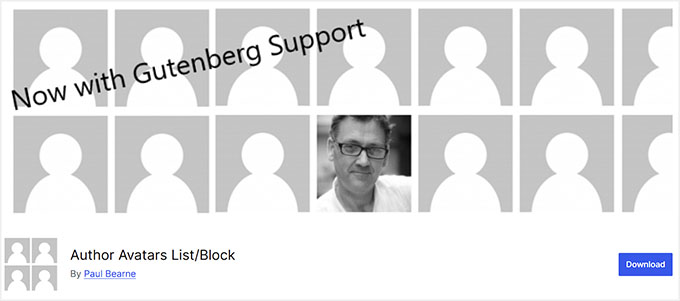
I’ve tested this tool myself, and it works really well for showing users in a clean, visual layout using Gutenberg blocks.
One of its biggest strengths is that you are not limited to just authors. You can also display other user roles like editors, contributors, or custom roles. This makes it especially useful for larger or multi-role websites.
It also works with Gravatar, so it automatically pulls in user profile images if they are set.
On top of that, you can choose exactly what author details to show, such as display name, username, or bio.
Plus, you get a good level of customization. You can adjust avatar sizes, filter which users appear, change sorting order, and even group users by role or blog in multisite setups.
Step 1: Install and Activate the Author Avatars List/Block Plugin
First, you need to install and activate the Author Avatars List/Block plugin on your WordPress site. Start by logging in to your WordPress dashboard. From here, go to Plugins » Add Plugin.
In the search bar, type ‘Author Avatars’. When you see the plugin, click the ‘Install Now’ button. After a few seconds, the button will change to ‘Activate’.
Go ahead and click it to activate the plugin on your site.
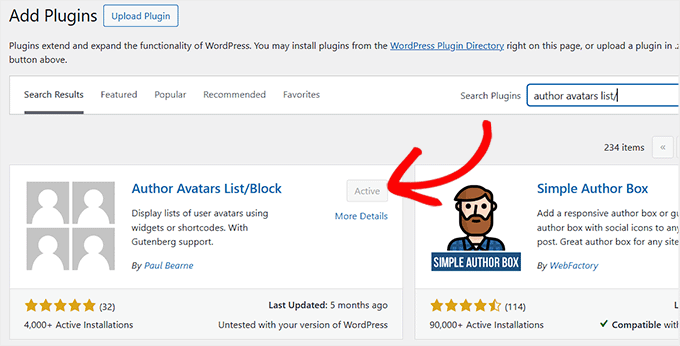
You can now start displaying your authors using a Gutenberg block, depending on where you want to show them.
If you are not familiar with installing plugins, I suggest following our beginner-friendly guide on how to install a WordPress plugin.
Step 2: Add the Author List Block to Your Post or Page
To display the author list, open the post or page where you want it to appear. I suggest creating a new page called something like ‘Our Authors’ or editing an existing page where this section fits naturally.
Once you are in the editor, click the ‘Add New Block’ icon at the top left to add a new block. Search for ‘Avatar Lists’ and insert the block into your content.
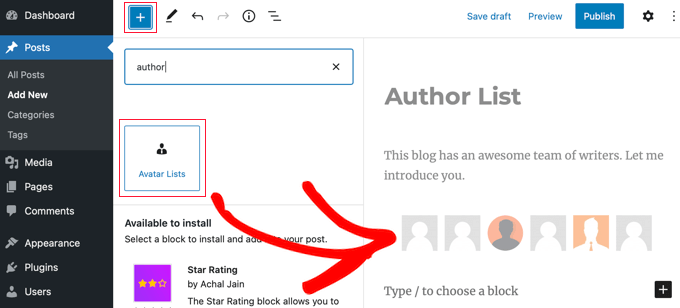
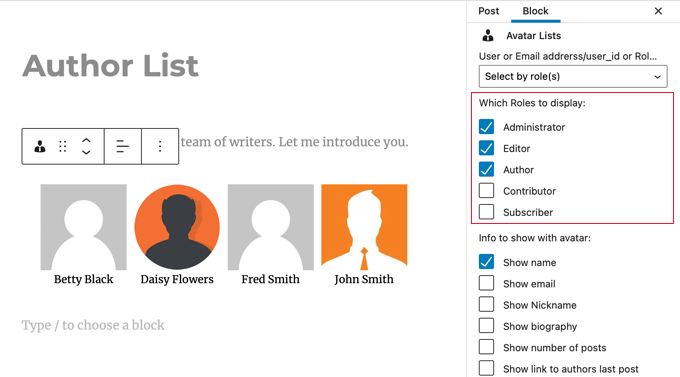
Next, you need to choose which user roles to display from the block settings panel on the right.
I recommend selecting only the roles you want to show, such as Authors, Editors, or Contributors.
If you leave all roles unchecked, the block will not display anything and may show an error message.
After that, you can control what information appears with each avatar. You can choose to show authors details like the name, email, bio, post count, or even their latest post.
For simplicity, I suggest sticking with just the name or display name, especially if you want a clean and minimal layout.
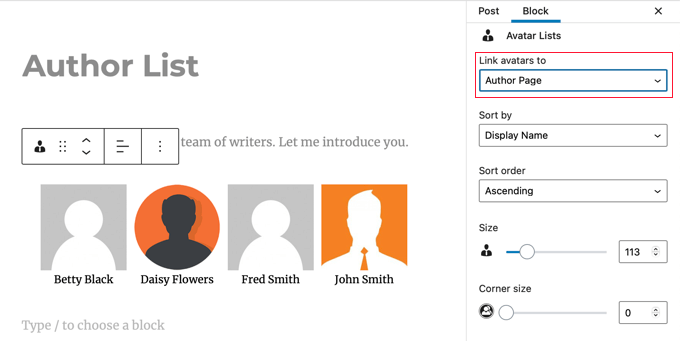
Next, scroll to the ‘Link avatars to’ option and choose ‘Author Page’ from the dropdown menu.
This is helpful because when a visitor clicks on an author’s name or avatar, it takes them to that author’s archive page where they can see all their posts.
💡 Expert tip: WordPress automatically creates a default author page for any user who has published at least one post. But it is usually very basic and not visually appealing.
To improve this, I recommend using SeedProd. It’s the best WordPress page builder for creating custom, visually appealing pages without coding. You can design a much better author layout that matches your site’s branding and improves the overall user experience.
For more details, check our guide on adding a custom author profile page in WordPress.
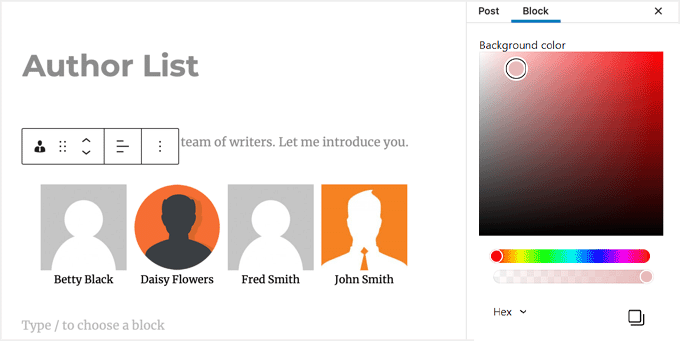
You can also customize the list’s appearance to match your theme. Adjust settings like avatar size and sorting order, or change design elements like background color, fonts, and borders to ensure the list blends nicely with your site.
I recommend not overdoing these settings at the start. Instead, make small changes, preview the result, and adjust until it looks clean and consistent with your branding.
Step 3: Configure Advanced Settings and Publish Your Author List
Next, you can fine-tune the advanced settings by scrolling down and opening the ‘Advanced’ section in the block settings. Here, you can control how your author list behaves and who appears in it.
For example, you can set the ‘Max. avatars shown’ option to limit the total number of authors displayed.
You can also use ‘Max. avatars per page’ if you want to control how many authors appear before pagination is added.
The plugin calculates the required pages automatically using a simple formula. So, if you have 25 authors and set the max to 10, it will automatically generate 3 pages for you.
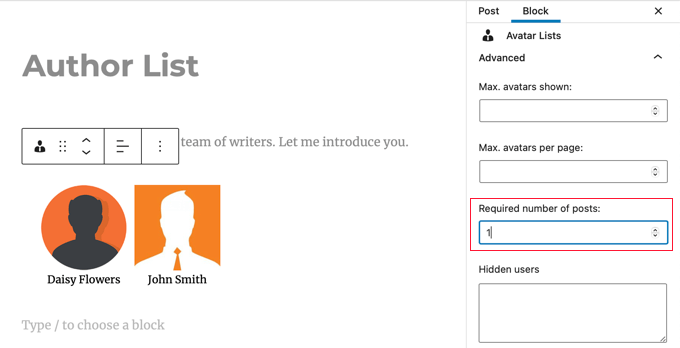
One setting I really like is ‘Required number of posts.’ I recommend setting this to ‘1’, so only users who have published at least one post on your site will be shown.
You can also manage visibility using the ‘Hidden users’ option, where you can exclude specific user accounts by adding their login IDs separated by commas.
If you want even more control, the ‘Whitelist of users’ option lets you display only selected users by listing their login IDs.
For most sites, simply setting the ‘Required number of posts’ to 1 is all you need to do here. You can always come back and explore the other options later.
Step 4: Preview and Display Your Author List
Once you have configured everything, it’s time to see your author list live on your site.
Go ahead and click ‘Publish’ or ‘Update’ if you haven’t already. Then open the page in a new tab to preview how your author list looks on the front end.
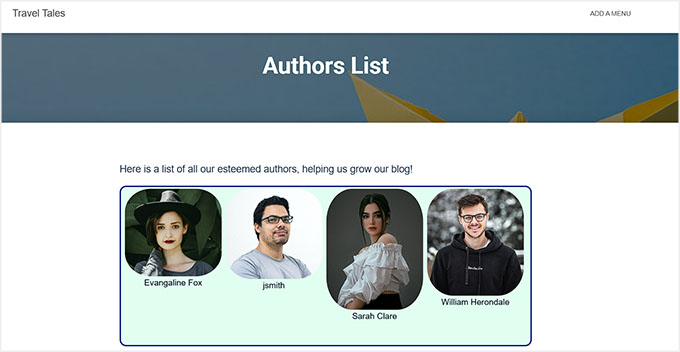
This step is important because it lets you quickly check spacing, avatar size, and which users are being displayed. If something doesn’t look right, you can always go back and adjust the block settings.
💡Expert Tip: How to Display an Author Photo Instead of Gravatar
By default, this plugin uses Gravatar to show each author’s profile image based on their email address. This works well in many cases, but not all authors may have a Gravatar set up.
If you want more control over profile images, I recommend replacing Gravatar with custom author photos. You can easily do this using PublishPress Authors, which allows users to upload their own profile pictures directly in WordPress.
For step by step instructions, see our guide on how to add an author’s photo in WordPress.
Method 2: Display WordPress Authors Using WPCode
🥈Best for: Users who want a simple, lightweight author list and are comfortable with adding tiny code snippets.
If you are looking to add just a simple list of authors to your WordPress site, then you can do it by adding a custom PHP code snippet using the wp_list_authors() function.
Now, you might have seen tutorials that suggest adding code directly to your theme’s functions.php file.
However, I don’t recommend this approach for beginners. Even a small mistake in the code can break your site and lock you out of the admin area.
That is why I recommend using WPCode instead.
With over 3,000,000 installations, I have found it to be the safest and easiest way to add custom code to WordPress. It lets you insert code snippets without editing theme files, and you can activate or deactivate them with a single click.
One of the features I really like is the location control. You can choose exactly where your code runs, such as before or after posts, inside content, or even between posts in archives. This makes it easy to control how and where your author list appears.
WPCode also includes Smart Conditional Logic, which is very helpful for more targeted displays. This gives you much more flexibility when you don’t want the list to appear sitewide.
I have used the tool several times, and it has never disappointed. To learn more about our team’s collective experience, take a look at our detailed WPCode review.
Step 1: Install and Set Up WPCode
You can start by visiting the official WPCode website and purchasing the plugin if you want access to advanced features.
Once you have it, follow the setup instructions to install it on your site. If you are not sure how to do this, follow our beginner-friendly guide on how to install a WordPress plugin.
📍 Note: You can use the free version of WPCode for this method since it works well for basic code snippets like an author list.
However, I will be using the Pro version because it includes features like Smart Conditional Logic and advanced display controls.
If you are on the free plan, you won’t have conditional logic. This means you’ll need to use the shortcode option to manually place the author list on a specific page, post, or widget area.
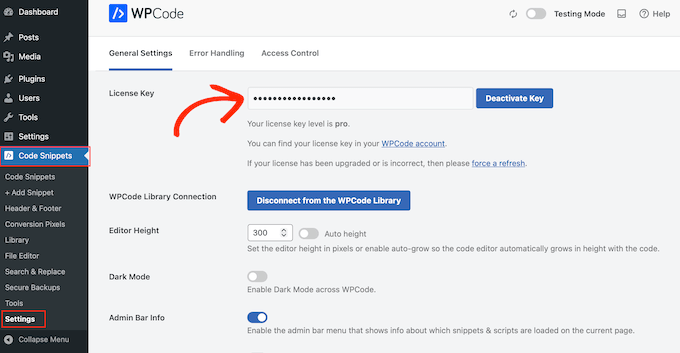
After activation, go to the Code Snippets » Settings page in the WordPress dashboard to enter your license key. You can get this information from under your account on the WPCode website.
Step 2: Create a New Code Snippet
Next, head over to the Code Snippets » + Add Snippet page from the WordPress dashboard.
Then, click the ‘+ Add Custom Snippet’ button under the ‘Add Your Custom Code (New Snippet)’ option.
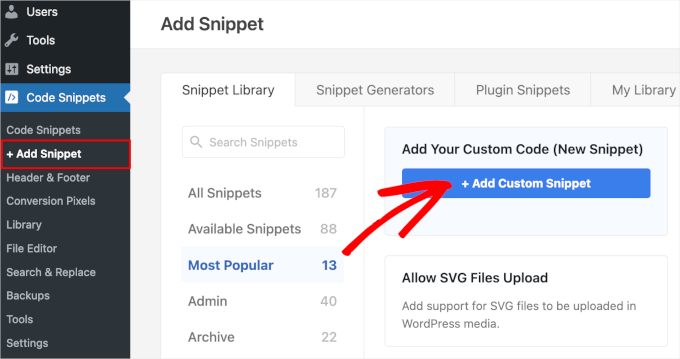
This will take you to the ‘Create Custom Snippet’ page, where you can begin setting things up.
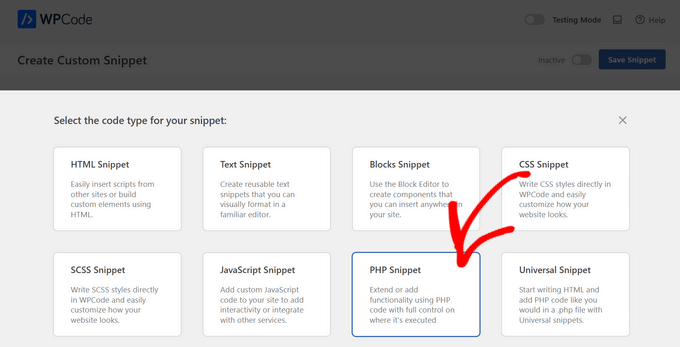
Start by selecting ‘PHP Snippet’ as your code type.
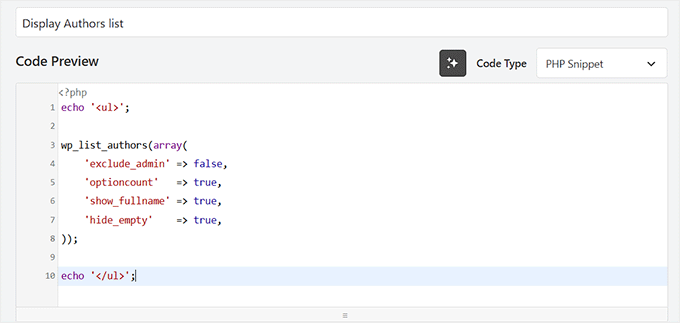
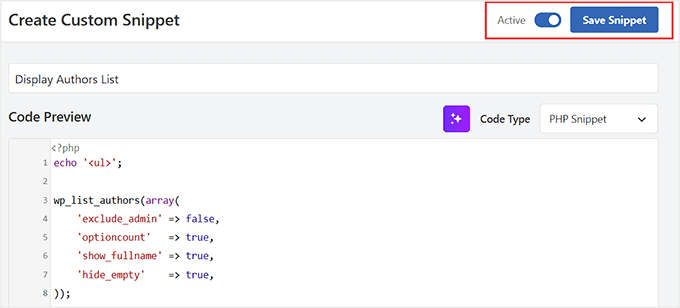
Then, give your snippet a name.
This title is just for your reference and won’t be visible on your site, so choose something like ‘Display Author List’, that helps you recognize it later.
Step 3: Add the Author List Code Snippet
Now it’s time to add the custom code that will display your list of WordPress authors.
In the WPCode editor, paste the following code into the ‘Code Preview’ box:
echo '<ul>';

wp_list_authors(array(
    'exclude_admin' => false,
    'optioncount'   => true,
    'show_fullname' => true,
    'hide_empty'    => true,
));

echo '</ul>';
This code simply tells WordPress to generate a list of all your site authors and display them inside a basic HTML list.
Keep in mind that the visual appearance of this list (like fonts and spacing) is entirely controlled by your active WordPress theme’s CSS for bulleted lists. If you want a more visual grid, Method 1 is the better choice.
It also displays the number of posts each author has written, so visitors can quickly see how active each contributor is on your blog.
Step 4: Choose Where to Display Your Author List
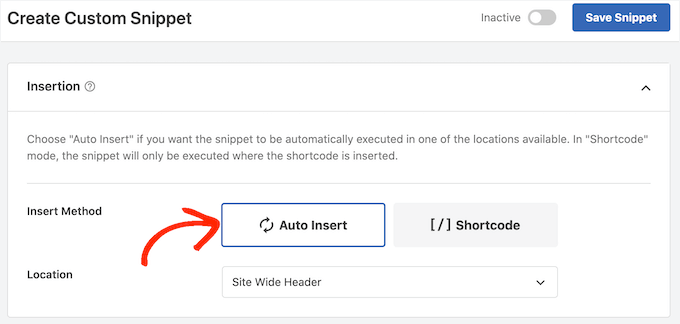
After adding your code, scroll down to the ‘Insertion’ section in WPCode. This is where you decide how and where your author list will appear on your site.
Here, you will see two options: ‘Auto Insert’ and ‘Shortcode.’
For this method, simply choose ‘Auto Insert.’
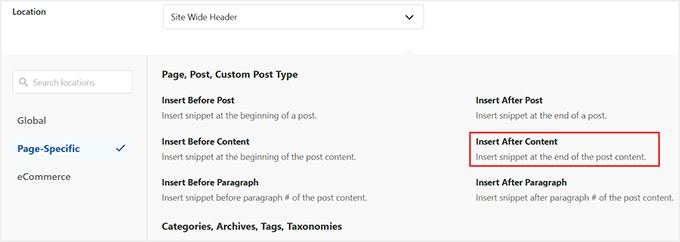
Next, expand the ‘Location’ dropdown menu and switch to the ‘Page-Specific’ tab.
WPCode gives you several placement options here, such as inserting the snippet before or after posts, inside content, or between posts in archives.
For keeping things simple, I recommend selecting ‘Insert After Post’. This means your author list will appear automatically at the end of your content across your site.
However, if you only want to display the author list on a specific page, then you should use a different approach.
Scroll down and enable the ‘Smart Conditional Logic’ option.
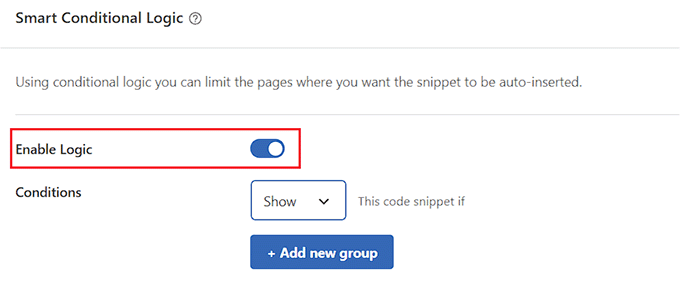
After that, make sure you select the ‘Show’ option for the code snippet condition and click the ‘+ Add new group’ button.
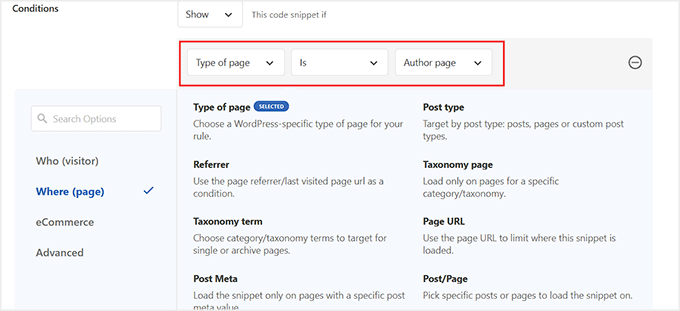
This will open up some new settings in the ‘Smart Conditional Logic’ section. From here, select the ‘Type of page’ option from the dropdown menu on the left.
Next, choose a ‘Specific Page’ (such as your ‘About Us’ or ‘Our Team’ page) where you want to display the list from the dropdown on the right.
📍Note: Smart Conditional Logic is a Pro feature and is not available in the free version of WPCode.
If you are using the free version and still want to add the author list to a specific page only, then I recommend switching to the ‘Shortcode’ option instead of ‘Auto Insert.’
WPCode will generate a shortcode that you can place anywhere using the ‘Shortcode’ block in WordPress, including posts, pages, or widget areas.
For more details on how this works, you can check our guide on adding shortcodes in WordPress.
Step 5: Activate and Save Your Snippet
After setting everything up, scroll back to the top of the WPCode screen.
Now toggle the switch from ‘Inactive’ to ‘Active.’ This will enable your code snippet on your site.
Next, click the ‘Save Snippet’ button to store your changes.
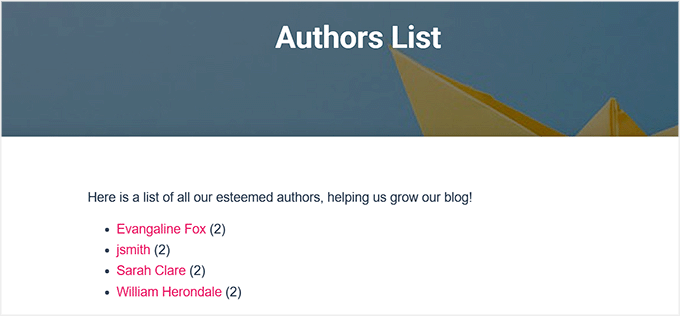
Once that’s done, visit the page or post where you chose to display the author list.
You should now see your list of WordPress authors appearing on the front end of your site.
📍Note: The author list will appear as a simple, unstyled bulleted list. Its final appearance depends on your WordPress theme’s styling. You can further customize its look with custom CSS.
More Ways to Improve Engagement on Your Multi-Author Blog
When you run a multi-author WordPress blog, listing authors is just one part of the picture. To further improve engagement on your multi-author blog, I recommend trying these simple strategies:
- Show Author Bios With Every Post: This helps readers understand who wrote the content and builds a stronger connection with your team.
- Link to Author Archive Pages: Make it easy for users to discover more articles from the same writer with just one click.
- Highlight Popular Posts: Feature your best-performing content to guide new visitors toward your most valuable articles.
- Add a Related Posts Section: Suggest similar articles at the end of each post to keep users browsing your site longer.
- Use a “Meet the Team” Page: Introduce your writers and contributors so your blog feels more personal and trustworthy.
- Encourage Category Exploration: Organize content clearly so readers can easily jump between topics they care about.
These small improvements work together to keep users engaged, increase page views, and make your WordPress blog feel more connected and user-friendly.
Frequently Asked Questions About Adding a List of Authors in WordPress
If you still have a few questions, you’re not alone. Many WordPress users run into the same confusion when setting up author lists for the first time.
In this section, I’ll answer some of the most common questions to help you get everything working smoothly on your site.
How do I list multiple authors in WordPress?
You can list multiple authors in WordPress by using a plugin like Author Avatars List/Block or by adding custom code with WPCode. Both methods let you display all your site authors in a clean list.
How to manage authors in a WordPress blog?
You can manage authors in a WordPress blog by assigning user roles from the Users section in your dashboard. This lets you control who can write, edit, or publish content on your site.
For more information, see our guide on improving the editorial workflow in a multi-author blog.
How many authors can you have on a WordPress blog?
You can have unlimited authors on a WordPress blog. WordPress does not restrict the number of users you can add, so you can scale your team as your site grows.
How to find writers for your blog?
You can find writers for your blog by hiring freelancers, accepting guest posts, or adding new users to your WordPress site. Many blog owners also use writing communities or job platforms to find contributors.
What is the difference between editor and author in WordPress?
The main difference is that an author can only write and publish their own posts, while an editor can manage and publish posts from all users. Editors also have more control over site content and revisions.
I hope this tutorial helped you learn how to display a list of authors in WordPress. You may also want to learn how to enable author tracking in WordPress or check out our list of plugins to manage WordPress multi-author blogs.
If you liked this article, then please subscribe to our YouTube Channel for WordPress video tutorials. You can also find us on Twitter and Facebook.



mohadese esmaeeli
Hello! How interesting and practical! We are a content production team, and we prepare some blog posts collaboratively. However, during publication, only the name of one author was possible to be listed under the post. The solution you mentioned is excellent and practical, and I am currently implementing it on our website.
WPBeginner Support
Glad our guide helped you solve that issue
Admin
takaitra
Another good list authors widget, with more features: http://wordpress.org/extend/plugins/list-authors/
I’ll look into adding an option to show avatars.
Gagan
Thanks alot..
Gagan
I’ve have a question, how to show top 10 contributors ?
Editorial Staff
With this plugin, don’t know if there is a way that exist, but there are other ways that exist. We will do a write up on that.
Admin
Fonda
Hello!
How can you add gravatar and descriptions?
Thanks!!!
Editorial Staff
What do you mean by descriptions? To add gravatar, you would simply have to add the code for author email in the gravatar code.
Admin
James Duffell
The description is referred to as “Biographical Info” within the users profile
Anton Trollbäck
Hi! Thanks for this great little plugin. But I would also like it to show gravatars. I don’t really understand “add the code for author email in the gravatar code.”
Do you mind explaining?
Thanks,
Anton
Editorial Staff
Yes, please view our already written article on (how to display author list with avatars)