


“Will I lose my Google rankings if I move from Blogger to WordPress?” That’s the first question we hear from anyone thinking about making the switch.
We get it. However, after helping many bloggers make this move, we can say with confidence that you can switch from Blogger to WordPress without losing your Google rankings.
In this guide, we’ll show you the exact steps we use, from exporting your Blogger blog to setting up the redirects that protect your search traffic.
Quick Summary: Switching from Blogger to WordPress requires exporting your Blogger content, importing it into a self-hosted WordPress site, and redirecting the old URLs to your new site.
Estimated time: 1 to 2 hours for a small blog.
Tools: Free BtW Importer plugin and two short code snippets.
Cost: The migration costs nothing. You’ll still need to pay for hosting and a domain name.
WordPress.com vs. WordPress.org: What’s the Difference?
There are two types of WordPress, and this guide uses WordPress.org, also known as self-hosted WordPress. WordPress.com is a hosted service where you cannot install plugins on the free plan. You’ll need to upgrade to a paid plan to unlock plugins and follow this tutorial.
For a full breakdown, see our comparison of WordPress.com vs. WordPress.org.
That being said, let’s take a look at how to move from Blogger to WordPress while keeping your Google rankings and traffic. Here are the steps we’ll cover:
- Step 1: Sign Up for WordPress Hosting
- Step 2: Export Your Blogger Blog
- Step 3: Import Blogger to WordPress
- Step 4: Setting Up Permalinks
- Step 5: Set Up Redirects From Blogger to WordPress
- Step 6: Moving Other Content From Blogger to WordPress
- Step 7: Verify Your Migration in Google Search Console
- Step 8. Things to Do After Migrating From Blogger to WordPress
- Frequently Asked Questions About Switching From Blogger to WordPress
Step 1: Sign Up for WordPress Hosting
To get started with WordPress, you will need a domain name and web hosting. A domain name is your website’s address, and web hosting is where your website files live.
You can choose any WordPress hosting provider that you want, like Bluehost or Hostinger. Both are officially recommended WordPress hosting providers and offer a free domain name for the first year.
For this tutorial, we used Bluehost, which automatically installed WordPress when we signed up, so we were able to log into our new site right away.
Step 2: Export Your Blogger Blog
Now that your WordPress site is ready, the next step is to export your content from Blogger.
Log in to your Blogger account, pick your blog, and click Settings in the left menu. Scroll down to the ‘Manage blog’ section, click ‘Back up content’, and then click ‘Download’.
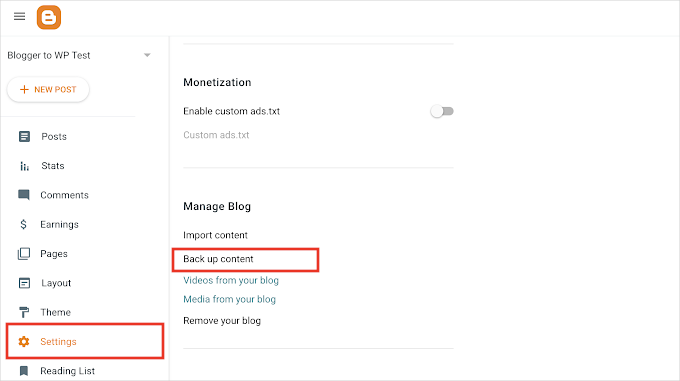
Blogger no longer downloads an XML file straight away. Instead, the Download button now opens Google Takeout, which is Google’s tool for downloading your data, with Blogger already selected.
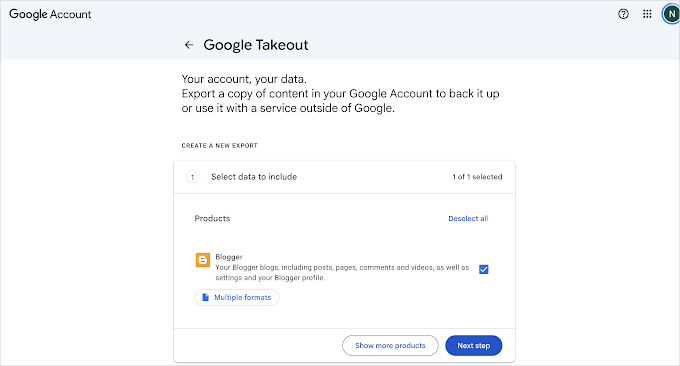
Click ‘Next step’, keep the default settings, and click ‘Create export’.
Google will email you when the export is ready, which usually takes a few minutes for a small blog.
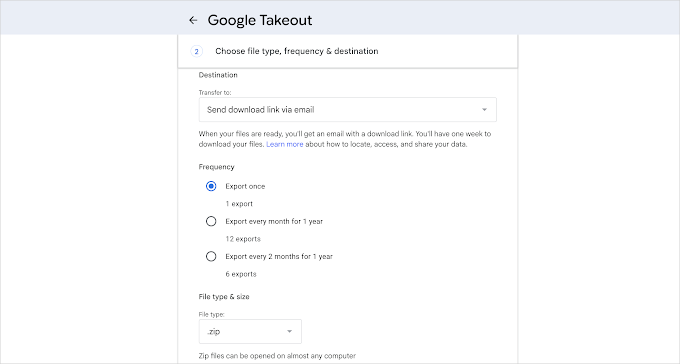
Click ‘Download archive’ in that email and save the .zip file to your computer.
Next, unzip the file. Open the Takeout folder, then Blogger, then Blogs, and then the folder with your blog’s name.
The file you need is called feed.atom. It holds your posts, pages, and comments.
If Takeout splits your export into more than one .zip file, check each one for a feed.atom file. You will import them one after another in the next step.
Note: Keep a copy of the whole archive in a safe place, like cloud storage or an external drive. It is your backup of the original blog. The Albums folder inside it holds every image you ever uploaded to Blogger, which we come back to in Step 6.
Step 3: Import Blogger to WordPress
With the feed.atom file on your computer, you can now import your content into WordPress.
WordPress comes with a default Blogger importer, available on the Tools » Import page in the admin area. However, that importer has been broken since July 2025. That is when Google moved Blogger backups into Google Takeout and changed the file format at the same time.
Luckily, there are alternative plugins you can use.
- BtW Importer – This is the plugin we’ll be using in this tutorial. It imports posts, pages, images, and even set up redirects. The downside is that it doesn’t import comments.
- Blogger Importer Extended – Imports posts, pages, images, and comments, but the free version is limited to 20 posts. You can use this if you have fewer posts or if you want to import comments.
First, install and activate the BtW Importer plugin. For more details, see our step-by-step guide on how to install a WordPress plugin.
Upon activation, click the new BtW Importer item in your WordPress admin menu. The page starts with a short list of things to know before you import.
Read it, then tick the ‘I’ve read and understood the information above’ box.
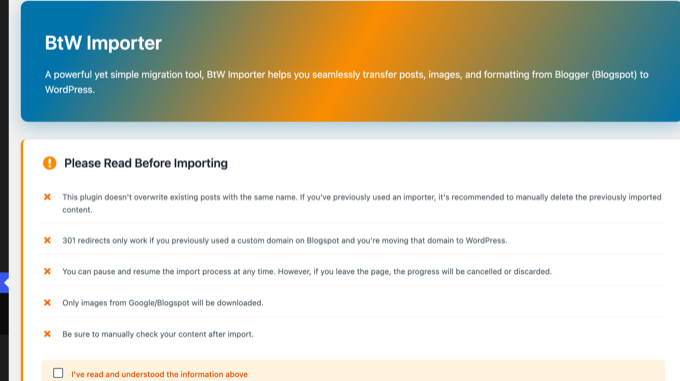
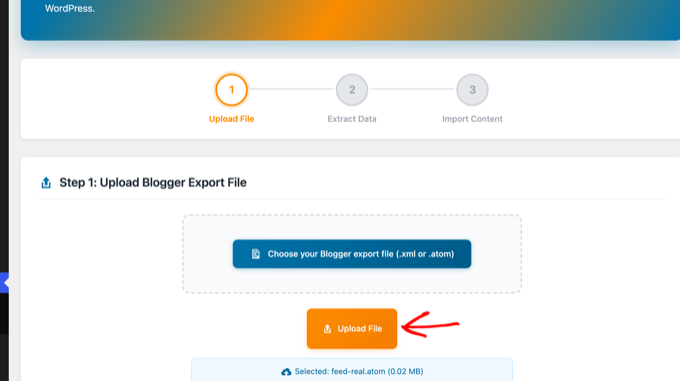
In Step 1, click the ‘Choose your Blogger export file’ button and select the feed.atom file. Then click the ‘Upload File’ button.
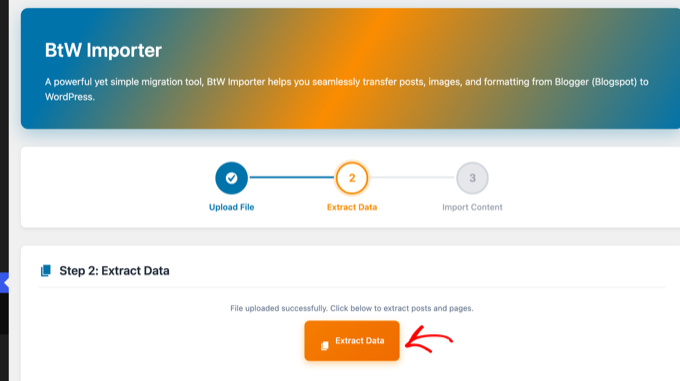
In Step 2, click the ‘Extract Data’ button. The plugin reads the file and counts your posts and pages.
Step 3 shows how many items it found. The ‘Advanced Options’ panel lets you keep the original Blogger author for each post, and it has an experimental option to convert the old Blogger HTML into WordPress blocks.
We recommend leaving that option unchecked for your first run, because you can always convert posts to blocks later in the editor.
Leave the batch size on ‘Recommended’ and click the ‘Start’ button.
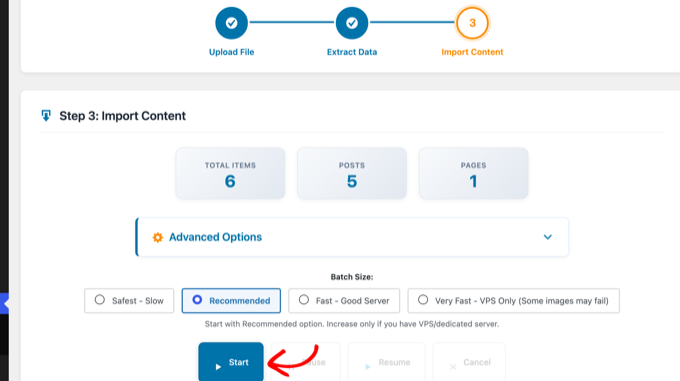
The plugin imports your posts and pages, downloads every image hosted on Google’s servers into your media library, and rewrites the image links inside your posts to the new copies.
It also records the old Blogger address of each post, which we use for the redirects in Step 5.
A progress log shows each item as it comes over, and you will see a ‘Congratulations!’ message when it finishes.
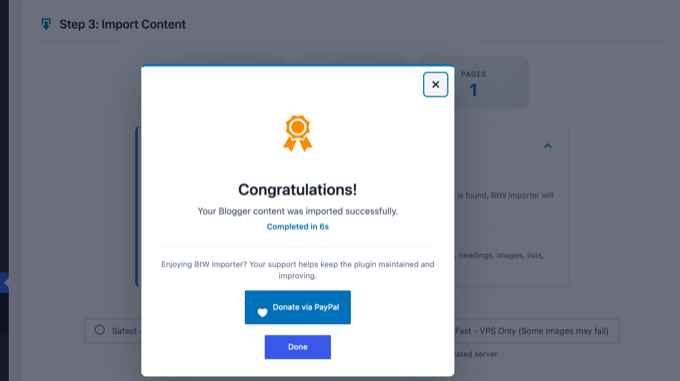
You can now check your content under Posts » All Posts and Pages » All Pages. Blogger labels become WordPress categories, drafts stay drafts, and the first image in each post becomes its featured image.
Step 4: Setting Up Permalinks
Now that your posts are in WordPress, let’s talk about their web addresses. Permalinks is the WordPress term for the URL structure of your posts and pages.
Blogger post URLs look like this: https://yourblog.blogspot.com/2026/08/post-title.html.
The BtW Importer plugin saved the old address of every post and page in a redirect map. Whenever a request for an old address reaches your WordPress site, the plugin sends it to the matching new post.
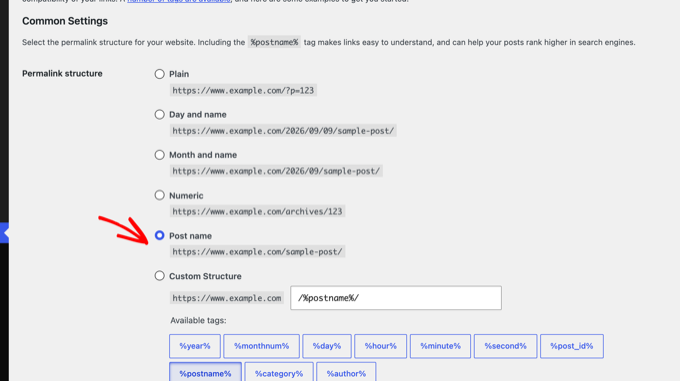
So keep WordPress’s default setting. Go to Settings » Permalinks and check that you have the ‘Post name’ option selected.
This setting gives you clean, SEO-friendly URLs like yourblog.com/post-title/.
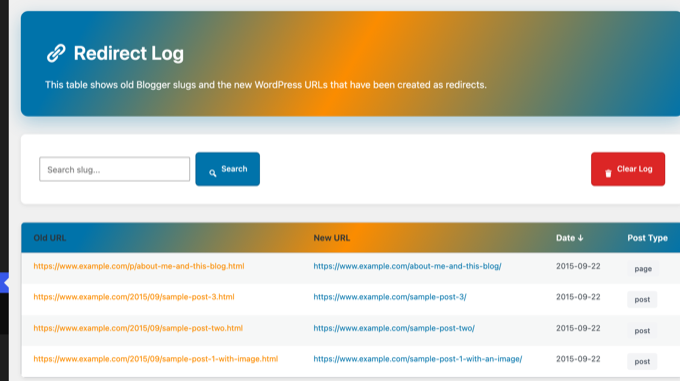
You can see the full list of old and new addresses under BtW Importer » Redirect Log. Every Blogger post and page should have a row here.
To test it, open one of the old addresses on your new domain, such as yourblog.com/2026/08/post-title.html. WordPress should send you straight to the new post.
In our test, the old post and page URLs all returned a 301 redirect to the right place.
This map only works for users that arrive at your WordPress domain. However, since your users and Google don’t know that you have moved, they will continue seeing your old Blogger blog until you finish Step 5.
Step 5: Set Up Redirects From Blogger to WordPress
Now that WordPress knows where every old address should go, it is time for the most important step of the whole migration, which is redirecting users and search engines like Google to your new WordPress site.
A redirect sends anyone who opens one of your old Blogger URLs to the same post on WordPress automatically.
It also sends a 301 status code, which is the code for a permanent redirect. This tells Google that the page has moved for good, so your rankings pass to the new address instead of starting from zero.
⚠️ If your Blogger blog has its own custom domain instead of blogspot.com, you may need to point your domain nameservers to your hosting provider. For instructions, please follow our tutorial on how to switch custom domain blogger blog to WordPress.
Blogger does not let you set up server redirects, so here is the workaround.
First, we add a small code snippet to your WordPress site. It receives the visitors that Blogger sends over, looks up the old address, and forwards them to the right post in WordPress.
Then, add a code snippet to your Blogger theme to send every visitor and search engine from your blogspot.com address to that snippet.
1. Add the Redirect Snippet to WordPress
We recommend adding the snippet with the free WPCode plugin, which is the safest way to add custom code to WordPress. For more details, see our guide on how to copy and paste code snippets in WordPress.
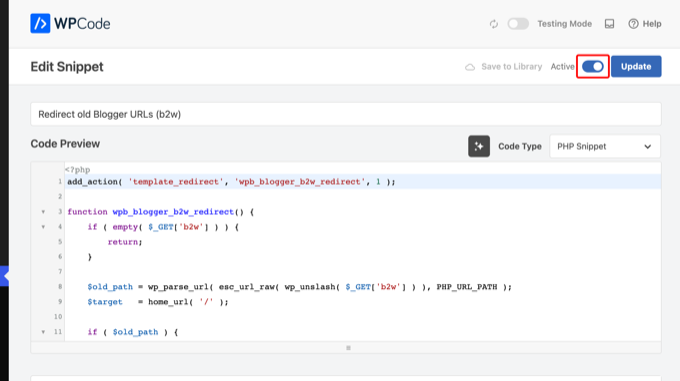
After installing WPCode, go to Code Snippets » + Add Snippet. Hover over ‘Add Your Custom Code (New Snippet)’ and click ‘Use snippet’.
Choose ‘PHP Snippet’ as the code type, give your snippet a name, and paste the following code:
add_action( 'template_redirect', 'wpb_blogger_b2w_redirect', 1 );

function wpb_blogger_b2w_redirect() {
	if ( empty( $_GET['b2w'] ) ) {
		return;
	}

	$old_path = wp_parse_url( esc_url_raw( wp_unslash( $_GET['b2w'] ) ), PHP_URL_PATH );
	$target   = home_url( '/' );

	if ( $old_path ) {
		$matches = get_posts( array(
			'post_type'           => array( 'post', 'page' ),
			'post_status'         => 'publish',
			'posts_per_page'      => 1,
			'ignore_sticky_posts' => true,
			'meta_key'            => '_old_permalink',
			'meta_value'          => $old_path,
		) );

		if ( $matches ) {
			$target = get_permalink( $matches[0] );
		}
	}

	wp_safe_redirect( $target, 301 );
	exit;
}
This code reads the old Blogger address that your Blogger theme will pass along, looks up the matching post or page that BtW Importer saved, and sends the visitor there with a 301 redirect. If nothing matches, it sends them to your homepage instead of a 404 error.
Below the code box, set the Insertion method to ‘Auto Insert’ and the Location to ‘Frontend Only’. Then switch the toggle at the top to Active and click the ‘Save Snippet’ button.
2. Replace Your Blogger Theme With the Redirect Code
Next, log in to your Blogger dashboard and go to the Theme page. Click the down arrow next to the ‘Customize’ button, and then select ‘Edit HTML’.
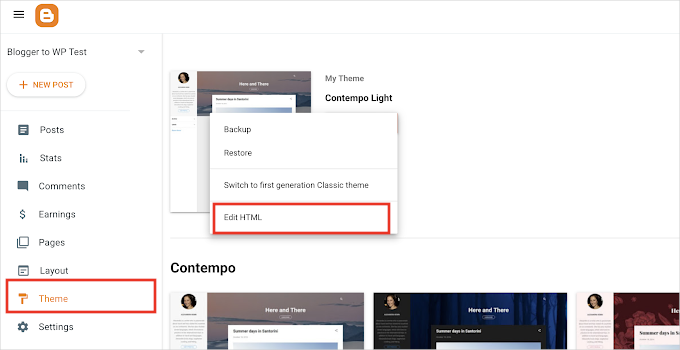
Blogger will now display the HTML code of your theme.
Before you delete anything, copy ALL of the existing Blogger theme HTML and save it to a text file on your computer as a backup.
Once you have backed up the original theme code, delete everything in the editor and paste the following code. Replace https://example.com with your new WordPress site’s address in all four places:
<?xml version="1.0" encoding="UTF-8" ?>
<!DOCTYPE html>
<html b:version='2' class='v2' expr:dir='data:blog.languageDirection' xmlns='http://www.w3.org/1999/xhtml' xmlns:b='http://www.google.com/2005/gml/b' xmlns:data='http://www.google.com/2005/gml/data' xmlns:expr='http://www.google.com/2005/gml/expr'>
<head>
<b:include data='blog' name='all-head-content'/>
<title><data:blog.pageTitle/></title>
<link expr:href='"https://example.com/?b2w=" + data:blog.url' rel='canonical'/>
<meta expr:content='"0;url=https://example.com/?b2w=" + data:blog.url' http-equiv='refresh'/>
<script type='text/javascript'>
//<![CDATA[
window.location.replace('https://example.com/?b2w=' + encodeURIComponent(window.location.href));
//]]>
</script>
<b:skin><![CDATA[
body { font-family: Arial, sans-serif; text-align: center; padding: 40px; }
]]></b:skin>
</head>
<body>
<b:section class='main' id='main' showaddelement='no'>
<b:widget id='Blog1' locked='true' title='Blog Posts' type='Blog' version='2'>
<b:includable id='main'>
<p>This blog has moved. <a expr:href='"https://example.com/?b2w=" + data:blog.url'>Click here if you are not redirected.</a></p>
</b:includable>
</b:widget>
</b:section>
</body>
</html>
This theme code does three things. It tells search engines that each old page has a new canonical address, uses a meta refresh tag to send them to that page, and redirects human visitors with a small script.
All three point at the WordPress snippet from the previous step, which then forwards to the exact post.
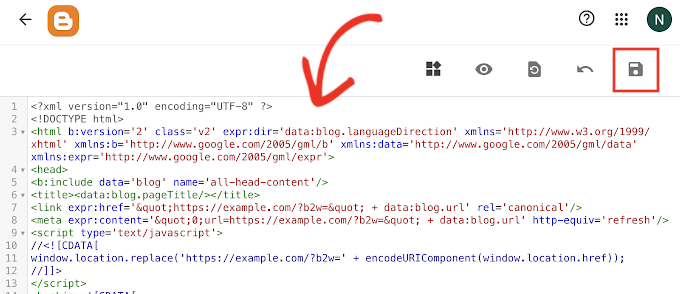
Don’t forget to click the ‘Save’ button to store your changes.
Older Blogger themes also serve a separate mobile version of your blog, and that version ignores the code you just pasted.
To turn it off, click the same down arrow next to the ‘Customize’ button and select ‘Mobile settings’.
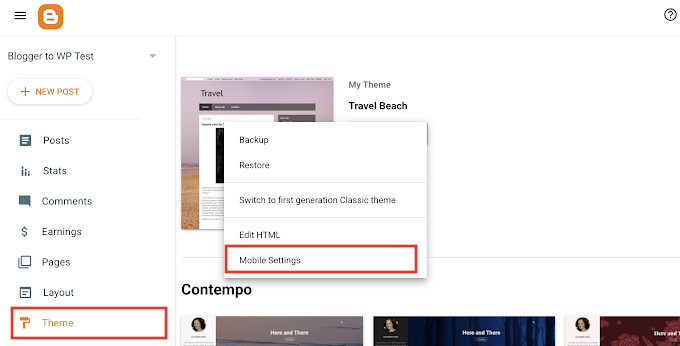
In the popup, choose the ‘Desktop’ option and click ‘Save’. If you don’t see ‘Mobile settings’, your theme is already responsive, and you can skip this.
Now test it. Open one of your old Blogger post URLs in a private browser window, and within a second you should land on the same post on your WordPress site.
3. Redirect Blogger’s ?m=1 Mobile URLs
When someone opens your Blogger blog on a phone, Blogger adds ?m=1 to the end of the address, and Google often indexes these mobile addresses alongside the normal ones.
In our tests, that small addition caused a real problem. WordPress uses m as its own parameter for date archives, so a request for yourblog.com/?m=1 or yourblog.com/post-title/?m=1 returns a 404 error page.
The fix is a second WPCode snippet that sends every ?m=1 and ?m=0 request to the clean URL with a 301 redirect. Create another PHP snippet in WPCode, just like you did above, and paste this code:
add_action( 'template_redirect', 'wpb_redirect_blogger_mobile_urls' );

function wpb_redirect_blogger_mobile_urls() {
	if ( ! isset( $_GET['m'] ) || ! in_array( $_GET['m'], array( '0', '1' ), true ) ) {
		return;
	}

	wp_safe_redirect( remove_query_arg( 'm' ), 301 );
	exit;
}
Scroll down a little and set the Location to ‘Frontend Only’, switch the snippet to Active, and click ‘Save Snippet’.
In our test, opening the homepage and a post URL with ?m=1 at the end both sent us straight to the clean URL.
Step 6: Moving Other Content From Blogger to WordPress
With your content moved and the redirects in place, it is time to check the pieces that need a manual touch. Below are five things to look at, and how to handle each one.
1. Pages
BtW Importer moves your Blogger pages, like About and Contact, into Pages » All Pages, and it redirects their old /p/ addresses too. Open each one to check the formatting, and add them to your WordPress theme’s navigation menus.
You might also want to check out our list of important pages every WordPress blog should have, so you don’t miss anything Blogger never had.
2. Widgets
Like Blogger, many WordPress themes use widgets to add content to your blog’s sidebar. To add them, visit the Appearance » Editor page for block themes and Appearance » Widgets page for classic themes.
For detailed instructions, see our guide on how to add and use widgets in WordPress.
If you are looking for a widget that WordPress does not have by default, then you likely need a plugin. WordPress has over 72,000 free plugins, so see our beginner’s guide on how to choose the right WordPress plugin.
3. RSS Feeds
People who follow your blog through RSS feeds will still be able to find your blog. However, they will not get any new content until you point the old feed to the new one.
To fix this, go to the Settings page in your Blogger dashboard. Scroll down to the ‘Site feed’ section and click ‘Post feed redirect URL’.
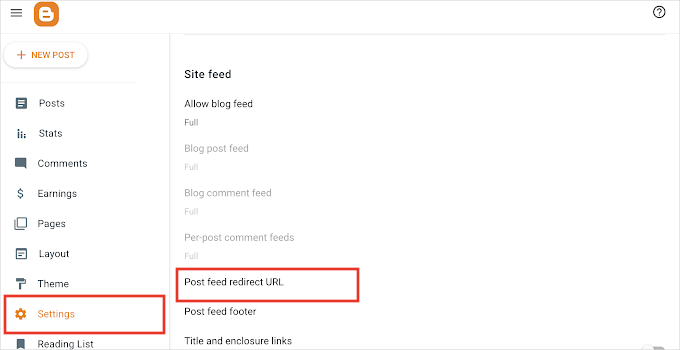
This will bring up a popup where you need to add the RSS feed URL of your WordPress website. Your WordPress feed URL will look like this:
http://example.com/feed
Don’t forget to replace example.com with your own domain name.
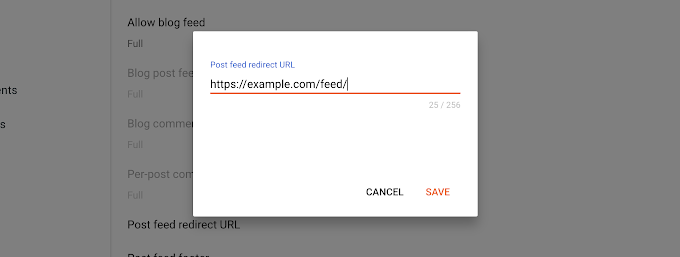
Click the ‘Save’ button to add the URL and save your settings.
4. Images
BtW Importer already downloaded the images that Google hosted for you into your media library and updated your posts to use them. Open Media » Library to see them.
If the plugin missed a few images, or you had images hosted elsewhere, our guide on how to import external images in WordPress shows a plugin that finds and downloads them.
The Google Takeout archive from Step 2 is your safety net. Its Albums folder contains a copy of every image you ever uploaded to Blogger, in original quality.
Step 7: Verify Your Migration in Google Search Console
Now that your content is in place, it is time to let Google know about the change. This step helps Google find your new site faster and protects your search rankings.
Here’s what you need to do:
- Add your new WordPress site to Google Search Console. If you haven’t already, follow our guide on how to add your WordPress site to Google Search Console.
- Submit your new XML sitemap. Submit your sitemap URL in Google Search Console so Google can discover all your new URLs. For step-by-step instructions, see our guide on how to create a sitemap in WordPress.
- Monitor your 404 errors. Over the next few weeks, keep an eye on the Pages report in Google Search Console to catch any 404 errors. If you spot broken URLs, set up additional redirects for them. You can do that with the free 404 to 301 redirect manager plugin.
- Install Google Analytics. To track your traffic with Google Analytics after the migration and make sure everything is working, we recommend installing MonsterInsights. For more information, see our guide on how to install Google Analytics in WordPress.
Step 8. Things to Do After Migrating From Blogger to WordPress
Your blog is now on WordPress, and your redirects protect your rankings. Three tasks are worth doing in your first week.
- Pick a fast theme. Your Blogger design does not transfer, so choose a lightweight theme that loads quickly on phones. Our list of the best free WordPress blog themes is a good place to start.
- Install the essential plugins. An SEO plugin, a contact form, and a backup plugin cover most blogs. See our list of must-have WordPress plugins.
- Set up backups. On Blogger, Google looks after your content. On WordPress, you are in charge, so pick one of the best WordPress backup plugins and schedule automatic backups.
Frequently Asked Questions About Switching From Blogger to WordPress
Is anyone still using Blogger?
Yes. Blogger is still online, and Google has not announced any plans to close it.
However, it only gets a few new features these days, and Google has now folded even its backup tool into Google Takeout.
Most bloggers who want to grow their blog move to WordPress because it’s easy to customize the appearance and extend its features.
What happens to my old Blogger blog after migration?
Your old Blogger blog will still exist after the migration. In fact, you need to keep it active, because the redirect code in your Blogger theme is what sends visitors to your new WordPress site.
Don’t delete your Blogger blog, as that would remove the redirects and cost you traffic.
We hope this article helped you switch from Blogger to WordPress without affecting your Google search rankings. You may also want to see our guide to which WordPress plan you should use or the most common WordPress myths debunked.
If you liked this article, then please subscribe to our YouTube Channel for WordPress video tutorials. You can also find us on Twitter and Facebook.




Mini
This useful even for moving free blog on blogspot to free blog on wordpress?
And will it transfer previously received comments too?
Katheriine
I have a problem with all of my pinterest pins stopping at a blogger page saying “this blog is no longer hosted by blogger do you wish to be redirected?” and you have to choose yes or no and obviously people usually just exit out or hit no so it’s killing my page views. Any help??
Susann
I don’t have the export blog (or import) button on my blogg. Only the Delete button. Did they take this away, how can I export my blog now? Or do I need to change anything somewhere else to get it to show up?
Eli
Hi, I don’t can’t use permalinks with /month/day, i need to use /blog-post-title.
is there a way to modify the php code, to get a proper redirect?
WAHEED HABIB
Dear Author, thank u so much for such a great help in transferring blogger data to wordpress theme. But redirection woud;nt work for me rather i use simple Blogger to WordPress Redirection plugin a very simple and easy to use tool i just love it. I have redirect my blogger site to WordPress.
Mallory
Hi! Thank you so much for this helpful guide!!
I’ve done everything as you explained and redirection works but I get this message on top of my wordpress: Notice: Undefined index: blogger in /var/www/vhost/example/home/html/wp-content/themes/betheme-child/functions.php on line 94
I therefore went and checked line 94 and this is the one: $blogger = $wp_query->query_vars[‘blogger’];
would you be able to help me?
Thank you so much
Patricia
Hi, currently trying to follow your instructions but I keep getting this message when I try to save the blogger redirection code in reference to the blog page title line.
“Error parsing XML, line 3, column 9: The content of elements must consist of well-formed character data or markup.”
Please help?
JC
Glad i found this. I’ve been so afraid to move my blog from blogger to W/P. One question: Do my followers on blogger also go with me?
Also, is there a way (don’t know what it’s called) to let those that come to your blogger site know that you’ve moved to W/P?
WPBeginner Support
If by followers you mean those who used Google ID to follow your blogger blog, then no.
Yes, using this method, people arriving at your blogger site through other sources will be properly redirected to your new site.
Admin
Lindsey
So helpful. However, when I refresh after all the steps, I get the 2nd code we pasted showing at the top. Am I missing something? It is even showing in my WP Admin dashboard!!
WPBeginner Support
It seems you pasted the code after a closing ?> php tag. You can paste the code again before the closing php tag or add this tag at the beginning of the code
<?phpAdmin
Katelyn
I am having the hardest time converting from BlogSpot to Word Press. For some reason I don’t know if it’s the browser I’m using or what but when I go to Settings –> Other —> to import and backup or backup content (those are the only two options it give me) I don’t have an export blog option. I’m getting ready to just freakin pay someone to do it!
Huda
What about the design theme? can I change it to wordpress theme?
Sy Abuzar
Hello. Brother.
This is Very Useful Article Amazing and Mind Blowing Guidelines Step by Step, I like It Thanks a lot,
Have a Nice Day Ahead
Febriyan
I had tried all the steps there and if I opened my blogspot blog on my computer, it worked just fine. It redirected automatically to the new domain on wordpress. But if I use my phone or asked my friend to access the blogspot, it didn’t do anything. No redirection at all.
Can you help me on this?
my blogspot is
Erin
Thank you for your post, super easy to follow and felt confident importing my blog. Though alas and alack I had trouble with the images, they didn’t import. I then followed your extra assistance for that scenario but whilst some imported to media library, some didn’t, and none are showing as featured images.
Any tips would be greatly appreciated.
collins
Thanks it helped,,Please i’ll love to talk 2 privately here is my mail address.
WPBeginner Support
Please use our contact page to send us private mail.
Admin
Mercedes
Thank you! This was super helpful.
Having a little trouble with the second code though. I have no idea how to even access the file I need to paste the code into?
WPBeginner Support
It goes in your theme’s functions.php file. Go to Appearance page in your WordPress admin area, and note the name of your active theme. Connect to your website using an FTP client, go to /wp-content/themes/your-active-theme-folder/ and there you will find functions.php file. Download it to your computer and open it with a plain text editor like Notepad. Paste the code at the end of this file. Save the file and upload it back to your theme folder using FTP.
Admin
Biz Harris
oh gosh, this was super helpful, but ONE note… maybe in the section about entirely changing the blogger code, be SUPER specific that you should change every “http://example.com” to your blog address AND that “www” beforehand isn’t necessary. I tried several iterations before I got this to work for me (and had a couple of panic attacks in the meantime.) anyway, thanks again from this VERY novie workpress beginner!
Nicole
This was such a helpful blog post. So many people offer too much information or not enough, but you walked me straight through it! Thank you! I used Thad’s advice to get the mobile views to redirect. That worked.
My only problem now is that I can’t get my “pages” to redirect. They didn’t export/import, so I created new pages, with new names. Can I redirect these 15 pages manually in some way? or at least have a user redirected to my new home pages? Right now they are getting the message that “page you were looking for…does not exist.”
Thank you again! You have been so helpful!
Jwphoto
I’m having this same issue. When I google my blog name these old blogger pages (these were my menu items, not posts) show up. I can’t find a way in blogger to change the url. Is there a way to redirect these individual pages or change their url? Deleting these blogger pages would be bad for SEO, right?
Pascale
Hello, can you confirm where we should paste the 2nd code in function.php? I have read the Beginner’s guide to pasting snippets from the web into wordpress and it is still not clear.
Thank you so much for your help!
WPBeginner Support
It needs to go in your WordPress theme’s functions.php file. You can paste it at the very end of that file.
Admin
Vinayak SP
Above code not worked fully until you do this :
Configure Permalinks on New WordPress
From WordPress Dashboard, go to Settings -> Permalinks and select Custom Structure option and paste the following value next to it and save changes.
/%year%/%monthnum%/%postname%.html
Jas
Hello Syed,
1.
a) I notice in this article you specify the Permalink Settings as follows.
“choose Month and Name”
b) However in your How to “Move Custom Domain Blogger Blog to WordPress” your specify Permalink settings differently in custom format.
“/%year%/%monthnum%/%postname%.html”
2. I did not see the second article until I had already done the migration. I used a) above, then after the migration was complete, I changed it to b) above.
Why the difference between the two? Did I create a problem by beginning with a) then changing to b)? The Google search links seem to link correctly from old posts to new. Is there another factor I am not considering?
Thanks for your time,
Jas
urgent, priority
Tawnya
I have a question on where you copy the 2nd code on redirecting to wordpress do I just copy the code at the bottom of the functions.php file or is there a specific place on that page to copy the code??
Tawnya
I understand all of this except where do I paste the code in wordpress when you say this?
***However, you still need to setup redirection on your WordPress site so that users are redirected to the proper posts.
You need to copy and paste the following code in your WordPress theme’s functions.php file***
Do I just copy that code you provided at the bottom of this section on my wordpress or do I need to make sure it goes in a specific spot??
I hope that makes sense. Thanks for this tutorial
WPBeginner Support
Yes you need to copy the code in the bottom section and then paste it in your WordPress theme’s functions file. Check out beginners guide to pasting snippets from the web into WordPress
Admin
Tawnya
Where in the functions.php do I copy the second code though? I am still confused where that code is supposed to go?
Zara
I can’t find tools or anything in wordpress. Did they update it?
WPBeginner Support
Nope.
Admin
Amy Hunt
I can’t find tools in WP either..Publish, Personalise,Configure those are the only categories?
Lyssa
Thank you for this helping tutorial
i have been read almost full of your blog it’s very informative and helpful
WPBeginner Support
Thanks for the kind words.
Admin
Carla Mota
You are the best!! Thanks
Millo Magnocavallo
Add to previous comment …
I just looked at the source version of the text that’s been imported and in some cases the img tag is appearing like this:
for some reason it’s not printing out the src?
Paul Wentzell
This happens for me, also. I do see that the images for those posts downloaded to the site directory, but it’s curious why they were not inserted into the src of the post.
Millo
Hey! Thank you so much for a great tutorial / how-to. It worked really well, only that I’ve noticed that some images are not appearing in the imported blog posts. Do you have any idea why that might be?
Sharaj Khan
what about blogger to blogger ??????
Sam
easy, just backup template and then upload it on the other blog
Olsi
I followed this guide and it worked very well, but I did a redirect test and it says 302 Moved Temporarily and not 301 as it should be.
I`m I doing something wrong? Anybody else did a redirect test?
Paul
I’m also seeing a 302 from any redirect checker tool I am using. All links are indeed redirecting correctly, but 302 is making me uneasy.
Gianluca
Hi, is it possible to import only several posts from the older blog, instead the entire blog?
Thales
I found a work around…
I have replaced the code (line 11):
window.location.href=”http://example.com/?blogger=”
by the following 3 lines:
var str = “”;
var url_old = str.substr(7);
window.location.href=’http://pequenospelomundo.com.br/?blogger=’+url_old;
It works fine and seems that I have kept my google rankings.
Joel
I’m considering this option but am getting stuck on step #1. When I export an xml file from Blogger, the resultant file only includes 200 of my 1030 posts. Why? And what can I do to actually back up ALL of my blog.
Wordpresser
Do you still need to redirect the blogger blog to the wordpress domain if the URL structure including domain, date, article name and .html ending of the URL will all be exactly the same on Wordpress as they are on Blogger?
Shelly
I have downloaded the blogger blog and am trying to import the file. It appears to be uploading but then I get the following error: Warning: Invalid argument supplied for foreach() in /home/content/p3pnexwpnas06_data02/87/2994987/html/wp-content/plugins/blogger-importer/blogger-importer.php on line 227
The blogger blog has almost 2,000 posts. Could the size be the problem? I’m afraid I am a complete newbie and am following directions step-by-step.
Kinshuk
Hi,
I am facing the similar issue to Shelly where I am getting following error:. I have around 2000 posts in blogger xml.
Regards.
Emilie
Thank you so much for such an informative and helpful video! I am totally a code newbie, but with your fantastic instructions, even I was able to get my blogger account to automatically send viewers over to my new domain. I only have one problem– and I think it has to do with the second set of code you had me post into the when the function.php file in wordpress. Rather than redirecting users to the specific article that they are attempting to reference in blogger, it just redirects to my entire, overall website. How can I fix it so that users who are clicking on old pinterest pins, etc, receive the recipe that they are looking for, rather than just a generic site where they have to search for the recipe they want? Thanks.
Fachreza
this is legal for blogger and wordpress ???
Michelle Dear
Yes. You own your data. You have the right to port it between tools.
Jericho
Thanks for this tutorial. I have a question, I am using custom domain in my blogger blog and this is the same domain I am going to use in WordPress. Do I have to disconnect the custom domain first and use the “blogspot.com” before heading to migration of my blog? If so, this will affect on my google rankings?
WPBeginner Support
Please see our guide How to move custom domain blogger blog to WordPress
Admin
Julia Taylor
Do you advise deleting the old blogger blog once the site is redirecting properly? Or should we wait for a certain period (if so, how long?)? Or is it best to leave it up for any reason?
WPBeginner Support
It is a free blog, why delete it if its not hurting your rankings? But if you must delete it, then we would recommend waiting for at least 6-12 months.
Admin
Julia Taylor
Well I guess I am not 100% confident we aren’t going to get hurt for duplicate content, since we are still seeing activity in the “Stats” tab. How do I test to make sure that is not going to happen?
Jason Booth
The 301 redirect and canonical tag should alleviate the fear about duplicate content but what I’ve found that this technique is not redirecting mobile traffic.
Mobile users are getting a different template on Blogger and not being redirected to the new site. I’ve been looking into it but have yet to find how to disable or change the template served to mobile devices.
Thales
I had the same issue (mobile users still accessing blogger). I have disabled mobile version in blogger and works fine.
Log in to blogger; go to template; click ‘update template’; on the top of the page you have the mobile preferences. Click and disable mobile version; then click back in ‘Revert to classic template’ – Done!
Julia Taylor
I am glad Jason pointed out the issue that mobile users are not being redirected. Can you guys please help us figure this out? I need the blog posts on mobile to also be redirecting to the new site, which they are not.
Julia Taylor
Oops, I missed the comment from Thales. Just did that, and it appears to be working. Thank you Thales!
Jason Booth
Thanks, Thales! Fixed it for me as well.
Julia Taylor
I followed all your instructions and everything seems to be working just fine, but we are still seeing some page views in the old Blogger site’s stats tab. Is it tracking the pages/posts that are redirecting to the new self-hosted WP site? Or is something not set correctly?
WPBeginner Support
Your blogger blog is not just visited by humans but also by many bots, crawlers, automated scrips, etc. Some of these bots may request a cached version of your blog this will generate a page view in Blogger’s stats. You can see the device information in your stats tab for that particular day.
Admin
Samantha
I’m trying to redirect my blog to my new wordpress site, but I’m turning all my blog posts into knowledge base articles.
How would I modify the code so that oldblog.blogspot.com/month/day/postname redirects to example.com/knowledgebase/postname
The “/knowledgebase” part is automatically added by the plugin I’m using and is not part of the permalinks structure.
WPBeginner Support
You can switch the post type to knowledgebase. We are not sure what kind of affect it will have on redirects. Its best if you test it on a local install with demo blogspot blog first.
Admin
Ketan
This was probably the easiest explanation of migrating from blogger to WP that I found till date. Thanks for posting. The redirect bit – that is something to do carefully.
Kim Brookes
I wrote a bit ago. You should probably ignore what I wrote because for some reason now it’s working. It’s either working now because I copied the snippet for the blogger template again, and changed the “example.com”s again. Or, because the links embedded on my WP site posts (that were ported from blogger) still have the blogger URLs, which WP interprets by substituting .blogger.com with my.new.url, which goes 404 on WP.
That is, in case it’s helpful, the post that was on blogger, now WP:
included a link in the text to
which somehow in the migration, or me doing something wrong, got changed into
and that’s a URL that doesn’t exist (WP with a .html instead of /)
So, mostly thanks for your awesome site. And ignore my previous comment.
-Kim
WPBeginner Support
We are glad you successfully migrated your website.
Admin
Kim Brookes
Awesome site you have here! I’ve used all sorts of the articles.
I’ve followed all of the instructions on this “how to switch” page. Most of it is working, but the old links on Blogspot aren’t redirecting to my new domain. They’re going to a 404. This is because the old blogspot URLs end in .html, and the new WordPress URLs end with the post_title/
as though it’s a directory instead of old-fashioned .html file. I think the issue is with the WP function code, but I don’t know the coding well enough to guess at how to make WP redirect to a (delete the slash, add “.html”) URL.
Nor do I know how to add the coding to the WP permalink page. I don’t want to mess with this, though because I don’t want “.html” added to all of my new posts. For now, the only think I can think to do is to change the permalink individually on all of my migrated-to-WP blogspot posts. Yuck.
Thanks for any help you can provide.
Julia Taylor
Thank you SO MUCH for this post…it really helped me! I do have a question. Is it possible to redirect the main blog address to a page on the site? The reason I am asking is because the new blog is just part of site, and redirecting blog reader to the homepage might be confusing. So can can I redirect example.blogspot.com to http://www.example.com/blog/, instead of http://www.example.com? I am a little nervous to go messing with your beautiful redirect code as I do not want to mess it up! Thanks so much!!!
WPBeginner Support
Yes, you can do that.
Admin
Christene
Before I begin doing this, I need to know something: Once all the content on my Blogger site is imported to WordPress…will all the imported posts automatically go live? Or will they import as a draft status? I wouldn’t want them to go live yet. The reason for the migration would be a stand-by thing, in case Blogger deletes my blog (they’ve already deleted two without any pre-notice to me, claiming they had spam), so I’m afraid they’re going to pull this stunt on my remaining blogs.
So as a pre-emptive, I’d like to install WP, set it up and import, but keep all the imported content in draft status as long as my blogs are still up. If Blogger notifies me they took down my other main blog, then that’s when I’d switch the WP draft status to published. Will someone please let me know about this? I’d hate to have my articles live on BOTH sites at the same time.
WPBeginner Support
All imported posts will go live.
You can go to Posts and click on the screen options button on the top right corner of the screen.
Under number of posts to show, select a number higher than the expected number of posts you think you might have. Click on the apply button.
WordPress will now show all your posts. On the top right corner of the posts list, you will find a checkbox to select all posts visible on screen.
After selecting all your posts, under bulk actions drop down menu, select Edit and then click on apply button next to it.
WordPress will now show you bulk editing options. Click on drop down menu next to Status section and then select Draft. Finally click on the update button. All your posts will now become drafts.
Admin
Tiffany MacBain
I followed the steps to import to WordPress from Blogger and received the message (on WP) that the import was in progress. How long does the import process take? It’s been 30 minutes so far, and I see none of my Blogger posts on WordPress. Thanks!
Laura McKissack
I wish I had come across this article a long time ago! I can’t believe I just crossed this off my to-do list in ten minutes. I’ve been putting it off forever because I thought it would be hard, ha. Now I have to figure out how to recover all the media files blogger has lost from my old blogs Any advice there?
Christene
I can’t believe you did this in only 10 minutes, Laura. It would take me at least 10 minutes just to READ through the instructions. And the images of all the HTML coding? And what to do with it? This looks as hard as the dickens.
Shakir
Thanks for the great tutorial .
But i want to ask that i also want to migrate blogger blog to wprdpress but i have to use the same domain name on wordpress , so what should i have to do for the proper redirection of posts to the new post urls so that the exact post url which is ranking in google should redirect to exact same post of wordpress ?
mahesh
Hello ty for such a great article. I want to migrate my blog to WordPress. The template which I m having right now will it available after migration or I Will have to use other?? And if I loose that template then how can I insert new theme in WordPress?
Plsss reply waiting for you
WPBeginner Support
No Blogger templates are different than WordPress. However, you should be able to easily find a much better theme for your WordPress site.
Admin
mahesh
I have already bought domain from godadday , now if I migrate to WordPress then how will I can use that in word press? I mean how will I able to transfer domain to WordPress? Pls repl
WPBeginner Support
You will need WordPress hosting. Once you have signed up for a hosting account, you will need to edit your domain settings on GoDaddy. Under domain settings locate Name Servers and then change them point to your new WordPress host.