


“Will I lose my Google rankings if I move from Blogger to WordPress?” That’s the first question we hear from anyone thinking about making the switch.
We get it. However, after helping many bloggers make this move, we can say with confidence that you can switch from Blogger to WordPress without losing your Google rankings.
In this guide, we’ll show you the exact steps we use, from exporting your Blogger blog to setting up the redirects that protect your search traffic.
Quick Summary: Switching from Blogger to WordPress requires exporting your Blogger content, importing it into a self-hosted WordPress site, and redirecting the old URLs to your new site.
Estimated time: 1 to 2 hours for a small blog.
Tools: Free BtW Importer plugin and two short code snippets.
Cost: The migration costs nothing. You’ll still need to pay for hosting and a domain name.
WordPress.com vs. WordPress.org: What’s the Difference?
There are two types of WordPress, and this guide uses WordPress.org, also known as self-hosted WordPress. WordPress.com is a hosted service where you cannot install plugins on the free plan. You’ll need to upgrade to a paid plan to unlock plugins and follow this tutorial.
For a full breakdown, see our comparison of WordPress.com vs. WordPress.org.
That being said, let’s take a look at how to move from Blogger to WordPress while keeping your Google rankings and traffic. Here are the steps we’ll cover:
- Step 1: Sign Up for WordPress Hosting
- Step 2: Export Your Blogger Blog
- Step 3: Import Blogger to WordPress
- Step 4: Setting Up Permalinks
- Step 5: Set Up Redirects From Blogger to WordPress
- Step 6: Moving Other Content From Blogger to WordPress
- Step 7: Verify Your Migration in Google Search Console
- Step 8. Things to Do After Migrating From Blogger to WordPress
- Frequently Asked Questions About Switching From Blogger to WordPress
Step 1: Sign Up for WordPress Hosting
To get started with WordPress, you will need a domain name and web hosting. A domain name is your website’s address, and web hosting is where your website files live.
You can choose any WordPress hosting provider that you want, like Bluehost or Hostinger. Both are officially recommended WordPress hosting providers and offer a free domain name for the first year.
For this tutorial, we used Bluehost, which automatically installed WordPress when we signed up, so we were able to log into our new site right away.
Step 2: Export Your Blogger Blog
Now that your WordPress site is ready, the next step is to export your content from Blogger.
Log in to your Blogger account, pick your blog, and click Settings in the left menu. Scroll down to the ‘Manage blog’ section, click ‘Back up content’, and then click ‘Download’.
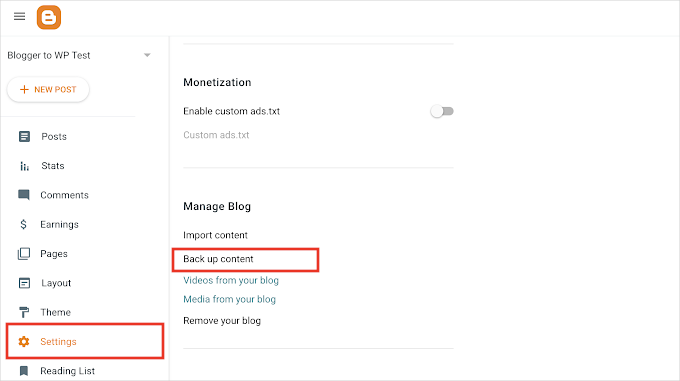
Blogger no longer downloads an XML file straight away. Instead, the Download button now opens Google Takeout, which is Google’s tool for downloading your data, with Blogger already selected.
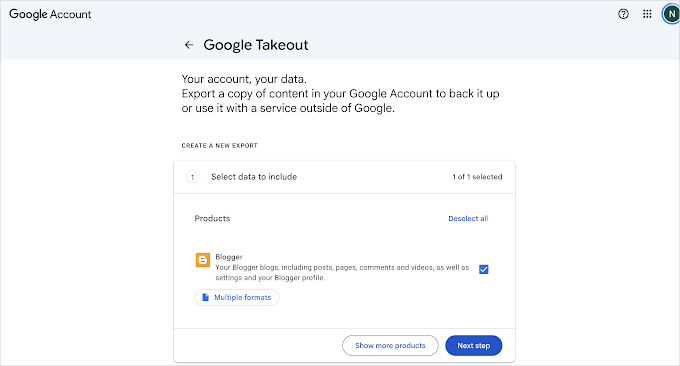
Click ‘Next step’, keep the default settings, and click ‘Create export’.
Google will email you when the export is ready, which usually takes a few minutes for a small blog.
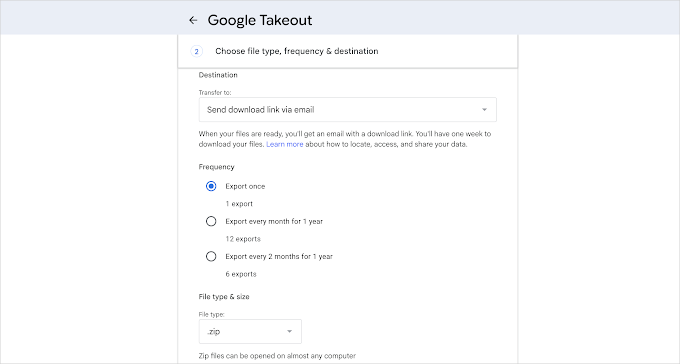
Click ‘Download archive’ in that email and save the .zip file to your computer.
Next, unzip the file. Open the Takeout folder, then Blogger, then Blogs, and then the folder with your blog’s name.
The file you need is called feed.atom. It holds your posts, pages, and comments.
If Takeout splits your export into more than one .zip file, check each one for a feed.atom file. You will import them one after another in the next step.
Note: Keep a copy of the whole archive in a safe place, like cloud storage or an external drive. It is your backup of the original blog. The Albums folder inside it holds every image you ever uploaded to Blogger, which we come back to in Step 6.
Step 3: Import Blogger to WordPress
With the feed.atom file on your computer, you can now import your content into WordPress.
WordPress comes with a default Blogger importer, available on the Tools » Import page in the admin area. However, that importer has been broken since July 2025. That is when Google moved Blogger backups into Google Takeout and changed the file format at the same time.
Luckily, there are alternative plugins you can use.
- BtW Importer – This is the plugin we’ll be using in this tutorial. It imports posts, pages, images, and even set up redirects. The downside is that it doesn’t import comments.
- Blogger Importer Extended – Imports posts, pages, images, and comments, but the free version is limited to 20 posts. You can use this if you have fewer posts or if you want to import comments.
First, install and activate the BtW Importer plugin. For more details, see our step-by-step guide on how to install a WordPress plugin.
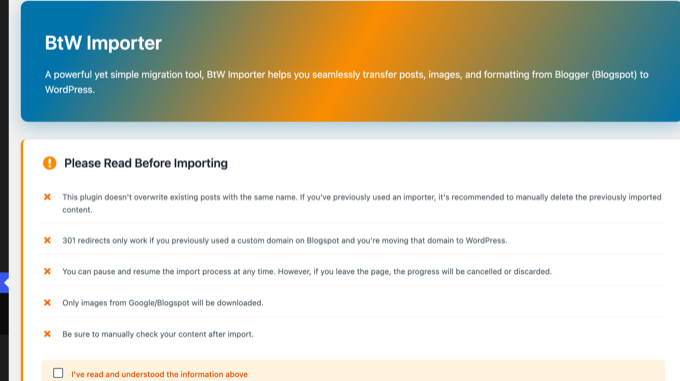
Upon activation, click the new BtW Importer item in your WordPress admin menu. The page starts with a short list of things to know before you import.
Read it, then tick the ‘I’ve read and understood the information above’ box.
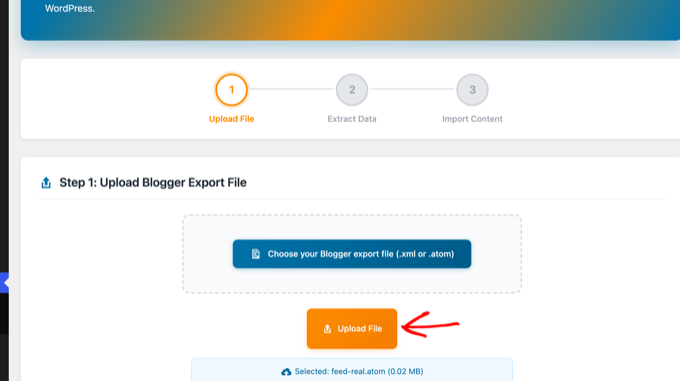
In Step 1, click the ‘Choose your Blogger export file’ button and select the feed.atom file. Then click the ‘Upload File’ button.
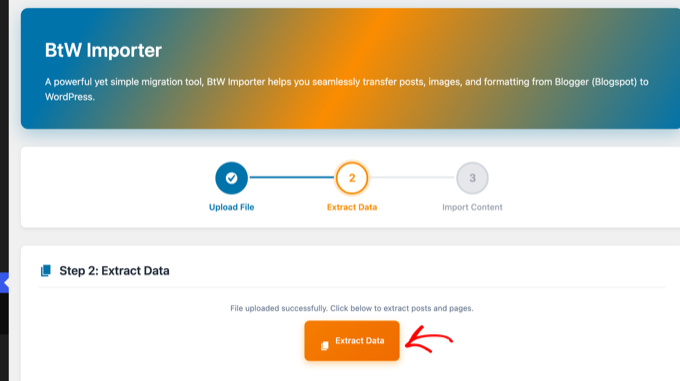
In Step 2, click the ‘Extract Data’ button. The plugin reads the file and counts your posts and pages.
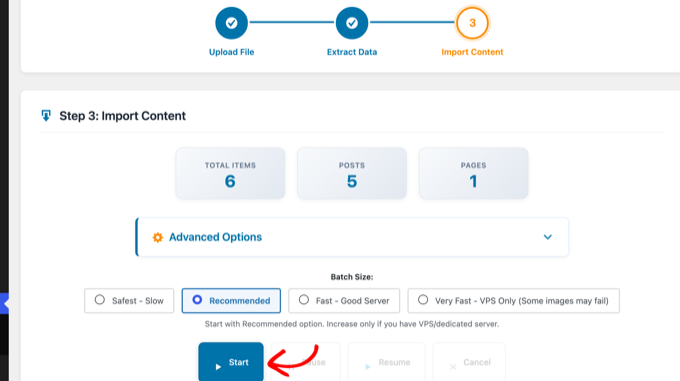
Step 3 shows how many items it found. The ‘Advanced Options’ panel lets you keep the original Blogger author for each post, and it has an experimental option to convert the old Blogger HTML into WordPress blocks.
We recommend leaving that option unchecked for your first run, because you can always convert posts to blocks later in the editor.
Leave the batch size on ‘Recommended’ and click the ‘Start’ button.
The plugin imports your posts and pages, downloads every image hosted on Google’s servers into your media library, and rewrites the image links inside your posts to the new copies.
It also records the old Blogger address of each post, which we use for the redirects in Step 5.
A progress log shows each item as it comes over, and you will see a ‘Congratulations!’ message when it finishes.
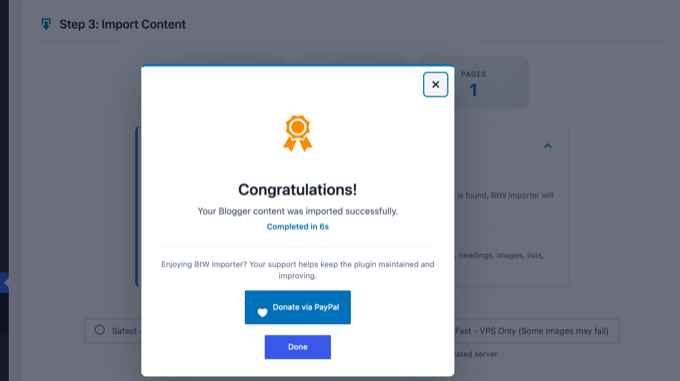
You can now check your content under Posts » All Posts and Pages » All Pages. Blogger labels become WordPress categories, drafts stay drafts, and the first image in each post becomes its featured image.
Step 4: Setting Up Permalinks
Now that your posts are in WordPress, let’s talk about their web addresses. Permalinks is the WordPress term for the URL structure of your posts and pages.
Blogger post URLs look like this: https://yourblog.blogspot.com/2026/08/post-title.html.
The BtW Importer plugin saved the old address of every post and page in a redirect map. Whenever a request for an old address reaches your WordPress site, the plugin sends it to the matching new post.
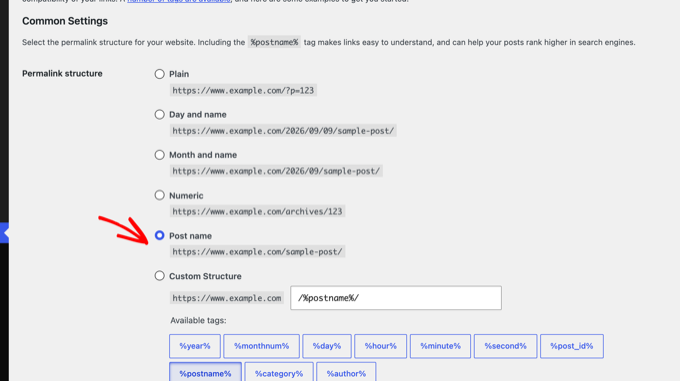
So keep WordPress’s default setting. Go to Settings » Permalinks and check that you have the ‘Post name’ option selected.
This setting gives you clean, SEO-friendly URLs like yourblog.com/post-title/.
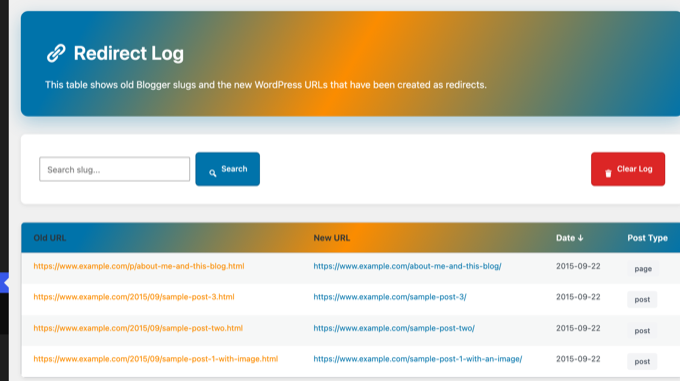
You can see the full list of old and new addresses under BtW Importer » Redirect Log. Every Blogger post and page should have a row here.
To test it, open one of the old addresses on your new domain, such as yourblog.com/2026/08/post-title.html. WordPress should send you straight to the new post.
In our test, the old post and page URLs all returned a 301 redirect to the right place.
This map only works for users that arrive at your WordPress domain. However, since your users and Google don’t know that you have moved, they will continue seeing your old Blogger blog until you finish Step 5.
Step 5: Set Up Redirects From Blogger to WordPress
Now that WordPress knows where every old address should go, it is time for the most important step of the whole migration, which is redirecting users and search engines like Google to your new WordPress site.
A redirect sends anyone who opens one of your old Blogger URLs to the same post on WordPress automatically.
It also sends a 301 status code, which is the code for a permanent redirect. This tells Google that the page has moved for good, so your rankings pass to the new address instead of starting from zero.
⚠️ If your Blogger blog has its own custom domain instead of blogspot.com, you may need to point your domain nameservers to your hosting provider. For instructions, please follow our tutorial on how to switch custom domain blogger blog to WordPress.
Blogger does not let you set up server redirects, so here is the workaround.
First, we add a small code snippet to your WordPress site. It receives the visitors that Blogger sends over, looks up the old address, and forwards them to the right post in WordPress.
Then, add a code snippet to your Blogger theme to send every visitor and search engine from your blogspot.com address to that snippet.
1. Add the Redirect Snippet to WordPress
We recommend adding the snippet with the free WPCode plugin, which is the safest way to add custom code to WordPress. For more details, see our guide on how to copy and paste code snippets in WordPress.
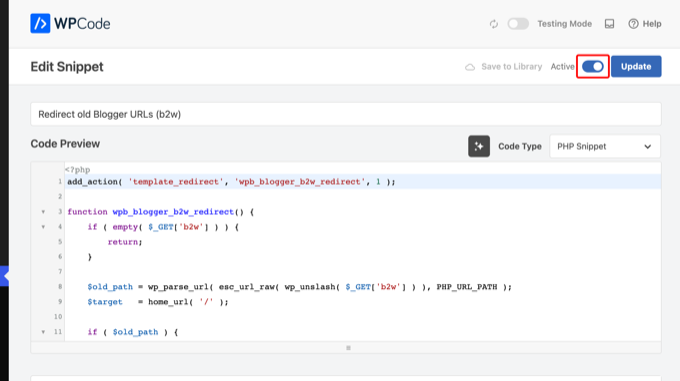
After installing WPCode, go to Code Snippets » + Add Snippet. Hover over ‘Add Your Custom Code (New Snippet)’ and click ‘Use snippet’.
Choose ‘PHP Snippet’ as the code type, give your snippet a name, and paste the following code:
add_action( 'template_redirect', 'wpb_blogger_b2w_redirect', 1 );

function wpb_blogger_b2w_redirect() {
	if ( empty( $_GET['b2w'] ) ) {
		return;
	}

	$old_path = wp_parse_url( esc_url_raw( wp_unslash( $_GET['b2w'] ) ), PHP_URL_PATH );
	$target   = home_url( '/' );

	if ( $old_path ) {
		$matches = get_posts( array(
			'post_type'           => array( 'post', 'page' ),
			'post_status'         => 'publish',
			'posts_per_page'      => 1,
			'ignore_sticky_posts' => true,
			'meta_key'            => '_old_permalink',
			'meta_value'          => $old_path,
		) );

		if ( $matches ) {
			$target = get_permalink( $matches[0] );
		}
	}

	wp_safe_redirect( $target, 301 );
	exit;
}
This code reads the old Blogger address that your Blogger theme will pass along, looks up the matching post or page that BtW Importer saved, and sends the visitor there with a 301 redirect. If nothing matches, it sends them to your homepage instead of a 404 error.
Below the code box, set the Insertion method to ‘Auto Insert’ and the Location to ‘Frontend Only’. Then switch the toggle at the top to Active and click the ‘Save Snippet’ button.
2. Replace Your Blogger Theme With the Redirect Code
Next, log in to your Blogger dashboard and go to the Theme page. Click the down arrow next to the ‘Customize’ button, and then select ‘Edit HTML’.
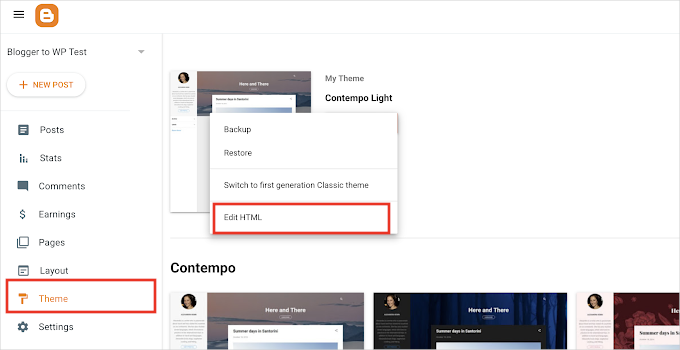
Blogger will now display the HTML code of your theme.
Before you delete anything, copy ALL of the existing Blogger theme HTML and save it to a text file on your computer as a backup.
Once you have backed up the original theme code, delete everything in the editor and paste the following code. Replace https://example.com with your new WordPress site’s address in all four places:
<?xml version="1.0" encoding="UTF-8" ?>
<!DOCTYPE html>
<html b:version='2' class='v2' expr:dir='data:blog.languageDirection' xmlns='http://www.w3.org/1999/xhtml' xmlns:b='http://www.google.com/2005/gml/b' xmlns:data='http://www.google.com/2005/gml/data' xmlns:expr='http://www.google.com/2005/gml/expr'>
<head>
<b:include data='blog' name='all-head-content'/>
<title><data:blog.pageTitle/></title>
<link expr:href='"https://example.com/?b2w=" + data:blog.url' rel='canonical'/>
<meta expr:content='"0;url=https://example.com/?b2w=" + data:blog.url' http-equiv='refresh'/>
<script type='text/javascript'>
//<![CDATA[
window.location.replace('https://example.com/?b2w=' + encodeURIComponent(window.location.href));
//]]>
</script>
<b:skin><![CDATA[
body { font-family: Arial, sans-serif; text-align: center; padding: 40px; }
]]></b:skin>
</head>
<body>
<b:section class='main' id='main' showaddelement='no'>
<b:widget id='Blog1' locked='true' title='Blog Posts' type='Blog' version='2'>
<b:includable id='main'>
<p>This blog has moved. <a expr:href='"https://example.com/?b2w=" + data:blog.url'>Click here if you are not redirected.</a></p>
</b:includable>
</b:widget>
</b:section>
</body>
</html>
This theme code does three things. It tells search engines that each old page has a new canonical address, uses a meta refresh tag to send them to that page, and redirects human visitors with a small script.
All three point at the WordPress snippet from the previous step, which then forwards to the exact post.
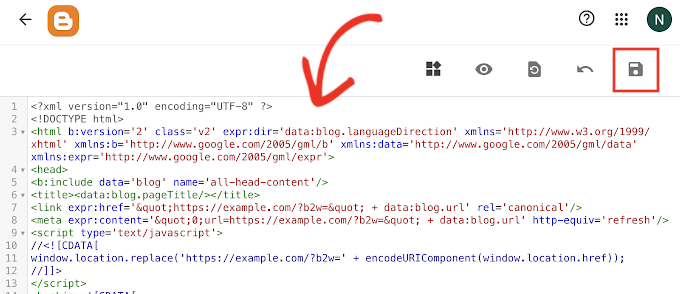
Don’t forget to click the ‘Save’ button to store your changes.
Older Blogger themes also serve a separate mobile version of your blog, and that version ignores the code you just pasted.
To turn it off, click the same down arrow next to the ‘Customize’ button and select ‘Mobile settings’.
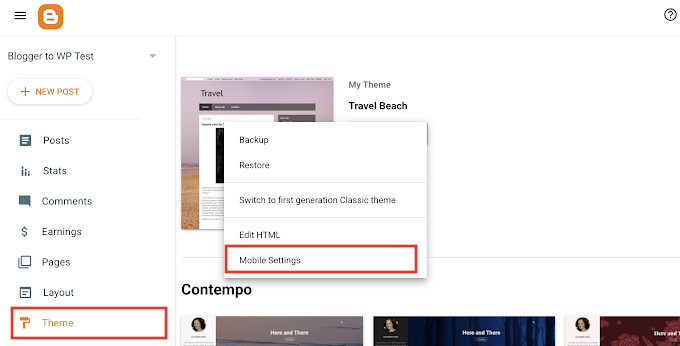
In the popup, choose the ‘Desktop’ option and click ‘Save’. If you don’t see ‘Mobile settings’, your theme is already responsive, and you can skip this.
Now test it. Open one of your old Blogger post URLs in a private browser window, and within a second you should land on the same post on your WordPress site.
3. Redirect Blogger’s ?m=1 Mobile URLs
When someone opens your Blogger blog on a phone, Blogger adds ?m=1 to the end of the address, and Google often indexes these mobile addresses alongside the normal ones.
In our tests, that small addition caused a real problem. WordPress uses m as its own parameter for date archives, so a request for yourblog.com/?m=1 or yourblog.com/post-title/?m=1 returns a 404 error page.
The fix is a second WPCode snippet that sends every ?m=1 and ?m=0 request to the clean URL with a 301 redirect. Create another PHP snippet in WPCode, just like you did above, and paste this code:
add_action( 'template_redirect', 'wpb_redirect_blogger_mobile_urls' );

function wpb_redirect_blogger_mobile_urls() {
	if ( ! isset( $_GET['m'] ) || ! in_array( $_GET['m'], array( '0', '1' ), true ) ) {
		return;
	}

	wp_safe_redirect( remove_query_arg( 'm' ), 301 );
	exit;
}
Scroll down a little and set the Location to ‘Frontend Only’, switch the snippet to Active, and click ‘Save Snippet’.
In our test, opening the homepage and a post URL with ?m=1 at the end both sent us straight to the clean URL.
Step 6: Moving Other Content From Blogger to WordPress
With your content moved and the redirects in place, it is time to check the pieces that need a manual touch. Below are five things to look at, and how to handle each one.
1. Pages
BtW Importer moves your Blogger pages, like About and Contact, into Pages » All Pages, and it redirects their old /p/ addresses too. Open each one to check the formatting, and add them to your WordPress theme’s navigation menus.
You might also want to check out our list of important pages every WordPress blog should have, so you don’t miss anything Blogger never had.
2. Widgets
Like Blogger, many WordPress themes use widgets to add content to your blog’s sidebar. To add them, visit the Appearance » Editor page for block themes and Appearance » Widgets page for classic themes.
For detailed instructions, see our guide on how to add and use widgets in WordPress.
If you are looking for a widget that WordPress does not have by default, then you likely need a plugin. WordPress has over 72,000 free plugins, so see our beginner’s guide on how to choose the right WordPress plugin.
3. RSS Feeds
People who follow your blog through RSS feeds will still be able to find your blog. However, they will not get any new content until you point the old feed to the new one.
To fix this, go to the Settings page in your Blogger dashboard. Scroll down to the ‘Site feed’ section and click ‘Post feed redirect URL’.
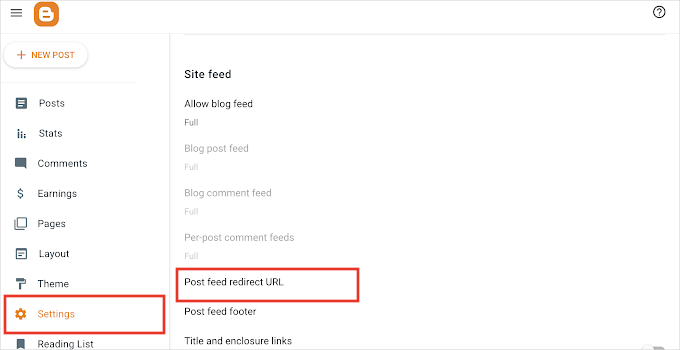
This will bring up a popup where you need to add the RSS feed URL of your WordPress website. Your WordPress feed URL will look like this:
http://example.com/feed
Don’t forget to replace example.com with your own domain name.
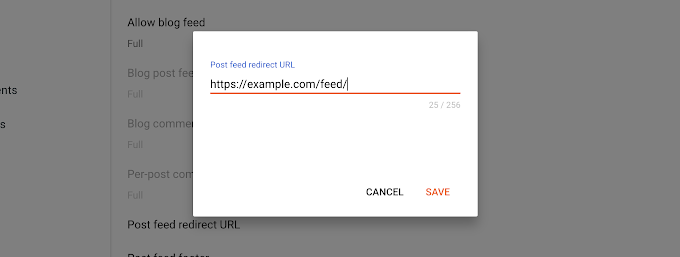
Click the ‘Save’ button to add the URL and save your settings.
4. Images
BtW Importer already downloaded the images that Google hosted for you into your media library and updated your posts to use them. Open Media » Library to see them.
If the plugin missed a few images, or you had images hosted elsewhere, our guide on how to import external images in WordPress shows a plugin that finds and downloads them.
The Google Takeout archive from Step 2 is your safety net. Its Albums folder contains a copy of every image you ever uploaded to Blogger, in original quality.
Step 7: Verify Your Migration in Google Search Console
Now that your content is in place, it is time to let Google know about the change. This step helps Google find your new site faster and protects your search rankings.
Here’s what you need to do:
- Add your new WordPress site to Google Search Console. If you haven’t already, follow our guide on how to add your WordPress site to Google Search Console.
- Submit your new XML sitemap. Submit your sitemap URL in Google Search Console so Google can discover all your new URLs. For step-by-step instructions, see our guide on how to create a sitemap in WordPress.
- Monitor your 404 errors. Over the next few weeks, keep an eye on the Pages report in Google Search Console to catch any 404 errors. If you spot broken URLs, set up additional redirects for them. You can do that with the free 404 to 301 redirect manager plugin.
- Install Google Analytics. To track your traffic with Google Analytics after the migration and make sure everything is working, we recommend installing MonsterInsights. For more information, see our guide on how to install Google Analytics in WordPress.
Step 8. Things to Do After Migrating From Blogger to WordPress
Your blog is now on WordPress, and your redirects protect your rankings. Three tasks are worth doing in your first week.
- Pick a fast theme. Your Blogger design does not transfer, so choose a lightweight theme that loads quickly on phones. Our list of the best free WordPress blog themes is a good place to start.
- Install the essential plugins. An SEO plugin, a contact form, and a backup plugin cover most blogs. See our list of must-have WordPress plugins.
- Set up backups. On Blogger, Google looks after your content. On WordPress, you are in charge, so pick one of the best WordPress backup plugins and schedule automatic backups.
Frequently Asked Questions About Switching From Blogger to WordPress
Is anyone still using Blogger?
Yes. Blogger is still online, and Google has not announced any plans to close it.
However, it only gets a few new features these days, and Google has now folded even its backup tool into Google Takeout.
Most bloggers who want to grow their blog move to WordPress because it’s easy to customize the appearance and extend its features.
What happens to my old Blogger blog after migration?
Your old Blogger blog will still exist after the migration. In fact, you need to keep it active, because the redirect code in your Blogger theme is what sends visitors to your new WordPress site.
Don’t delete your Blogger blog, as that would remove the redirects and cost you traffic.
We hope this article helped you switch from Blogger to WordPress without affecting your Google search rankings. You may also want to see our guide to which WordPress plan you should use or the most common WordPress myths debunked.
If you liked this article, then please subscribe to our YouTube Channel for WordPress video tutorials. You can also find us on Twitter and Facebook.



Meghan
Thank you for this great tutorial. If my blogger blog is already being redirected to my .com, are the steps the same when migrating to wordpress? Or do I need to go back to a web address before migrating? Thanks in advance!
Anandan K
Hi,
The major problem I am facing right now after doing all the above mentioned is the urls are not being redirected to wordpress.
Eg. blogger urls have “.html” and wordpress do not, so I end up getting a 404 no result found page. Any help would be really appreciated.
WPBeginner Support
The code you added in functions.php file should take care of that. Please repeat all the steps to make sure you haven’t missed anything.
Admin
Jason Booth
This was a huge help in migrating our blog.
Unfortunately the redirects from Blogger don’t seem to work on mobile devices. Blogger appears to do a server side redirect to example.com/?m=1 before the template with the client side redirect loads.
Any thoughts on this? I can’t see anything in Blogger to change to force mobile devices to use the modified template with the client side redirect.
boethius
@Jason Booth:
the ?m=1 problem is because you are still using a separate template for mobile for your blogspot. Disable it and then use the classic ones again, and it will work!
Giuseppe
Hi! Thank you for this detailed guide.
I am not able to import embedded videos (most of them published on Youtube). Did I miss something?
Thank you
Nuhaa Bardien
Hi! Thank you for this tutorial! I am really excited to be getting into Wordpress and will definitely be using your tutorials to get me started!
Samantha
I tried this and I think I have one of the codes wrong. My blogger site has a link that you have to click in order to be redirected to new site. Also when going to one of the old blogger posts directly, it still shows on blogger. No redirect at all. Please help!
Elizabeth Busey
I’ve just followed all of your instructions to shift my blog from blogger to WordPress. I’ve been testing with google searches — using relevant key words but not my name. I am finding that for posts older than 2 months, it is marked as archived and the search finds the correct blog immediately. For newer posts (some which were done on Blogger and some directly on WordPress) the google search summary listing will have the correct blog, but the link goes to the blog roll where there are abbreviated versions of the blogs (in chronological order) that you can scroll through. But the searcher would have no idea which blog it refers to. I should add that the search is ignoring category labels which should be leading directly to a post and not the blog roll.
Whew! I’d appreciate any advice.
Brittny
Thank you so much for this but I have one question about it, I was able to transfer my posts to Wordpress but all my pictures are fuzzy and not the high quality like they were on blogger. Any reason why?
Thank you
Yas
I have exactly the same problem !
!
Jana Gordon
I have my permalinks set up correctly but my URL’s from Pinterest to my site are off.
Pinterest has this: http://example.com/2015/10/postname/.html
M site has this: http://example.com/2015/10/postname.html
How do I add that extra “/” before the .html in my WordPress permalink?
Vivian
Im currently using 1and1 web hosting? How do i transfer to bluehost?
Im using blogger and would like to transfer to wordpress.org. The video is very helpful! I need to sit down and spend hours to do it. Wish me luck! =D
Thank you!
Vivian
WPBeginner Support
Please take a look at our free blog setup service.
Admin
marlamarlas
How will I transfer original artwork like logo and layout?
WPBeginner Support
For logo you can save the image file and use it in your new WordPress site if your theme supports it. However, you may not be able to use the same layout in WordPress.
Admin
Adrienne
Darn, I needed this last month. Oh well, I lost my ranking on this. But will look at this for the future.
Editorial Staff
That sucks — you can still implement the redirect and get some of the lost traffic back.
Admin
Taylor
After I have downloaded my blog from blogger, I don’t see the option on wordpress I don’t see “tools” on my side bar. I am using wordpress.com not .org.
Editorial Staff
This guide and just about every other tutorial on this site is only for WordPress.org (self-hosted open source software). We do not offer support or tips for WordPress.com (closed platform).
Admin
Giampiero
Thank you for this, I moved all my post “manually” from blogger to my wordpress site, this post would have been really helpful.
dameelare
I use godaddy.com to host my site pls will it work on there also ?
WPBeginner Support
Yes it would.
Admin
Rebecca Bryant
Help i keep getting an error when I import. This is the error I get
Import Blogger
Sorry, there has been an error.
File is empty. Please upload something more substantial. This error could also be caused by uploads being disabled in your php.ini or by post_max_size being defined as smaller than upload_max_filesize in php.ini.
WPBeginner Support
Please open the blogger import file you downloaded in a text editor to make sure that it is not empty. If it is, then try downloading the export file again.
If it is not empty, then please try increasing the upload_max_filesize limit in php
Admin
Hasi Aulia
Hi Mate,
I Think you have to add some settings at .htaccess, I try this tutorial but I get problem, I get 406 page when get parameter that was sent by my old blogspot Redirect.
But I try to fix it with add this code at my .htaccess:
SecFilterEngine Off
SecFilterScanPOST Off
You should add this in the tutorial.
Thanks
WPBeginner Support
Majority of users don’t need to do this. It basically by passes mod_security module in older versions of Apache. Please contact your web host for more information and ask them to upgrade Apache or have it properly configured to run web applications like WordPress.
Admin
Karan
Hey! Amazing blogpost! Very helpful..I have exported my blog to wordpress..However, the permalink structure was of no use, as the blogspot blog used ‘dot html’ at the end of every slug..Hence, the old indexed links from google, take the visitor to a ‘Page Not Found’ message on my new wordpress blog..I followed all the instructions correctly..any help?
WPBeginner Support
These instructions would work, the code we shared above can detect your blogger post and the WordPress code can match it to the same post in WordPress. The blogspot’s .html URLs are not an issue, and neither is country specific blogspot URLs.
Admin
Mario
Thank you so much! It worked!
Budak kampung
Hi,
Is blog transfer do able without cost? Thinking to do it with Bluehost but they charge USD99 for the process.
Jude
I tried it for it didn’t work.
WPBeginner Support
Can you please provide more details? It seems you have infiniteWP installed on that domain.
Admin
Connor Rae
Wow, this is really helpful! I have been thinking about making the switch from blogger to Wordpress for a while, but never thought it would be this straightforward. My blogger dashboard just picked up a habit that makes the page freeze, then give me a popup telling me to kill the page. Because of this, I can still make posts, but when I log in, I only get 2 clicks before the page dies, so editing previous posts is no longer possible. This has been going on for weeks, and bloggers support team had couldn’t explain what is going on, so I’m moving on to Wordpress. Has anyone else had this problem with blogger where the page is slower than normal, then freezes and dies after 2 clicks/about 30 seconds, whichever happens first? If it’s a bug I can fix, or something I can wait out for an update to fix, I wouldn’t mind trying to just fix the blog that I have.
RAJENDER
All my doubts about wp to blogger migration is cleared in a very good manner by reading this article. Thanks a lot # wpbeginners Team
Ana
Hi, thanks for this tutorial. I have a doubt, I have a Blogger blog and want to move to WP, but not to a blog but to a website with a blog, so my posts permalinks would be mydomain.com/blog/2015/10/post-title.html, due to the “blog” slug it can’t be the same as the Blogger link, what can I do?
WPBeginner Support
The above redirects and permalink settings should still work for you.
Admin
EIMIE
I try switch my blog to new wordpress but not redirect.. how it?
WPBeginner Support
Please see the redirection instructions above.
Admin
fabian
What about moving from joomla to wp ?
WPBeginner Support
Please see our tutorial on how to move your site from Joomla to WordPress.
Admin
Mary Grace
Will it be okay if I just delete my Old blogspot blog after exporting since it’s just 1 month old? What I want to export is only my 40 articles.
WPBeginner Support
It your blogspot blog was indexed by search engines then it is recommended that you use redirection. This helps search engines understand that your site has moved.
Admin
Connor Rickett
This is wonderful! I had no idea this was actually possible, let alone relatively straightforward.
Derdus
Hey thanks for the blog. I followed all the steps. However, all redirects goes to home of the new blog and not the correct post. What did I do wrong?
WPBeginner Support
We have updated the article. Please follow the new instructions. Thanks.
Admin
Srinivas
Hi , Thanks for indepth tutorial …
For some blogger posts , i have used custom permalinks ,will that give error when i migrate from blogger to wordpress ?
emeka obi
Under the Page Attributes section i didnt see template or WPBeginner Blogger when creating new page that was after i have uploaded the text files to my wp theme using filezilla can some tell me where to find it?
Rickard
Great guide for directing traffic from blogger to new site. The redirect works perfectly!
BUT… This does not return a 301 redirect status code!!
Tried several tools including:
It returns status code 200.
So… “without Losing Google Rankings”? – are you sure about that??
Dale Reardon
I have read some warnings on other sites that Google has stopped interacting with the WP importer and you can’t currently import your Blogger blogs.
Is this true do you know? I see this article hasn’t been updated since last year hence why asking.
Dale.
Angie
I ran into this issue, but instead used a plug in called Blogger Importer Extended and it worked even better with more features.
Shashwat Tiwari
“You’re being redirected to this article because the application you’re using uses OAuth 1.0, and we only support the newer OAuth 2.0 at this time.” says google OAuth page which means blogger importer is not working anymore.
Randal
Did you find any solution this version issue? I’m having the same problem.
Nevine
Will this affect your adsense a/c and information in it?
Susan Smith
My AdSense increased significantly after migrating to self hosted WordPress. I also set it to redirect all of the international domains from blogger as well.
Nenad
I have custom domain on blogger… do I have to rename and buy new domain and after that migrate whole blog or stay at same domain? There are about 7.000 posts published at blogger blog.
Karen
HELP!
So I followed these instructions EXACTLY and everything is redirecting beautifully.
EXCEPT that ALL of the links to my blog from Twitter, Facebook, Bloglovin, etc, ALL redirect to the same post from last September. I can’t figure out what the heck is going on, which makes it really hard to fix it. Any suggestions???
huislaw
Thanks for the tutorial.
My pages are redirected correctly.
But when I try to use the function “Change of Address” in Google Webmaster Tools, it says:
“We couldn’t find any 301-redirect directives for your site. For more details check the Fetch as Google tool.”
Is there a way to make the Change of Address in Webmaster Tools?
Or is it important to inform Google about the change of address?
Thanks.
Chris
I’m unable to import from blogger to WP. I didn’t give me a message; it didn’t do anything after I selected the IMPORT button. The posts don’t appear in the WP site. Help!
Nathan Nelson
I had the same problem, this morning. Try using the plugin “Blogger Importer Extended”. That worked for me.
Shoks
Same problem resolved with this plugin! Tnx
amy
hi, has anyone figured out the permalink situation? My transfer is not working and I think it may have something to do with that… my theme uses a custom permalink.
Katie
I’ve completed the instructions above and everything seemed to be right. But, when clicking on an old link on say twitter the link redirects and I get this error “Parse error: syntax error, unexpected T_NS_SEPARATOR in /home/sangla1/aspire2.com/wp-content/themes/salient/wp-blogger.php on line 15”
Not sure how to fix this. Any help would be great!
Karen
Did you ever find a solution for this? I’m having a similar problem, except that instead of getting an error, my links redirect to an old post.
Arun
Katie,
I was getting an error code similar to what you’ve posted and after umpteen trial and error, I found, it was caused by the wpb-blogger.php code. I copied it off the webpage and those line numbers in the code were intact.
When I copied the code by clicking on “View Source” on the top right corner of the code snippet, It started working.
Keshav Saini
Hi,
I am using custom permalinks structure /%post_id%/%postname% in my wordpress blog so can’t use the permalink structure as specified in the post above. Doing the redirect causes 403 error for my blog. Do I have to change anything in the code to make it work with my current permalink structure?
Xander Lim
This is what I need! It seems that blogspot has already given me full knowledge about blogging, now this will be the time to migrate it on wordpress platform. Thanks a lot for this guide, this is very helpful for me.
Peter Bates
Where is the Post Feed Redirect url located on a hosted Wordpress.org site? I see no feed subdirectory in my Wordpres.org site.
Raya Ezelle
Yay! Thanks so much. All the old URL’s redirect perfectly
cesar
Hi. doesn’t wordpress has a size limit for importing blogger’s xml file?
Jason
I just wanted to thank you for this guide, it has been a great help when working with a client. Even though I had major problems with the Blogger Importer -plugin, rest of the process went smoothly when following this guide. Thanks again.
natachy
i have completed redirecting my blogger to wordpress but the problem is redirecting my wordpress site so users are redirected to proper posts. I’m using a mac, i saved the code into a textile (without making any changes). when I try to upload it into theme directory, it keeps unpacking (not installing). please help
gaurav dutt
I had a blogspot blog and a wordpress Veg Momos and the situation is that i don’t want to import my whole blog to the wordpress, but only few posts without re writing them, i would rather say i want migrate a particular category of posts. What should i do for that ?
sugar
I am making a migration of the BBlogger blog to an existing self hosted Wordpress domain. Thus Permalinks are already set to be http://www.domain.de/posts At Step #2 I should be adjusting my permalinks like you say, but my permalinks are already set. How do I solve this problem without killing the permalinks in the existing Wordpress blog? Thanks for any help.