


“Will I lose my Google rankings if I move from Blogger to WordPress?” That’s the first question we hear from anyone thinking about making the switch.
We get it. However, after helping many bloggers make this move, we can say with confidence that you can switch from Blogger to WordPress without losing your Google rankings.
In this guide, we’ll show you the exact steps we use, from exporting your Blogger blog to setting up the redirects that protect your search traffic.
Quick Summary: Switching from Blogger to WordPress requires exporting your Blogger content, importing it into a self-hosted WordPress site, and redirecting the old URLs to your new site.
Estimated time: 1 to 2 hours for a small blog.
Tools: Free BtW Importer plugin and two short code snippets.
Cost: The migration costs nothing. You’ll still need to pay for hosting and a domain name.
WordPress.com vs. WordPress.org: What’s the Difference?
There are two types of WordPress, and this guide uses WordPress.org, also known as self-hosted WordPress. WordPress.com is a hosted service where you cannot install plugins on the free plan. You’ll need to upgrade to a paid plan to unlock plugins and follow this tutorial.
For a full breakdown, see our comparison of WordPress.com vs. WordPress.org.
That being said, let’s take a look at how to move from Blogger to WordPress while keeping your Google rankings and traffic. Here are the steps we’ll cover:
- Step 1: Sign Up for WordPress Hosting
- Step 2: Export Your Blogger Blog
- Step 3: Import Blogger to WordPress
- Step 4: Setting Up Permalinks
- Step 5: Set Up Redirects From Blogger to WordPress
- Step 6: Moving Other Content From Blogger to WordPress
- Step 7: Verify Your Migration in Google Search Console
- Step 8. Things to Do After Migrating From Blogger to WordPress
- Frequently Asked Questions About Switching From Blogger to WordPress
Step 1: Sign Up for WordPress Hosting
To get started with WordPress, you will need a domain name and web hosting. A domain name is your website’s address, and web hosting is where your website files live.
You can choose any WordPress hosting provider that you want, like Bluehost or Hostinger. Both are officially recommended WordPress hosting providers and offer a free domain name for the first year.
For this tutorial, we used Bluehost, which automatically installed WordPress when we signed up, so we were able to log into our new site right away.
Step 2: Export Your Blogger Blog
Now that your WordPress site is ready, the next step is to export your content from Blogger.
Log in to your Blogger account, pick your blog, and click Settings in the left menu. Scroll down to the ‘Manage blog’ section, click ‘Back up content’, and then click ‘Download’.
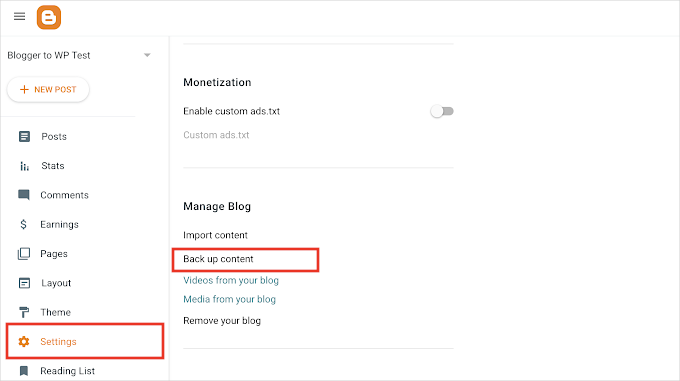
Blogger no longer downloads an XML file straight away. Instead, the Download button now opens Google Takeout, which is Google’s tool for downloading your data, with Blogger already selected.
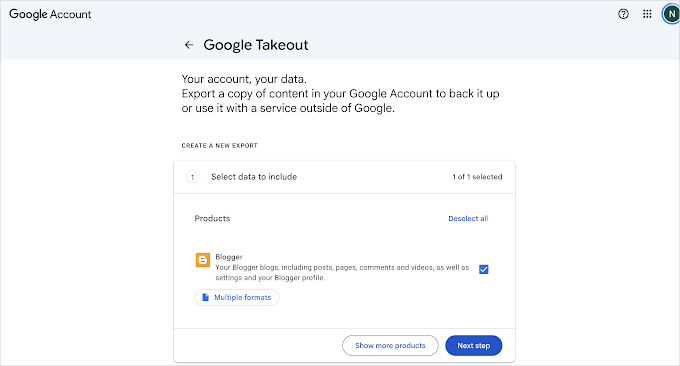
Click ‘Next step’, keep the default settings, and click ‘Create export’.
Google will email you when the export is ready, which usually takes a few minutes for a small blog.
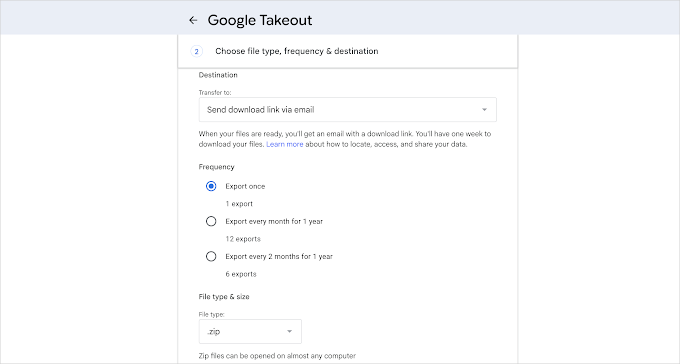
Click ‘Download archive’ in that email and save the .zip file to your computer.
Next, unzip the file. Open the Takeout folder, then Blogger, then Blogs, and then the folder with your blog’s name.
The file you need is called feed.atom. It holds your posts, pages, and comments.
If Takeout splits your export into more than one .zip file, check each one for a feed.atom file. You will import them one after another in the next step.
Note: Keep a copy of the whole archive in a safe place, like cloud storage or an external drive. It is your backup of the original blog. The Albums folder inside it holds every image you ever uploaded to Blogger, which we come back to in Step 6.
Step 3: Import Blogger to WordPress
With the feed.atom file on your computer, you can now import your content into WordPress.
WordPress comes with a default Blogger importer, available on the Tools » Import page in the admin area. However, that importer has been broken since July 2025. That is when Google moved Blogger backups into Google Takeout and changed the file format at the same time.
Luckily, there are alternative plugins you can use.
- BtW Importer – This is the plugin we’ll be using in this tutorial. It imports posts, pages, images, and even set up redirects. The downside is that it doesn’t import comments.
- Blogger Importer Extended – Imports posts, pages, images, and comments, but the free version is limited to 20 posts. You can use this if you have fewer posts or if you want to import comments.
First, install and activate the BtW Importer plugin. For more details, see our step-by-step guide on how to install a WordPress plugin.
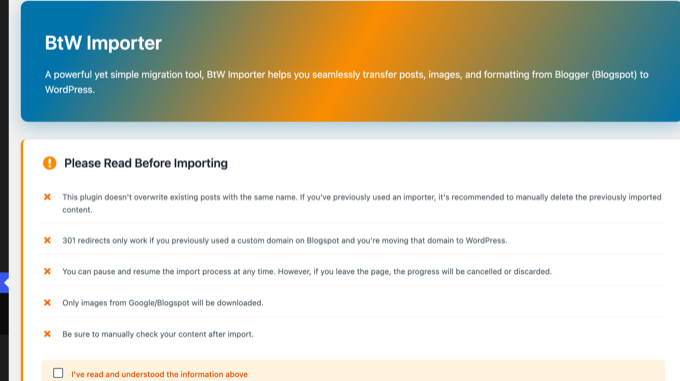
Upon activation, click the new BtW Importer item in your WordPress admin menu. The page starts with a short list of things to know before you import.
Read it, then tick the ‘I’ve read and understood the information above’ box.
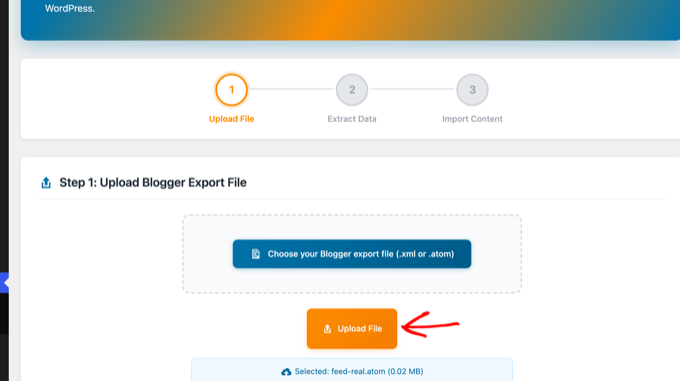
In Step 1, click the ‘Choose your Blogger export file’ button and select the feed.atom file. Then click the ‘Upload File’ button.
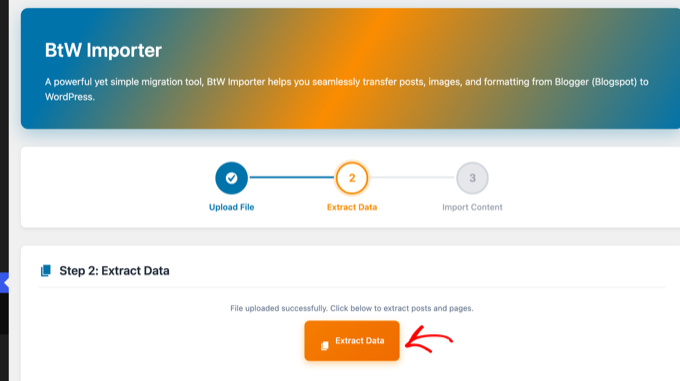
In Step 2, click the ‘Extract Data’ button. The plugin reads the file and counts your posts and pages.
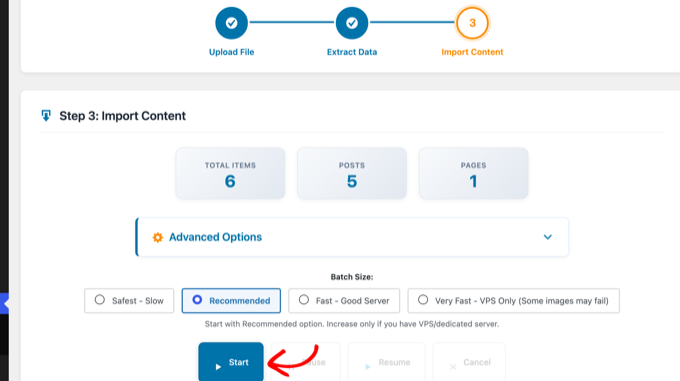
Step 3 shows how many items it found. The ‘Advanced Options’ panel lets you keep the original Blogger author for each post, and it has an experimental option to convert the old Blogger HTML into WordPress blocks.
We recommend leaving that option unchecked for your first run, because you can always convert posts to blocks later in the editor.
Leave the batch size on ‘Recommended’ and click the ‘Start’ button.
The plugin imports your posts and pages, downloads every image hosted on Google’s servers into your media library, and rewrites the image links inside your posts to the new copies.
It also records the old Blogger address of each post, which we use for the redirects in Step 5.
A progress log shows each item as it comes over, and you will see a ‘Congratulations!’ message when it finishes.
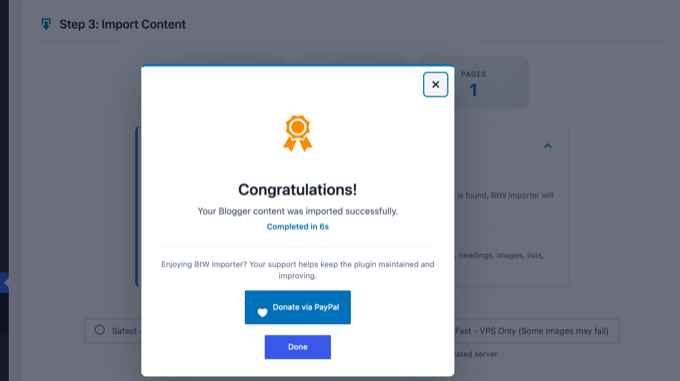
You can now check your content under Posts » All Posts and Pages » All Pages. Blogger labels become WordPress categories, drafts stay drafts, and the first image in each post becomes its featured image.
Step 4: Setting Up Permalinks
Now that your posts are in WordPress, let’s talk about their web addresses. Permalinks is the WordPress term for the URL structure of your posts and pages.
Blogger post URLs look like this: https://yourblog.blogspot.com/2026/08/post-title.html.
The BtW Importer plugin saved the old address of every post and page in a redirect map. Whenever a request for an old address reaches your WordPress site, the plugin sends it to the matching new post.
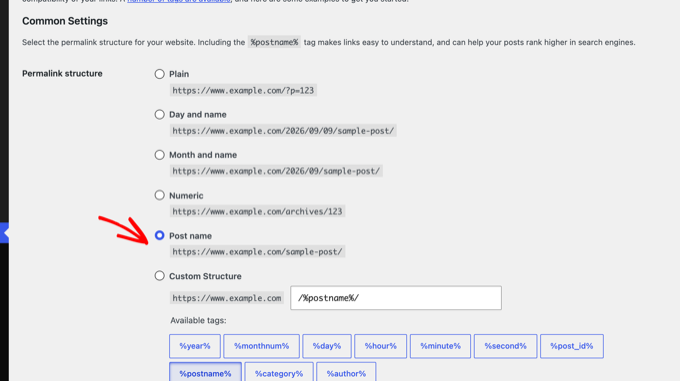
So keep WordPress’s default setting. Go to Settings » Permalinks and check that you have the ‘Post name’ option selected.
This setting gives you clean, SEO-friendly URLs like yourblog.com/post-title/.
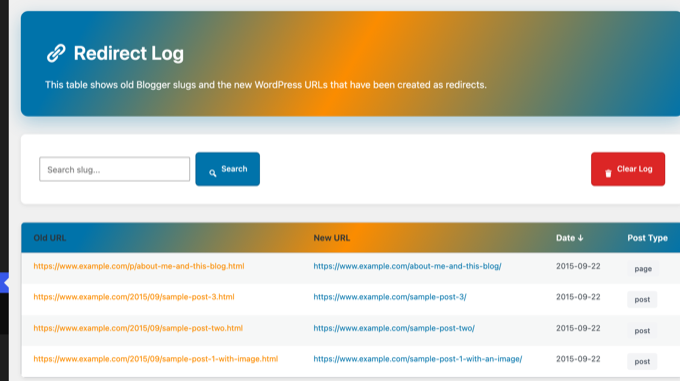
You can see the full list of old and new addresses under BtW Importer » Redirect Log. Every Blogger post and page should have a row here.
To test it, open one of the old addresses on your new domain, such as yourblog.com/2026/08/post-title.html. WordPress should send you straight to the new post.
In our test, the old post and page URLs all returned a 301 redirect to the right place.
This map only works for users that arrive at your WordPress domain. However, since your users and Google don’t know that you have moved, they will continue seeing your old Blogger blog until you finish Step 5.
Step 5: Set Up Redirects From Blogger to WordPress
Now that WordPress knows where every old address should go, it is time for the most important step of the whole migration, which is redirecting users and search engines like Google to your new WordPress site.
A redirect sends anyone who opens one of your old Blogger URLs to the same post on WordPress automatically.
It also sends a 301 status code, which is the code for a permanent redirect. This tells Google that the page has moved for good, so your rankings pass to the new address instead of starting from zero.
⚠️ If your Blogger blog has its own custom domain instead of blogspot.com, you may need to point your domain nameservers to your hosting provider. For instructions, please follow our tutorial on how to switch custom domain blogger blog to WordPress.
Blogger does not let you set up server redirects, so here is the workaround.
First, we add a small code snippet to your WordPress site. It receives the visitors that Blogger sends over, looks up the old address, and forwards them to the right post in WordPress.
Then, add a code snippet to your Blogger theme to send every visitor and search engine from your blogspot.com address to that snippet.
1. Add the Redirect Snippet to WordPress
We recommend adding the snippet with the free WPCode plugin, which is the safest way to add custom code to WordPress. For more details, see our guide on how to copy and paste code snippets in WordPress.
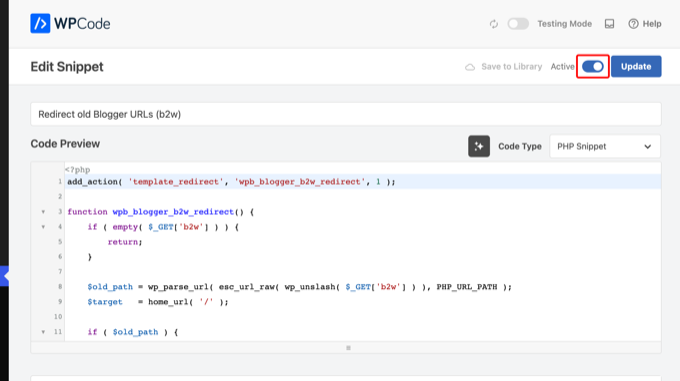
After installing WPCode, go to Code Snippets » + Add Snippet. Hover over ‘Add Your Custom Code (New Snippet)’ and click ‘Use snippet’.
Choose ‘PHP Snippet’ as the code type, give your snippet a name, and paste the following code:
add_action( 'template_redirect', 'wpb_blogger_b2w_redirect', 1 );

function wpb_blogger_b2w_redirect() {
	if ( empty( $_GET['b2w'] ) ) {
		return;
	}

	$old_path = wp_parse_url( esc_url_raw( wp_unslash( $_GET['b2w'] ) ), PHP_URL_PATH );
	$target   = home_url( '/' );

	if ( $old_path ) {
		$matches = get_posts( array(
			'post_type'           => array( 'post', 'page' ),
			'post_status'         => 'publish',
			'posts_per_page'      => 1,
			'ignore_sticky_posts' => true,
			'meta_key'            => '_old_permalink',
			'meta_value'          => $old_path,
		) );

		if ( $matches ) {
			$target = get_permalink( $matches[0] );
		}
	}

	wp_safe_redirect( $target, 301 );
	exit;
}
This code reads the old Blogger address that your Blogger theme will pass along, looks up the matching post or page that BtW Importer saved, and sends the visitor there with a 301 redirect. If nothing matches, it sends them to your homepage instead of a 404 error.
Below the code box, set the Insertion method to ‘Auto Insert’ and the Location to ‘Frontend Only’. Then switch the toggle at the top to Active and click the ‘Save Snippet’ button.
2. Replace Your Blogger Theme With the Redirect Code
Next, log in to your Blogger dashboard and go to the Theme page. Click the down arrow next to the ‘Customize’ button, and then select ‘Edit HTML’.
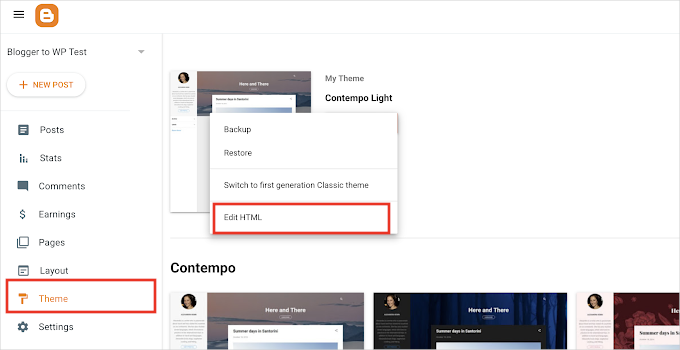
Blogger will now display the HTML code of your theme.
Before you delete anything, copy ALL of the existing Blogger theme HTML and save it to a text file on your computer as a backup.
Once you have backed up the original theme code, delete everything in the editor and paste the following code. Replace https://example.com with your new WordPress site’s address in all four places:
<?xml version="1.0" encoding="UTF-8" ?>
<!DOCTYPE html>
<html b:version='2' class='v2' expr:dir='data:blog.languageDirection' xmlns='http://www.w3.org/1999/xhtml' xmlns:b='http://www.google.com/2005/gml/b' xmlns:data='http://www.google.com/2005/gml/data' xmlns:expr='http://www.google.com/2005/gml/expr'>
<head>
<b:include data='blog' name='all-head-content'/>
<title><data:blog.pageTitle/></title>
<link expr:href='"https://example.com/?b2w=" + data:blog.url' rel='canonical'/>
<meta expr:content='"0;url=https://example.com/?b2w=" + data:blog.url' http-equiv='refresh'/>
<script type='text/javascript'>
//<![CDATA[
window.location.replace('https://example.com/?b2w=' + encodeURIComponent(window.location.href));
//]]>
</script>
<b:skin><![CDATA[
body { font-family: Arial, sans-serif; text-align: center; padding: 40px; }
]]></b:skin>
</head>
<body>
<b:section class='main' id='main' showaddelement='no'>
<b:widget id='Blog1' locked='true' title='Blog Posts' type='Blog' version='2'>
<b:includable id='main'>
<p>This blog has moved. <a expr:href='"https://example.com/?b2w=" + data:blog.url'>Click here if you are not redirected.</a></p>
</b:includable>
</b:widget>
</b:section>
</body>
</html>
This theme code does three things. It tells search engines that each old page has a new canonical address, uses a meta refresh tag to send them to that page, and redirects human visitors with a small script.
All three point at the WordPress snippet from the previous step, which then forwards to the exact post.
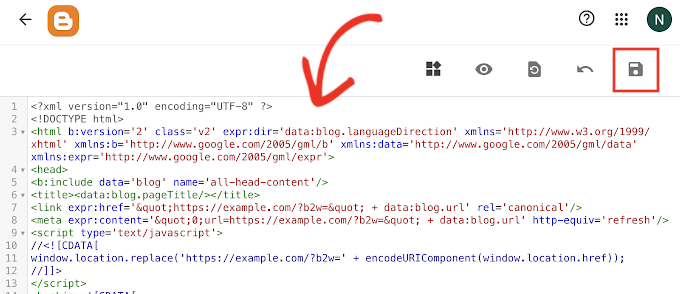
Don’t forget to click the ‘Save’ button to store your changes.
Older Blogger themes also serve a separate mobile version of your blog, and that version ignores the code you just pasted.
To turn it off, click the same down arrow next to the ‘Customize’ button and select ‘Mobile settings’.
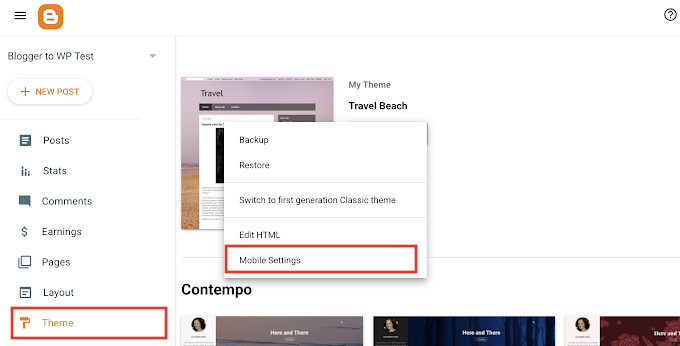
In the popup, choose the ‘Desktop’ option and click ‘Save’. If you don’t see ‘Mobile settings’, your theme is already responsive, and you can skip this.
Now test it. Open one of your old Blogger post URLs in a private browser window, and within a second you should land on the same post on your WordPress site.
3. Redirect Blogger’s ?m=1 Mobile URLs
When someone opens your Blogger blog on a phone, Blogger adds ?m=1 to the end of the address, and Google often indexes these mobile addresses alongside the normal ones.
In our tests, that small addition caused a real problem. WordPress uses m as its own parameter for date archives, so a request for yourblog.com/?m=1 or yourblog.com/post-title/?m=1 returns a 404 error page.
The fix is a second WPCode snippet that sends every ?m=1 and ?m=0 request to the clean URL with a 301 redirect. Create another PHP snippet in WPCode, just like you did above, and paste this code:
add_action( 'template_redirect', 'wpb_redirect_blogger_mobile_urls' );

function wpb_redirect_blogger_mobile_urls() {
	if ( ! isset( $_GET['m'] ) || ! in_array( $_GET['m'], array( '0', '1' ), true ) ) {
		return;
	}

	wp_safe_redirect( remove_query_arg( 'm' ), 301 );
	exit;
}
Scroll down a little and set the Location to ‘Frontend Only’, switch the snippet to Active, and click ‘Save Snippet’.
In our test, opening the homepage and a post URL with ?m=1 at the end both sent us straight to the clean URL.
Step 6: Moving Other Content From Blogger to WordPress
With your content moved and the redirects in place, it is time to check the pieces that need a manual touch. Below are five things to look at, and how to handle each one.
1. Pages
BtW Importer moves your Blogger pages, like About and Contact, into Pages » All Pages, and it redirects their old /p/ addresses too. Open each one to check the formatting, and add them to your WordPress theme’s navigation menus.
You might also want to check out our list of important pages every WordPress blog should have, so you don’t miss anything Blogger never had.
2. Widgets
Like Blogger, many WordPress themes use widgets to add content to your blog’s sidebar. To add them, visit the Appearance » Editor page for block themes and Appearance » Widgets page for classic themes.
For detailed instructions, see our guide on how to add and use widgets in WordPress.
If you are looking for a widget that WordPress does not have by default, then you likely need a plugin. WordPress has over 72,000 free plugins, so see our beginner’s guide on how to choose the right WordPress plugin.
3. RSS Feeds
People who follow your blog through RSS feeds will still be able to find your blog. However, they will not get any new content until you point the old feed to the new one.
To fix this, go to the Settings page in your Blogger dashboard. Scroll down to the ‘Site feed’ section and click ‘Post feed redirect URL’.
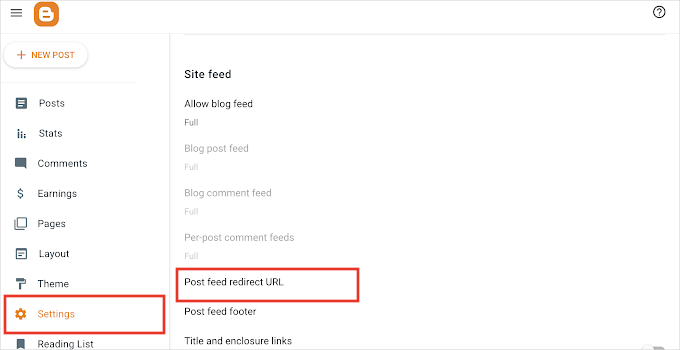
This will bring up a popup where you need to add the RSS feed URL of your WordPress website. Your WordPress feed URL will look like this:
http://example.com/feed
Don’t forget to replace example.com with your own domain name.
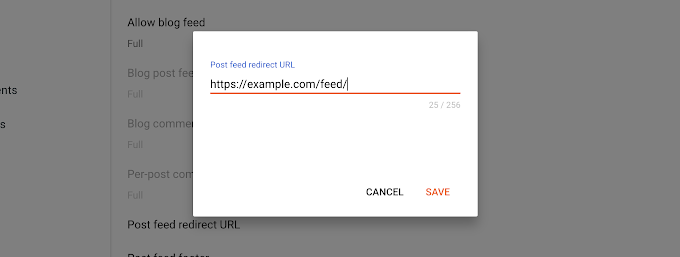
Click the ‘Save’ button to add the URL and save your settings.
4. Images
BtW Importer already downloaded the images that Google hosted for you into your media library and updated your posts to use them. Open Media » Library to see them.
If the plugin missed a few images, or you had images hosted elsewhere, our guide on how to import external images in WordPress shows a plugin that finds and downloads them.
The Google Takeout archive from Step 2 is your safety net. Its Albums folder contains a copy of every image you ever uploaded to Blogger, in original quality.
Step 7: Verify Your Migration in Google Search Console
Now that your content is in place, it is time to let Google know about the change. This step helps Google find your new site faster and protects your search rankings.
Here’s what you need to do:
- Add your new WordPress site to Google Search Console. If you haven’t already, follow our guide on how to add your WordPress site to Google Search Console.
- Submit your new XML sitemap. Submit your sitemap URL in Google Search Console so Google can discover all your new URLs. For step-by-step instructions, see our guide on how to create a sitemap in WordPress.
- Monitor your 404 errors. Over the next few weeks, keep an eye on the Pages report in Google Search Console to catch any 404 errors. If you spot broken URLs, set up additional redirects for them. You can do that with the free 404 to 301 redirect manager plugin.
- Install Google Analytics. To track your traffic with Google Analytics after the migration and make sure everything is working, we recommend installing MonsterInsights. For more information, see our guide on how to install Google Analytics in WordPress.
Step 8. Things to Do After Migrating From Blogger to WordPress
Your blog is now on WordPress, and your redirects protect your rankings. Three tasks are worth doing in your first week.
- Pick a fast theme. Your Blogger design does not transfer, so choose a lightweight theme that loads quickly on phones. Our list of the best free WordPress blog themes is a good place to start.
- Install the essential plugins. An SEO plugin, a contact form, and a backup plugin cover most blogs. See our list of must-have WordPress plugins.
- Set up backups. On Blogger, Google looks after your content. On WordPress, you are in charge, so pick one of the best WordPress backup plugins and schedule automatic backups.
Frequently Asked Questions About Switching From Blogger to WordPress
Is anyone still using Blogger?
Yes. Blogger is still online, and Google has not announced any plans to close it.
However, it only gets a few new features these days, and Google has now folded even its backup tool into Google Takeout.
Most bloggers who want to grow their blog move to WordPress because it’s easy to customize the appearance and extend its features.
What happens to my old Blogger blog after migration?
Your old Blogger blog will still exist after the migration. In fact, you need to keep it active, because the redirect code in your Blogger theme is what sends visitors to your new WordPress site.
Don’t delete your Blogger blog, as that would remove the redirects and cost you traffic.
We hope this article helped you switch from Blogger to WordPress without affecting your Google search rankings. You may also want to see our guide to which WordPress plan you should use or the most common WordPress myths debunked.
If you liked this article, then please subscribe to our YouTube Channel for WordPress video tutorials. You can also find us on Twitter and Facebook.


Marco Dickert
Hi there,
I just tried to migrate my blogger-blog to my self-hosted wordpress. Almost all things work as expected, but not the redirection from blogger. I inserted a logging function in the template code for the wordpress-sided interface and recognized that this page does not get any parameters from the blogger redirection. That means I simply get redirected to my home page.
Is it possible that blogger changed variable names or something? Does anyone has an idea how I could fix that problem?
Cheers, Marco
WPBeginner Support
Marco, we have just updated the post with a completely new re-written version. Please follow it now, hopefully it will resolve your issue.
Admin
Marco Dickert
@WPBEGINNER Support:
First of all: It’s really nice that you’ve updated this article! I guess you help many users with that.
Meanwhile I solved my problem, and wrote my solution in an email to Amit Agarwal, but he seems to be very busy.
Since I come from Germany I don’t get “blogspot.com”-Domains in my Google search results, but “blogspot.de”. Others in German-speaking Europe get also different TLDs like “blogspot.at” or “blogspot.ch”. That is a problem for the template code. I could fix that simply by changing these lines:
$tld_fix = preg_replace("/blogspot\.[a-zA-Z0-9]+/", "blogspot.com", $old_url);
$permalink = explode("blogspot.com", $tld_fix);
With this fix it should work all around the world. Maybe you can implement it in your post; it might be useful for some people.
Cheers, Marco
WPBeginner Support
Thanks Marco for this really useful fix. We have updated the article to include this.
nil
Hey,
I have the same problem. Tried your script but when I go to an old posting I just get redirected to my first page, not to the post.
Regards
nil
Liza Pritz
Wouldn’t it be easier to use a plugin? Something like “CMS2CMS Blogger to WordPress Converter” ? With this plugin, it is posible to migreta the content, the set up 301 redirect and keep all the visitors and ranking on a new Wordpress site?
Does anyone knows something about that?
Saad Ansari
Nice efforts. One shop stop guide for Blogger to Wordpress migration.
Is there any way of importing all images from blogger and put them all together in Wordpress? I’ve a huge number of images with me. Uploading each of them MANUALLY would be a nightmare, isn’t it? So do let me know if there is any smart and efficient plan B for it. Thanks!
Xuhair Raxa
great post !!! but i have a question.. that is after the conversion,will the domain be .com or blogspot.com ? As i have a blog http://tricksnsolutions.com which is wp blog after making it a blogger blog shall it remain to tricksnsolutions.com or tricksnsolutions.blogspot.com ? please solve my confusion
WPBeginner Support
This guide is for switching from Blogger to WordPress not the other way around.
Admin
Briana M
My old website is with Blogger, but I am switching over to Wordpress and using a new domain name. I already have hundreds of business cards with my old domain name listed (###.blogspot.com) and I want that old domain name through Blogger to redirect to my new domain name and Wordpress website. How can I go about doing this?
WPBeginner Support
You can do so following the steps mentioned in the article above.
Admin
Kanchana
thanks ,,,
Bryan
Hi there,
I am a newbie.
I just wanted to ask a quick question:
When I import my blogger posts into wordpress, will they be deleted from blogger or will they still be there with no changes?
Thanks
WPBeginner Support
They will still be there if you don’t explicitly delete them.
Admin
Christian
Hi!
The Blogger code doesn’t work today. I think the markup is obsolete because Blogger says the following by submitting the code from WP Beginner:
“The value of attribute “dir” associated with an element type “html” must not contain the ‘<' character."
I just replaced simple and double quotes and other ways to solve this, but is completely impossible. Does anyone know if Blogger has made related to the markup?
Thank you all.
hafzaa
Very well explained…will try it..hope so it may work…
Kapil Dev Singh
I have moved from blogger to WordPress and carried out all the steps. I am encountering two problems-
1. The blogger link for specific blogs is not taking me to the wordpress
2. When someone wants to come to wordpress following a specific blog link, it shows – the file could not be found and give a list of all the published blogs. Once clicked on the specific blog for which the link was followed, it opens up.
Regards
Desi
I keep getting this message in blogger
Error parsing XML, line 2, column 73: The value of attribute “dir” associated with an element type “html” must not contain the ‘<' character.
anyone else?
Carl
(Previous comment did not include code… how can I do that?)
Not sure if something has fundamentally changed with the blogger importer or how posts info is stored in the database; But the code above for the wpbeginner-blogger.php failed for almost all my links. I ended up changing it to this:
<?php
 /*
  Template Name: Blogger Redirect (do not use)
 */
 global $wpdb;
 $old_url = $_GET['q'];
 if ($old_url != "") {
   $permalink = explode("blogspot.com.au", $old_url);

  $new_url = $permalink[1];
  header ("HTTP/1.1 301 Moved Permanently");
  header("Location: $new_url");
 }

?>
Anyone see any reason this is bad? It seems to work perfectly, I’m still trying to figure out why it was done any other way to begin with… As long as you fix the permalinks to match the old blogger ones
Dean
Hi, hopefully someone will be able to help. Whenever I click one of my old blogger posts it just sends me to my new wordpress site’s homepage not to the correct blog post? any ideas how to fix this. thanks.
Raj Amal
My old blogger posts it just sends me to my new wordpress site’s homepage not to the correct blog post. Plese help me
Paige
I’m having the same issues. How did you fix this?
Sanskar
I am stuck with the infinite loop. The website keeps refreshing and never loads. I am not sure how to fix it.
Sanskar
OK, I am sorry about the previous comment. I was using Switch hosts firefox plugin and I was browsing on my local copy. My website has not gone live yet. Though I have clicked on Go live button on Godaddy, and looks like DNS settings are updated, but my website has gone in an infinite loop and never loads. It loads the title, loads the favicon and I also see it loading chrome extensions like alexa and adblock, but then it refreshes and starts loading again. This never stops.
Do you think it is the problem with DNS? or that I did not follow the tutorial properly? It has been already 11 hours since I updated the DNS. Both my domain and hosting is bought from Godaddy.
WPBeginner Support
Using an FTP client, connect to your website and download .htaccess file to your computer. Then delete the one on your live site. See if this resolves the issue. If it does, then this means there is nothing wrong with DNS settings of your website and it was probably a redirection issue. You may also contact your web host for support if this does not solve your issue.
Admin
Gari Anne
Everything worked perfectly! Thanks! How Long do I have to leave the Published “Blogger” page on my new word press blog? Or is there a way to hide that page?
Carol
I’m still having the same problems but none of my comments have been published or answered. Did the guy who wrote this post give up on it? I’ve noticed a few people had the same problem – is it something that can be fixed? It would be great to get a response.
Thanks
carol
ok – I’ve been reuploading the text doc over and over and one thing that has changed is – I’m using a Mac and my doc is .rtf. When I take the .rtf off after the .php I get the line 16 error code but if I keep the.rtf on after the .php and I clink on any of my blogger posts it redirects to the Blogger page that I created for the redirect on my new website. Does that make sense? I don’t understand any of this php stuff so I don’t have any idea why it would do that just by adding or deleting the .rtf extension – but that’s what happens.
I hope you have some idea of how I can fix this. It seems like it’s something pretty simple – I just don’t know what.
carol
i just redid all the the cpanel installation part and now the syntax error says line 16
Parse error: syntax error, unexpected T_STRING in /home4/craftyc/public_html/wp-content/themes/suffusion/wpbeginner-blogger.php on line 16
carol
I just went through the whole process and when I click on “View Blog” on my Blogger page it redirects perfectly to my website (yay!), but if I click on any of the individual posts I get this error message:
Parse error: syntax error, unexpected T_STRING in /home4/craftyc/public_html/wp-content/themes/suffusion/wpbeginner-blogger.php on line 15
I saw some people here getting syntax errors on different lines but I didn’t see anything to fix it.
Besplatne Knjige
Hello!
I have this blogger blog, and I would like to build some backlinks on worpress blog. Is there any way to create some wordpress blog and automatically post parts of my original post from blogger with my link. Something like auto post on social networks…
I hope you understand what I want (my English is not so good)
Thank you
nick
hi, i am about to carry out this process but i have one concern. my blogger address doesnt have the blogspot.com attached to it. i paid to have the domain showing just my blog name. however i still edit my blog with blogger. now i want to switch and im wondering if theres any step i need to do differently so as not to run into problems.
cheers
Sharon
I have the same situation. I already bought my domain but still hosting it on blogger and I want to switch but I don’t know if I should follow the same steps as discussed here on this post. Any help is greatly appreciated.
Jackie Montalvo
I have the same issue so I’d love to hear what my options are because I’ve wanted to switch ove but I wasn’t sure I could since I bought the domain name already. Please let me know!
WPBeginner Support
You can manage your custom domain from the registrar website. Currently Blogger has stopped offering custom domain registration from the Blogger interface so most users need to purchase a domain from another registrar and then setup the domain to point to the Google servers. When moving this domain to a new web host you need to remove these settings from your domain control panel on the registrar’s website.
1. First find out your domain registrar.
2. Login to your domain registrar control panel.
3. Remove CNAME and A record settings pointing to Google servers.
4. Enter your new webhost’s settings into domain control panel.
Most WordPress hosting providers offer detailed guides on how to move a domain name to point to their servers.
Admin
Holt Johnson
I found the Blogger To WordPress plugin to be much simpler to use.
http://wordpress.org/plugins/blogger-to-wordpress-redirection/
Amanda
Thank you SO much for posting that plugin …. I was going crazy trying different tutorials with none of them working!
Naomi Madelin
I tried this, but get the message from Wordpress that I can’t access Content nor fiddle with Themes in any way. So I’m now stuck!
Sagar
Hello!
I want to migrate a blog on Blogger to Wordpress which just has 15 pages, no posts, so I can do it manually, but I want to know about 301 redirect, how do I do it? Please can you help me with this?
Elaine Griffin
I’m very confused, because when I go to tools -> import, I am prompted to download a plugin. Any thoughts?
Thanks!
Editorial Staff
Yes you have to do that.
Admin
Emma
Does anyone know if you can import from 2 different blogger blogs into one wp?
Jan Bear
Thanks for a useful post.
When you’ve finished this process, will you be able to do future blog posts in WordPress, or do you have to continue using Blogger as your blog platform?
Does this integrate the WordPress and Blogger blog posts? Or will they be on separate pages of the new site?
Editorial Staff
You would have to use WordPress for all new posts.
Admin
Wendi Gratz
Never mind – I figured it out. For those who run into the same problem. . .
When you copy and paste the PHP coding make sure there isn’t a blank line above the start of the <?php.
I don't know if mine snuck in during copying or pasting – but I removed it and everything works perfectly now.
Lenin
For some users, all the blogspot posts might be redirected to the new blog homepage (and not the individual new post URL). This is because the original link is blogspot.in and not blogspot.com
To fix this issue, add the following line of code after the link $permalink = explode(“blogspot.com”, $old_url);
if(count($permalink) == 1) //we cant find blogspot.com in the URL lets try for blogspot.in
{
$permalink = explode(“blogspot.in”, $old_url);
}
Tim
Great post. Unfortunately after doing this Google marked my old Blogger blog as a spam blog! I’m going through the process to get it unlocked, so hopefully that will solve it. Great tutorial though and very simple to follow – thanks!
John Pile
This is a really great step-by-step tutorial. Unfortunately, I missed one of the wpbeginner.com links in the replacement template for my blogger site. It resulted in redirecting to your website, which then prompted Blogger to immediately mark my blog as SPAM.
I fixed the template and now everything redirects correctly, but I had to request that my blog be reviewed or else it will be deleted in 22 days.
I’m wondering if anyone else has ran into this issue and how the review process went? I used one of my test websites for this, so I won’t be incredibly disappointed if the original blogger site is deleted, but I did want to offer this warning to others. I recommend using CTRL-F to replace all occurrences of wpbeginner.com in the template.
-John
Tim
I replaced all instances and it still marked my old blog as spam. It must just be the fact that it’s doing a complete redirect that makes them think it could be spam. I’ve just kicked off the review process, so I’ll have to see how it goes. Did yours come back ok in the end?
R. endymion
Hello, I’ve also replaced all instances but it is still marked as SPAM. Has anybody found a solution for this ?
Thank you.
R. endymion
I report to google and they change it in only one day. We just need to be patient.
jose morales
I just downloaded all my site in Blogger however it is not showing the whole article… any ideas?
Salue
i’v done all of this THANK YOU
was wondering 1 thing can i delete the blogger page that i made ? because its showing in the menu bar like next to about me
zed kosnar
Hello again! managed to fix the other error, and now i get redirected from Blogger to wordpress, but if I click on an old post, of blogger I get his message “Parse error: syntax error, unexpected T_LNUMBER in /nfs/c09/h01/mnt/127155/domains/desdeabajo.net/html/wp-content/themes/twentyeleven/WPBeginner-Blogger.php on line 5” hope you can guide me here… Thanx in advance!
zed kosnar
Hello!
I followed the instructions but when I posted the HTML (step 5) try to check “a preview” I get this message “Your template could not be parsed as it is not well-formed. Please make sure all XML elements are closed properly. XML error message: Comment must start with “<!–".
Error 500 " I double checked data and still getting this message, doesn't save if I click try to go ahead… Any thoughts what I could be doing wrong? Thank you!
David
Hi, on step 5 I get this message:
Error parsing XML, line 3, column 73: The value of attribute “dir” associated with an element type “null” must not contain the ‘<' character.
Can you help?
nick
solve this issue? im experiencing the same error
Alexander
The problem occurs if you do not press “Revert to classic template”. Even if you did not changed the template at the beginning you have to revert to classic template, then it should work.
Joanna Mecina
Hello, i have a blogger template, how ca i convert it to wordpress? Thanks
Linda Leyble
Hi – very good post. I switched last month from Blogger and I am very happy. But, since Feedburner is going away – do you recommend that we use FeedBlitz instead? Very confused about this.
And also – when I left Blogger – I lost many of my followers on GoogleFriend Connect. I emailed my followers there and alerted them to my new site. Slowly but surely I am gaining them back on my new site. I also emailed the RSS followers on Feedburner and also on Bloglovin. Do you recommend any other ways for people to follow your blog?
Thanks,
Linda
Editorial Staff
We haven’t seen any public press release by Google that says FeedBurner is going away. Sure there are some speculations around the industry that it is, but only time will tell. We are sticking with feedburner for now.
Admin
Kaitlin
Everything looked great, but now that I’m clicking past links (posted to facebook) to check if the redirect is working properly, I’m getting this error:
Parse error: syntax error, unexpected T_STRING in /home/content/81/9774981/html/wp-content/themes/simple-catch/WPBeginner-Blogger.php on line 3
Help?
Editorial Staff
Line 3 is the name of the template. There has to be another error.
Admin
Jeanne
I just migrated a blog from blogger to Wordpress but used a plugin to perform a similar task as above. I don’t like plugins and am thinking of deactivating it and doing this instead.
Question though: One thing I found that did NOT work when I did this was that pages did not redirect. Posts redirected just fine with no problems at all (well, I did have to have my hosting provider whitelist mod security) but PAGES would not redirect at all (and, worse, not only would they not redirect, links pointing to old blogger pages would return a “page not found” error).
Before I deactivate the plugin I’m using, and go this route, I’m curious if this will work for pages….Any comment?
Thanks!!
Gretchen Louise
I’m not seeing the “Revert to Classic Template” anywhere. Have they removed that option?
Dave Morrow
Agreed, I am having the same problem, the newest Blogger does not seem to have that option… Anyone else have an answer for this?
Tom G
Go to templates…
Scroll to the bottom of the page.
It says something like “Classic Template” or something like that. I can;t get to it now that I have done it.
Then scroll to the bottom of that refreshed page. It’s at the bottom.
Sorry if this doesn’t make sense. It was not as cut and dry as listed above.
Chetan
Nice Post. I was wondering if moving from blogspot to wordpress is possible if I have a custom domain hosted on blogger?
Look forward to your reply.
Monkey
Hi, Great tutorial thank you.
Does this work with any wordpress theme?
I am very new to Wordpress. So apologies if this is an ignorant question.
Editorial Staff
Yes this should work with any WordPress theme.
Admin
Ahmad Awais
Nice tutorial Faizan Bro, Finally you are using WordPress
I hope you are not quite aware of the fact that WP is much strong than Blogger platform.
Keep up your great work.
–
I would rather say that instead of page template you can slowly move on to each post and use 301 redirect plugin for redirecting and making your blog independent of the old blogger’s template.
Syed Faizan Ali
Thanks Bro, Yeah After going through lots of Articles and Tutorials I discovered WordPress is the best Blogging Platform I have converted few of my Blogger Blog to The Self-Hosted WordPress Blog.
Your Idea is Cool but if we have tons of Posts like 4000 posts, then redirecting would become stressful. This method is quite good, takes less time and gives perfect results.
Derek
Hi Stephen,
For step 4 how do you write “blogger” in the URL? Click on change permalinks? I did that and change the permalink to end with /blogger but still revert back to previous URL that end with ?page_id=149.
Syed Faizan Ali
Brother Create a New Page and Write The Title blogger, Choose WPbeginner from the Template Menu don’t Worry About the URL And Publish it, Now Open the Published Page Again From Your WordPress ADMIN PANEL and you will be able to See the URL beneath the Page Title, Just Click EDIT and rename it to /blogger and don’t Forget to UPDATE THE POST.
Also Update your WordPress Permalink Go to WordPress Dashboard >> Settings >> Permalinks >> Custom Structure >> /%year%/%monthnum%/%postname%.html.
Gautam Doddamani
i was using blogger earlier but changed to wordpress since it is the best cms around and also i get full control over my site…and there are a ton of tutorials for wordpress which makes blogging more easier and fixing site less time consuming
Syed Faizan Ali
Yes, indeed WordPress has the most powerful Blogging Platform. Keep it up on Good Things Peace and Blessing.
Guppu Boss
Nice Tutorial Faizan. I have just purchased hosting and after my exams i am going to transfer my blogger blog to wordpress. You explained all steps very well. Will follow this tutorial again while transfering my blog.
Syed Faizan Ali
Thanks For Sharing Nice Views, Yes Brother Feel Free To Apply This Tutorial Any Time You Like. Its Great That you are thinking to move from Blogger to WordPress, it will give more power to you. Peace Mate
Mairaj Pirzada
Great Post, well done Syed Brother! You did a Nice Work! Keep it up but I don’t need this post as My site is now setup on Wordpress!
Syed Faizan Ali
Oh it’s Splendid, that you are already using WordPress. Thanks Buddy. Peace and Blessings
Stephen Cronin
Hi. Have you tested that PageRank is preserved?
The 301 is happening on your WordPress site, not your Blogger site. It is merely telling Google to use one of your WordPress pages instead of another one of your WordPress pages (and transfer PageRank between these).
The 301 is not telling Google to use your WordPress site instead of your Blogger site, or to transfer any PageRank from your Blogger site to your WordPress one.
You’re using JavaScript to move *users* from the Blogger site to the WordPress one, but there is no evidence that Google will treat this as a 301 and transfer any pagerank.
A few years ago, the prevailing SEO wisdom would have been that Google couldn’t even crawl the JavaScript, so the Googlebot wouldn’t even go to the WordPress site. Googlebot can now execute some JavaScript, but still – what makes you think it will treat it as a 301?
I’m not having a go at you personally, but this is the first I’ve heard of this (I can’t find anyone else in SEO circlet talking about this) and I’d be really interested in seeing the evidence that this works. Thanks.
Editorial Staff
Hey Stephen,
This is a guest post. However from the looks of the code, the canonical tags are the ones that should do the work.
Admin
Stephen Cronin
Okay, I missed that. That will probably work as well as anything. #mybad.