



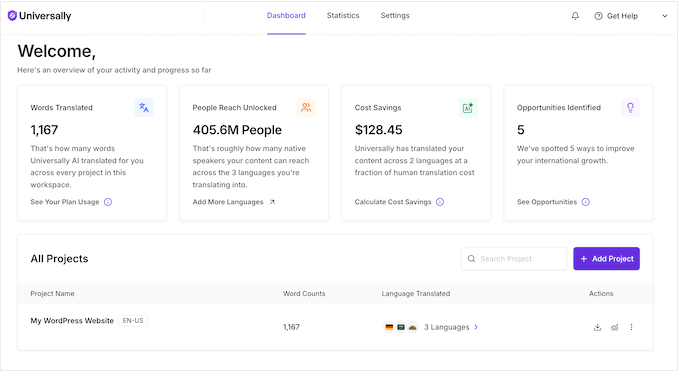
We’ve been using Universally for a while now at WPBeginner to translate our WordPress content and reach readers around the world.
Before switching, we tried just about every well-known WordPress translation plugin. Most of them bloated our database and slowed down our admin area. On our eCommerce stores, the slowdown even reached the checkout, which is the last place you want it.
We knew we needed a solution that could translate our entire website easily and affordably without affecting performance.
That’s what led us to Universally. It translates your whole site into 110 languages in minutes, with no database bloat and no slowdown.
After using it across many of our sites, we wanted to share our experience so you can decide if it’s right for you. Here’s our complete Universally review.
Universally Review: Why Use It in WordPress?
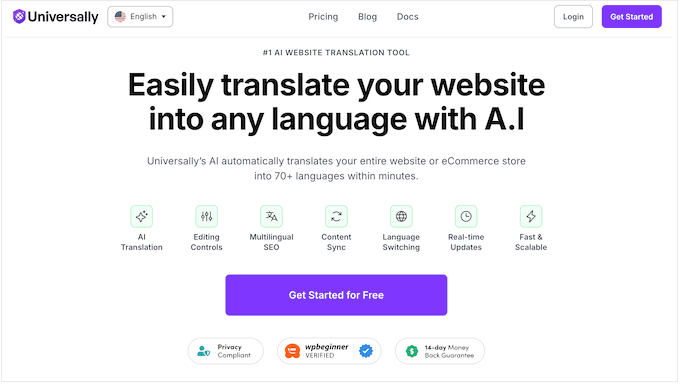
Universally is an AI-powered website translation tool built for site owners who want to reach a global audience without managing complicated translation workflows.
Once installed, it automatically detects every translatable element on your site, including blog content, button text, menu items, form labels, image alt tags, schema.org data, even your product descriptions on your eCommerce store, and more.
Universally translates them into 110 languages within minutes.
Unlike traditional translation plugins for WordPress, Universally doesn’t store anything extra in your WordPress database. Translations live on Universally’s cloud and content is delivered from edge (cloud servers closest to the user). This means your international visitors will likely see a faster version of your website.
Best of all, the Universally plugin works alongside the WordPress tools you’re probably already using, including WooCommerce, SeedProd, Elementor, Beaver Builder, and the leading SEO plugins. So you’re adding a global audience on top of your current setup, not rebuilding it.
Universally Review: Our Honest Experience Testing It on Real Sites
In our experience, the only way to know if a tool actually delivers is to use it on a live site. We used it on many of our sites, including WPBeginner.
We wanted to push it across the board, from simple blog posts right through to complex checkout flows. Here’s everything we found, the good and the few downsides, so you can decide whether Universally is the right AI website translation tool for you.
1. Full Website Translation in Minutes, Not Months
When someone lands on your site and can’t read the language it’s written in, they leave and head to a competitor’s site that speaks their language.
In other words, while your content sits in a single language, someone else is building the localized version of your business and collecting the customers you worked so hard to attract.
The old way to fix this was to hire professional translators. But that’s slow, expensive, and never truly finished. When you publish every new post or product, you’ll have to pay your translators and wait until they translate your site.
Universally’s AI translation engine removes that bottleneck completely by letting you translate your entire site’s content almost instantly.
At the time of writing, Universally supports 110 languages. That covers nearly every major market, along with the regional variants that usually require expensive separate add-ons in other tools.
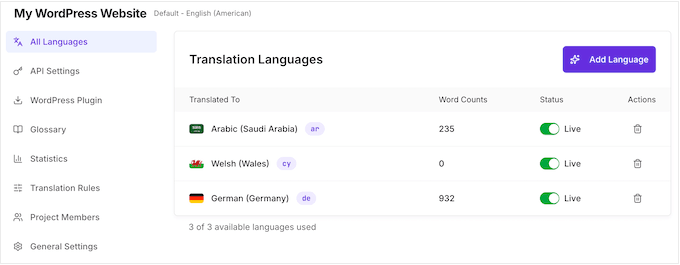
How We Use It: WPBeginner is a content-heavy site full of technical tutorials and WordPress resources. Unlike other plugins we’ve tested before, we didn’t have to wrestle with complicated settings or a manual workflow.
Within a few minutes, the entire site was translated into multiple languages. Product names stayed exactly as they should, plural forms matched perfectly, and culturally specific phrases were adapted rather than translated literally.
When you’re trying to build trust with international readers, those subtle details are exactly what separate a site that converts from one that feels off.
Our Honest Review: Compared to where machine translation was even two years ago, Universally is in a completely different league. The new AI models have gotten so much better that a small business owner who is not using translations is just missing out. For everyday content, this is the best automated quality we’ve seen.
2. Protecting Your Brand With AI Glossaries and Rules
The AI-powered glossary is how Universally keeps your brand voice and industry terminology consistent across every language.
To set it up, you simply add a list of terms with specific rules attached:
- Keep untranslated: Force the engine to leave a brand name or product exactly as it is, everywhere.
- Force specific translations: Make sure a technical term is always translated the same way in a given language, avoiding confusing synonyms.
- Case-sensitive matching: Use case-sensitive rules for precise control over things like acronyms (for example, “SEO”) versus regular words.
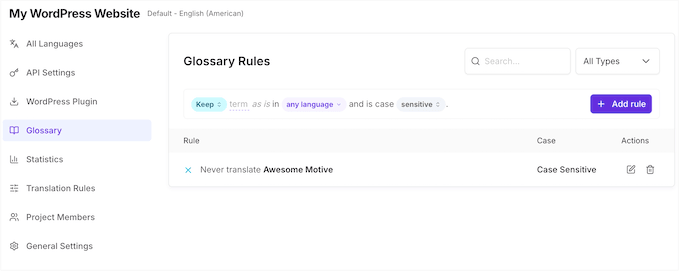
If you regularly use specific product names, trademarks, or technical language, this is a must-have feature.
How We Use It: We logged into the Universally dashboard and built a glossary with our product names, a few acronyms, and some trademarked feature names we wanted kept in English.
Then we tested its flexibility by adding a technical term we wanted rendered a specific way in German, while letting the AI handle it naturally everywhere else. Universally applied these per-language rules cleanly, with no surprises.
Our Honest Review: The glossary is one of those features you don’t realize you need until you’ve already run into the issue. Trust us, the first time you see an AI mistranslate your flagship product name across hundreds of blog posts, you’ll understand why this matters. Fixing those errors by hand is a nightmare. What we appreciate most is that Universally’s version is clean and code-free: you set your rules once, and the engine does the heavy lifting from there.
3. International Rankings Made Easy
This is the feature we think will make Universally pay for itself. Search engine optimization (SEO) is exactly where many translation tools break your site, even when the content looks fine on the surface.
Universally sidesteps those traps by automatically generating translated meta titles, meta descriptions, and structured data for every language you add. It also creates translated Open Graph tags, translated internal links, and clean per-language URL prefixes like /fr/ or /de/.
It even manages your hreflang tags, which are the technical signals that tell search engines exactly which version of a page matches a specific language and region.
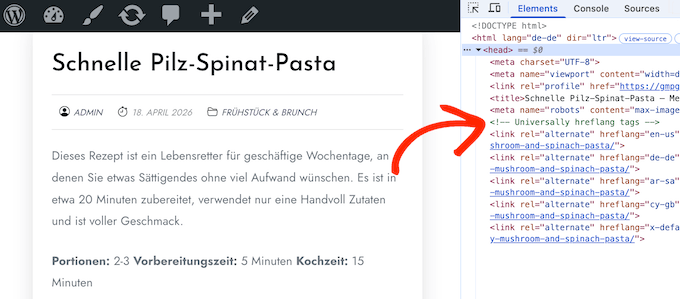
The payoff is that every translated page is fully crawlable and indexable. Instead of treating your translations as duplicate content, search engines treat each language version as its own independent, primary page, which is exactly what you need to rank in international search results.
How We Use It: On one of our sites, we went looking for the technical errors that translation plugins so often cause. Instead, Universally produced clean hreflang blocks across all our target languages and per-language URLs that worked perfectly.
We also confirmed that it preserved our schema markup. Everything was indexable, with no broken redirect chains and no conflicts with the original source language.
Our Honest Review: Multilingual SEO is easily one of Universally’s strongest features, and the one most likely to grow your traffic. One tip from experience: Universally translates the metadata you give it, so it pays to get your source-language SEO right first. We’d run a tool like All in One SEO (AIOSEO) on your original titles and descriptions, so Universally has the best possible foundation to translate from.
4. Global Performance Without the Database Bloat
If you’ve ever tested your site speed after installing a traditional translation plugin, you probably noticed that your pages suddenly load more slowly.
Here’s why: Most translation plugins save a copy of every translated page inside your WordPress database. The more languages you add, the harder your database has to work, and the slower your site gets.
Since Universally doesn’t store anything extra in your WordPress database, you can add dozens of languages without touching your site’s core performance, and your existing CDN and caching plugins keep working right alongside it.
How We Use It: We tested and compared site speed on one of our sites before and after connecting Universally with three active languages. The translated versions loaded just as fast as the source-language pages, and our Core Web Vitals scores didn’t move at all. That’s the first time we’ve ever been able to say that about a translation plugin.
Our Honest Review: Website performance is a big advantage when it comes to using Universally. Translations are served from Universally’s cloud and content is delivered from servers closest to the user. Uptime was rock-solid throughout our testing.
5. Granular Control and Exclusion Rules
Sometimes you don’t want AI touching your content at all. Maybe it’s a code snippet, a testimonial in someone’s exact words, or a legal disclaimer you can’t rephrase.
Universally solves this by letting you exclude specific CSS classes and element IDs from translation. You can even exclude entire pages, which is perfect for legal documents, internal directories, or region-specific landing pages that should only ever exist in one language.
You set these rules once in the dashboard, and Universally applies them across your whole site automatically.
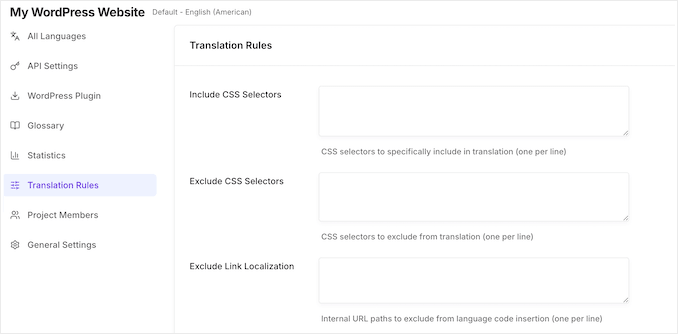
How We Use It: On one of our sites, we added exclusion rules for a PHP code block, a testimonial slider, and a branded pricing table we wanted kept in the original language. We also excluded a legal page from translation entirely, since the wording needed to stay in English for compliance reasons. Universally respected every single rule without us doing anything else.
Our Honest Review: Exclusion rules are one of those small features that save you from massive headaches, and we’d consider them essential in any serious translation tool. Universally’s implementation is straightforward enough that anyone can manage it without specialist help, which is exactly what you want.
6. Set It and Forget It: Automated Content Syncing
This is the feature that changes how you run a global site. Keeping every language version in sync when you publish new content is one of the most annoying parts of going multilingual, and Universally just handles it.
The moment you hit ‘Publish’ on a post or product, Universally translates it into every active language and pushes it live automatically. You never have to remember to trigger a thing. The same goes for edits: change something in your source language, and Universally syncs that change across every translated version.
This is exactly where manual workflows fall apart. We’ve seen countless sites where the English blog is updated regularly while the translations sit stale for weeks, which hurts both engagement and your SEO rankings.
How We Use It: We published a new blog post on one of our sites and watched the Spanish, German, and French versions appear within a few minutes. Each one had the correct metadata, a localized URL, and even translated image captions.
Our Honest Review: Automatic real-time syncing is the one feature we’d be most reluctant to give up. If you’re coming from a manual workflow where you export files or click ‘Translate’ every time you fix a typo, this is the change you’ll feel every single day. It makes running a global site feel as simple as running a single-language blog, and for anyone who publishes regularly, it justifies the cost of a paid plan on its own.
7. Mobile-First Language Switcher and Auto-Detection
Universally ships with a built-in language switcher that lets visitors move between every language your site supports. It comes with several styling options, so you can match it to your branding and WordPress theme without writing any custom CSS.
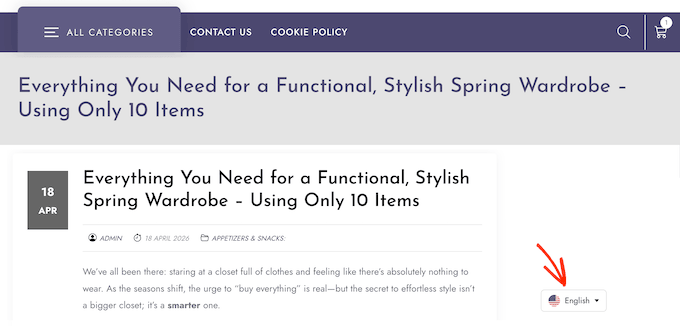
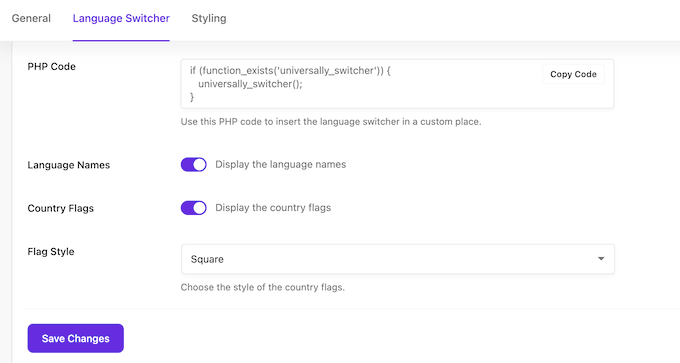
You can customize the colors, borders, border radius, and dropdown styling, and choose to show language names, country flags, or both.
Placement is just as flexible: Universally can auto-place the switcher in any corner of the screen, or you can drop it anywhere on your site using a shortcode it generates for you.
The part we appreciate most is the smart auto-detection. Universally identifies a visitor’s likely language from their browser settings, IP location, and previous visits, then gently suggests the right version rather than force-redirecting them. It also remembers their choice for return visits.
On top of that, the switcher meets WCAG 2.1 AA accessibility standards and is built mobile-first, with properly sized tap targets so visitors won’t accidentally tap the wrong language on a small screen.
How We Use It: We dropped the switcher into the header of one of our sites and set it to show the native name of each language (like Français or Deutsch) instead of just flags. In our opinion, showing language names is the better option, since flags can misrepresent specific regions.
Our Honest Review: Plenty of language switchers look fine until you check what they’re doing to your site speed. Universally’s loads asynchronously, weighs under 5KB, and has zero Cumulative Layout Shift, so it won’t quietly tank your Core Web Vitals. Pair that with WCAG 2.1 AA accessibility and mobile-first tap targets, and you get a rare front-end widget that’s both well-designed and well-engineered.
8. Works With Your Favorite Plugins and Page Builders
Plugin compatibility is where a lot of translation tools fall down, and it’s where Universally shines.
It’s designed to work alongside the most popular tools in the WordPress ecosystem, including major page builders like SeedProd, Elementor, Divi, and Beaver Builder. It also plays nicely with caching plugins, CDNs, and the leading SEO plugins like All in One SEO, Yoast SEO, and Rank Math.
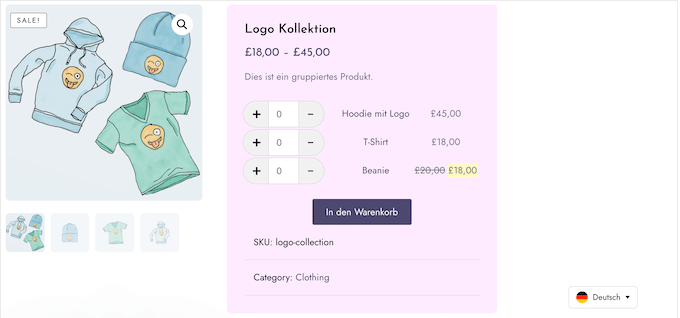
For online store owners, the WooCommerce integration is the standout. Universally translates everything an international customer needs to see, including product titles, descriptions, attributes, variations, categories, cart, and checkout. (Just remember you’ll still need a payment gateway like Stripe or PayPal that supports local currencies to complete the experience.)
How We Use It: On one of our sites, we built a WooCommerce store and several SeedProd landing pages before connecting Universally. It picked up every plugin’s output automatically, without us touching a single configuration setting. That included product pages, landing page copy, and the full checkout flow.
If you’ve ever tried to translate a WooCommerce store by hand, you know how much time this saves. Universally turns a complex, multi-day task into a fully automated one.
Our Honest Review: Plugin compatibility is one of those ‘quiet’ features that saves you the most time in the long run. We didn’t hit a single conflict during testing, even when we deliberately tried to create one. Universally is a textbook example of a tool that just works.
9. Built-in Analytics Dashboard
The analytics dashboard shows you exactly which languages are bringing in visitors, which pages perform best in each language, and how conversion rates differ across regions.
You can even track revenue by language, so you can answer real business questions like “should we add Portuguese?” with actual numbers instead of guesswork. For a site expanding into new markets, that’s gold for deciding where to invest your marketing budget next.
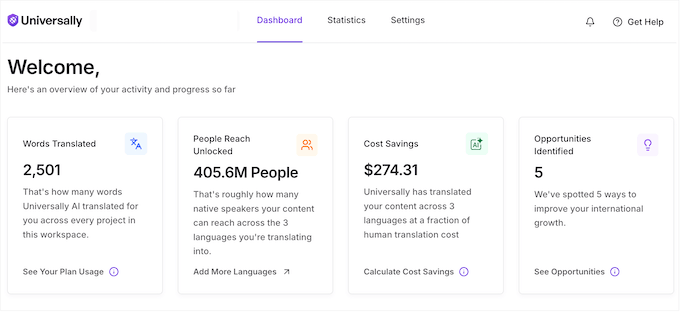
The dashboard also tracks translation coverage (the percentage of your site translated for each language) and includes a quality indicator that flags pages with unusually high bounce rates in a specific language, so you can spot and fix translation issues fast.
Analytics activate automatically when you install Universally, with no manual setup. The data then flows into Google Analytics, your eCommerce platform, your CRM, and the other tools you already use.
Our Honest Review: The analytics dashboard is more useful than we expected. It’s not meant to replace a full analytics tool like MonsterInsights or Google Analytics, but it gives you per-language conversion and revenue data that’s normally very hard to pull together. In one glance, you can see which markets are actually converting and decide where to focus next, without digging through complex reports.
Universally is the Most Affordable AI Translation Tool
Universally is one of the most affordable AI translation tools we’ve come across, and it’s 50% cheaper than other tools like Weglot.
It also offers a genuinely useful free plan so you can test the AI on your own content before paying a cent. The free tier covers one website, one additional language, and up to 2,000 translated words. That’s not enough to run a fully multilingual blog or store, but it’s plenty to translate an About page or a key landing page and see firsthand whether the output matches your brand voice and handles your jargon correctly.
Our advice: treat the free tier as a quality test, not a starter setup. Spend those 2,000 words on your most complex content, since that’s where you’ll really see what the engine can do.
When you’re ready to go further, the paid plans unlock more languages, higher word counts, and support for multiple sites. Choose annual billing and you’ll get two months free. The prices below reflect that annual rate.
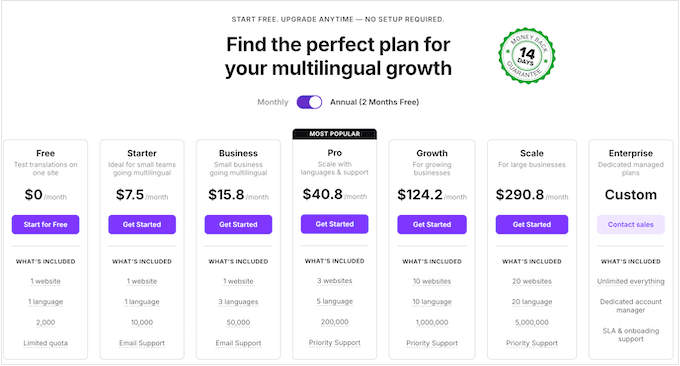
- Starter ($7.50 per month). One website, one language, and 10,000 translated words. A great starting point if you run a small business website or personal blog and want to add a second language.
- Business ($15.80 per month). One website, three languages, three team members, and 50,000 words. A solid choice for most content-heavy blogs and WooCommerce stores.
- Pro ($40.80 per month). Marked ‘Most Popular,’ this covers three websites, five languages, five team members, and 200,000 words, plus more advanced analytics like page view stats. We’d recommend this tier for freelance developers or small agencies managing a handful of client sites.
- Growth ($124.20 per month). Ten websites, ten languages, and one million words. A good fit for larger agencies or in-house teams maintaining multiple properties.
- Scale ($290.80 per month). Twenty websites, twenty languages, twenty team members, and five million words. Built for enterprise publishers or agencies operating across many regions at once.
- Enterprise (custom pricing). Unlimited sites and languages, a dedicated account manager, and SLA-backed support. Worth a look if you have a huge content library or strict compliance requirements.
Universally Review: Community and Professional Support
Universally’s documentation hub is well organized into categories covering everything from installation and language management to troubleshooting, billing, multilingual SEO, migrating from other plugins, and a dedicated developer/API section.
The guides are clearly written for site owners rather than developers, which fits the product’s audience perfectly.
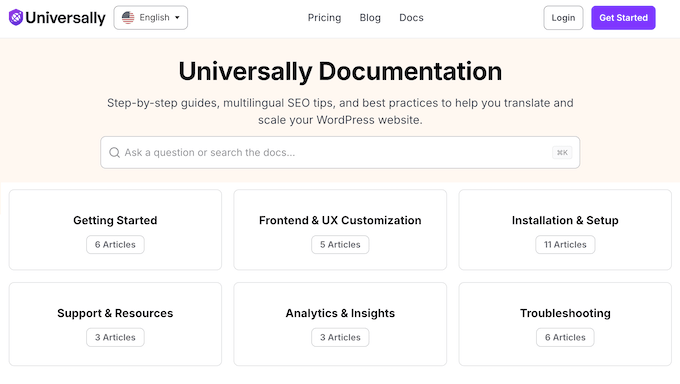
If the docs don’t have what you need, you can reach the Universally team directly by submitting a support ticket. They don’t publish a specific response-time SLA, but we found them fast and genuinely helpful during our testing.
Support is included on every paid plan, and upgrading to Pro or higher unlocks Priority Support for faster answers. If you’re running a high-traffic business site where every minute of downtime counts, those higher tiers are worth it for the quicker turnaround.
💡 If you do reach out, we highly recommend following our guide on how to properly ask for WordPress support. The more context and screenshots you provide upfront, the faster the team can solve your problem and get your site back on track.
Is Universally the Right AI Website Translation Tool for You?
After testing it across many blogs, eCommerce stores, and more, our verdict is simple: Universally has become an essential part of how we manage multilingual content at WPBeginner, and it’s the strongest AI-first translation tool we’ve used.
What stands out most is the performance. Because Universally keeps translations in its own cloud instead of your WordPress database, you can add language after language without slowing your site down.
And since translated pages are served from edge servers close to each visitor, your international audience often gets a faster experience, not a slower one. After years of watching traditional plugins bog down our admin area and even our checkout, this alone was a huge deal for us.
If you’re just starting out or have a limited budget, the free plan lets you test the AI on your most important pages, and Starter adds a second language to a small blog or business site.
Universally is the most affordable AI translation tool on the market. Compared to other AI translation platforms, Universally is up to 50% cheaper.
Universally: Your Top Questions Answered
To help you decide if Universally is right for you, we’ve pulled together the most common questions we hear from our readers. Here’s what you need to know:
Is AI translation accurate enough?
Yes, for the vast majority of content. In our testing, standard blog posts and marketing pages were ready to publish as they were. For high-stakes pages like legal disclosures, we’d still have a native speaker review the copy, but that’s true of any translation tool.
Do I need any coding, or is it beginner-friendly?
No coding required. Universally is built for site owners. You install the plugin, connect your account, and pick your languages, and it handles the translation, SEO tags, and language switcher automatically. Even advanced options like glossary terms and exclusion rules are managed through simple dashboard settings.
Will Google penalize my AI-translated content?
No. Google doesn’t penalize translated content as long as it’s properly marked up, and this is one of Universally’s biggest strengths. It automatically adds hreflang tags, translated metadata, and clean per-language URLs, which tell search engines that each version is a distinct page for a specific language and region, not duplicate content. That’s exactly what you need to rank in international search results.
Do I need a separate domain or subdomain for each language?
No. By default, Universally publishes each language under a clean subdirectory of your existing site, like yoursite.com/fr/ or yoursite.com/de/. That means you don’t have to buy extra domains, set up new hosting, or manage separate websites.
If you liked this article, then please subscribe to our YouTube Channel for WordPress video tutorials. You can also find us on Twitter and Facebook.

Universally User Reviews
Please share your Universally review to help others in the community.