


A reliable WordPress backup plugin automatically sends site backups off your server on a schedule and restores everything with a single click.
Duplicator with Duplicator Cloud is our top pick, and UpdraftPlus is best for free backups to Google Drive.
In this guide, we’ll compare the 6 best WordPress backup plugins, including their cloud storage, incremental backups (copies of only what changed) and free features.
Our Top Picks for the Best WordPress Backup Plugins
| Pick | Best For | Pricing |
|---|---|---|
| Duplicator | Cloud backups with one-click restore | Free + paid from $69.30/yr |
| UpdraftPlus | Free backups to Google Drive or Dropbox | Free + paid from $70/yr |
| Jetpack VaultPress Backup | Real-time backups for WooCommerce stores | Paid from $59.40 for the first year (backups need a paid plan) |
| BlogVault | Managed off-site backup service | 7-day free trial + paid from $49.50/yr |
| Total Upkeep | Budget backups | Free + paid from $2.50/mo, billed yearly |
| BackWPup | No-frills free backups | Free + paid from $49/yr |
Local vs Cloud Backups: Where Your Backup Should Live
While many web hosts create automatic backups for you, those copies typically live on the same server as your website. If that server crashes or gets hacked, your backup can disappear right alongside your site.
To protect your business, you need an off-site backup. This is a separate copy stored somewhere other than your web server.
A simple way to plan this is the 3-2-1 rule, which means keeping 3 copies of your data on 2 different storage types, with at least 1 copy off-site.
There are two ways to get your backups off-site:
- A plugin that sends backups to cloud storage – Plugins like Duplicator and UpdraftPlus send your backup files directly to your preferred cloud provider, such as Duplicator Cloud, Google Drive, Dropbox, or Amazon S3.
- A backup service that keeps copies on its own servers – Services like BlogVault and Jetpack VaultPress Backup create the backup and store it for you, so you don’t need a separate storage account.
Full vs Incremental Backups
A full backup copies your entire website every time. Meanwhile, an incremental backup only saves the files and database changes made since your last backup.
This means incremental backups run faster, consume less cloud storage, and avoid putting unnecessary strain on your web host.
Incremental backups are essential if you run a high-traffic site, busy WooCommerce store, or perform daily or hourly backups. Here’s how each plugin handles them:
- Duplicator – Incremental backups require Duplicator Pro (version 5.1 or newer) paired with a paid Duplicator Cloud storage plan.
- BlogVault – All plans come with incremental backups built-in, and all processing takes place on BlogVault’s offsite servers to keep your site fast.
- Jetpack VaultPress Backup – Every paid plan makes one full backup first, then automatically switches to incremental backups.
- UpdraftPlus – Incremental backups need UpdraftPlus Premium, as the free version only makes full backups.
How We Test and Review Backup Plugins
To see how these plugins perform in real-world scenarios, we tested them on a sample site with roughly 1 GB of files and a 41 MB database. We also set up a second test environment specifically for BlogVault.
Here’s how they performed:
- A full backup to cloud storage – Duplicator created a 433 MB backup package in about a minute, completing its upload to Duplicator Cloud in 9 minutes total. Meanwhile, UpdraftPlus generated a 425 MB backup and sent it directly to Google Drive in just 3 minutes and 12 seconds.
- An incremental backup after a small change – After adding a new blog post and an image, Duplicator Pro ran an incremental backup in 53 seconds. It was just 3.81 MB, compared with 475 MB for the full backup that incremental mode starts from.
- A restore – Duplicator’s one-click recovery brought our entire site back online in 71 seconds. UpdraftPlus restored the exact same site from Google Drive in 2 minutes and 58 seconds.
- A restore with wp-admin locked out – We broke our test site so neither the site nor wp-admin would load, then restored it from the Duplicator Cloud dashboard in 28 seconds. On a second test site, Duplicator’s Recovery Point link did the same job in 112 seconds.
- A restore with the free version – While you can restore a backup using the free version of BackWPup, it requires a manual extra step. You have to download the backup file to your computer and re-upload it through the restore page first.
Keep in mind that upload and restore speeds will vary depending on your host and internet connection, so use these figures as a general benchmark. We also manually verified all pricing and free plan features directly on each developer’s site.
Why Trust WPBeginner?
WPBeginner is led by Syed Balkhi, a recognized expert and entrepreneur in the WordPress community. Our team has more than 16 years of experience in building and optimizing WordPress websites, so we know what backup features are the most important for website owners.
To give you the best recommendations, we set up demo websites to test every backup plugin and see how it performs in real life. Our editorial team also fact-checks our content for factual accuracy.
Want to learn more? Check out our editorial guidelines for more information.
1. Duplicator (Cloud Backups With One-Click Restore)
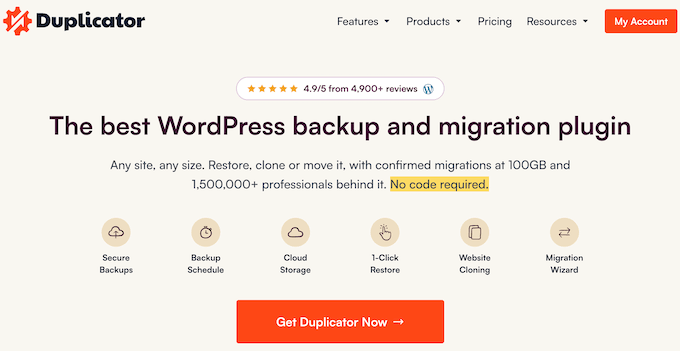
Duplicator is a popular WordPress plugin designed for backing up and migrating websites. You can choose between the premium plugin, or the free Duplicator Lite.
We use Duplicator on many of our partner sites to ensure our site data is always safe and easy to move. We’ve also written a full Duplicator review based on these experiences.
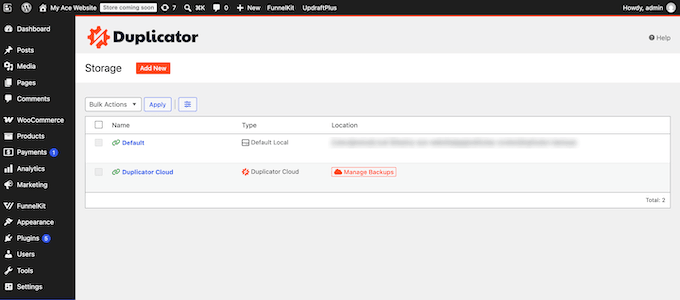
Duplicator Cloud is a paid storage plan, even if you use the free Duplicator Lite plugin. It sends your backups directly to secure remote servers without requiring a third party account like Google Drive or Amazon S3.
Plans start at $29/year for 2 GB and go up to $199/year for 150 GB.
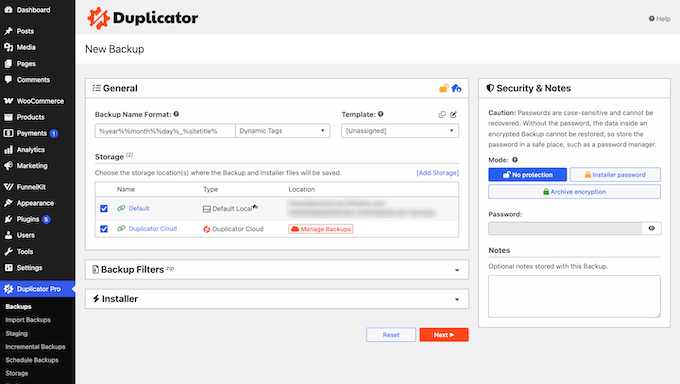
Duplicator Cloud can restore your site even when WordPress won’t load.
To set this up, click the recovery icon next to the ‘Edit’ button on your website’s page in Duplicator Cloud and save a recovery connector, which is your site’s FTP or SFTP login. Choose SFTP if your host offers it, because the FTP option sends your password as plain, readable text.
For this feature to work, your package must be a complete site backup that includes your database, core files, themes, plugins, and uploads. If you exclude any folders or tables to save storage space, you will not be able to perform an emergency restoration through Duplicator Cloud.
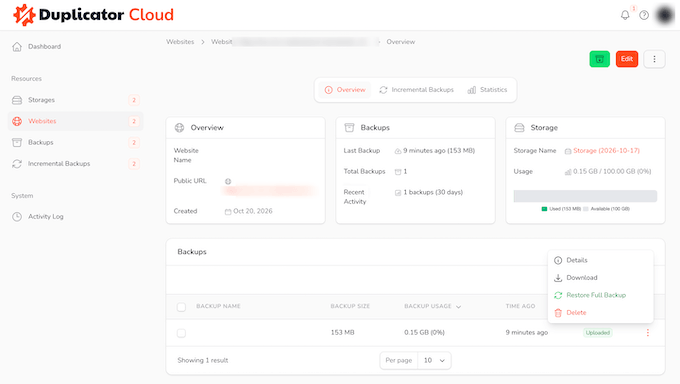
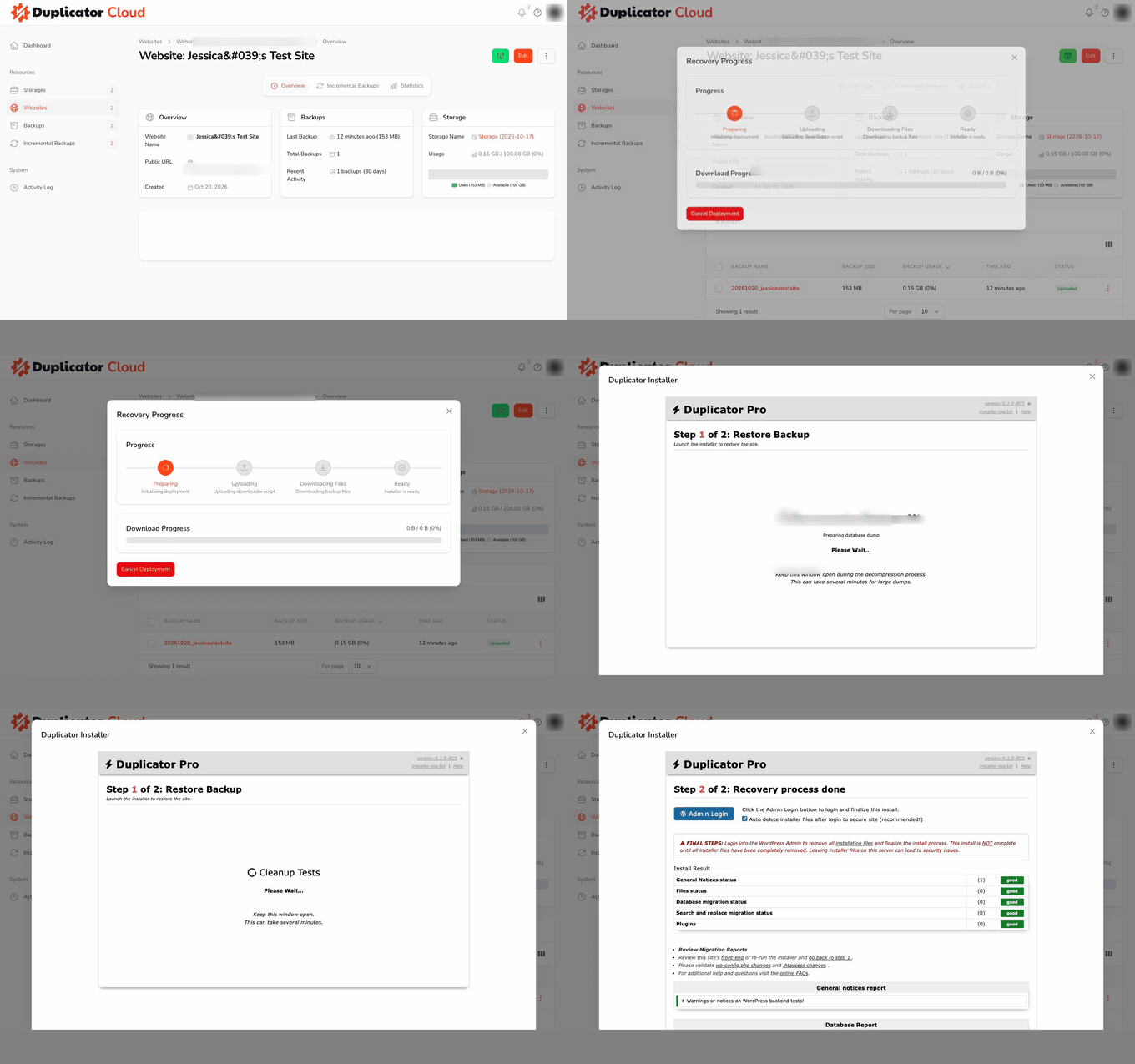
To restore a backup, open the backup menu, select Restore Full Backup, and confirm your choice by clicking Start Restore.
From there, accept the terms inside the Duplicator installer that opens within your dashboard and click Restore Backup to finalize the process. In our test, this seamless workflow brought a locked out site back online in just 28 seconds.
Duplicator Pro can also restore your site without Duplicator Cloud.
Set a Recovery Point under Duplicator Pro » Tools » Recovery and save the Recovery URL, then open that link if you’re ever locked out of your site.
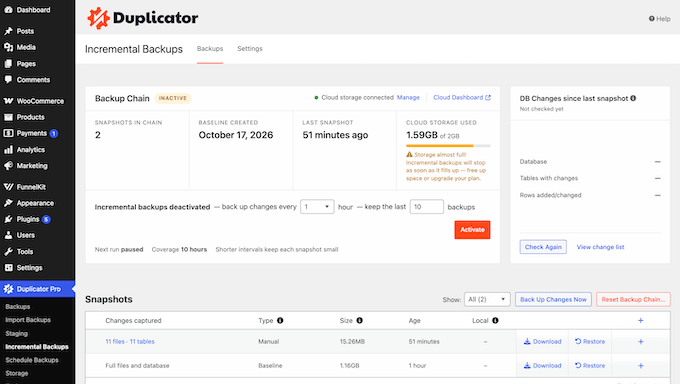
Duplicator Pro 5.1 and newer can make incremental backups to Duplicator Cloud, and the Cloud storage plan is paid. After one full backup, Duplicator saves only what changed. In our test, that was 3.81 MB in 53 seconds, compared with 475 MB for the first full backup.
You turn this on from Duplicator Pro » Incremental Backups, where you can back up changes every 1 to 24 hours. In our test, the 475 MB full backup took up 1.16 GB of Duplicator Cloud storage, so choose a storage plan with plenty of room.
If the incremental backup says it ‘does not meet the build requirements’ after you restore or move a site, go to Duplicator Pro » Tools and click ‘Delete Installation Files’, then try again.
Pros of Duplicator:
- One-click restores are included in the free version.
- AES-256 encryption scrambles your backup file so only someone with the password can open it.
- Pro also sends backups to Google Drive, Dropbox, Amazon S3 and OneDrive.
- It supports large sites and multisite networks.
- You can run a backup by asking your AI assistant, using the free WPVibe plugin.
Cons of Duplicator:
- Scheduled backups need Duplicator Pro, which can back up your site automatically every day or week.
- Duplicator Cloud storage is a separate yearly plan.
Pricing: You can download Duplicator Lite from WordPress.org. Meanwhile, premium plans start at $69.30/year (normally $99), and Duplicator Cloud storage starts at $29/year.
WPBeginner readers can use our Duplicator Pro coupon code for a discount on their purchase.
Why we recommend Duplicator: It gives you one-click restores for free, and Duplicator Cloud adds off-site storage and incremental backups without a separate storage account.
2. UpdraftPlus (Free Backups to Google Drive or Dropbox)
UpdraftPlus is the best free option if you want off-site backups without paying for additional storage.
You can choose between the free version or upgrade to UpdraftPlus Premium, depending on your site’s needs.
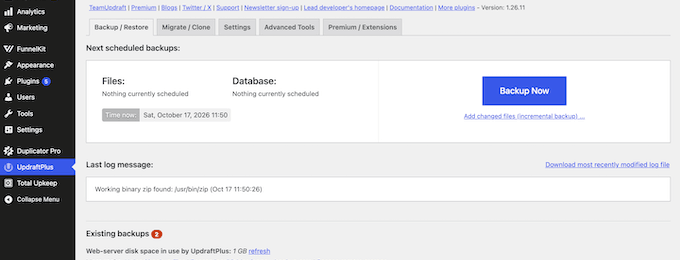
The free plugin lets you schedule automatic backups and send them directly to popular remote services like Google Drive, Dropbox, and Amazon S3.
In our test, the free version restored the entire website straight from Google Drive directly through the dashboard. We’ve also written a full UpdraftPlus review based on these experiences.
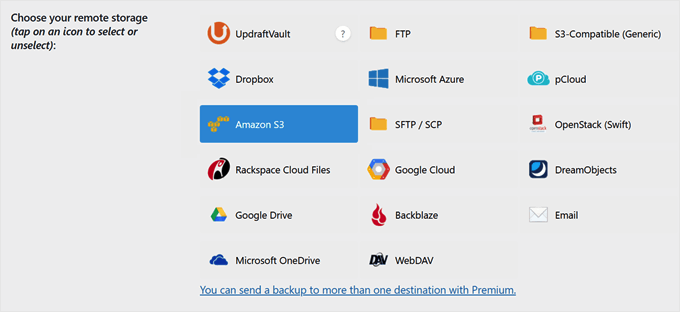
Within the free version, you can set automatic backups to run every 2 to 12 hours, daily, weekly or monthly.
However, advanced features like incremental backups, OneDrive support, SFTP, and several other remote storage destinations require an UpdraftPlus Premium subscription.
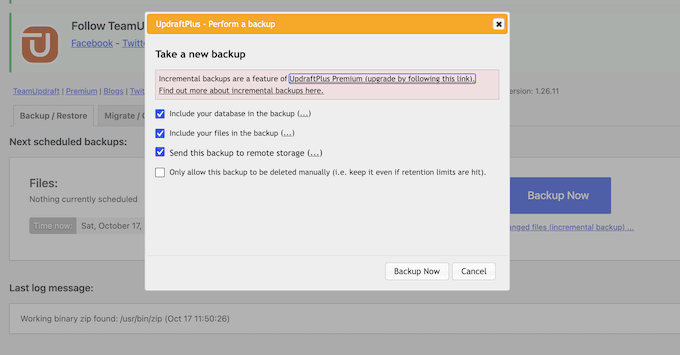
Pros of UpdraftPlus:
- You can restore files, plugins, themes, or the database on their own, or restore everything at once.
- Email notifications alert you automatically whenever a backup finishes.
Cons of UpdraftPlus:
- Database encryption requires UpdraftPlus Premium, so backups made with the free plugin aren’t encrypted.
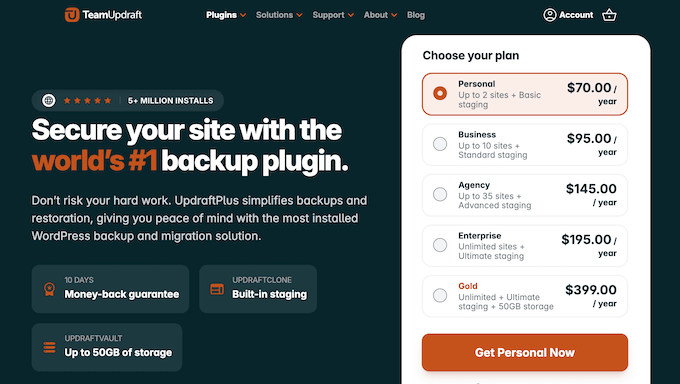
Pricing: You can download the free version of UpdraftPlus from the official WordPress repository. Meanwhile, UpdraftPlus Premium starts at $70/year for up to 2 sites.
Why we recommend UpdraftPlus: It offers scheduled off-site backups and full restores completely for free, using cloud storage accounts you likely already have. This makes UpdraftPlus an easy, cost-effective way to keep your site data safe.
3. Jetpack VaultPress Backup (Real-Time Backups for WooCommerce Stores)

Jetpack VaultPress Backup is a dedicated backup service from Automattic, the company behind WordPress.com. You can choose between the standalone backup plan or bundle it with other Jetpack features depending on your site’s needs.
This service saves a copy of your website every time a change occurs and stores it directly on Jetpack’s remote servers.
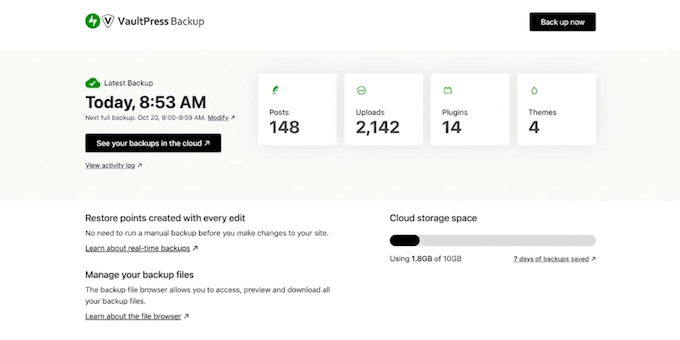
If you run an online store, Jetpack can restore your site while keeping your most recent orders and customer data intact. This means you won’t lose new sales data when you roll back to an earlier backup.
Pros of Jetpack VaultPress Backup:
- Backed by Automattic’s enterprise-grade infrastructure and security expertise.
- Backups run entirely on external servers so your site stays fast and responsive without taking up your own hosting resources.
- Simple one-click restoration process for both full and partial backups.
- Direct support from WordPress.com’s expert team.
Cons of Jetpack VaultPress Backup:
- The free plugin needs a paid Jetpack plan before it can make any backups.
- The 10 GB plan includes a 30-day backup archive, which can fill up on large sites.
Pricing: The Jetpack VaultPress Backup plugin is free to install, but backups need a paid plan. Plans start at $59.40 for the first year with 10 GB of storage, then renew at $119.40/year.
Why we recommend Jetpack VaultPress Backup: It’s the best option on our list for e-commerce sites because real-time backups protect every new order as it happens. This keeps your WooCommerce order history completely safe without putting extra stress on your server.
4. BlogVault (Managed Off-Site Backup Service)
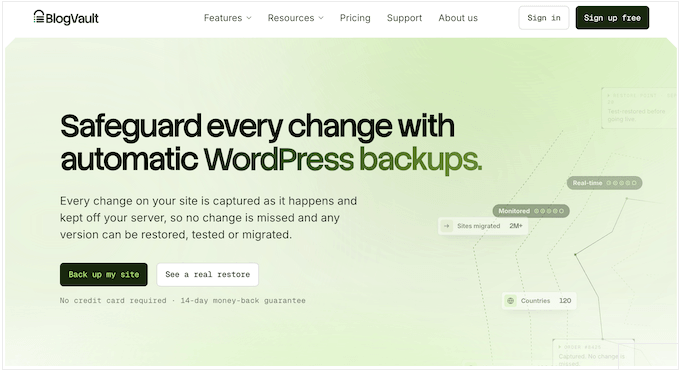
BlogVault is a managed backup service, which means its remote servers automatically create and store your site’s backups for you. Its incremental backups run on BlogVault’s servers, so there’s no extra load on your hosting. You can pick a plan that fits your preferred backup schedule and gives you access to the exact management tools you need.
During our testing, BlogVault performed its initial daily backup by copying our entire second test site offsite, which totaled about 2 GB of data. We have shared our complete thoughts and experience with this service in our detailed BlogVault review.
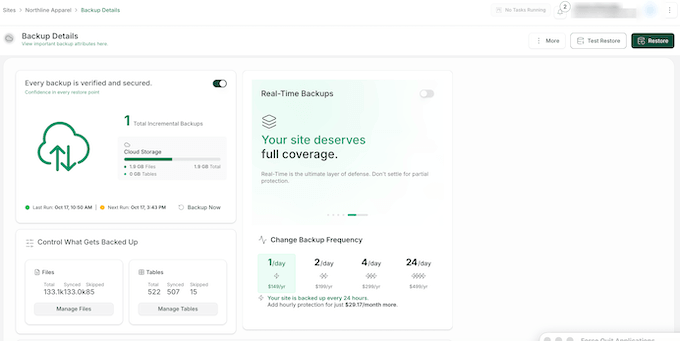
Store owners can enable real time backups in BlogVault to immediately log every WooCommerce order and customer update. Real-time backups save each change as it happens, so you don’t lose sales data between daily backups.
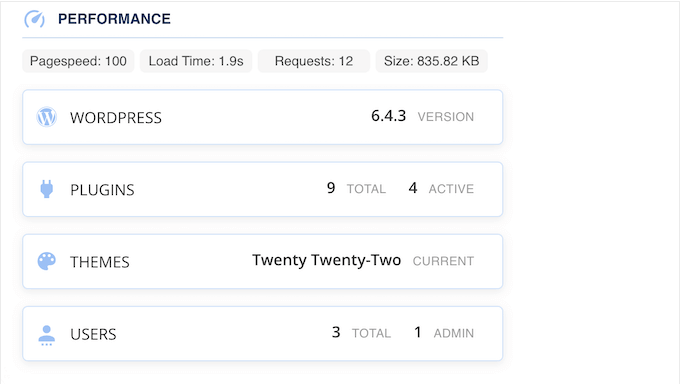
BlogVault’s integrated monitoring dashboard sets it apart from other tools. You can easily track your backup status, site uptime, malware threats, and Core Web Vitals all from one central location.
Pros of BlogVault:
- Built-in malware scanning and web application firewall.
- Automatic backup testing to verify that your backup files work before you need them.
- Detailed activity logging tracks every change made to your WordPress site.
- Staging and test restores that let you check a backup on BlogVault’s servers without altering your live site.
Cons of BlogVault:
- The starting plan only includes daily backups, while real-time updates require a higher-tier subscription.
Pricing: BlogVault has a 7-day free trial with no credit card needed. Paid plans start at $49.50 for the first year (normally $99/year) for daily backups on a single website.
Why we recommend BlogVault: This is the best managed solution on our list. It automatically handles backups, secure offsite storage, and test restores behind the scenes, keeping your website safe without slowing down performance.
5. Total Upkeep (Budget Backups)
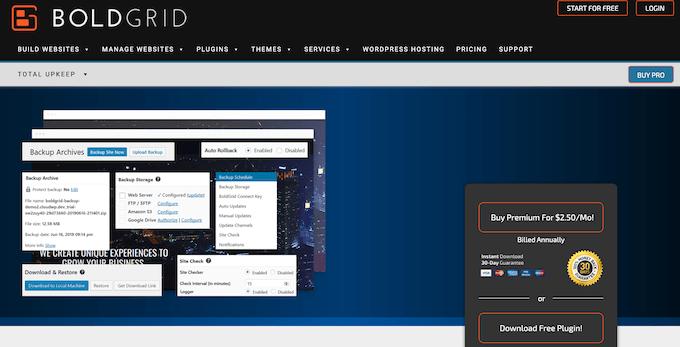
Total Upkeep is one of the most budget-friendly backup plugins available for WordPress users. You can choose between the free version or upgrade to the Premium plan depending on your site’s needs.
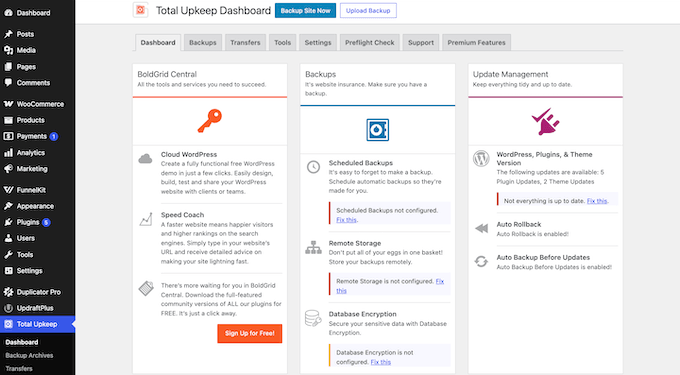
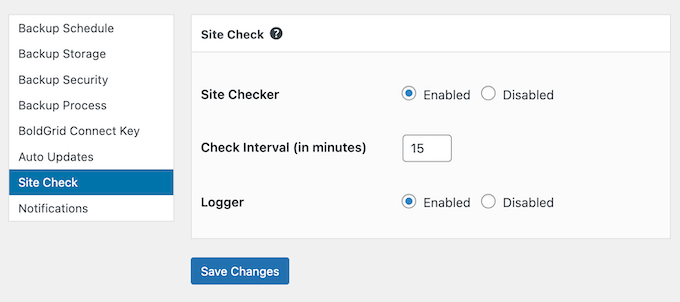
Unlike other backup plugins that simply create backups, Total Upkeep includes a Site Check feature that actively scans for potential problems before they cause data loss.
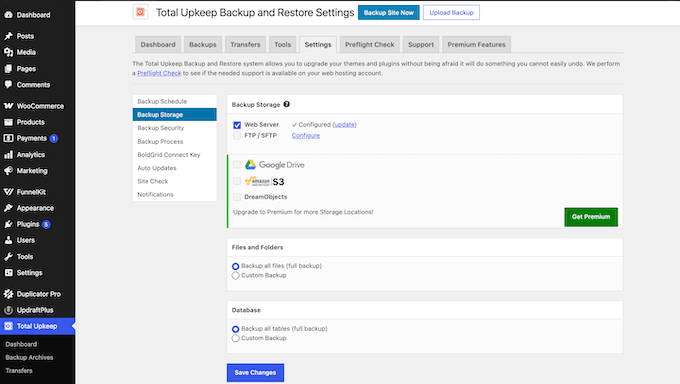
The free plugin stores your files on your web hosting server or via remote FTP and SFTP connections.
However, if you want to store your backups on external services like Google Drive, Amazon S3, or DreamObjects, you will need to upgrade to the premium plugin.
Pros of Total Upkeep:
- Automatically creates WordPress backups right before software updates to prevent unexpected site crashes.
- Built-in Site Check feature for proactive error detection and data loss prevention.
- Flexible backup scheduling with options for custom file and database table selection.
- Includes an emergency restoration script to recover completely crashed sites.
Cons of Total Upkeep:
- Sending backups to Google Drive or Amazon S3 needs Total Upkeep Premium.
Pricing: You can download the lite version of Total Upkeep for free. Meanwhile, Total Upkeep Premium costs $2.50/month (billed annually at $30/year) and includes coverage for unlimited websites.
Why we recommend Total Upkeep: This is a solid, budget-conscious choice for website owners who manage multiple sites.
6. BackWPup (No-Frills Free Backups)

BackWPup is an ideal choice if you’re looking for a simple, no-frills backup solution that just works.
A short setup wizard guides you through choosing what to back up, how often to run it, and where to store your files, allowing you to create complete WordPress backups for free.
While the free version lets you restore a backup, it requires a few manual steps. You need to download the backup file, upload it on the BackWPup » Restore backup page, and enter your database details.
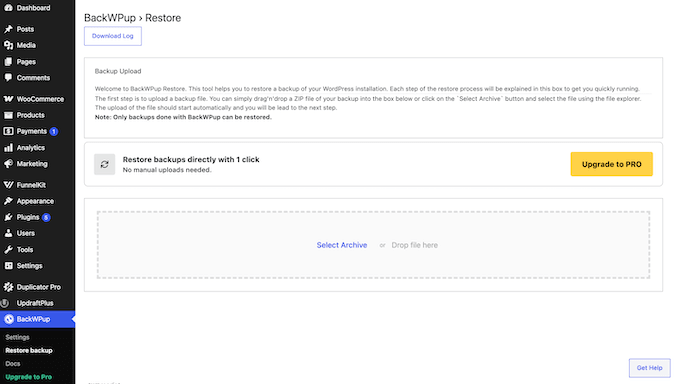
If you want to perform one click restores directly from your remote storage, you will need to upgrade to the premium plugin.
Pros of BackWPup:
- Clear, simple interface that doesn’t overwhelm users with unnecessary options.
- Easy-to-schedule automatic backups that run seamlessly in the background.
- Free backups to Dropbox, Amazon S3, FTP and Microsoft Azure.
Cons of BackWPup:
- You can only restore backup files created specifically by BackWPup.
- Popular remote storage options like Google Drive and OneDrive require BackWPup Pro.
Pricing: You can grab the free version of BackWPup from WordPress.org. Meanwhile, BackWPup Pro starts at $49/year for 2 sites.
Why we recommend BackWPup: This backup plugin is a good fit for bloggers, small business owners, or anyone who wants a straightforward way to keep their files safe. A clear setup wizard guides you through every step, and automated scheduling keeps your backups running consistently without any extra effort.
Where to Store Your Backups (and Your Media Files)
Here are the most common places to store your backups:
- Duplicator Cloud – Built into Duplicator, so you don’t need a separate storage account.
- Google Drive or Dropbox – Convenient options that use free cloud storage you likely already have, and UpdraftPlus connects to both.
- Amazon S3 – The cheapest option per gigabyte for large sites, but it takes more setup.
If you came here looking for cloud storage for your images, WP Offload Media moves your media library to Amazon S3, Google Cloud or DigitalOcean Spaces. This saves server space while also speeding up delivery.
It isn’t a backup plugin, though. The free Lite version offloads new uploads only, while the premium plugin (from $39 for the first year) also moves your existing media library.
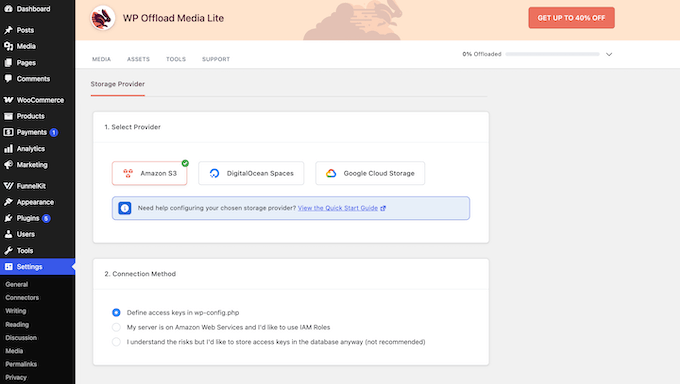
Alternatively, you can connect Google Drive directly to your WordPress media library.
Which Is the Best WordPress Backup Plugin?
Here’s the best pick for each job:
- Cloud backups with one-click restore – Duplicator paired with Duplicator Cloud.
- Free backups – UpdraftPlus, or Duplicator Lite if you want one-click restores.
- Large or busy sites – Incremental backups in Duplicator Pro or BlogVault.
- WooCommerce stores – Jetpack VaultPress Backup.
WordPress Backup FAQs
Does WordPress have built-in backups?
No, WordPress doesn’t include a built-in backup system. While WordPress does automatically save revisions of your individual posts and pages, it doesn’t create complete backups of your website files or MySQL databases.
How do I back up my entire WordPress site?
The easiest way to back up your WordPress site is to use backup plugins like Duplicator or UpdraftPlus.
Many WordPress hosting providers also include backups in their plans. However, those copies are usually stored on the same server as your site, so keep an off-site copy too for extra safety.
Is my host’s backup enough?
Usually not. Most web hosts store backups on the same server as your website. A single server failure or security breach can destroy both your live site and your backup files.
It’s best practice to keep at least one copy off-site, as we explain in our local vs cloud backups section.
What is the 3-2-1 backup rule?
The 3-2-1 backup rule requires keeping three total copies of your data across two different media types, with at least one copy stored offsite.
For example, you might have a live website on your hosting server, a local backup stored on a local drive or server, and a cloud backup stored off-site in Duplicator Cloud or Google Drive.
What is an incremental backup?
An incremental backup saves only the files and database entries that have changed since your last backup. Because it avoids re-copying unchanged data, an incremental backup is faster and smaller than a full backup.
You can learn more about which plugins support this feature in our full vs incremental backups section.
Where are my WordPress backups stored?
That depends on your plugin settings. Most plugins save backups in a folder on your web server by default, which isn’t safe if the server fails.
To keep your website data secure, connect your plugin to remote storage like Duplicator Cloud, Google Drive, or Dropbox. Storing your site files offsite protects your data if your main server fails.
How do I back up WordPress without a plugin?
You can download your files over FTP and export your database using your hosting control panel.
If you need a step-by-step walkthrough, our guide on how to make a WordPress database backup manually covers the entire process.
Is there a free backup plugin for WordPress?
Yes, several popular backup plugins offer free versions.
Duplicator’s free version is great if you want an easy-to-use backup wizard. UpdraftPlus is ideal if you need free cloud storage integration with services like Google Drive or Dropbox.
How often should I back up my WordPress site?
It depends on how often your site changes. It’s best to back up active blogs daily, while you should back up online stores in real time, or several times a day, to safeguard fresh customer orders.
If you rarely change your site, a weekly backup works fine.
Best WordPress Backup Guides for Your Website
- How to Backup Your WordPress Site (Ultimate Guide)
- Beginner’s Guide: How to Restore WordPress from Backup
- How to View a WordPress Backup as a Website (Easiest Way)
- Best Dropbox Plugins for WordPress (Expert Picks)
- How to Connect Google Drive to Your WordPress Media Library
- How to Easily Save a Blog Post to Your Computer
We hope this article has helped you find the best WordPress backup plugin for your website. You may also want to check out our guide on must-have WordPress plugins for your business and our comparison piece on All in One WP Migration vs Duplicator.
If you liked this article, then please subscribe to our YouTube Channel for WordPress video tutorials. You can also find us on Twitter and Facebook.




Dr Russell Cunning
I’ve been using UpdraftPlus for a while now, and theonly issue I have is that no matter what settings I change, it will NOT delete old backups. Consequently my hosting gets full and I have to go in and manually remove the old backups. I have them set to email me the .zip file, and only keep 1 backup on hand – but UpdraftPlus will not delete them. And unless you buy the ‘Premium’ version, there is no help available – you have to log in to get assistance. No way I’m buying the ‘Premium’ version of a plugin that doesn’t work properly!
Serge Mayer
Hello!
Then so it happened that on my sait there was a failure, and many files were damaged.
I decided to be protected. Also I found very interesting and simple solution
First of all I I have downloaded BackUpWordPress but unfortunately gives out problem with BBpress
I deactivated the dropbox plugin and reinstalled it, unfortunately now it is coming up with the above error. After I decided to pump WordPress Backup Dropbox I try to install the plugin again. The error was removed and I fixed this problem.
rokibul
how backup my data plz help
waqas
How do i back Up my site after update wp ….?
i’m confuse because I cannot backup my data and update wp new version please solve my problem
Ck
I have been using UpdraftPlus for years and found it a great tool and it’s free. However, I just ran into an issue and needed to restore a database with UpdraftPlus plugin which I recently updated. When I uploaded my backup which was downloaded from an slightly older version of the plugin, I received an error and found out that it was not backward compatible. The error message pointed to a “fix” for this which consisted of about 8 posts with absolutely no explanation or help what so ever.
WHAT’S THE POINT OF A BACKUP/RESTORE DATABASE PLUGIN THAT IS NOT BACKWARD COMPATIBLE??? I think it’s safe to say – I’m done with UpdraftPlus.
Joe Miles
This is highly unusual, but the reason for this isn’t incompatible backup formats (the backup format hasn’t changed). It’s a decision the WP core devs made about support for ancient MySQL versions.
You’ll need to update MySQL on the destination site – which the documentation explains.
For more help, please enter a question on the forum and we’ll be happy to help.
Matt
Maybe I’m dense, but the manual way to create site backups, including db backups, is not rocket science. So maybe I expect too much from a plugin designed to simplify the backup process. The sites I manage only require changes a few times each month. Sometimes not even that. So for me, it’s easier to use CODA to backup my site files, and rely on WP Database Backup to handle that. It’s so rare I need to restore a site, that I’d rather know my backups are legit.
Today, after reading this article I tried to find BackupBuddy but your links don’t work, and the return results in Google also wouldn’t resolve to a page. So I installed BackWpup on a site to test. It took three tries to get it to work. Your tutorial was somewhat helpful, but there are some changes in the dashboard options I saw. I have no idea what was causing the plugin to just hang for an hour, especially on a very small site . . . but I deactivated it, reactivated it, created the Job Name all over again, and it finally worked. However, I had to reload the page for the progress bars to get to 100%.
I went ahead and installed on a larger site and same issues. However, after 4 hours of messing with it, I finally uninstalled it. I lost work time thinking “any minute now” it’s going to work.
Maybe it’s because I updated my core WP to 4.5 today, but I don’t think that’s the issue. I did post a comment on their support page earlier today, and haven’t seen a reply.
I can now see why you just spend the money on a plugin that works. I guess I’ll have to do the same.
Amy Yoffie
Is there a backup program for my WordPress site that lets me do a backup of my site anytime I want? In other words, all the backup programs backup on a preset schedule, but sometimes I want to be able to add a backup manually.
Thank you.
WPBeginner Support
Most plugins in the list allow you to start a manual backup at anytime you want.
Admin
Sagar
On your recommendations here I tried almost all but finally I ended up with “BackUpWordPress” on my new blog – as this sends you a link to download the backup files.
Homer
Before, I’m using Updraft plus. But now, I used to subscribed a Wordpress Management service. They take care my website for me. They have their own backup system which is indefinitely stored on a cloud service. They also do some task for me, task related to my subscribed website.
credits to for such a good service
Jorge Wong
Have you heard about Backup Guard? For me it’s the best choice for backing up my blogs. Check it out
Richard Smith
I’m afraid I’ve had nothing but bad experiences with VaultPress. It has proven to be difficult to set up correctly and the customer service is very, very slow. Additionally, the customer service reps I have dealt with have not been very helpful at all. I do not recommend them at all.
Karen Ratte
Try BlogVault. – Worth every penny. It has saved my bacon several times and easy to use, reliable and quick. Support is fantastic too.
ERDAL
UpdraftPlus is the best by far
Mark C.
This is a good article and many will find it very helpful.
However, for 2015 I’m very surprised that number 7 (WP-DB-Backup) made the list as it only backs up the database. With respect to WP-Beginner, the title of the article uses the word “best” not “most popular” and backing up only the database is certainly not the best practice in today’s WordPress environment.
Many free backup plugins have the option to backup just the database on a schedule. Heck, most security plugins do as well – and on a schedule.
Also, I’ve found that Akeeba Core for WordPress is a great free solution for complete backups as well as restores. BackupBuddy is my preferred choice, but some who are on poor hosting have time out issues with it. Akeeba Core is a good alternative to try as it uses a different technology that seems to have more success with those hosts.
All in all a great article.
JennyC
Thank you this extremely helpful! It’s seriously like wordpress for dummies. Thanks!
Emily
UpdraftPlus is absolutely awesome! and the free version is cover most needed for just backup + upload to cloud storages. I tried it before found this. And I don’t thank they have bad interface. It really simple to use and very easy. Just a few clicks and you go. I really love it!
Prithviraj
BackWP UP is not worth. It makes great backup. Everything in a Zip, but restoring needs Adminer. It made all the restoration full of hassle. In the end, I did a manual restore, which was a crazy difficult task. Although I did it.
Joe Miles
The review says BackWPUp is complete – but without the ability to restore backups it’s incomplete!
UpdraftPlus has quickly become the world’s most popular backup in the last year because it is complete. BackWPup can even use UDP to restore backups made with their plugin.
Cathy Goodwin
Same problem. I think it’s important to add a note to this post to show that BackWPUP requires extra software or plug-ins to restore. One reason to use backup is to clone and this won’t do it.
Gabriela
You should also take in consideration the WP MyBackup which has many advanced features that other plugins do no provide. Besides that is comes FREE. If you need a more versatile version of it then it has also a PRO version which comes for only few bucks.
niki
I have a few clients on Godaddy hosting (ughh!) and Backupbuddy is no longer working because they choke their servers…does anyone have any experience with vaultpress and Godaddy? It is making me nervous that the sites are not getting backed up properly and I’d love to have the peace of mind
Stanford Griffith
If you want to migrate a site with UpDraft Plus, you’ll need to spend $30/year for access. It’s for an unlimited number of sites, but the year isn’t just support (60 days) and updates (1 year); it’s also support to install it on any new sites.
I tried just backing up with the site as a test before I bought the migration add-on, and it failed miserably after 10% of a tiny site.
David Anderson
Hi Stanford,
Sorry to hear you had a negative experience with UpdraftPlus. I’ve searched our support system for your name, and couldn’t find any tickets – please do file one if you have a problem. People have successfully used UpdraftPlus on sites up to 50 gigabytes in size (we’ve not tested beyond that).
Just to clarify – if you purchase the Migrator component, then you can download a zip file from your account page to install which you can use whenever you like – for life. It’s only the alternative install method, via connecting to updraftplus.com and downloading the latest add-on from your account, which you only have access to for 1 year; but, you don’t need to use that method.
David
Heinrich Ferreira
I’ve used several of the above plugins and none come close to UpDraftPlus. The UI is simple and to the point so I can’t see how the UI is cluttered.
I’ve been using UpDraftPlus on over 10 sites without a hitch. It’s been flawless on each site. I’ve also had to transfer all 10 sites over to a new host and without this plugin it would have been a nightmare. I didn’t need to use the migrator plugin at all but that may be down to how I installed each site.
Howard Lee Harkness
I have used Backup Buddy on several sites for a couple of years. Up until about two months ago, it worked really well. I even used it to migrate all of my sites to a new host using a lot less time than I expected.
Then it broke.
I’m not sure why, and the tech “support” at iThemes doesn’t know, either. I keep getting the same set of things to try (which I already did after reading their help files, and before submitting my first support ticket).
I’m guessing that there is a problem with a firewall plugin that I use, but even disabling all other plugins and renaming the .htaccess file does not get BB to work. For now, I am using the cPanel backup — which works, and fairly quickly — despite the fact that it’s a little less convenient than BB *used* to be. But a backup that actually works is much better than one that doesn’t.
I don’t really fault the program itself, but the “support” staff there is truly clueless.
Jimmy Krug
I’ve had the same thing happen with other plugins (Backup Buddy, Updraft Plus, etc.) They work good until… they don’t. Today I use a combination of plugin and Cpanel Backup. With Cpanel, I backup the Home Directory first, then the databases. By using a combination of plugin along with Cpanel, I have a “plan B” if something strange happens with one of the plugins. Sure, it takes a few extra minutes to make a Cpanel backup, but it’s worth having the peace of mind.
Jamila Chisti
WP-DB-Backup makes it really simple to create database backups, schedule automated backups, and restore your database.
francoise
Hi, is there a plugin that support both the daily scheduling and the choice of only a particular user posts?
Shams
I votes Updraft Plus as the best backup plugin and there are many valid reasons for it;
It is a completely free plugin. Anyone can take backups on local or remote storage without paying a penny.
It supports Dropbox with the help of which anyone can store backup on cloud and restore it on any hosting server. And thus it makes WordPress server migration very easy.
With the help of Updraftplus we can restore WordPress database and even files via WordPress dashboard and there is no need to do any work around like in Backupbuddy.
Umar Farooq
AWESOME!!!!!!
You just have solved my BIGGEST problem mate! Thanks for your review of Updraft Plus plugin
David
Greetings. I just installed and used UpdraftPlus (the free version). I agree with your review except that I did not find the interface at all cluttered. In fact, it is great and simple to use. I linked the backups to do remote backup with two clicks, to use DropBox. I am very pleased and impressed.
By the way, if you ask for an email address, it would be good to say something about how/why you are using it, and whether it will be publicly visible or not. In any case, thank you for a good review.
Mike
The only worthy and truly free ones are UpdraftPlus and xCloner
The other plugins are paid services or you have to pay to restore your backup
With UpdraftPlus you can backup and restore from GoogleDrive, Dropbox, Amazon S3…
xCloner is a more advanced solution, it also works as standalone solution for any website, but only supports Amazon S3 as a remote backup service, the problem with Amazon S3 service is that its only free for 12 months after registration
simone
Are you sure that the light vaulpress plan includes the incremental backup ? From what I see on their website, it doesn’t.
Michale
“Restoring a WordPress site from backup is also very simple. The BackWPup Pro version comes with priority support, ability to store backups on Google Drive, and some other cool features.”
Really? HOW EXACTLY, since BackWPup doesn’t have a Restore Backup function?!? For restoring backups you have to use another plugin and it all but easy! Did you even try this plugin before recommending it?
Arthur
I am using WordPress Backup (https://wordpress.org/plugins/backup-wp/) and it works like a charm. Highly recommended if you are looking for something simple!
Dedek Hajes
Updraft, BackupWordPress, Duplicator all fails on large sites.
I’ve got about 2.2GB eGallery and they fail due timeouts, no matter what hosting.
Solution?
Manual backup via FileZilla. Perhaps, once I become pro I go for VaultPress. That seems to be only one solution left for large sites.
Mark C.
Dedek – more than likely the reason for the timeouts on large sites with those plugins is the host has set the servers up for short PHP run times. Some hosts will adjust their settings if you call and ask and tell them why you need it.
Heinrich Ferreira
I think you’ll find your host setup is the issue. I’ve backed up and restored sites around 6gb without any issues.
Bill Hibbler
Backup Buddy is no longer free, unfortunately. The license ends up costing far more than the subscription based service you use unless you have a lot of sites to backup.
xpil
My favourite choice is UpdraftPlus. Fort a small site with a single-target backup store, the free version does its job just perfectly. And I had an opportunity to test the restore process, too. It is relatively painless, although some basic knowledge of MySQL databases and Linux filesystems is necessary.
Steve
Just loaded up WP-DB-Backup, bit concerning no update on repository for 1 year, super easy to install and configure…wow
Syed Balkhi
That’s awesome. Glad to help
owlsheadbiz
Many thanks for the recommendations! Just installed BackUpWordPress and it worked like a champ.
WPBeginner Staff
Some web hosts may have restrictions on installing some plugins. Please contact your web host for more information.
Warren Johnson
I just looked at BackWPup (9/2014) and the message on Wordpress is that this backup tool is not allowed.
Ricky Douglas
I was using Online Backup for WordPress to take care of my backup needs but after reading this review i’ve decided to give BackWPup try.
Thanks for sharing!
-Ricky
WPBeginner Staff
David,
We feel that our beginner level users
would be overwhelmed by the number of options. The options and
instructions on the updraftplus’ settings tab can be simplified using UI
elements like help buttons which expand when a user clicks on them to
show instructions. The text can be made more easy to read. Unnecessary
notifications can be hidden or closed once they are displayed.
. There is no button to close the two notifications that appear on plugins settings page.
. On the settings tab there are too many options.
. Whole sentences of instructions are linked.
. There is a request to purchase addons multiple times on the settings tab.
We
think that all these things can be cleaned up to create a better UI and
a better user experience, which will make updraftplus even more user
friendly.
Thanks
Emily
Agree with this but actually I like the link that open for more information. As beginner sometime use google for every sections is such a painful lol
Brian Breslin
Hey what about PressBackup?
Stephen Lahey
I love BackupBuddy. So quick and reliable. I can’t imagine using anything else for my WP sites.
WPBeginner Staff
Yes, you should always have your own backup system in place. Many of our users found themselves in situations where their hosting providers backup was corrupt or simply not available. Remember that your hosting provider is not obliged to backup your site. Its better to be safe than sorry.
David Anderson
Hi guys,
Thanks for including UpdraftPlus in the review. I was really surprised about the comments about the user interface, as this is something we’ve put a lot of effort into simplifying…. and the ease of use is mentioned very frequently in our reviews (and I can’t remember when I last saw a review that said that it was complex) – http://wordpress.org/support/view/plugin-reviews/updraftplus – I’d be really grateful if you could elaborate, because if there’s anything that can be further simplified then I would be grateful.
David
Uriahs
there is nothing wrong with the interface…our company use it to backup all of our clients websites also ours. I haven’t seen anything that a beginner level user would find hard. Great product, thanks
Jason
Thanks for these great selections! I have most of these in my list as well; however, I have been using Online Backup for WordPress by Backup Technology on a couple sites. It has worked very well for me. If I ever do go the premium route, I would go for Backup Buddy for sure. Thanks for sharing!
Matt
i am currently using godaddy as my host and they have a backup system integrated into their CPanel. Are there any advantages these 7 wordpress backup plugins have over godaddy’s backup system? thank you!
Manuel Echeverry
I personally use backWP up and it works as good as it said, fortunately untill know i didn’t used the backup but is good to have the peace of a backup stored in the cloud
Kate_H
I have tried the majority of the free backup plugins but have discarded them all for one reason or another. I like the idea of VaultPress but really didn’t want another subscription based service so I finally took the plunge and purchased a licence for BackupBuddy and so far I have been really pleased with how easy it is to use. The hardest part was opening and creating the storage accounts so I could save different backups to different locations.
Jer Trihouse
Updraft-Plus and Xcloner are both worthy of consideration; and free
James Salmons
You articles are among my favorites and I have previously found every
tip to be right, but I have to say that I have found one point here to
be quite different than my personal experience.
After using a number of other backups and finding most of them confusing at some point I switched to Updraft Plus exactly because it was so user friendly.
For example, when you want to restore you click on a big restore button, it shows you a list of a half dozen big buttons to restore each category:
pages, posts, database, etc. Very easy. I found the same to be true with
each stage of setting it up.
I had a friend with a strange saying: “As the farmer said when he kissed the cow, everyone to his own taste!” Perhaps the same applies here, we all have different tastes and come from different backgrounds, but I find Updraft Plus very easy to use.
Ihor Vorotnov
Check Revisr – a free plugin to deploy and backup your wp site with git (including database). It’s new but looks very promising.