


Affiliate marketing can make you money. People are earning with it every day, and you’ve probably seen those success stories all over the internet.
But affiliate marketing doesn’t click right away for everyone. Some people struggle at first, while others slowly build income that actually lasts.
The difference usually isn’t talent or luck. It’s how they go about it. The ones who see results focus on helping readers, sharing real experiences, and recommending things they genuinely trust.
I’ve spent years working closely with affiliate marketing and building a business around it with Pretty Links. This has helped me learn what actually helps and what tends to hold people back.
In this guide, I’ll share 7 simple, practical tips to help you grow your affiliate marketing revenue. You don’t need a huge audience or fancy tools. Just take it one step at a time and build it the right way.
Note: This is a guest post by Blair Williams, the founder of Pretty Links, a popular all-in-one affiliate link management plugin.
💡Key Takeaways: How to Grow Affiliate Revenue
In a hurry? Here are some key takeaways to grow your affiliate revenue:
- Promote products you’ve actually used – Readers trust firsthand experience more than polished hype.
- Structure your content for AI and search engines – Clear headings, lists, and FAQ schema make posts easier to read and rank.
- Create comparison posts that help people decide – Side-by-side reviews reduce decision fatigue and boost conversions.
- Build long-term relationships with brands – Trusted partnerships can lead to better support, deals, and paid opportunities.
- Build an email list – Capture your audience and promote products over time
- Target long-tail keywords with buying intent – Specific searches attract ready-to-buy readers and face less competition.
- Disclose affiliate links – Transparency builds trust and keeps you compliant
Below, I’ll walk through each tip and show how to apply it on a WordPress site — even if you’re just getting started.
- Why Affiliate Marketing Looks Different in 2026 (And Why That’s a Good Thing)
- Promote Products You’ve Actually Used
- Structure Your Content for AI and Search Engines
- Create Comparison Posts That Help People Decide
- Build Long-Term Relationships With Brands You Promote
- Build an Email List to Increase Affiliate Sales
- Target Long-Tail Keywords With Buying Intent
- Disclose Affiliate Links (It Builds Trust)
- Bonus: Helpful WordPress Tools for Affiliate Marketers
- Your Affiliate Action Plan for 2026
- Frequently Asked Questions About Affiliate Marketing
- Expert Guides for Affiliate Marketing
Why Affiliate Marketing Looks Different in 2026 (And Why That’s a Good Thing)
Affiliate marketing works differently in 2026 because search engines and readers now reward clarity and real experience, not mass-produced content.
Here’s what changed:
- AI made content faster and more common, so it’s harder for generic posts to stand out.
- Basic reviews don’t perform well anymore because they don’t help people decide.
- Search engines favor clear answers and firsthand experience, not filler content.
The good news? These changes make it easier for helpful, beginner-focused content to compete.
Why Honest, Simple Content Works Better Today
Honest, simple content works better today because people want clear answers from real experiences, not perfect-sounding reviews.
I’ve noticed that posts doing well now aren’t the longest or the flashiest ones. They’re the ones that clearly explain what a product does, who it’s for, and what to expect before clicking “buy.”
Here’s why this approach works so well:
- AI can’t show real screenshots or talk about mistakes you made.
- Being honest and specific helps beginners build trust faster.
- Smaller sites can win by being more helpful, not by publishing more content.
When you focus on clear answers and real experiences, your content becomes easier to trust. And in 2026, that trust is what helps affiliate content rank, get clicks, and earn commissions.
Now, let’s dive into my list of affiliate marketing tips to help you make more money.
1. Promote Products You’ve Actually Used
The fastest way to get clicks and sales is simple: only promote products you’ve actually used.
Readers can spot fake reviews instantly, and Google favors firsthand experience — this is exactly what E-E-A-T is about (Experience, Expertise, Authoritativeness, Trustworthiness).
I’ve noticed that when I share real screenshots or talk about unexpected results, my posts get more engagement and clicks than generic reviews. People trust honesty over polished hype.
In fact, research shows that 79% of consumers actively look for websites with product reviews when making a decision. This means that showing firsthand experience matters more than ever to win over your readers.
So how do you make sure your review is genuine and ready to share? Use this quick checklist before you start writing:
- I’ve used the product myself.
- I can clearly name the pros and cons.
- I would genuinely recommend it to a friend.
If you can check all three, you’re ready to share your experience.
Show your real experience in your posts by including screenshots, sharing personal examples, and being honest about what surprised you or what the product isn’t great for.
You can even create a small table for readers to scan quickly, like this:
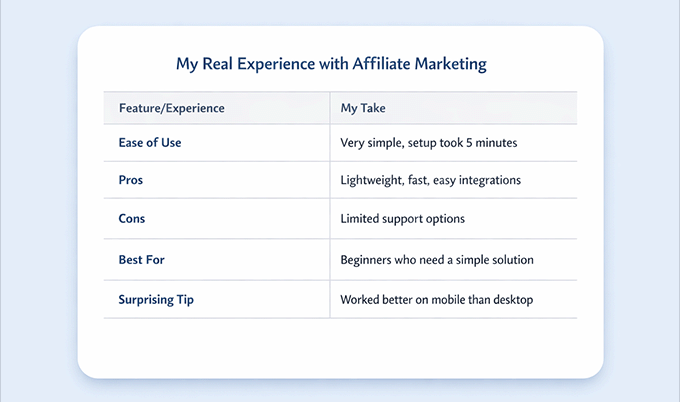
The key is to be specific and helpful. When you show real experience, readers trust you, your content ranks better, and your affiliate links actually perform.
2. Structure Your Content for AI and Search Engines
How you structure your review content matters — both for readers and for search engines. Clear layouts help people find answers fast and make it easier for Google and AI tools to understand your post.
Here’s what works best for review content:
| Tip | Why It Works |
|---|---|
| Answer the Question Early | Readers immediately know if you recommend the product, and search engines see a clear focus. |
| Use Clear Headings | Organizes your review by features, pros/cons, and use cases so it’s easy to scan. |
| Use Lists | Lists make information quick to read and highlight key points like pros, cons, or steps. |
| Use Tables | Perfect for comparing multiple products side by side — makes differences obvious. |
| Add an FAQ Section | Answers common questions and keeps readers on the page. You can also add FAQ schema to help Google understand your content and show rich results. For this, I recommend AIOSEO, a popular SEO tool that comes with a built-in FAQ block and makes it easy to add FAQ schema to your posts. |
I’ve found that AI tools can be really helpful for structuring your content for both readers and search engines. They don’t replace your experience — they just help you organize, plan, and speed up the process.
That is why I recommend using AI assistants like ChatGPT or Jasper to streamline your affiliate content creation.
Here’s how I use them:
- List Common Questions About a Product: Find what readers are actually searching for.
- Create a Rough Outline: Organize headings, pros/cons sections, and comparison points.
- Suggest Content Structure: Tables for product comparisons, bullet lists for features, or a simple FAQ layout.
- Generate Draft Text: Only as a starting point; always rewrite in your own words and add your real experience.
By combining structured sections, tables, FAQ schema, and AI, your reviews become easy to read, trustworthy, and optimized for search engines, while staying helpful for readers.
3. Create Comparison Posts That Help People Decide
Comparison posts are one of the best ways to help readers choose a product while boosting your affiliate revenue.
People who read these posts usually have high buying intent, which means they’re already close to making a decision. They want clear guidance, not hype, and honest pros and cons help them feel confident about their choice.
Comparison tables reduce decision fatigue by letting readers see differences side by side, so they don’t have to sift through paragraphs of text.
Here’s the framework I follow when creating comparison posts:
- Choose 3–5 Products — Don’t overwhelm readers, keep it manageable.
- Use the Same Criteria for Each Product —Makes comparisons clear and fair.
- Highlight Best Use Cases — Show which product is ideal for beginners, power users, or small teams.
- Add a Quick “Our Pick” Section — Tell readers which one you recommend and why.
You can see this in action at WPBeginner, where their team regularly writes showcase articles that include comparison tables for plugins and tools.
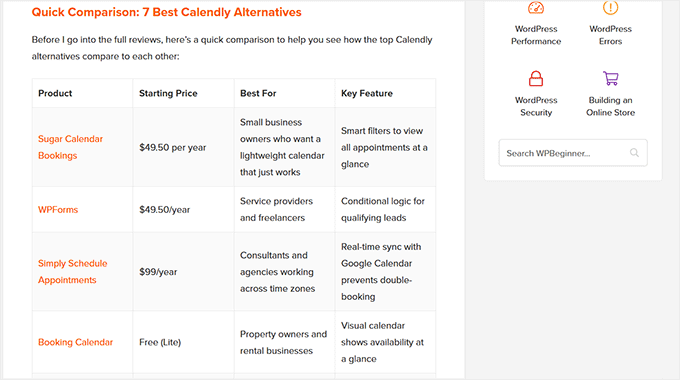
This gives readers a scannable way to decide which product fits their needs.
4. Build Long-Term Relationships With Brands You Promote
In 2026, affiliate marketing isn’t just about dropping links anywhere. It’s about building trust with the brands you promote.
Brands today want reliable partners, not random affiliates throwing links around.
Affiliates who nurture relationships often get better support, early access to new products, and even bonuses or paid placements.
This is when a brand pays you directly to feature their product, usually after you’ve proven that your audience engages and converts.
So how do you start building these relationships without feeling like you need to do heavy outreach?
Focus on quality over quantity: promote fewer products, but do it well.
Mention the brands naturally across multiple posts, share honest feedback (including what didn’t work), and show that you’re a genuine user, not just a promoter.
There are also simple ways to get on a brand’s radar:
- Reply to affiliate welcome emails.
- Share your content with them on social media.
- Use affiliate dashboards to apply for higher tiers or special programs.
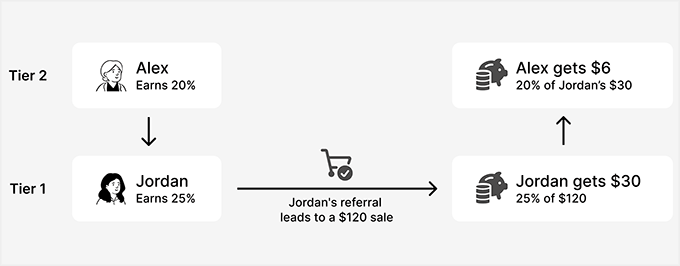
The key is to start with affiliate links, prove your performance, and let paid placements come later. This approach helps you build trust with both your audience and the brand and sets you up for long-term success.
5. Build an Email List to Increase Affiliate Sales
One of the best ways to grow your affiliate income is to build an email list. Unlike one-time visitors, your email subscribers are an audience you control.
You can recommend products over time, nurture trust, and see higher conversions than relying on blog posts alone. I’ve found that even sending just a few well-timed emails can make a huge difference in affiliate clicks and revenue.
A simple 3-email sequence works well for beginners:
- First Email: Welcome + free resource to get your subscriber engaged
- Second Email: Helpful tip with a soft mention of a product
- Third Email: Personal recommendation based on your experience
But building your email list isn’t just about sending emails — it’s also about capturing visitors before they leave your site.
Around 70% of abandoning visitors never return, so if you don’t act, you could be missing out on potential subscribers and affiliate clicks.
This is where OptinMonster comes in, which is the best lead generation tool. You can use it to set up exit-intent popups that show a relevant offer based on the page your visitor is reading.
For example, someone checking out a product review can see a targeted email signup or affiliate offer just as they move their mouse to leave.

Combined with your simple 3-email sequence, this strategy turns leaving visitors into engaged subscribers and helps increase your affiliate revenue.
For a step-by-step guide, check out this article on how to create popups that convert.
6. Target Long-Tail Keywords With Buying Intent
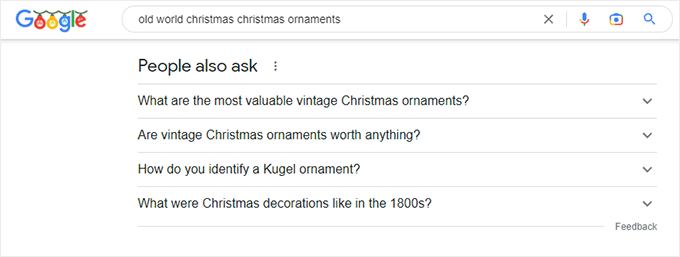
One of the easiest ways to get more affiliate sales is to focus on long-tail keywords. These are longer, specific search phrases that show someone is ready to buy.
They usually have less competition than broad keywords and a higher chance of converting into commissions.
I’ve noticed that targeting long-tail keywords works best when you think like your reader. Ask yourself what exact question they would type into Google if they were ready to make a purchase.
Words like “best,” “vs,” “review,” and “for beginners” are often great indicators of buying intent. Naturally adding these in your content helps readers and search engines understand exactly what your post is about.
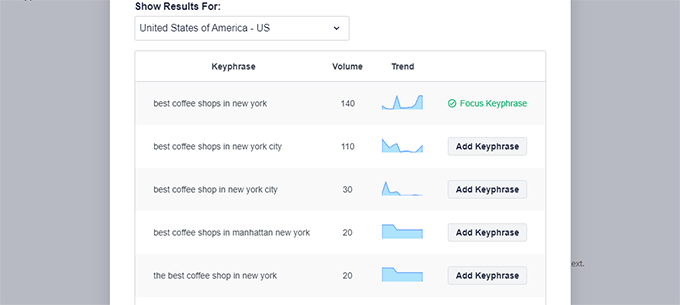
You can make this process much easier by using AIOSEO right inside WordPress. It helps you generate long-tail keyword ideas from Semrush and lets you add them directly to your content analysis for optimization.
After that, you can include these long-tail keywords in your title, headings, intro, and throughout your content.
7. Disclose Affiliate Links (It Builds Trust)
Disclosing your affiliate links might feel awkward at first, but it actually helps, not hurts, your credibility. It’s required by law, sets honest expectations for your readers, and shows that you’re transparent about earning a commission.
I’ve seen my fair share of people getting into trouble for not disclosing properly.
I’ve also found that when marketers are upfront with affiliate links, readers are more likely to trust their recommendations, and that trust directly improves clicks and conversions.
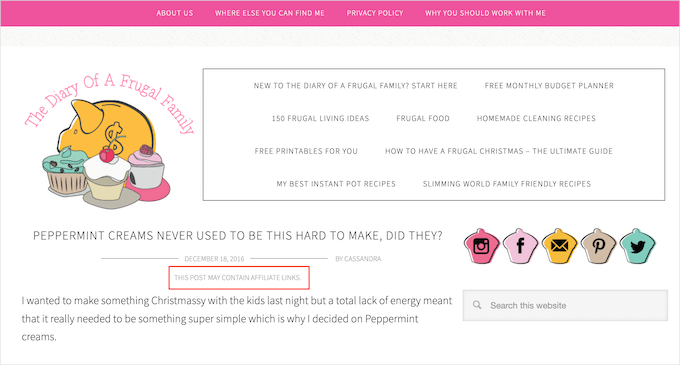
I recommend placing a short text disclosure at the very top of your post or immediately before the first affiliate link. It must be easy to see without scrolling to ensure your readers know exactly what to expect.
This keeps your content transparent and builds trust.
Here’s a quick example you can use:
“Some of the links in this post are affiliate links. If you click and make a purchase, I may earn a small commission at no extra cost to you. I only recommend products I personally use and trust.”
For more details, check out this guide on adding affiliate disclosure links in WordPress.
Bonus: Helpful WordPress Tools for Affiliate Marketers
Using the right tools can make a huge difference in your affiliate marketing success. They help you track performance, manage links, capture leads, and optimize your content, so you spend less time guessing and more time earning.
Here are some tools I recommend:
- Pretty Links – Manage, shorten, and track your affiliate links so they’re easy to share and organized.
- MonsterInsights – See which posts and links are performing best to focus on what drives revenue.
- OptinMonster – Build your email list and capture leaving visitors with exit-intent popups.
- AIOSEO – Optimize your posts for search engines and generate long-tail keywords right inside WordPress.
- ThirstyAffiliates – Another great option for managing affiliate links, cloaking, and tracking clicks.
These tools aren’t about fancy features. Instead, they solve real problems and make it easier to grow your affiliate revenue consistently.
Your Affiliate Action Plan for 2026
Remember, you don’t need to do everything at once. Affiliate marketing works best when you focus on one step and build consistency over time.
Start by picking one tip from this guide that makes the most sense for you and your site.
Whether it’s promoting products you’ve actually used, targeting long-tail keywords, or building an email list, taking action and being honest with your audience will get you results.
Trust and consistency are what turn casual readers into loyal followers, and loyal followers are what drive affiliate revenue.
Here’s how to get started today:
- Start a WordPress blog and pick your niche.
- Learn how to make money blogging with honest recommendations.
- Build an email list to capture and nurture your audience over time.
Take one step today, then the next — before long, you’ll start seeing the results of consistent, smart affiliate marketing.
Frequently Asked Questions About Affiliate Marketing
Even with a solid strategy, beginners often have questions about how affiliate marketing really works.
I’ve put together some of the most common questions I hear, along with clear, simple answers to help you get started with confidence.
Has AI made affiliate marketing harder?
Not really. AI has made content creation faster, but it can’t replace real experience or genuine recommendations. Your unique perspective is still what drives trust.
What are high-paying affiliate niches?
The most profitable niches are usually SaaS (software), finance, and health. These industries often offer high recurring commissions or large one-time payouts because each new customer is very valuable to the company.
What are common affiliate marketing mistakes?
The biggest mistake is promoting products you haven’t actually used. Other common errors include ignoring SEO, failing to clearly disclose affiliate links, and giving up too soon before seeing results.
How do beginners start affiliate marketing?
Start by choosing a specific niche and building a website, like a WordPress blog. Then create helpful content that solves problems for your audience and naturally include affiliate links to products that provide solutions.
For more information, see this guide on affiliate marketing.
What are the risks of affiliate marketing?
The main risk is income instability. You rely on other companies’ programs, which can change terms, reduce commissions, or even shut down without much notice.
Can you make $10,000 a month with affiliate marketing?
Yes, it’s possible, but it takes time, consistency, and strategy. Top earners treat it as a serious business, diversify traffic sources, and focus on high-value products rather than chasing quick wins.
Why do so many people fail at affiliate marketing?
Most fail because they treat it like a “get rich quick” scheme. They often quit when results don’t come immediately or lose audience trust by spamming links instead of providing genuine value.
Expert Guides for Affiliate Marketing
I hope my practical tips will help you grow your affiliate marketing revenue.
You may also like to see these guides on affiliate marketing:
- The Ultimate Affiliate Marketing Guide for Beginners – Step by Step
- How to Write an Affiliate Product Review (Expert Tips)
- Best Affiliate Marketing Tools and Plugins for WordPress
- Best Affiliate Tracking and Management Software for WordPress
- Pretty Links vs ThirstyAffiliates: Which is Right for Your Site?
- How to Easily Create Short Amazon Affiliate Links in WordPress
- How to Cloak Affiliate Links on Your WordPress Site
If you liked this article, then please subscribe to our YouTube Channel for WordPress video tutorials. You can also find us on Twitter and Facebook.


Mrteesurez
Good job, Mr. Blair Williams, you have really nailed out the points.
Thanks for sharing us the 4 different types of search intent as this will prepare one to better write, organize and present blog posts for users.
Tal
I really liked the explanation on the different types of intent, thanks!
Peter Iriogbe
I had tried doing some affiliate marketing stuff in the past but didn’t succeed after a year so I dropped off. But after reading this post I would love to kickstart the journey with the new things I learned from this site today. Thanks so much
Moinuddin Waheed
wel explained covering all the points to make affiliate marketing work best.
Thanks Blair Williams for making such an insightful guide on affiliate marketing that actually converts.
targeting the investigative intent search is the key here, as chances of conversion will be much higher.
I will be implementing these pro tips to make sure my affiliate marketing tactics starts working for sure.
Mrteesurez
I completely agree with you! Mr. Blair Williams did an excellent job breaking down how to make affiliate marketing effective. Targeting investigative intent is something I hadn’t fully considered before, but it makes so much sense. I’ve been struggling with conversions, and this guide really opened my eyes to new strategies. I’m excited to implement these tips and see how they boost my affiliate marketing efforts. Thanks for sharing your thoughts!
Jiří Vaněk
Thanks to Mr. Blair Williams for sharing his many years of experience. It was an enlightening read. And also thanks to wpbeginner for these occasional guest articles from interesting personalities.