


You’ve probably heard that AI search is killing affiliate marketing. Google now answers many searches right on the results page, and shoppers ask ChatGPT and Gemini what to buy.
What an AI can’t do is buy the product, use it for a month, and tell you what broke. Readers who are about to spend money still want that, and they click through to the site that has it.
In this article, we’ll explain the ultimate affiliate marketing guide for beginners.
Here’s everything we’ll cover, so feel free to jump straight to whichever section you need:
- How Much Can You Actually Make?
- What Is Affiliate Marketing and How Does It Work?
- Step 1: Pick Your Niche
- Step 2: Choose Your Platform
- Step 3: Join Affiliate Programs
- Step 4: Create Content That Converts
- Step 5: Manage Your Affiliate Links in a Central Location
- Step 6: Get Traffic to Your Affiliate Content
- Step 7: Track What Earns and Do More of It
- Common Affiliate Marketing Mistakes to Avoid
- Frequently Asked Questions About Affiliate Marketing
How Much Can You Actually Make?
It’s important to look at what your current traffic is actually worth.
If you rely on display ads, you need lots of traffic before the numbers mean anything. Google AdSense pays per impression, and most publishers measure their earnings using RPM (Revenue Per Mille, or thousand pageviews). Rates vary widely by niche and by where your readers live, but a new site rarely earns more than a few dollars per thousand pageviews.
Affiliate marketing works differently because it doesn’t require volume. Instead, it needs targeted traffic. This is visitors who land on your site, ready to buy.
Here’s how those earnings compare across the exact same 1,000 visitors:
| What 1,000 visitors are worth | Typical return | What it depends on |
|---|---|---|
| Display ads | Roughly $0.20 to $5.00 per 1,000 ad impressions | Sheer volume of pageviews |
| Affiliate commissions | $300 at a 1% conversion rate on a $100 product paying 30% | How closely your readers match the product |
Keep in mind, these numbers are examples, not a projection. The takeaway is the gap between the two approaches, not the exact totals.
The best part of affiliate marketing is its simplicity. You don’t need inventory, employees, or your own products. A single post you write today can generate income for years to come.
The success at affiliate marketing takes time. Anyone promising faster results is likely trying to sell you something. You can learn how to spot these tactics in our guide to common affiliate marketing scams and how to avoid them.
What Is Affiliate Marketing and How Does It Work?
Affiliate marketing is a way to earn money by recommending products or services you use and trust. When someone buys through your tracking link, you earn a commission at no extra cost to the buyer.
At WPBeginner, we do this by recommending tools and plugins we actually use on our own websites. You can do the same on your blog, YouTube channel, or social media.
Here’s how it works:
- Join an affiliate program – Sign up for a company’s free program to get your unique tracking link.
- Share your link – Place the link naturally in blog posts, videos, emails, or social posts where it helps your audience.
- Earn commissions – When someone clicks your link and buys, you earn money automatically.
To make it easier to picture, here is a simple visual showing how the affiliate marketing process works from start to finish:

For example, imagine you run a travel blog. You could write a post about planning a trip to Italy and recommend travel gear, booking websites, or tour services. If a reader buys through those links, you earn a commission.
How Affiliates Earn Commission
You don’t always need to drive a sale to earn a commission. Before picking an affiliate program, it’s worth knowing the four main payment models and how much effort each requires:
- Pay per sale – You earn a commission when someone makes a purchase. This is the most common model, used by Amazon and most software companies.
- Pay per lead – You earn when a visitor completes a specific action, such as signing up for a free trial or requesting a quote. You will often see this called Cost Per Action (CPA) on affiliate networks.
- Pay per click – You earn purely on the traffic you send, regardless of whether it converts.
- Recurring commissions – You earn a payout every month or year for as long as the referred customer maintains their subscription. This structure is where long-term passive income tends to add up.
Step 1: Pick Your Niche
A niche is the specific, focused topic you build all your content around. In the zero-click era, the most critical test of a niche comes down to whether you can personally acquire the products and test them yourself.
Search engine AI overviews and conversational bots already deliver generic product recommendations. A standard recommendation on its own no longer earns a click, since an AI can simply summarize it on the search page.
However, AI can’t share information it doesn’t have. When your site is the only place to find real, hands-on test results, readers have to visit your pages to get the answer.
Our WordPress hosting guide shows this approach in action. We opened paid accounts with every provider, installed the same site on each one, and ran our own speed and uptime tests.
It also means you need to choose a niche you can realistically afford to evaluate. Testing $60-a-year software tools is much more budget-friendly than trying to buy $2,000 camera lenses.
Keeping your niche narrow works in your favor in three key ways.
- Makes ranking easier – Covering one topic deeply builds topical relevance far better than covering ten topics thinly.
- Builds authority faster – You become the reference on one subject instead of a generic voice on everything.
- Improves conversions – Readers trust your recommendations more when every other post on your site addresses the same set of problems.
Before committing, it’s also worth checking that people are actively searching in that niche.
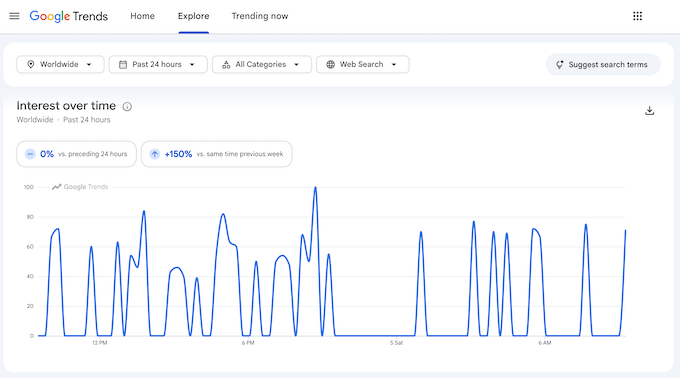
Our guide on how to do keyword research walks through the process, and free tools like Google Trends will show you whether interest is growing or fading.
Step 2: Choose Your Platform
Your choice of platform dictates how you create content, how readers discover it, and how you manage your affiliate links.
Here is how the three main paths compare:
| Platform | Best For | Startup Cost |
|---|---|---|
| WordPress blog | Publishing content you own outright and control | Around $50 to $100 a year for hosting and a domain |
| YouTube channel | Filming products that need to be seen working | $0 to $100 using a smartphone and free editing software |
| Social media | Promoting the content you publish on your blog and channel | Free to start on Instagram, TikTok, or Pinterest |
For beginners, we always recommend starting with a blog, which is what we use for WPBeginner. You own your traffic, your search rankings build over time, and you can grow an email list directly from your site.

That ownership is the core reason an affiliate needs a website. Content published anywhere else can be removed without warning through an algorithm change, a policy update, or a suspended account. This leaves you with no way to recover your work.
The downside is that a blog takes longer to grow initially, as you must earn every visitor instead of relying on an established platform to distribute your content.
Social media works best as a distribution channel rather than a home for your content. After publishing a review on your blog or YouTube channel, you can use Instagram, TikTok, or Pinterest to promote that content.
If you’ve settled on a blog, you’ll need three things: a domain name, web hosting, and WordPress. The whole setup takes under an hour and requires zero coding.
Our step-by-step guide on how to start a WordPress blog walks you through the entire process, from buying your domain name to publishing your first post.
When setting up your blog, it is worth choosing a theme designed specifically for content websites. Themes built for review and comparison layouts make your content easier to read and optimize for conversions.
We’ve gathered our top recommendations in our list of the best WordPress themes for affiliate marketing.
Step 3: Join Affiliate Programs
Before you apply anywhere, publish 5 to 10 solid posts first. Most programs will review your site before approving you, and an empty site will almost certainly get rejected.
You can find programs that fit your niche in a few ways:
- Affiliate networks – Platforms like Awin, Impact, and CJ Affiliate host thousands of programs in one place while handling tracking and payouts for you.
- Direct programs – These are managed by the company itself with no middleman.
- Amazon Associates – Amazon covers almost every physical product imaginable, and approval is relatively straightforward. Our guide on how to build an Amazon affiliate store covers the exact setup.
- Search online – Searching for ‘[product name] + affiliate program’ uncovers smaller niche programs that never show up on major networks.
A quick word on Amazon Associates, since it’s where most beginners start. It’s a reasonable place to learn how tracking works, but since April 2026 Amazon pays only on the specific item you linked to, rather than the shopper’s full cart.
What to Look For in an Affiliate Program
Not every program is worth your time. Four key factors directly determine how much you actually earn:
- Commission rate – Look at your payout per sale, whether it is a percentage or a fixed amount, and whether it recurs over time.
- Cookie duration – A cookie is a tracking file saved in the reader’s browser when they click your link. The duration determines how long you receive credit for the referral. For example, a 30-day cookie means you still earn if the visitor buys three weeks later.
- Relevance – Only promote products that genuinely fit your niche. Promoting irrelevant offers destroys conversions and erodes your audience’s trust.
- Payout threshold and reliability – Check the minimum you must earn before the affiliate will pay you. A high threshold can stall your cash flow for months when you’re first starting out.
Step 4: Create Content That Converts
Before choosing a content format, it helps to understand what Google looks for in review content. Google evaluates content against E-E-A-T: Experience, Expertise, Authoritativeness, and Trustworthiness.
The ‘experience’ factor matters most for affiliates because AI cannot replicate it. Google’s quality guidelines specifically look for work that demonstrates first-hand knowledge gained from using a product, testing a service, or visiting a location.
Google’s guidance for product reviews asks for evidence of your process: how many products you tested, the metrics you gathered, and supporting proof like your own photos.
Here’s how to meet each part of E-E-A-T in a review:
- Experience – Buy or trial the product, use it for a real task, and publish your own images or screenshots rather than relying on the vendor’s marketing images.
- Expertise – Publish your testing method and your numbers, so a reader can see how you reached your verdict.
- Authoritativeness – Name the author, add a real author biography, and link to the other work you’ve published on the same topic.
- Trustworthiness – Outline what the product does poorly and disclose your affiliate relationships clearly on the page.
Four specific content formats drive most affiliate sales. Instead of sticking to just one, we recommend using a mix so you can help readers at every stage of their buying process.
- Reviews – You cover a single product in depth for readers who already know that product exists. Our ThirstyAffiliates review is an example of this format in action.
- Comparisons – You put two competing products side by side to help undecided readers choose, as we do in our Pretty Links vs ThirstyAffiliates breakdown.
- Tutorials – You solve a specific problem, while introducing that product naturally as part of the solution. Our guide on how to cloak affiliate links shows how this works in practice.
- Resource pages – You round up the best options in a category for someone browsing, like our curated list of the best affiliate marketing tools and plugins.
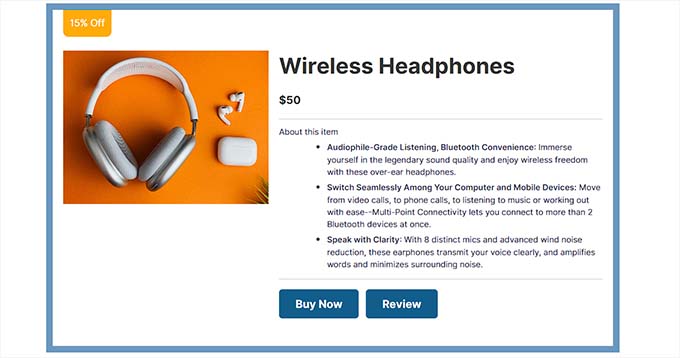
When a full review feels like too much work for a particular product, an affiliate product box serves as a good middle ground. It displays key features, current pricing, and a call to action inside a compact block.
Our tutorial on creating an affiliate product box shows how to build one.
Step 5: Manage Your Affiliate Links in a Central Location
Imagine what happens when a brand you recommend switches affiliate networks. Every link you’ve added for them breaks overnight. If you pasted those URLs directly into individual posts, you’ll have to manually hunt down and update every single one across your entire site.
Managing your links centrally solves this. Every mention on your site points to one clean link on your own domain, like the https://wpbeginner.com/refer/ links we use. When the destination changes, you only need to update the link once.
We use ThirstyAffiliates for this. After installing and activating the plugin, you can add a link by going to ThirstyAffiliates » Add Affiliate Link in your WordPress dashboard.
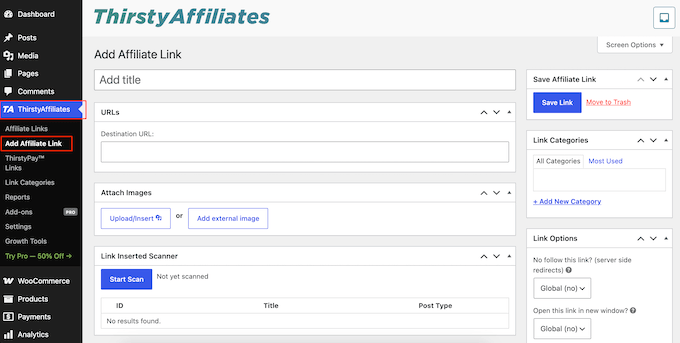
Since the title at the top of the screen becomes part of your clean URL, enter the product name there. Then paste the full affiliate URL from your program into the Destination URL box and save it.
While you’re on this screen, set ‘No follow this link?’ to Yes. Google asks that links you’re paid for carry a nofollow or sponsored attribute, and this setting adds it for you.
There is one exception worth knowing before you start. Amazon’s Operating Agreement prohibits cloaking or obscuring its affiliate URLs, so Amazon links have to stay uncloaked. Our guide on how to create short Amazon affiliate links covers the settings that handle this safely.
For the full setup, see our tutorial on adding affiliate links with ThirstyAffiliates and our guide on automatically linking keywords with affiliate links.
Before publishing, make sure you add a clear disclosure to your site.
If a post contains affiliate links, then you need to tell readers upfront, because in the United States that’s a Federal Trade Commission (FTC) requirement and many programs treat non-disclosure as grounds for removal.
Our guide on adding an affiliate disclosure automatically shows how to display these notices across your site.
Step 6: Get Traffic to Your Affiliate Content
All this prep work is useless without readers, and bringing in traffic is the step most beginners underestimate. We recommend building three traffic sources, starting with search.
Rank for Searches With Buying Intent
Search traffic is the most important traffic source for affiliates because it reaches users at the exact moment they’re deciding what to buy. The main challenge is choosing which searches to target.
Aim for commercial-intent keywords, which are the phrases people type when they’re comparing products rather than just learning about a topic. Searches like ‘best plugin for X’, ‘X vs Y’, and ‘X review’ convert at a completely different rate than informational searches such as ‘what is X’.
Once you’ve picked a product category, cover it properly rather than publishing one post and moving on.
A dedicated review, a side-by-side comparison against a key competitor, and a tutorial solving the core problem the product addresses will collectively capture far more search volume than a single post.
Search now also includes AI assistants, and they behave differently from a results page. ChatGPT and Perplexity answer questions directly and cite a handful of sources. The best way to get cited by AI is to publish original testing data that AI tools cannot create on their own.
Most WordPress SEO plugins, like All in One SEO (AIOSEO), Yoast SEO, or Rank Math, will handle the on-page basics for you.
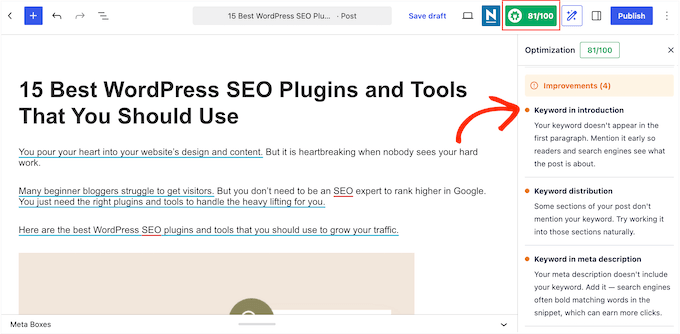
We use AIOSEO on WPBeginner. Its TruSEO checklist sits inside the WordPress editor and scores each post during the drafting process.
This feature is included in the free version of AIOSEO.
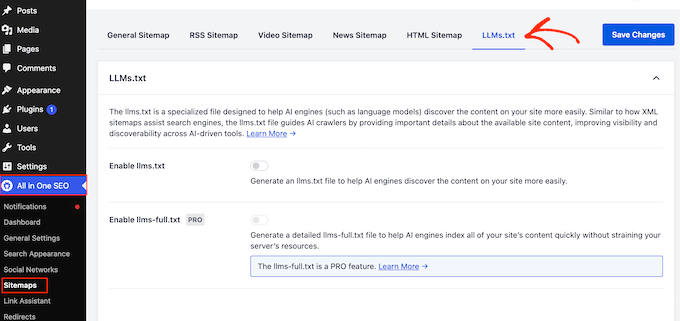
The same free plugin can also generate an LLMs.txt file. This is a structured summary that tells AI assistants how to read and cite your site.
Go to All in One SEO » Sitemaps » LLMs.txt and activate the ‘Enable llms.txt’ slider.
For everything else, see our ultimate WordPress SEO guide.
Build an Email List From Day One
An email list is an audience you actually own, making it the most valuable asset for a content site. Search rankings move and social accounts get suspended, but a list of addresses stays entirely in your control.
For affiliate marketers, an email list lets you reach people again long after they’ve left your site. That follow-up is where a lot of commissions actually happen.
For a detailed walkthrough, check out our guide on how to create an email newsletter.
Bring Readers Back With Push Notifications
Push notifications are short messages sent directly to a subscriber’s browser or phone, even when they aren’t on your site. They work well for affiliate marketing because they bypass social media algorithms and email spam folders entirely, which drives repeat visits.
We use PushEngage on our own websites, and you can see how it performs in our breakdown of how WPBeginner uses push notifications to grow return traffic. Because PushEngage runs as a WordPress plugin, you can manage the setup directly inside your dashboard.
The free plan covers up to 200 subscribers, so you can test the channel before paying anything. Keep in mind that the free tier limits you to one website and 30 campaigns in total.
If you want to compare other options first, we’ve reviewed the top alternatives in our roundup of the best push notification software for websites.
Step 7: Track What Earns and Do More of It
If you aren’t tracking your conversions, you’re just guessing where your money comes from.
We use MonsterInsights for this, because it records clicks on your cloaked links and groups them by post, so you can see which content and which individual links produce sales. Our tutorial on how to install Google Analytics in WordPress covers the initial setup.
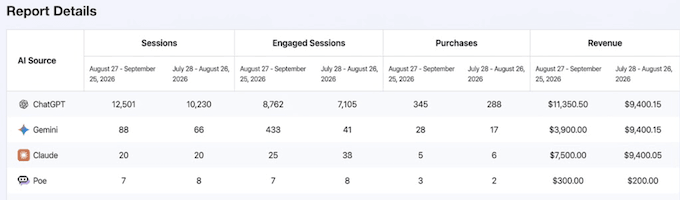
Because more buyers are turning to AI for product recommendations, as we mentioned earlier, tracking this new traffic is crucial.
MonsterInsights’ Plus plan includes an AI traffic attribution report that breaks down sessions, pageviews, and revenue driven by tools like ChatGPT, Claude, Gemini, and Poe, so you can tell exactly which AI assistants are sending you paying customers.
To compare alternative tracking tools, see our roundup of the best analytics solutions for WordPress.
Common Affiliate Marketing Mistakes to Avoid
Some mistakes cost you a little traffic, while others cost your entire site. These are the ones to actively watch for:
- Publishing roundups of products you’ve never touched – Content assembled from spec sheets is the fastest way to become invisible in search results.
- Overloading posts with links – Too many affiliate links in a single post reads as spam and buries the URLs that would have converted. Only include the links that are genuinely relevant.
- Copying manufacturer descriptions – Reusing the vendor’s own copy gives readers nothing they can’t find on the official product page, giving search engines no reason to rank your content.
- Overhyping products – Exaggerated claims fall apart the moment a reader buys, and a reader who feels oversold won’t come back. Naming a product’s actual weaknesses is precisely what makes your praise credible.
- Neglecting the reading experience – Dense text and cluttered links make posts hard to navigate. Headings, short paragraphs, images, and clear CTA buttons all help to keep readers engaged.
Frequently Asked Questions About Affiliate Marketing
Which affiliate programs are best for beginners?
The best affiliate program for a beginner is one for a product you already use, because you can review it honestly.
Beyond that, Amazon Associates has the easiest approval process and the largest catalog, which makes it a useful training ground. Awin is worth joining for its major retail brands and global merchants.
Finally, direct programs from software companies in your niche tend to pay the most, since their commissions are percentage-based and often recur every month.
What’s the difference between affiliate marketing and MLM?
Affiliate marketing is not multi-level marketing, and the difference is where the money comes from.
Affiliate marketing pays you a commission when someone buys a product through your unique referral link, and a sale is the only way you earn.
Multi-level marketing (MLM) pays you for recruiting other sellers beneath you. You then take a percentage of their revenue.
Do I need to pay to join affiliate programs?
No, and being asked for money is a warning sign. Legitimate affiliate programs are free to join, because they only pay out when you generate a sale.
Our guide to common affiliate marketing scams covers the other major red flags you should know.
We hope this guide helped you see how to get started as an affiliate marketer. You may also want to see our guides on how to create an affiliate product box and the best affiliate marketing tools and plugins for WordPress.
If you liked this article, then please subscribe to our YouTube Channel for WordPress video tutorials. You can also find us on Twitter and Facebook.


Jiří Vaněk
I recently started using affiliate marketing through paid articles on my blog. I set a price, and based on that, I either publish a review article about a product or not. I carefully choose what I post on the blog and what I don’t. But since I’m still a complete beginner in affiliate marketing, I’m very grateful that I could read some great advice from you, experienced professionals in marketing. Thank you for covering this topic, which is still new to me. Sometimes, you don’t realize the risks involved until you read about them from someone who truly understands the field.
Dennis Muthomi
TOTALLY agree that as an affiliate marketer, it’s vital to only promote products I have tested and found valuable from personal experience.
For me when I recommend a new ai software tool on my blog, I always sign up to explore the features thoroughly as an actual user first.
If I don’t find the product provides value, I simply cancel the subscription and search for better alternatives that would truly benefit my audience.
THATS HOW IT IS!
Jiří Vaněk
Yes, I completely agree. It’s also about the fact that when you recommend something, you’re indirectly building your brand and reputation. If you promote low-quality products that you haven’t personally tested, you risk getting negative reviews on your brand and name over time, and that can be very hard to recover from. That’s why it’s especially important in affiliate marketing to know what you’re promoting and have some experience with it. After all, you only have one name and brand, and damaging it can be very easy. It’s also good to remind others of this fact.
Emmanuel
please which word press theme do you use, i want to know i love it
WPBeginner Support
Our theme is a custom theme that we created that is not publicly available at the moment.
Admin
Moinuddin Waheed
I want to know about the target audience while planning for an affiliate product.
so if I am in India and I want to target a product that is mostly used in United States or United Kingdom.
as these countries have a good affiliate commision structure.
is it viable as a blogger to make such an endeavour?
or it is always to target the local audience?
I mean thinking globally due to internet.
WPBeginner Support
You do not need to target a local audience when you set up an affiliate marketing site. As long as users can view your site you can target that audience
Admin
Moinuddin Waheed
It means as long as I do right content strategy and have content that aligns with the products, I can easily Target the global markets.
Thanks wpbeginner this clearly makes sense. I used to think that doing affiliate marketing locally only would be viable. but in reality due internet access all over the globe, there is no barriers as such.
Ahmed Omar
I am just starting my trial in affiliate marketing.
the post is quite useful and detailed.
but I have a question, Is it possible to affiliate similar products of two different companies on a single website?
Thank you
WPBeginner Support
You certainly can have similar products on one site even if they are from different companies.
Admin
Kabsha Majid
It’s a good idea to do affiliate marketing using WordPress.org. It’s a highly effective method for affiliate marketers. It’s the best way to create credibility among your audience.
Using affiliate links on Facebook, Instagram, etc. does not work much. Also, you can’t convince someone to take any action unless they trust you and the services you provide.
You have put a great deal of effort into this blog and provided us with a unique guide. Please tell me what I should do to rank my blog for investigational intent keywords. I request you to provide a complete guide about investigational intent keywords.
WPBeginner Support
We would recommend taking a look at our guide below for finding keywords no matter the niche
https://www.wpbeginner.com/beginners-guide/how-to-do-keyword-research-for-your-wordpress-blog/
Admin
Jon Weberg
By far, the most important aspect of affiliate marketing… Is treating it just like any other digital marketing business. People often think it’s as easy as becoming an affiliate, and just posting your link out there in content… When in reality, the most successful affiliate marketing form deadly efficient and great content, advertising, follow up, sales processes, and more.
But, taking it one step at a time first before one gets a better understanding, is more then acceptable!
WPBeginner Support
Thanks for sharing your opinions on affiliate marketing
Admin
Michael Mbwika Muli
Your opinion is very correct, thank you
Abdul Hanan
Is it possible to affiliate similar products of two different companies on a single website? Let suppose, clothing affiliate program of amazon and walmart on same site.
If yes, do you recommend it?
Biswajeet
Yes, you can in fact promote as many products you want from as many affiliate companies. However, it’s wise not to.
I would recommend sticking to 2-3 companies at a time and promote products only if it fits in your niche.
Abdul Hanan
Can I do both affiliate marketing and dropshipping on a single site?
WPBeginner Support
You could if you wanted to.
Admin
Alina
Such a great information. Been wasting time searching internet, till I found all the info I need in one place. Thank you!
WPBeginner Support
Glad our guide was helpful
Admin
Jaydeep b patil
Your blog is best
WPBeginner Support
Thank you
Admin
Kavita Podar
I just came across your blog post and must say that it’s a great piece of information that you have shared. This is really helpful content and must be shared across. Great blog post!
WPBeginner Support
Thank you, glad you found our content helpful
Admin
Ury
Hello: what are the best plug-ins for SEO Affiliate marketing?
WPBeginner Support
For SEO in general, we would recommend taking a look at our article below:
https://www.wpbeginner.com/wordpress-seo/
Admin
Neil
Hi
Need help.
Which to do first, create a blog about a product or apply for affiliate program?
Thanks!
WPBeginner Support
You would want to have a site with content before applying for an affiliate program
Admin
Farhan Jabbar
Thank you so much!
Such a wonderful write up; straightforward, easy to understand with deep insight!
This article really helped me to understand the core of affiliate marketing.
Keep it up!
WPBeginner Support
You’re welcome, glad you’ve found our article helpful
Admin
Hussnain Iqbal
Thank you for the article, I found it helpful. But a question remains in my mind: the affiliate program only works if you have enough traffic going through your website. Now, my website is new and my traffic is a desgrace. Any ideas on how to tackle that?
WPBeginner Support
For increasing your site’s traffic, you would want to take a look at our guide here: https://www.wpbeginner.com/beginners-guide/how-to-increase-your-blog-traffic/
Admin
Harish Kumar
such amazing ideas to start a blog on different niches. Really a useful post with clean and clear details. Thanks for sharing this post. Keep sharing.
WPBeginner Support
You’re welcome, glad you like our content
Admin
rajuchalna
affiliate marketing sense and also seems helpful for small business, Thank you for this information.
WPBeginner Support
Glad we could share it
Admin
John
Awesome post. Usually I never comment on blogs but your article is so convincing that I never stop myself to say something about it. You’re doing a great job Man,Keep it up.
can i use your website link and this information for my audience. i want to publish it to my people so that they can go deeper inside and for me it could be easy to convince them
WPBeginner Support
You can certainly link to our content if you wanted.
Admin
Sanjay Sajeev
Hi,
Very useful and informative post.
I have a doubt about affiliate link. How many affiliate link can I add in a blog post.
I have written a blog post that contains 1500 words. I need to add 13 affiliate links. If I add that much affiliate links, will it badly affect my site’s SEO? Please clarify my doubt
WPBeginner Support
It would depend on what you are writing about and how you are writing the article for how that would affect SEO, more links shouldn’t be a large factor unless it is adding no value to your users.
Admin
Cash Teachers
Thank you for this extremely helpful information! It’s a useful post regarding affiliate marketing & in fact, this is one of the best list & points on the subject.
WPBeginner Support
Thank you for your kind words
Admin
Grahame
Hello wpbeginner People,
Thank you for a very straightforward introduction to the world of Affiliate Marketing. I’m looking forward to the journey and just starting out. For me, I’m just as enthusiastic about the challenge of gaining success for its own sake, as the financial rewards it may hopefully bestow on me. There are so many variables involved and putting the whole thing together feels like attempting a 40,000-piece jigsaw puzzle with a hangover.
Keep up the good work and I wish you continued success, I’m sure you’ve earned it.
Grahame.
Angie Cox
I’m in the process of creating a new blog now and have decided on a niche to focus on. I’d like to implement affiliate marketing as soon as the blog launches. Was wondering if affiliate networks require those requesting to become affiliate marketers to have a certain number of followers before approving the request to join the affiliate program? Generally, what types of requirements have to be met when applying to join an affiliate network? I’d hate to apply then get rejected because I haven’t met the minimum requirements, if those exist. Thanks!
WPBeginner Support
Hi Angie,
These requirements may vary and you will have to review their program policies before applying.
Admin
Bob Schaffer
I have yet to implement all the tools you have shared and recommended in this article, but I really like the way you explain things. It is written in a very easy-to-read style, and ho hype or exaggerated comments. Now I have to get busy and take the necessary time to study, and implement, your recommendations. Thank you for all that you have shared.
Johnpaul onwueme
I really enjoyed this interesting article.
Keep it up.
David
Thanks. I looked into affiliate marketing once, and wanted to set up a product review site. I got stuck looking for a good theme – any suggestions for a WP theme (paid or unpaid) that plays well with product reviews?
And plays well with AdSanity – which looks interesting?
Looking at it from the other perspective – where would a product manufacturer go to find affiliates?
WPBeginner Support
Hi David,
There are many WordPress themes for affiliate marketers that you can start with.
Product manufacturers go to affiliate networks and join them as merchants.
Admin
Dhananjay Satanure
Hey Syed,
Do you have any Personal Experience that Affiliate Programs, PAY?
Or just this is fake program to, I mean the company tell us to Promote their product and do not pay to us?
WPBeginner Support
Hi Dhananjay,
Yes we have used affiliate programs, and yes they do pay. If you join a large affiliate network, then those payments are mostly automated.
Companies that don’t pay affiliate partners risk losing their reputation and will have hard time finding affiliate partners in the future.
Admin
Shahla Banu
Hi,
Affiliate marketing works well as long as one is getting good traffic. A lot depend on what percentage of US traffic does one get on his blog (in case he’s promoting products useful for US audience). So, it’s always good to choose right affiliate programs, write good content and do social media marketing.