


Sharing a new blog post is exciting until you paste a long, clunky URL into your social media update. It can look messy and eats up precious character limits, especially on platforms like X (formerly Twitter).
We’ve been there, and after managing dozens of websites, we’ve found the best ways to create clean, short links right from WordPress. This simple step makes your content much more shareable and professional.
In this guide, we’ll show you the exact methods we use. You’ll learn how to easily create short links that are perfect for social media, emails, and tracking your marketing campaigns.
Why Create a Short Link in WordPress?
Sharing your web content on social media can build user engagement and bring new users to your website. But pasting in long links or URLs isn’t always the best way.
That’s because some social media platforms will limit the number of characters you can use. A shorter URL gives you extra space for more useful content, which can lead to more engagement and traffic to your WordPress website.
That’s why URL shortener services like Bitly and TinyURL were originally created. They take a long link and make it shorter so that it doesn’t take up as much space.
For example, if you’re using SEO-friendly URL structures, then you might have long URLs that look something like this:
https://www.wpbeginner.com/beginners-guide/self-hosted-wordpress-org-vs-free-wordpress-com-infograph/
Our short link for that post saves a lot of space:
http://wpbeg.in/b6xh7G
Note: We use a custom domain, wpbeg.in, for our short links, which is a bit more technical to set up and would require you to purchase another domain. We have a separate tutorial on how to create your own customized short URL.
In the past, WordPress made it easy to get a short link to your blog post or page. There was a Get Shortlink button located right next to the permalink area of the classic editor.
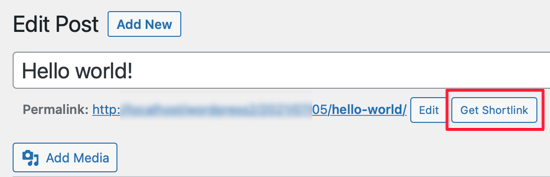
However, if you recently started your blog, then you will not see this feature on your WordPress site because it was removed after WordPress version 4.4. WordPress still creates the links, but the button has been removed.
In this guide, we’ll cover two great ways to do this. First, we’ll use a plugin to create branded, memorable short links (like yoursite.com/offer) that are perfect for marketing. Then, we’ll show you how to find the simple, built-in short link that WordPress automatically creates for every post.
Still, there are a few ways you can get short links for your WordPress posts and pages.
We’ll cover the best link shortener plugin, plus a couple of ways you can restore the ‘Get Shortlink’ button in the classic editor. Simply click the links below to jump straight to each option:
Method 1: Create Short Links Using the Pretty Links Plugin
We’ll start with a method that works for everyone. The Pretty Links plugin is one of the best URL shorteners for WordPress. It doesn’t rely on the classic editor and will create its own short link out of any URL.

It works with all links, including pages outside of your blog or website. So, besides letting you share your own content, it’s also the perfect tool for shortening affiliate links.
To get started, you’ll need to install and activate the free Pretty Links plugin. For more details, see our step by step guide on how to install a WordPress plugin.
Note: There is a Pro version of Pretty Links with more powerful features like keyword auto-linking, link categories, and tags, but for this tutorial, we will be using the free version.
Once you activate the plugin, a Pretty Links section is added to your WordPress dashboard. To create your first short link, you need to go to the Pretty Links » Add Link page.
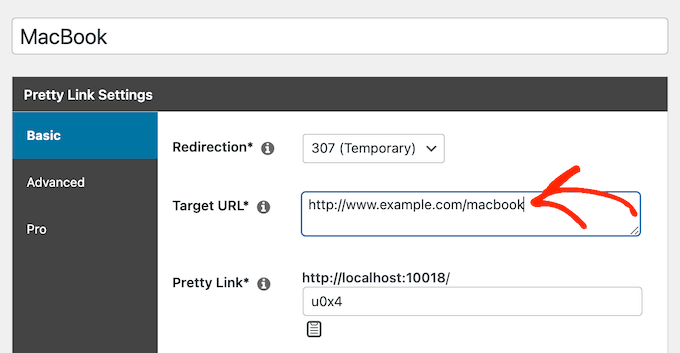
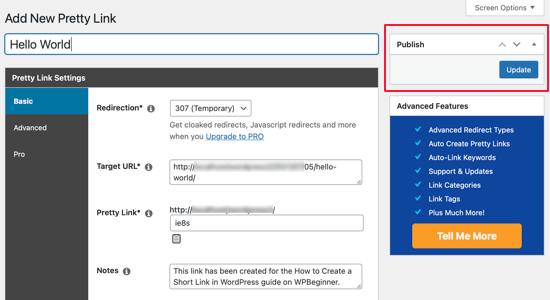
Next, paste the original URL you want to shorten into the ‘Target URL’ field. A short Pretty Link is automatically created for you, but you can customize the slug to make it more readable and memorable. For example, you can change yoursite.com/a9b8c7 to something like yoursite.com/ebook, which is great for marketing campaigns!
Once you’ve created a few short links, you may not remember what they are all for.
To keep your links organized, we highly recommend filling in the ‘Title’ and ‘Notes’ fields. This will make it much easier to find and manage your links later on.
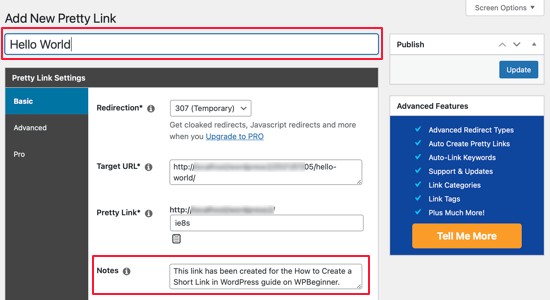
Once you have filled in the Pretty Links form, click the ‘Update’ button to activate the short link.
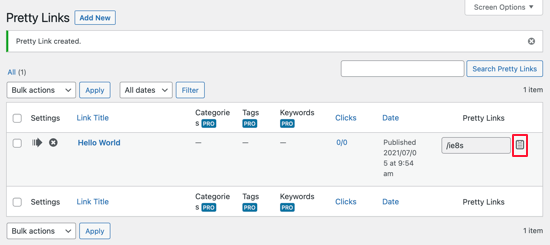
You will now see a list of all of your Pretty Links. To copy one to the clipboard, just click on the ‘Copy’ icon at the right of the screen.
After that, you can paste it into any of your social media channels. Pretty Links will even keep track of how many clicks each link gets.
While Pretty Links has built-in analytics, you can further improve your analytics by connecting it with Google Analytics using the MonsterInsights plugin.
For more details, see our step by step guide on how to properly set up Google Analytics in WordPress.
Method 2: Finding Your Default WordPress Short Link (No Plugin Needed)
Did you know that WordPress automatically creates a simple short link for every post and page on your site? This method doesn’t require any plugins or code, and it’s a great way to get a short URL in a pinch.
This default short link uses your post’s unique ID and looks like this:
https://www.yourwebsite.com/?p=123
Here’s how to easily find the ID for any post or page.
First, go to your WordPress dashboard and navigate to Posts » All Posts. Then, simply hover your mouse over the title of the post you need a short link for.
Look at the bottom-left corner of your browser window. You will see the post’s edit URL appear, and within that URL, you will see post= followed by a number. That number is the Post ID!
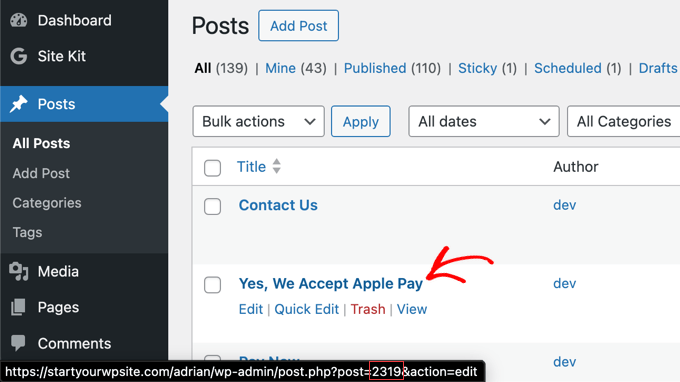
For example, if the ID is 2319, then your default WordPress short link is https://www.yourwebsite.com/?p=2319.
While this link isn’t as pretty as the custom ones you can make with Pretty Links, it’s very short and works perfectly for quick sharing.
Frequently Asked Questions About Short Links
Many of our readers have questions about creating and using short links in WordPress. Below are answers to some of the most common ones we receive.
1. Will using short links hurt my WordPress SEO?
No, using short links will not hurt your SEO as long as they use proper 301 redirects. Search engines like Google understand that the short link is just a pointer to the original URL and will pass along any link equity correctly.
2. What is the best URL shortener for WordPress?
We believe Pretty Links is the best URL shortener for most WordPress users. It’s easy to use, lets you create custom branded links, and provides click-tracking features right inside your WordPress dashboard.
3. Can I track who clicks on my short links?
Yes, you can. A major benefit of using a plugin like Pretty Links is its built-in analytics. It tracks every click on your short URLs, giving you valuable data on how your links are performing across different channels.
4. Do I need a custom domain for my short links?
No, you don’t need a custom domain. By default, plugins like Pretty Links will create short URLs using your main domain (such as yoursite.com/offer). However, using a custom short domain (like our wpbeg.in) can make your links even shorter and reinforces your brand.
Additional Resources
Now that you know how to create short links, you can explore these other guides to get the most out of your site’s marketing and link-building efforts.
- Beginner’s Guide to Affiliate Marketing – Learn how to use short links effectively to promote products and earn commissions.
- How to Track Outbound Links in WordPress – Discover how to see which external links your visitors are clicking on.
- How to Cloak Affiliate Links on Your WordPress Site – Take your link shortening skills to the next level by cloaking your affiliate URLs.
- Best Internal Linking Plugins for WordPress – Find tools that help you build smart links between your own articles, boosting SEO.
- How to Add Nofollow Links in WordPress – Understand when and how to use the nofollow attribute for your external links.
We hope this article helped you learn how to create a short link in WordPress. You might also like to learn how to add nofollow links in WordPress or see our comparison of the best internal linking plugins for WordPress.
If you liked this article, then please subscribe to our YouTube Channel for WordPress video tutorials. You can also find us on Twitter and Facebook.


Dennis Muthomi
Well after I read this, I’m trying out the Pretty Links method.
It seems like a time-saver compared to having to visit an external site to shorten links before sharing them.
And it can also be used for affiliate links, so that’s a plus for me.
Jiří Vaněk
Until now, I used external url shorteners as external services, it’s great that an internal tool can also be used for a website where I need it.
amr
How to create a new field at the bottom of the article?
Write a short link to the article
And the short link next to the field
WPBeginner Support
We do not have a specific solution for that at the moment but we will certainly share if we find something we would recommend
Admin
Faris Alnaeb
Hello,
Thank you for the topic. I was using the manual method. But now it is not working with WP 5 Gutenberg editor.
Is there a new way for it?
Thank you
David Grant
I would love to see a “Get Shortlink” capability for the Admin Bar when logged in, so one does not have to go to the post/page editor to get the shortlink. Any gurus have any suggestions?
Editorial Staff
If you’re using the WP Bitly plugin, then it does add it to the admin bar as well.
Admin
Memokecil
Is it possible using a shortener to share a link blocked by Fb. And it works automatically for ‘share button’.
My domain was blocked Fb when it encountered an interruption, it was fixed but still blocked, and the ‘share button for Fb’ on my page is no longer useful.
Thank’s WpBeginner.
Editorial Staff
Not 100% sure if that would work, but you can try it by using the WP Bitly plugin as your URL shortener.
Admin