


The ‘Error too many redirects’ issue is one of the most common WordPress errors, and you can usually fix it in a few minutes.
The error simply means that your website is stuck in a redirect loop, and it can even lock you out of your WordPress admin area.
In this article, we will show you how to easily fix the ‘Error too many redirects’ issue in WordPress, step by step, even if you can’t log in.
Quick Answer: How Do I Fix the Too Many Redirects Error in WordPress?
Clear your browser cookies first. If the error stays, it is almost always one of three settings: your WordPress Address and Site Address have to match exactly, Cloudflare’s SSL mode has to be set to Full, and / or your .htaccess file may need resetting.
You can do all of that even if you are locked out of your dashboard, by editing wp-config.php over FTP.
What Causes the Too Many Redirects Error in WordPress?
A redirect loop happens when page A sends your browser to page B, and page B sends it straight back to page A. Your browser tries again and again, gives up after about 20 attempts, and shows the error instead of your website.
Redirects themselves are normal. WordPress and many plugins use them to create permanent 301 redirects and fix 404 errors. The problem starts when two redirect rules point at each other.
This error usually appears immediately after one of these actions, not because the action is wrong, but because a setting was configured incorrectly while doing it:
- You moved the site to HTTPS or installed an SSL certificate.
- You turned on Cloudflare (or another reverse proxy / CDN).
- You installed an SSL plugin or a redirect-manager plugin.
- You edited the site URL, migrated hosts, or pasted a ‘force HTTPS’ rule into .htaccess.
Plugins that fix the SSL insecure content issue or a WordPress caching plugin can also cause this error.
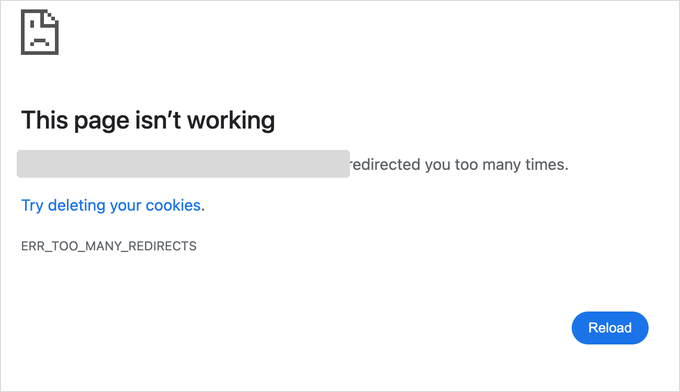
This is how the ‘ERR_TOO_MANY_REDIRECTS’ message looks in Google Chrome.
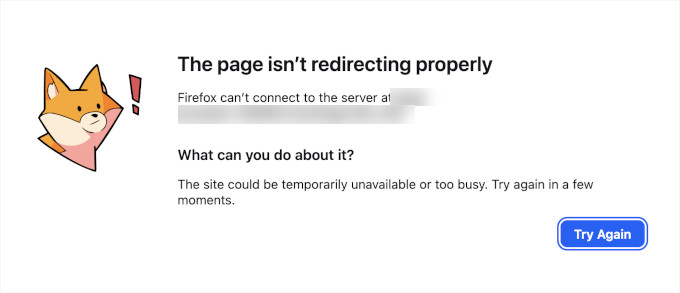
This is how the error looks in Firefox with the message ‘The page isn’t redirecting properly’.
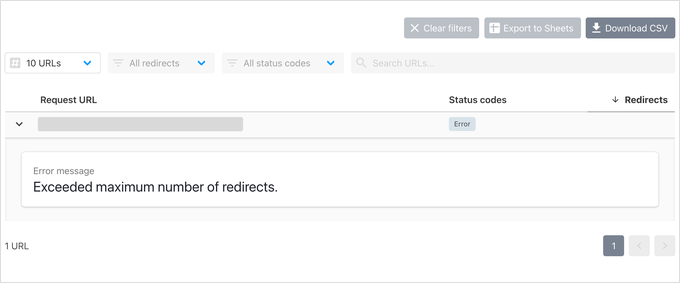
The error page does not tell you what causes the loop. To find out the issue, you can use a free tool like httpstatus.io, enter your website URL and look at the redirect chain.
A healthy site shows one 301 (a permanent redirect) ending in a 200 status code, which means the page loaded normally.
A broken site shows a long chain of 301s bouncing between the same two URLs, and those two URLs tell you what cause the issue. For example, if they differ by http and https or www and non-www, then you can follow the steps below to fix them.
Important: Some of the fixes below change your site’s core files and database. Before you change anything, please create a backup. You can follow our guide on how to make a WordPress database backup manually.
Here are the steps we will cover:
- Clear Your Browser Cache and Cookies
- Make Your WordPress Address and Site Address Match
- Fix Cloudflare’s SSL Setting
- Reset Your WordPress .htaccess File
- Deactivate All WordPress Plugins
- Fix the Redirect Loop on wp-admin Only
- Fix Too Many Redirects After Migrating Your Site
- What to Do If the Error Is Still Not Fixed
1. Clear Your Browser Cache and Cookies
A common cause of the error could be your web browser cookies. First, try a hard refresh (Ctrl + F5 on Windows or Cmd + Shift + R on Mac), and then try accessing your website using a different web browser, like Firefox, Safari, Opera, or Microsoft Edge.
If you are able to access your website normally using a different browser, then you need to clear the cookies and cache in your regular browser.
You don’t have to wipe everything. Clearing the cookies for just your own website is enough.
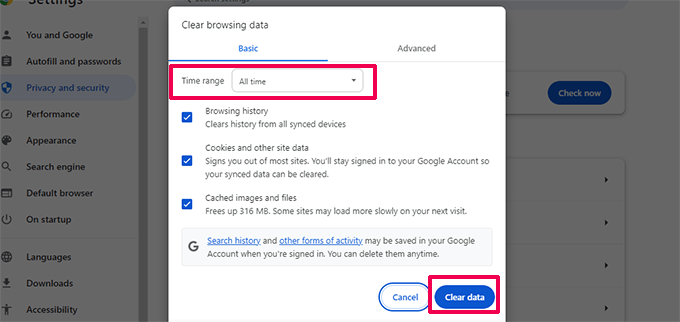
We have a detailed guide on how to clear your browser cache in all major browsers that will help you do that.
On the other hand, if a different browser shows the same error, then the loop is coming from your website rather than your browser, and your URL settings are the next thing to check.
2. Make Your WordPress Address and Site Address Match
A major cause of this error is a mismatch in your WordPress URL settings.
Normally, you can view these options on the Settings » General page.
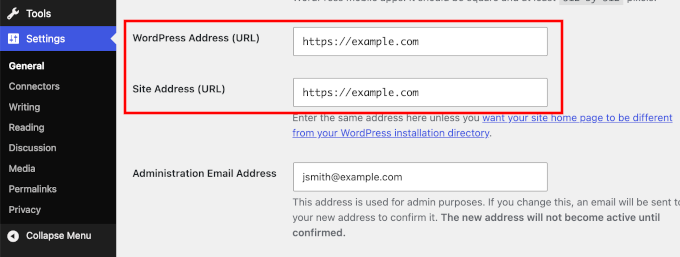
For most websites, the URLs in the ‘WordPress Address’ and ‘Site Address’ fields must be exactly the same. Check all three of these details in both fields:
- http vs https – both fields must use the same one.
- www vs non-www – pick one version and use it in both fields.
- Letter case – the URLs should be all lowercase.
Since the error might have locked you out of the WordPress admin area, you may need to fix the URLs without the dashboard. You can do that by editing the wp-config.php file, which sits in the root folder of your website.
Connect to your site using an FTP client or the File Manager app in your hosting control panel. Then, open wp-config.php in a plain text editor and add these two lines just above the line that says ‘That’s all, stop editing!’:
define( 'WP_HOME', 'https://example.com' );
define( 'WP_SITEURL', 'https://example.com' );
Don’t forget to replace ‘https://example.com’ with your own site URL. Now, save the file and upload it back to your website, then visit your site to see if this resolves the error.
Note: These two lines override the URL settings in your database. Once your site is working again, you can leave them in place. The fields on the Settings page will just appear locked.
For more methods, see our tutorial on how to easily change WordPress URLs.
3. Fix Cloudflare’s SSL Setting
If the error started right after you connected your site to Cloudflare, then this is almost certainly your fix.
Cloudflare works as a reverse proxy. That means it sits between your visitors and your server, answering requests from its own network to make your site faster and safer.
The usual cause is Cloudflare’s SSL mode being set to Flexible, which creates an infinite loop. With Flexible SSL, visitors connect to Cloudflare over HTTPS, but Cloudflare talks to your server over plain HTTP. Your server then redirects that HTTP request back to HTTPS, and the loop begins.
To fix this you need to follow these two steps.
First, in Cloudflare dashboard go to SSL/TLS » Overview and change the mode from Flexible to Full, or Full (strict) if you have a real SSL certificate installed on your server, which you should.
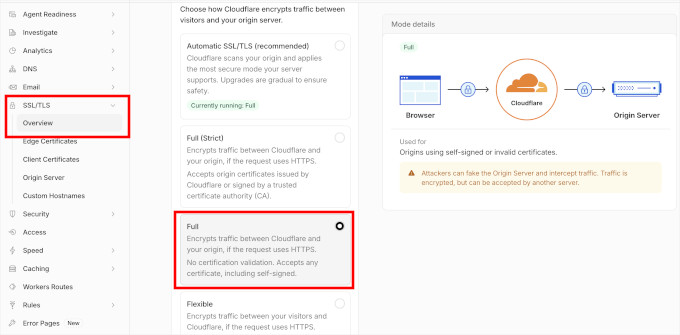
Second, add the snippet below to the wp-config.php file so that WordPress correctly detects that the visitor is on HTTPS behind the proxy.
Add this to wp-config.php, above the ‘stop editing’ line:
if ( isset( $_SERVER['HTTP_X_FORWARDED_PROTO'] ) && $_SERVER['HTTP_X_FORWARDED_PROTO'] === 'https' ) {
    $_SERVER['HTTPS'] = 'on';
}
That pairing resolves the large majority of Cloudflare redirect loops.
The same snippet also works if your site sits behind any other reverse proxy, load balancer, or NGINX front end.
While you are in the Cloudflare dashboard, purge its cache as well, so an old cached redirect doesn’t keep showing the error. Go to Caching » Configuration and click the ‘Purge Everything’ button.
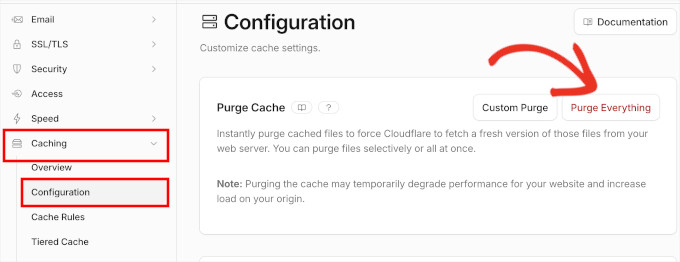
4. Reset Your WordPress .htaccess File
Note: This step applies to websites running on Apache, the most common type of web server. If your site runs on NGINX, another popular web server, then there is no .htaccess file. On NGINX the redirect rules live in the server configuration, which you cannot edit over FTP, so ask your host to check it for a rule that points back on itself.
The .htaccess file is a special file that your web server uses to manage redirects and other server settings. WordPress also uses this file for SEO-friendly URLs and other redirects.
Sometimes, WordPress plugins may make changes to your website’s .htaccess file, which can trigger this error. It is also possible that deactivating a plugin will not remove those changes from your .htaccess file.
In that case, you will need to manually reset your WordPress .htaccess file.
Again, you will need to access your website using an FTP client or the File Manager app in your hosting dashboard.
Once connected, you will see the .htaccess file in the root folder (usually /public_html/) of your website.
Note: If you cannot find your .htaccess file, then see our guide on how to find .htaccess file in WordPress.
First, you need to download a copy of your .htaccess file to your computer as a backup.
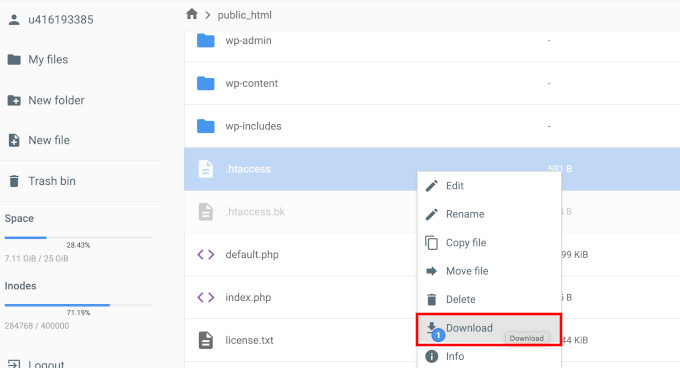
After that, rename the file to .htaccess_old rather than deleting it. Your server stops reading it either way, and renaming means you can undo this in two seconds if the file turns out not to be the cause.
You can now try visiting your homepage. If it loads, then your .htaccess file was causing the redirect error. Your inner pages will return 404 errors until you recreate the file below, so don’t read that as a failed test.
Now you will need to recreate the .htaccess file.
Normally, your WordPress website can do it on its own. Simply go to the Settings » Permalinks page and click on the ‘Save Changes’ button at the bottom.
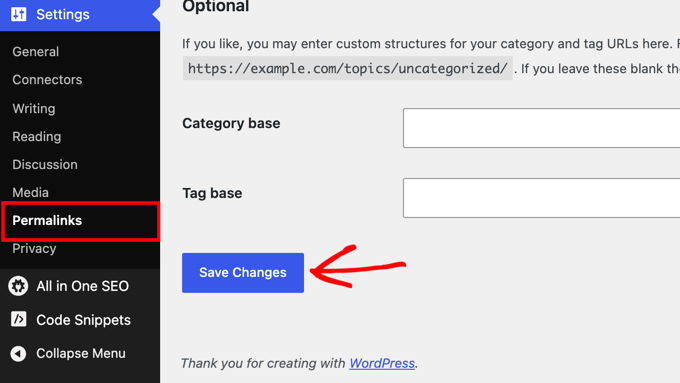
If you prefer, you can also recreate the file yourself.
Simply create a new .htaccess file in your site’s root folder and paste in the default WordPress rules:
# BEGIN WordPress
<IfModule mod_rewrite.c>
RewriteEngine On
RewriteRule .* - [E=HTTP_AUTHORIZATION:%{HTTP:Authorization}]
RewriteBase /
RewriteRule ^index.php$ - [L]
RewriteCond %{REQUEST_FILENAME} !-f
RewriteCond %{REQUEST_FILENAME} !-d
RewriteRule . /index.php [L]
</IfModule>
# END WordPress
5. Deactivate All WordPress Plugins
If resetting the .htaccess file did not clear the loop, then the next likely cause is a plugin conflict.
Any plugin that sets up a redirect in a way that conflicts with the default WordPress redirects can cause this error. The usual suspects are SSL or HTTPS-forcing plugins, redirect managers, caching plugins, and security or login plugins.
To fix this, you need to deactivate all WordPress plugins on your website. Normally, you can just go to the Plugins » All Plugins page in the WordPress admin area and deactivate plugins from there.
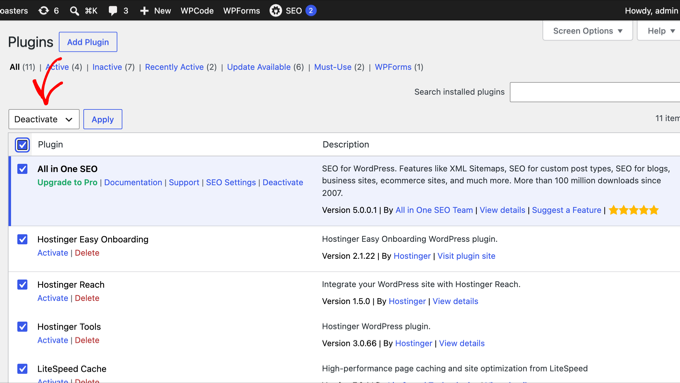
However, we are assuming that due to the redirect error, you may be unable to access the WordPress admin area.
In that case, you will need to deactivate WordPress plugins using an FTP client like FileZilla or the File Manager app in your WordPress hosting control panel.
Simply connect to your website using an FTP client and go to the /wp-content/ folder.
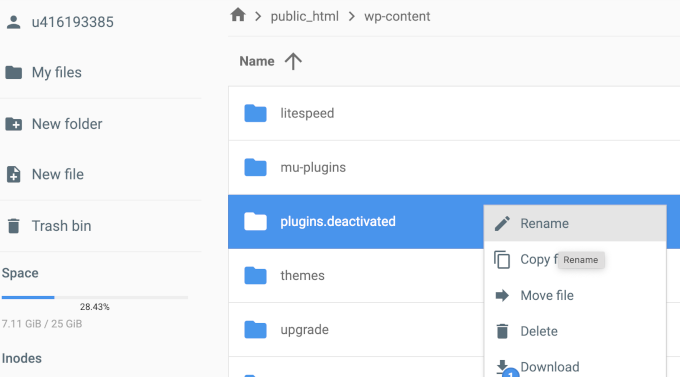
There you will find the plugins folder, which you need to rename to ‘plugins.deactivated’.
Doing this will deactivate all the WordPress plugins on your site.
Basically, WordPress looks for a folder called plugins to load the plugin files. When it does not find the folder, it automatically disables the active plugins in the database.
Now, you can try visiting your WordPress website. If you are able to log in to your WordPress admin area now, then this means one of the plugins was causing the error.
To figure out which plugin was the culprit, you need to switch back to the FTP client or File Manager app and rename your plugins.deactivated folder back to ‘plugins’.
After that, switch to the WordPress admin area of your website and go to the Plugins » All Plugins page. From here, you can activate your plugins one by one and then visit your website to see if you can reproduce the error.
Once you find the plugin that is causing the error, you can find an alternative to that plugin or report the issue to the plugin’s WordPress support forum.
6. Fix the Redirect Loop on wp-admin Only
Sometimes, your website works fine for visitors, but the login page or the wp-admin area keeps redirecting. This version of the error usually comes from your WordPress login cookie or a URL mismatch that only affects the admin area.
Here is what to check, in order:
- Clear your cookies for the site – a corrupt login cookie is the most common cause, and Step 1 above shows you how.
- Make your URLs match – a www vs non-www mismatch sometimes breaks only the admin area, so double-check Step 2.
- Look for a COOKIE_DOMAIN line – open wp-config.php and check for a line containing
COOKIE_DOMAIN. If it doesn’t match your domain exactly, remove that line, save, and try logging in again. - Deactivate security and login plugins – plugins that change your login URL or limit login attempts can create admin-only loops. Use the FTP method from Step 5, but rename only that one plugin’s own folder inside /wp-content/plugins/. Renaming the whole plugins folder would take every plugin offline for the visitors who can still browse your site.
For more solutions, see our guide on how to fix the WordPress login page refreshing and redirecting issue.
7. Fix Too Many Redirects After Migrating Your Site
If the error appeared right after you moved your website to a new domain or a new host, then some part of your site is still pointing at the old address.
First, make sure your WordPress Address and Site Address use the new domain. If you cannot log in, use the wp-config.php method from Step 2 to set them.
Next, you need to update the old links left in your database. Your posts, pages, and theme settings can still contain links to your old domain, and those links can bounce visitors between the old and new addresses.
Install the free Search & Replace Everything plugin and go to the Tools » WP Search & Replace page.
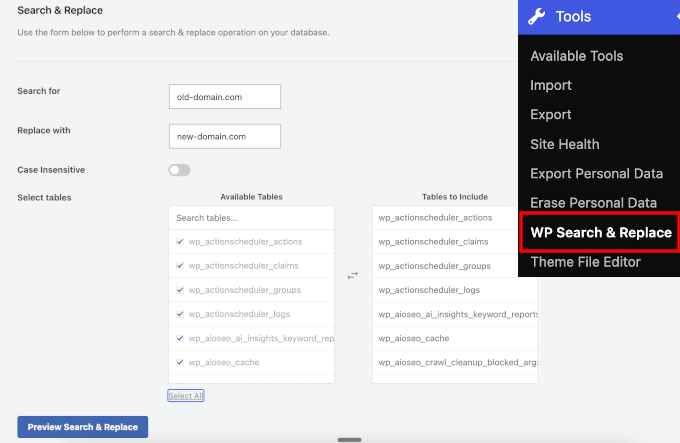
Here, you can run a search for your old domain and replace it with the new one.
You should also check your old site or old host for a redirect that points at the wrong address. For step-by-step instructions, see our guide on how to fix WordPress redirecting to the old domain after migration.
If you are planning another site move, you can avoid this error next time by following our checklist on how to properly move WordPress to a new domain.
What to Do If the Error Is Still Not Fixed
If they did not fix the problem, then you may need to talk to your WordPress hosting company to make sure that there isn’t a server issue.
Once they fix the issue on your site, you should also be able to figure out what caused it.
If it was a plugin, then you need to report the issue to the plugin’s support forum. See our guide on how to ask for WordPress support. However, if you are unable to get help, then you can always find an alternative plugin that does the same thing.
If the error was caused by a WordPress site misconfiguration, then you can make a note of it and ensure that your site settings are properly set up.
For more tips, see our detailed tutorial on how to troubleshoot WordPress issues on your own like a total WordPress pro.
Frequently Asked Questions
How can I fix the ‘Too many redirects occurred’ error?
This is how Safari words the same redirect loop error. Clear the cookies for the website in Safari’s Privacy settings and try again. If it is your own website, work through the fixes in this article, starting with your URL and SSL settings.
How do I fix ‘localhost redirected you too many times’?
This happens on local WordPress installs when the site URL still points at your live domain. Add the WP_HOME and WP_SITEURL lines from Step 2 to wp-config.php using your local address, such as http://localhost/mysite, and then clear your browser cookies.
How do I fix a website that keeps redirecting?
Run the website address through a redirect checker like httpstatus.io to see the full chain. Then remove the conflicting rule. It is usually a redirect plugin, an .htaccess rule, or an SSL setting sending visitors back and forth between two versions of the same URL.
Video Tutorial
If you don’t enjoy written instructions, you can follow along with our video tutorial instead:
We hope this article helped you resolve the ‘error too many redirects’ issue on your website. You may also want to bookmark our ultimate handbook of common WordPress errors and see how to contact WordPress support.
If you liked this article, then please subscribe to our YouTube Channel for WordPress video tutorials. You can also find us on Twitter and Facebook.



Gerjon
When plugins are the issue (a sort of site appears when the plugins folder in de-activated), chances are you’ve used an ‘under constructions’ plugin when building the site on a temp location. de-activate this plugin first!
Bene
Hi,
I’ve followed to the letter this tutorial to move my site from my localhost to my production site. However I’m having issues with accessing the site.
I’m all good to access the WP-admin dashboard however I cannot get to the website, for some reason it keeps redirecting me to my localhost.
This is driving me nuts:
– I’ve updated the wp_ptions both home and siteURL
– I’ve placed the .htaccess as per the comment
– I’ve searched my database and could not find anywhere else except on cross-page links localhost
I really don’t know how this redirect to my localhost is taking place.
Any hint?
Nate Balcom
Thanks so much this worked like a champ. It took all of 2 minutes and I was able to get back into my admin. Much appreciated. I’m going to share the bajesus out of this.
kiran dev
copy plugin folder from wp-content and place it somewhere else then just delete plugin folder from wp-content and reload your wp-admin.php url now it ask for wp login…enjoy but all plugins will deactive and copy plugin folder from where you saved it and paste inside wp-content…..
now its normal ……
thanks me later :)))
Dan N
I’ve been trying to solve this issue. My site works fine and I’ve removed the plugins directory, but I can’t seem to get to my wp-admin page. Anything beyond wp-admin results in 404 and if I go to /wp-admin, it results in ‘too many redirects’.
Can’t seem to figure it out!!!!! Please help!!
WPBeginner Support
First try the section ‘Change Site URL Without Access to Admin Area’ in the article above. Try adding www to your site URL. If it already has it, then try removing it. If this does not solve your problem, then try these steps.
Connect to your website using FTP.
In your site’s root folder, locate the .htaccess file and download it to your computer as backup.
Edit the FTP file on your webserver and paste this code inside it.
# BEGIN WordPress <IfModule mod_rewrite.c> RewriteEngine On RewriteBase / RewriteRule ^index\.php$ - [L] RewriteCond %{REQUEST_FILENAME} !-f RewriteCond %{REQUEST_FILENAME} !-d RewriteRule . /index.php [L] </IfModule> # END WordPress1-click Use in WordPress
Try accessing your website and admin area now.
Admin
Dan N
OK so get this. I did all of the possible things from this site and others and absolutely none of it worked. Then I went to do a restore to a previous backup and it got worse. HTTP500s all around.
After some troubleshooting, it turned out somehow Namecheap’s file permissions got mucked around with (not by me) and once that was fixed by the tech, everything came back up just fine.
I guess you can’t really rule out SERVER ISSUES even if it isn’t being controlled by you.
Latif
Thankss aaaaloottt brooooo…. I’ll reinstall my wordpress if i dont find how to fix here hahahahahaha
Intan
Help please, i added in script into the html body in wordpress.. then my website is not accessible. I have deleted the script but still cannot access my website.any advice?
Jon
Is it possible that having the url setting you mentioned in your first solution could cause the cycle of redirects if they are set to https but a plugin is forcing all pages but one to http?
Javier
Hi! Ijust upgraded WP on one of my sites to 4.4.1. After doing so, site loads fine, but when trying out wp-admin, I keep getting a:
The page isn’t redirecting properly error.
I tried to delete .htaccess but I don’t see it regenerated. I also tried to rename plugins folder with no luck.
Permissions seem to be fine, and it is just wp-admin failing.
Any clues you can share with me?
WPBeginner Support
Try deactivating all plugins.
Admin
Dane Morgan
They said ” I also tried to rename plugins folder with no luck.” which IS deactivating all plugins.
Rawal Baig
Also have same problem when I updated to WP 4.4.2, It was working fine first but now site is accessible but can’t access WP-Admin.
Any help would be appreciated lot.
WPBeginner Support
You can start troubleshooting by first deactivating all your WordPress plugins.
Rantej
Just sharing solution that worked for me. I had tried everything including disabling plugins, changing themes, home & site url in phpmyadmin or wp-config etc. But in the end just deleted and uploaded the recent wp-admin and wp-includes folder. Everything is back to normal
Laura VAB
Thanks! Reuploading the folders worked for me when nothing else did!
Rantej
Don’t forget to replace outside wordpress files as well (wp-logon, wp-settings etc) apart from wp-admin & wp-include folders.
mad
Thanks bro It worked for me..
neetta
Thanks a lot. It worked for me too when everything else failed.
Sam
Had this issue. Added a new SSL certificate. Discovered it was a setting in WooCommerce under Checkout Settings. Had to uncheck the “Force HTTPS after checkout” option. Instead, I used the Force https plugin.
Ming
YOU are my hero, this worked for me!
YES
Thanks!! worked
Donna
Just created a new page on my blog and am getting a redirect loop on it. Just on the one page. All of the other pages seem to work.
Before it happened I click the buy button and since that it went to redirect. Baffled… but hate the idea of reloading all of the plugins. Hoping there is a shorter solution.
Jamie
Just the information I was looking for! I changed my DNS then quickly changed back to the original DNS after some issues. Now, I get this error in Firefox and some other browsers. Is this something that my host has to fix?
Shailansh
Can you please tell me how to check, which plugin is causing the redirect loop error?
WPBeginner Support
Deactivate all WordPress plugins, and then login to your website. Try installing and activating fresh copy of each plugin you had until you find the one that caused the error.
Admin
Sumon
hi thanks for nice post, still i am wonder how to solve my website loop error, i am facing problem on particular feed page that is showing error, pls reply to solve my problem
WPBeginner Support
It seems your feed is redirecting to an unauthorized URL. This could mean that your site is infected. Before you do anything else, first deactivate all your WordPress plugins and switch to a default WordPress theme like twenty sixteen. If this resolves your problem then it was an issue with one of your plugins or your WordPress theme. If this does not help, then try steps in our step by step guide fixing hacked WordPress site.
Admin
panos
Thank you very much! You have helped me a lot!!!
Uzair Hayat
I’m not sure what caused the error on my site upon launch.
A few users started facing redirect errors including some on my team.
I believe this was the work of some plugin, but i cant put my finger on it :/
I was able to fix the problem by removing www from my urls.
Adam
Thank you for this post. I have been trying to deal with my redirect problem for days. I have tried everything on this site, yet the problem persists. I even did a fresh install. And, while that helped googlebot being able to crawl my site and helped my sitemap not being redirected, I still have a redirect issue when I use the seobook header check tool.
I even changed the permission to 755 on only the directories of wp_admin. The only thing I haven’t done is delete .htaccess because if something goes wrong there, then I would have to rebuild the site. And, I’ve been at this too long to rebuild it again to have the same problem.
Is it a hosting issue? I’m with godaddy and the site is carauctiongurus.com . I definitely learned a lot about WordPress having this redirect issue. Can you help?
WPBeginner Support
You can download your .htaccess file to your computer and then delete it from server. If anything goes wrong you can upload the original .htaccess back to the server.
Admin
Adam
Thank you. I have done what you asked and the site is still reachable, however SEOBook and MXToolbox still show and infinte redirect loop. Should I give it some time first? Thanks again.
Nikhil
Thanks for all…
After research of two days and try everything in that blog….
Finally I found
0750 replace 0755
Done…..
The Best Blog I Ever seen for Wordpress Solution….
All Solution at One Place….
Keep Posting……
Strahinja Krstić
Hey NIKHIL,
Thanks for your comment. Just one question:
You said “0750 replace 0755”. Do that numbers mean file permissions for FTP folders?
Craig
First I want to thank you for your article.
Some of this worked, all of it help me troubleshoot.
If you have Woo-commerce installed into your blog for a store add-on there are additional settings added to your Permalink Settings; Common Settings and Product permalink base.
The Common Settings are for the articles and must be set to any setting other than default or Custom Structure. This will stop the error.
You helped me, I hope this helps another.
C-
Taufiq
Thank you for the tip. It worked! I messed up the WP settings when I changed the site address URL and WP address URL from teasan.com.au to teasan.com.au/organic-matcha ….. the website then went to a redirect loop! Couldnt even log in.
Downloaded FileZilla and added
define(‘WP_HOME’,’http://example.com’);
define(‘WP_SITEURL’,’http://example.com’);
as suggested and it worked!! Thank you so much.
However, now the URLs on the settings are pretty much locked. But its ok, I dont think I will ever change it again!
Teo
Thanks a lot for this post, really helpful!!
Caroline
I found that mine was caused by a missing trailing slash “/” at the end of my upload_url_path in the wp_options database table…
Presto
After looking at several highly technical and complicated to no result, your post did the trick. To me, it was the plugin I chose to include during the WP installation.
Thanks a lot!
Strahinja Krstić
Hey PRESTO,
Can you share with us which plugin caused your problem?
Graham Frame
Tried all teh above and still getting same error?
Baffled!
Jose
My website was doing good, but I installed woocommerce plugin on my site and now my website has this error message, so like I read it is good to contact my host?
megan
if we change mysql username and password
in cpanel or … and if we don’t edit wp-cofing.php file this error follow us
Sarah Brabazon
Thank you so much! I read the first paragraph of the tutorial and fixed my problem.
Deepak
I really appreciate for this tutorial with simple explanation.
Thanks.
manohar
Am glad you are doing this , Create job with simple explanation. Thanks.
Josh
I tried this solution and it completely complicated things even more, making the issues much worse. Be careful, always seek out the help of a professional developer before playing around with areas like this in your website.
David
Great post. I also had the issue of the redirects and here is one solution that I came across just recently. I had deactivated the plugins and had the url in the proper locations. What happened is that I transferred the site over to another host. The issue that I came across was the php.ini file that was causing the issue. Some servers will let you put in a custom .ini file while others do not. I deleted the .ini file since it was not needed in the new server since I set the php files to be all the same for multiple accounts. Once I did that, I was able to log in the site as usual.
sandeep
David,
Could you please elaborate on how you resolved the issue. I am facing the same probelm, we moved the site to a new host and new domain name. The urls are proper and there are no plugins. we have multiple sites hosted. If multisite is set to false, login page works fine,but cant see any sites in the dashboard. If multisite is set to true, getting too many redirects issue. The url is being pointed to new-domain-name/wp-signup.php?new=new-domain-name
if I could fix this too many redirects issue, I should be able to view my sites in dashboard (also I have do search/replace in wordpress database (interconnectit script)
“Some servers will let you put in a custom .ini file while others do not. I deleted the .ini file since it was not needed in the new server since I set the php files to be all the same for multiple accounts.”
Did you delete the php.ini file in /etc/php5/apache2/php.ini ?
Looking for urgent help. Thanks in advance !!
Odinekachukwu Ishicheli
Admin, Now I am having issues with my pages. The homepage is the only thing working.
WPBeginner Support
Login to admin area of your WordPress site. Go to Settings -> Permalinks. Click on the save changes button at the bottom of the page. View your website to see if it worked.
Admin
Odinekachukwu Ishicheli
I can’t thank you enough for this. M site has been giving me the “redirect error” since February and even after deactivating all plugins still had the same issue, until I looked for my .htaccess file from my cPanel and delete.
Thank you so much for the help, I am stuck now to your site learning all the little tips and tricks after running away from my software engineering classes.
emile
hi there,
i tried all of the above and it still won’t work.
define(‘WP_HOME’,’http://example.com’);
define(‘WP_SITEURL’,’http://example.com’);
with and without the www.
i tried deleting the .htaccess and deactivating all the plugins and ‘This webpage has a redirect loop’
‘ERR_TOO_MANY_REDIRECTS’ is still showing.
can someone help me?
thanks
Asif Shahzad
I am using cloudflare ssl and i am getting same error check this screenshot http://prntscr.com/6rhjtb how can i fix this ssl redirect loop error?
Ernest
Hi
Just wanted to thank you for this. I’ve been struggling with a specific plugin and your recommendations help me fix it.
I haven’t found a solution for the layman anywhere else.
Thanks.
Ashish Makwana
Hi every body,
i also have same problem but solution is here:
1)
Ref :https://www.wpbeginner.com/wp-tutorials/how-to-fix-error-too-many-redirects-issue-in-wordpress/
Open wp-config.php and add these two lines
define(‘WP_HOME’,’http://yourdomain.com’);
define(‘WP_SITEURL’,’http://yourdomain.com’);
/*also add below */
/*Ref :https://tommcfarlin.com/resolving-the-wordpress-multisite-redirect-loop/*/
define(‘ADMIN_COOKIE_PATH’, ‘/’);
define(‘COOKIE_DOMAIN’, ”);
define(‘COOKIEPATH’, ”);
define(‘SITECOOKIEPATH’, ”);
/*and in last if you have apply code for canonical url into ,htacces then comment it means disabled it but not remove */
take backup first .htaccess file then do above change.
Enjoy your day!!!!!!!!!
Andre
OMG! I simply have no words to thank you. I’m about 10 hours trying to fix this issue to install wordpress and I’ve read a thousand blogs and couldn’t fix it.
Editing config.php with those two first lines solved the problem.
Thank you very much.
Succes for you!
WPBeginner Staff
No they do not. People usually assume that applying permissions recursively on directories should also affect files inside directory. This is not correct. You can have different permissions for directories and different permissions for files inside the directory.
robrecord
Well, I am totally flummoxed. I have one site in a multisite install that only does this SOMETIMES. For example, Earlier today the site was fine and I was loading it up on multiple browsers and multiple machines. I have not touched the config or anything on the backend, and now it’s ‘too many redirects’. This has been going on for weeks. Really need this to be fixed!
I’ve verified permissions. I’ve verified & reset permalinks settings. I’ve removed cookies. I’ve verified & reverified domain mapping settings. Checked home & site URLs. Checked SEO settings. Reset nginx page cache and WC3 object cache. Disabled browser cache. Disabled all WP plugins.
It’s only saying ‘too many redirects’ for the home page; I can log in to admin and view other pages.
I appreciate all help so far… Does anyone have any further suggestions please?
Paul Vincent
Hi, did you ever find a solution to your issue with the occasional too many redirects issue? I’m experiencing the same problem – it occurs once or twice a day for anonymous users, but anyone signed in is fine, which makes me assume it’s a cache problem, but so far nothing has fixed the issue…
Thanks,
Paul
uhhm.net
just fyi, anyone trying to solve this issue where other conventional suggestions do not work…
make sure your owner/group permissions are correct.
ie, if you manually uploaded wp-admin & wp-includes via your root login, you will need to change folder/file ownership and group to whichever account your wordpress installation is on.
to change ownership/group from shell:
chown -R ownername:groupname foldername
ie:
chown -R wpaccount:wpaccount wp-admin
chown -R wpaccount:wpaccount wp-includes
this applies to cPanel, Linux, Unix installations etc.
WPBeginner Staff
First create a backup of your website download all your files and backup your database using phpMyAdmin.
After that delete your .htaccess file
Open wp-config.php and add these two lines
define(‘WP_HOME’,’http://example.com’);
define(‘WP_SITEURL’,’http://example.com’);
Replace example.com with your own domain name.
If you are not seeing error too many redirects issue but seeing white screen. Then try these steps:
https://www.wpbeginner.com/wp-tutorials/how-to-fix-the-wordpress-white-screen-of-death/
If this doesn’t help then select your wp-admin folder in FTP client and change file permission to 755. Make sure you check to apply the permissions recursively and apply it to all the directories inside wp-admin. Do not set it for all files resursively, just the directories.
robrecord
“Make sure you check to apply the permissions recursively and apply it to all the directories inside wp-admin. Do not set it for all files resursively, just the directories.”
These sentences appear to contradict each other.
Mat
Thanks for the post. I still don’t have it working though.. Anyone has another suggestion? I tried everything in this post : http://wordpress.org/support/topic/cant-add-www-to-the-domain?replies=3
Thanks in advance!
Gino
Thank you!
Nabil Kadimi
A few more tricks that can help:
* Re-save your permalinks structure
* In permalinks settings, remove any non-alpha-numeric characters from the bases
R0ckland
Thanks for this. Took my some time to get this working but your blog sorted it out for me.
Cheers.
Pamela
Thanks for the information. Based upon what you said, I thought I may have a conflict with an SEO plug-in that I recently installed, but my redirect problem was with one new post. In the settings for the plug-in, I saw that “create autogenerated description” was checked. Since I am writing my own descriptions, I unchecked that (thinking that it may create a conflict). But that didn’t change anything.
Elsewhere, I read that the redirect error could be caused by changing the post title when the permalink is set to post title. Since I have a new assistant helping me with the blog, I thought maybe this had happened.
Before unplugging all of the plug-ins, I created a new post, pasted the text from the post with the redirect error, deleted error-prone post, and published the new post. Now it works!
Jason George
Thanks for your information. I have also read that this can be caused by a file permissions issue on wordpress folders. The article mentioned verifying that the permissions are set to 644 on all of your wp-admin folders and files. Hope this helps someone out.
Evelyn Guzman
I’m glad you’re doing this and you’re doing a great job. I also feel great to be following you because I have 2 big problems with WordPress so I am watching for these. One is on getting a lot of spams and I have Akismet on. Perhaps the problem is that in the comment box, WordPress puts down by default my user name and the clickable word logout instead of getting prospective commenters to login.
robrecord
You would only see your name as the user name because it’s you, and you are logged in. Everybody else sees a blank login box.
Uzair Hayat
You can actually try using disqus for your commenting.