


Do you want your website to stand out in Google search results?
Adding emojis to your SEO titles is a simple way to grab attention and get more clicks. At WPBeginner, we use them to make our headlines pop against the plain white background of search pages.
In this guide, I will show you how to easily add emojis to your SEO title in WordPress.

Why Add Emojis to Your SEO Titles?
Emojis are small digital icons used to communicate emotions, objects, activities, and other concepts. They can either replace text or enhance the message, giving it more meaning.
On a page filled with words, colorful and bright emojis help your page stand out.
By using emojis, you draw attention to your page and make your brand seem more human, attracting your target audience and boosting click-through rates.
While increasing your CTR isn’t guaranteed to help you rank better on Google, getting more traffic to your website is always a good thing.
That’s not the only reason. Search engines also support search queries with emojis. Try typing ‘🍕recipe’ into Google’s search bar.

You’ll find search results containing the ‘🍕’ emoji because Google recognizes the emoji in the search query and looks for pages that match that specific content.
How to Use Emojis in Your SEO Titles
Emojis can negatively impact your click-through rates and SEO if they are seen as misleading or spammy.
Before you start embedding emojis all over your titles, there are some ground rules to follow:
- Consider your audience: Emojis work better for some niches than others. For example, including emojis on a recipe page for the best cocktails to make in the summer might be appropriate. However, adding a heart or syringe to a page related to health care may hurt your brand’s reputation.
- Don’t use emojis to replace words: No matter how clear or descriptive your emojis are, they should never replace words because users are forced to interpret the meaning of the emoji instead of being told.
- Use clear emojis: Avoid ambiguous emojis that people can misinterpret. Instead, stick to simple ones that are widely known to all audiences.
- Use emojis that work on both light and dark backgrounds: Don’t use light emojis on a light background. For example, a yellow hand emoji works better on light backgrounds than a white hand emoji. This is especially important for SEO titles since Google’s default results background is plain white.
Now that you know how to use emojis responsibly, you are ready to begin using them on your web pages.
Here is the step-by-step guide on how to do it.
How to Add Emojis to Your SEO Titles
Adding emojis to your titles is incredibly easy once you have a good plugin. Without it, you might have to leave your post editor to find and copy emojis from another website, which breaks your workflow.
The first step to adding emojis to your SEO titles is using the free All in One SEO plugin.
AIOSEO offers on-page analysis so you can optimize your blogs to rank higher in search results. You can also use the built-in emoji picker to add emojis to your SEO titles.
AIOSEO also comes with an SEO checklist tool, a link assistant, and many other features that can help you optimize your website and boost your rankings.
Over the past couple of years, we’ve been using this plugin to improve our site’s SEO, and we’ve since seen a noticeable increase in both our rankings and traffic. To learn more about our experience, see our AIOSEO review.
Start by installing the AIOSEO plugin. For more details, you can follow our step-by-step guide on how to install a WordPress plugin.
Once that’s done, you are ready to edit your blog posts and pages and add emojis to your SEO title.
Edit Your SEO Title
Optimizing your metadata is super simple with the AIOSEO plugin. In the left-hand menu of the WordPress admin dashboard, select Posts.
You can also do this for pages on your WordPress blog, but for this tutorial, we are just going to edit a post as an example.
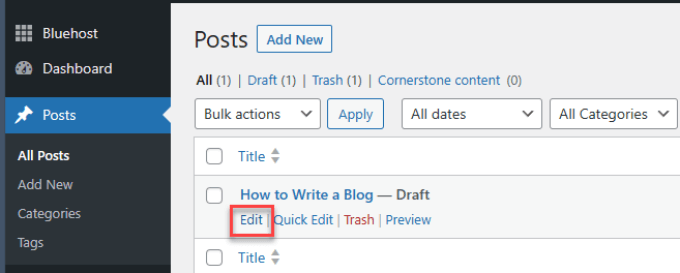
Find the blog post you’d like to update. Then click the ‘Edit’ link. If you have both the Block and Classic editors enabled, then either will work.
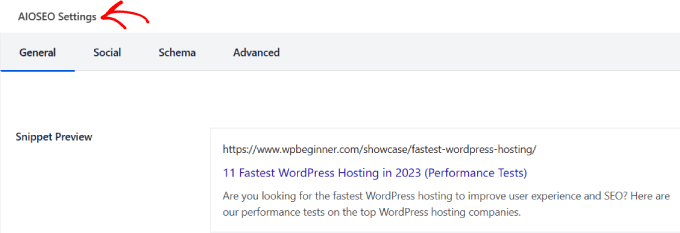
Simply scroll down the WordPress content editor until you get to the ‘AIOSEO Settings’ tab.
From there, you can edit the post title field.
Choose Your Emoji and Add It
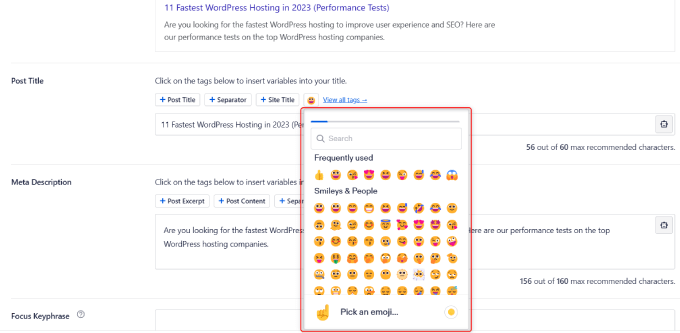
Now, you are ready to add your emoji to your metadata. To do that, scroll down a little further below the AIOSEO Settings.
Under Post Title, click on the emoji icon next to the tags in each field.

It’ll open up a window with a selection of emojis for you to choose from.
Browse through and insert emojis of your choice, or just use the search bar to find what you are looking for.
Lastly, make sure to hit ‘Update/Publish.’
After that, the emoji will appear in the SEO title and be displayed in search results.
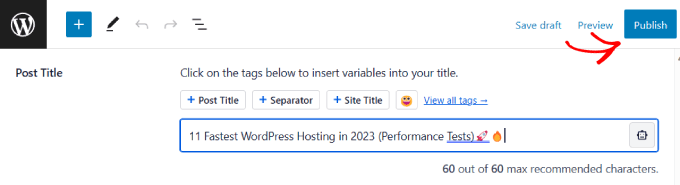
Now, select your emoji of choice, and that’s it! Congratulations, you’ve just added emojis to your SEO title!
Frequently Asked Questions About Using Emojis in WordPress
Now that you know how to add emojis to your SEO titles, you may have a few more questions about how to effectively use emoticons to enhance your WordPress website.
How Do You Add Emojis to HTML Titles?
In the past, you needed special codes to add emojis to HTML. However, modern websites use character encoding that allows you to simply copy and paste the emoji directly inside the title tag. That said, using an SEO plugin is still the safest and easiest method for WordPress users.
Do Emojis Affect SEO?
Google says you can use emojis in your SEO pages, including titles, but it won’t help or harm your search rankings in any way. However, emojis indirectly help your SEO efforts by improving click-through rates.
Emojis can humanize your brand, and if users spend more time on your site or interact with your content, these signals could boost your search ranking position.
Do Emojis Go Before or After Your Title?
Using emojis before the title can give a bad user experience, especially for anyone using a screen reader. The software will read the emoji’s text description aloud (like ‘Pizza Slice’) before your actual headline, which can distract users from your main topic.
How do I add emojis to my WordPress blog?
For Windows, you can press the Windows + . (Period) shortcut keys on your keyboard. For Mac, you can simply go to the menu bar at the top of the screen and click Edit » Emoji & Symbols.
Additional Resources
We hope this article has helped you learn how to add emojis to your WordPress SEO titles. You may also want to read these additional resources:
- Ultimate WordPress SEO Guide for Beginners (Step by Step)
- SEO Title vs H1 Post Title in WordPress: What’s the Difference?
- How to Improve Organic Click Through Rate (CTR) in WordPress
- How to Add Keywords and Meta Descriptions in WordPress
- Best WordPress SEO Plugins and Tools That You Should Use
- How to Install a WordPress Plugin – Step by Step for Beginners
If you liked this article, then please subscribe to our YouTube Channel for WordPress video tutorials. You can also find us on Twitter and Facebook.



Olaf
Emojis in SEO titles can be interesting in terms of catching attention, but honestly, I’ve never really noticed them anywhere. Is it because Google has abandoned this technique and no longer displays them, or have I just not been lucky enough to come across such a title? If they are still used, could this be a real competitive advantage when writing titles?
WPBeginner Support
From an SEO perspective Google does not give an advantage or disadvantage for using them, it would depend more on your target audience for if emojis work for you
Admin
kzain
This is an interesting concept! I never thought about adding emojis to SEO titles. While it’s great to know they won’t hurt SEO, the potential for increased click-through rates is intriguing. The idea of using EmojiCopy websites to easily add emojis seems convenient
Jiří Vaněk
I tested adding emojis to my website. SEO didn’t worsen or improve. As for traffic, it remained the same. However, what I noticed was that Google occasionally displayed emojis in the SERP, but rather rarely. In practice, about 90% of the time, Google didn’t show them in the SERP even though they were in the title. I don’t understand why. Perhaps something changed on Google’s side, and it started ignoring emojis and not displaying them.
mohadese esmaeeli
Simply press the window key and the period key simultaneously on your keyboard. A window will open, and within it, you can select your desired emoji.
WPBeginner Support
For some cases that would work but if you are adding HTML you would want to use the unicode characters
Admin
Dennis Muthomi
I use that shortcut too. It’s super handy for quickly adding emojis anywhere.
One thing I’ve noticed though is that emoji designs can vary quite a bit between Windows, Android, Apple devices, etc.
Jiří Vaněk
After some time gap, I would like to ask about this topic. I’m using AIO SEO and have started adding emoticons to the headlines of some articles. But when I look in the SERP results, I don’t see emoticons. They just aren’t there. The same thing happens to me often in the meta description, where I have emoticons, but the result on google is basically completely different. Does everything written in the article still apply, or has Google somehow modified the display of results in the SERP and doesn’t show emoticons anymore? In the headline, when I click on the article, I see emoticons. Also in google analytics, but not in SERP.
WPBeginner Support
For the time being what we have in the article is still correct, Google does not mind either way with emoji in your titles. Search engines are mainly being selective on if they display the emoji in the SERP or not.
Admin
Jiří Vaněk
Thank you for the explanation. What struck me was that I was adding emojis, but I didn’t see them on Google’s SERP yet. But I’ve been using this tactic for about a month, so we’ll see.
Jiří Vaněk
Never noticed this in search results before. Perhaps because I tend to search for technical stuff where emojis aren’t really in the headlines, or hardly there at all. However, it’s an interesting way to increase click-through if the website appears in the SERP. Moreover, if, as you mentioned, it doesn’t negatively impact SEO, it could be an intriguing option for websites targeting an audience that finds emojis appealing.
Ralph
My wife wants to start recipe blog and this looks very interesting with that pizza emoji. Even if this doesn’t help with SEO, if we land top3 result, this just sticks out and make people curious. I think this is a great idea. Thanks for sharing this!
WPBeginner Support
You’re welcome
Admin