


Building an online store in 2026 no longer means hiring a developer or spending thousands of dollars. You can set one up yourself in an afternoon, even if you’ve never written a line of code.
In this guide, we will walk you through selling physical products with WordPress and WooCommerce using the same setup we’ve used for our own online stores.
We will take you from a blank site all the way to a store that is ready for its first order.
- What Are You Going to Sell?
- Step 1: Set Up Hosting and a Domain Name
- Step 2: Install WordPress
- Step 3: Set Up Your WooCommerce Store
- Step 4: Design Your Online Store
- Step 5: Add Products to Your Store
- Step 6: Set Up Payments, Taxes, and Shipping
- Step 7: Optimize for SEO and Speed
- How to Get Your Very First Customers
- FAQs About Starting an Online Store
What Are You Going to Sell?
Because different types of products require completely different setups, let’s make sure you’re using the right software before we get started:
- 🛍️ Physical Products: If you’re selling clothing, handmade goods, gadgets, or anything else that requires inventory tracking and physical shipping, then this article is for you. We’re going to show you how to use WooCommerce.
- 🎓 Online Courses: If your goal is to sell student lessons, video lectures, or interactive quizzes, we recommend using a learning management system instead. You can see our comprehensive guide on how to create and sell online courses for full, step-by-step instructions.
- 💻 Digital Downloads: If you’re selling items like ebooks, music, software, or printable PDFs, a dedicated digital delivery plugin is a much better option than a heavy eCommerce platform. Check out our step-by-step tutorial on how to sell digital downloads on WordPress to get started.
Step 1: Set Up Hosting and a Domain Name
Before you can build anything, you need two things. A domain name is the address customers will type to reach you, like yourstore.com. Web hosting is the space on the internet where your store’s files, product photos, and content live.
Domain names usually cost about $15 per year, and hosting adds a small monthly fee on top. Choosing the right host can bundle both services together and cut your startup costs significantly.
We’ve tested dozens of hosting companies, and for new WordPress stores, we recommend Bluehost. Here is why they are our top pick for beginners:
- You get a free domain name for your first year.
- They set up your SSL certificate (the security feature that encrypts customer data) automatically and for free. This is essential for any store that accepts payments.
- They are an official WordPress.org recommended host.
- All their eCommerce plans come with WordPress and WooCommerce pre-installed. This means a major part of your website setup is already complete before you even log in for the first time.
Want to compare a few options? Two other hosts we trust for online stores are Hostinger (known for its low starting prices) and Levamo (a managed host built for speed).
For more options, see our guide to the best WordPress hosting.
Step 2: Install WordPress
If you signed up with Bluehost using our link, then WordPress and WooCommerce come pre-installed, so there’s absolutely nothing to install here.
To reach your dashboard, sign in to Bluehost and click ‘Edit Site’, or type your domain followed by /wp-admin/ into your browser (like mystore.com/wp-admin/).
Using a different web host? Our complete WordPress installation guide has step-by-step instructions for every major provider, and the whole process only takes a few minutes.
Step 3: Set Up Your WooCommerce Store
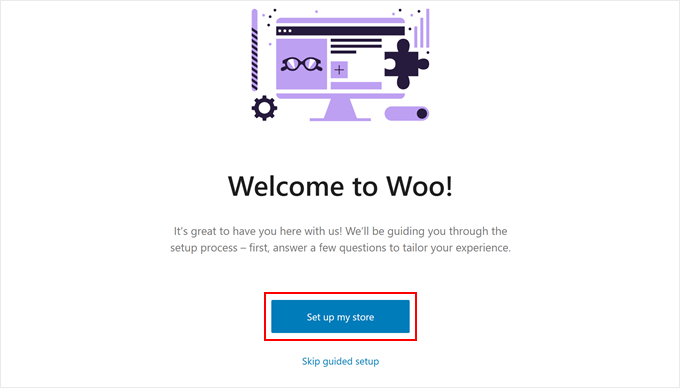
If WooCommerce is pre-installed, then you’ll usually see its setup wizard the first time you log in to your WordPress dashboard.
If you don’t see it right away, our WooCommerce made simple tutorial walks you through installing and activating the plugin.
Once WooCommerce is active, you can start the wizard by clicking the ‘Set up my store’ button.
You can technically skip this onboarding process, but we don’t recommend doing that. This is because the wizard automatically creates your essential store pages so you don’t have to build them from scratch.
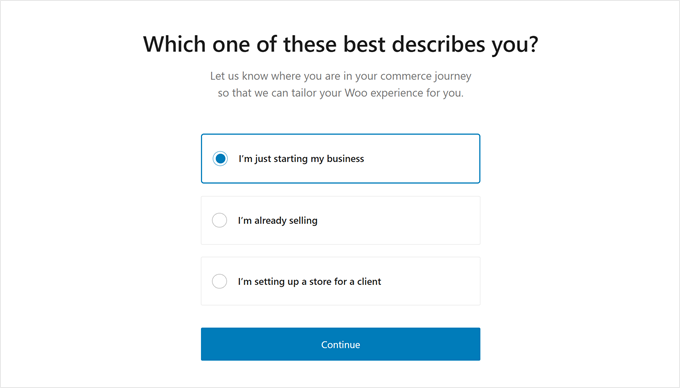
On the next screen, WooCommerce asks about you as a business owner.
If you’re new to this, then you can pick the ‘I’m just starting my business’ option.
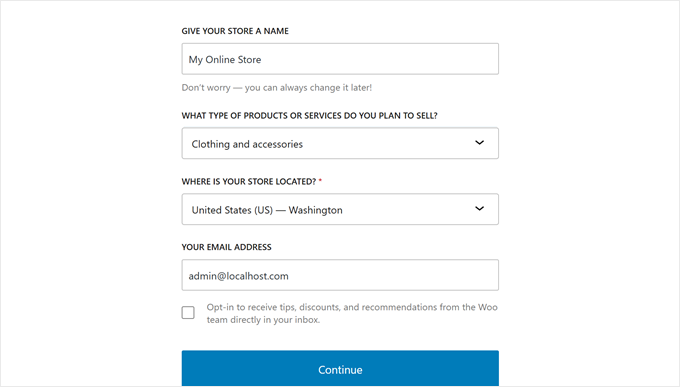
Next, it’s time to provide some business details. This includes your business name, the type of products you sell, your store location, and your business email address.
After filling everything in, click ‘Continue’.
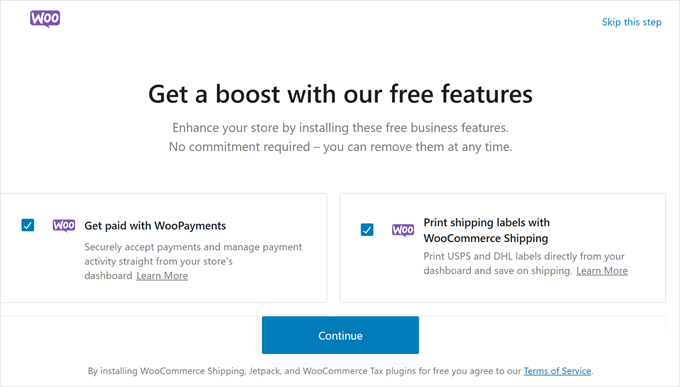
WooCommerce then suggests some free extensions you can install.
You can select the ones you plan to use and click ‘Continue’, or click ‘Skip this step’ for now.
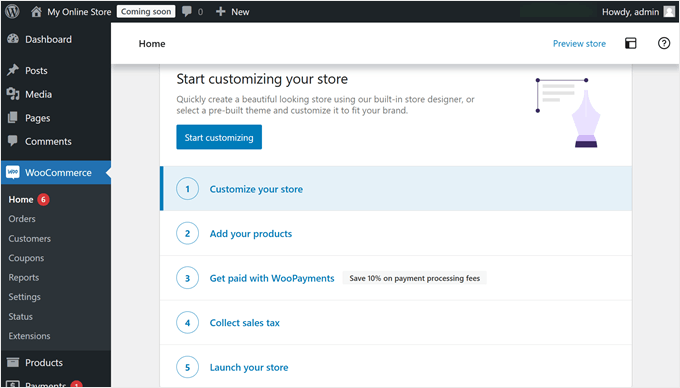
After installing everything, WooCommerce will display a helpful checklist for building your store.
Next, we’ll work through the most important items on that checklist.
Step 4: Design Your Online Store
The first item on that checklist is choosing a WordPress theme. A theme controls how your store looks and functions.
WordPress has thousands of themes, but not all of them suit online stores. Ideally, you want one that’s built specifically for WooCommerce, so we’ve put together a list of the best WooCommerce themes to help you out.
To install a theme, go to Appearance » Themes in your WordPress dashboard and click ‘Add New Theme’.
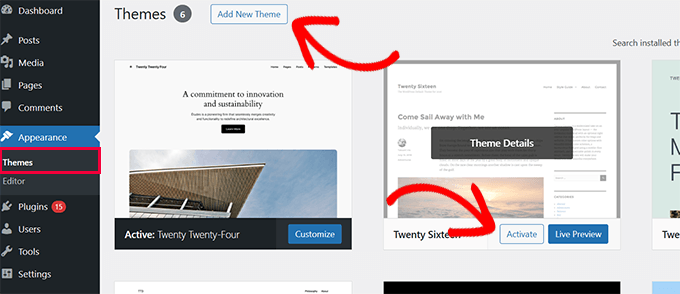
From there, you can browse and install any theme you like.
When it comes to customizing your theme, you’ll either have access to the classic theme customizer or the newer full site editor, depending on what theme you’re using. Our guide on how to edit a WordPress website covers both options.
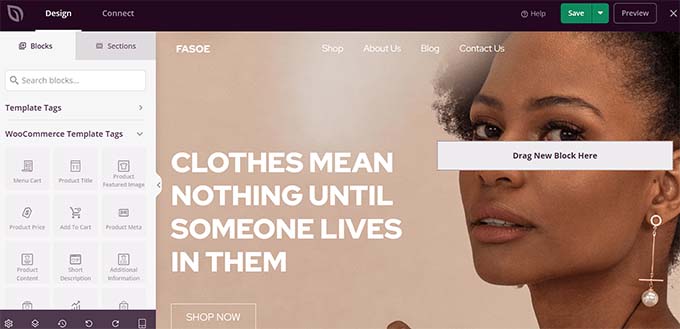
If you’d like more control over your online store’s design, then you can also use a drag-and-drop page builder instead.
SeedProd is the one we use for our own websites, and it comes with dozens of WooCommerce starter sites (templates) and customizable WooCommerce blocks.
For more options, see our roundup of the best page builders for WordPress.
Theme customization is an ongoing process, and you can keep refining it as your store grows. For help with specific pages, see our guide on how to edit WooCommerce pages to make things easier.
Step 5: Add Products to Your Store
To add a product, go to Products » Add new product from your WordPress menu.
This will open up the product editor screen, which looks a lot like the standard WordPress editor, but with some new sections for eCommerce.
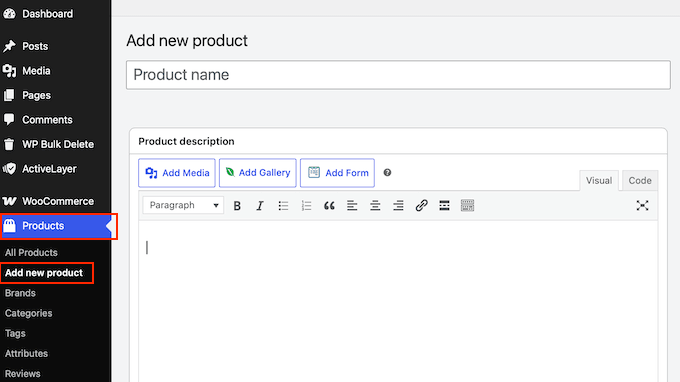
Entering a Product Title and Description
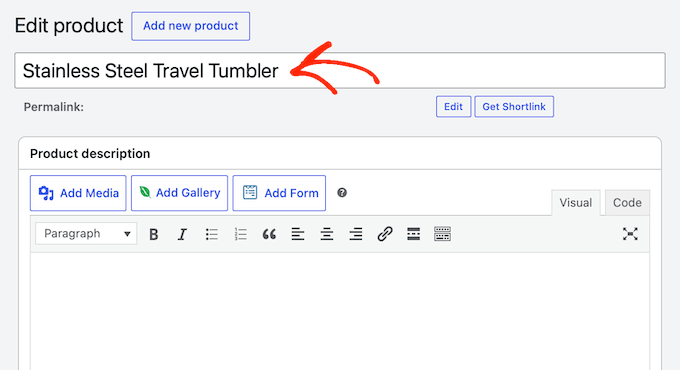
Next, you’ll need to enter a clear and descriptive product title.
Keep in mind that this is usually the very first thing your potential customers will see on your store page, so you’ll want to make it compelling.
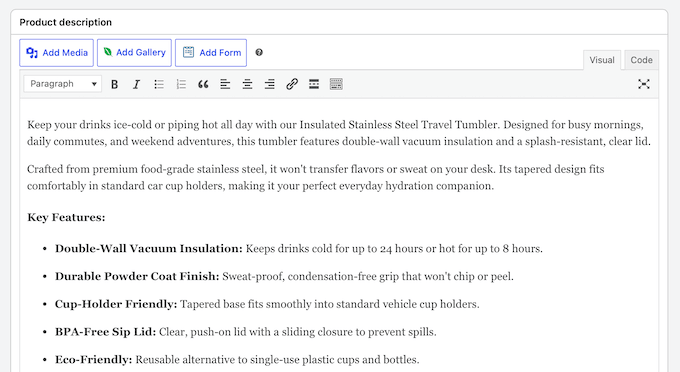
Right below the title is the main description box. This is where you can really sell the product.
We recommend writing a few well-structured paragraphs here that highlight key features, benefits, and important details.
Try to put yourself in the buyer’s shoes: What questions would you ask before purchasing? Be sure to answer those questions right in the text.
Adding Product Categories and Tags
On the right side of your screen, you’ll see options for ‘Product categories’ and ‘Product tags.’ These help keep your store organized and make it easier for visitors to find what they’re looking for.
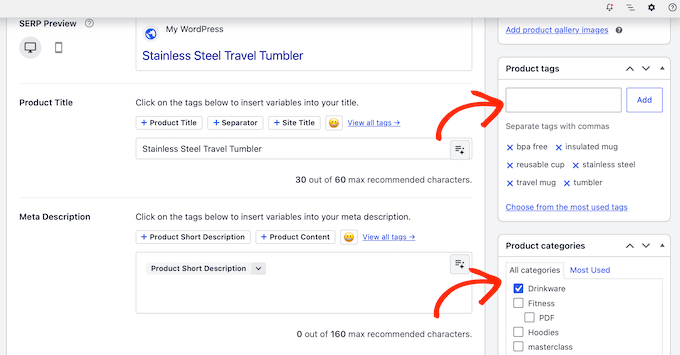
For more information, see our guide on how to add product tags, attributes, and categories in WooCommerce.
Creating Beautiful Product Galleries
Next up is your Product Image, which is your single most important selling tool. Online shoppers can’t physically touch your products, so we can’t stress this enough: always use high-quality, clear photos.
In the bottom-right sidebar of your editor screen, you’ll see two dedicated sections for visual assets:
- Product Image: This is the main, featured photo for your item. It’s the primary image visitors will see on your main shop catalog page and search results.
- Product Gallery: This is where you can upload additional supporting photos.
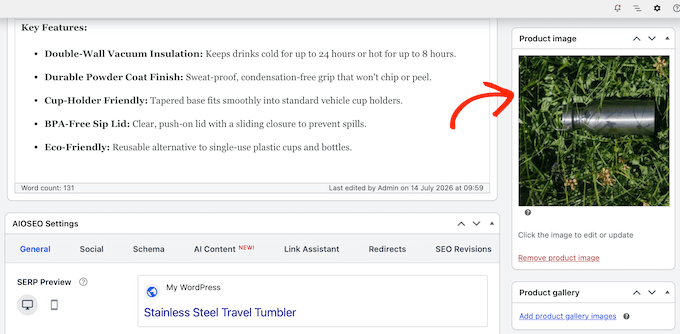
For detailed, step-by-step instructions, please see our guide on how to create a WooCommerce product image gallery.
Configuring Your Product Data
Next, head down to the ‘Product data’ box and click on the dropdown menu at the top.
From here, you’ll need to choose the product type you want to add:
- Simple Product: Select this if you’re selling a single item with a fixed price and no extra options, like a coffee mug or a paperback book.
- Variable Product: Choose this option if your item comes in different variations like sizes, colors, or materials. For example, you might have a t-shirt available in Small, Medium, and Large, with different prices or stock levels.
Most products are Simple, so this is what we’ll be using for this guide.
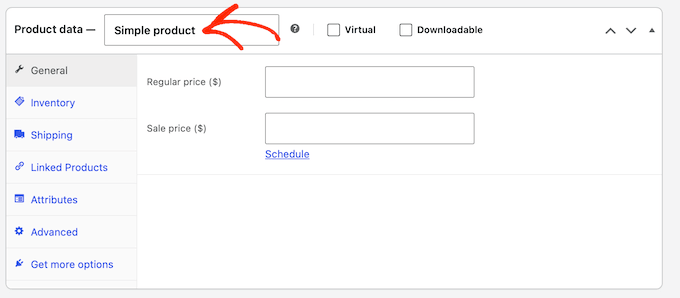
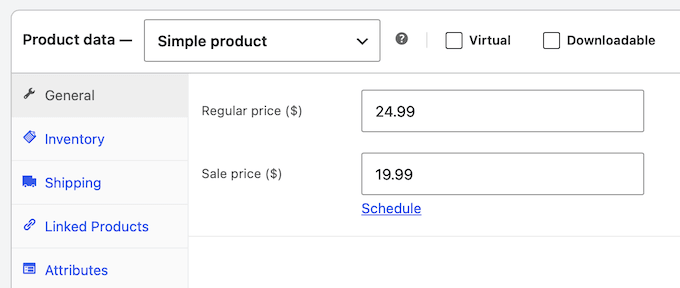
After making your selection, click on the ‘General’ tab. This is where you’ll set the pricing for your product.
Go ahead and enter your standard price in the ‘Regular price ($)’ field. If you’re planning to run a discount or promotion, you can also fill out the ‘Sale price ($)’ field.
Setting up Your Inventory
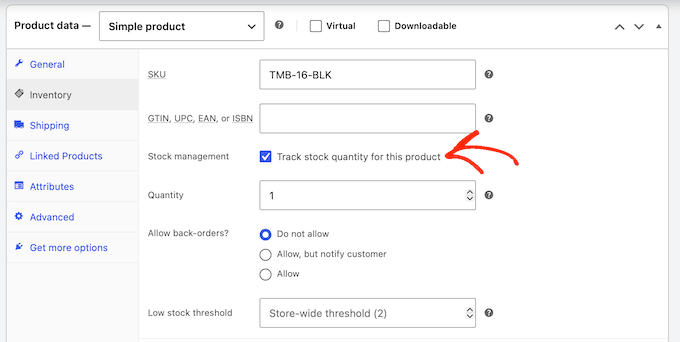
With that done, select the ‘Inventory’ tab.
In this section, enter a SKU (Stock Keeping Unit). This is a unique code used to track and identify your individual inventory items.
While this is optional, we highly recommend adding an SKU. A clear, logical SKU system will make it easier to manage your stock, especially as your business starts to grow.
You can use any naming convention that makes sense for your business (like TSHIRT-RED-LG).
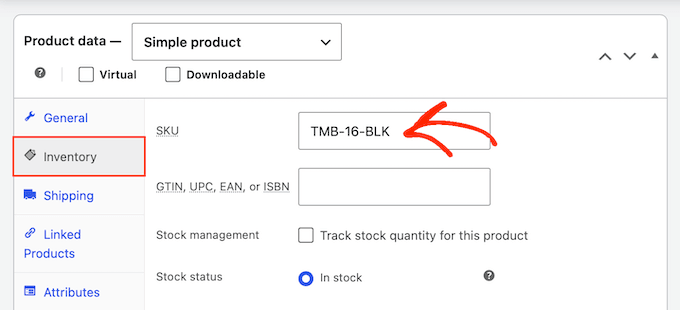
If you want WooCommerce to manage your inventory automatically, go ahead and check the box that says ‘Enable stock management at product level.’
Once checked, WooCommerce will display a few new options where you can enter your exact Stock quantity. WooCommerce will then automatically track purchases and mark the item as ‘Out of stock’ as soon as it sells out.
Adding Shipping Rates
With that done, click on the ‘Shipping’ tab.
In this section, you can enter the product’s Weight and Dimensions (Length, Width, and Height).
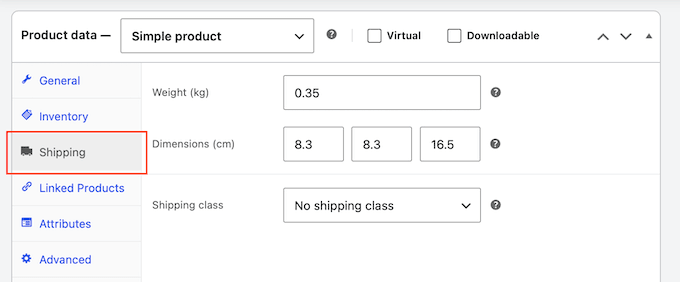
You can skip this if you’re using a simple flat-rate shipping method, but it’s worth filling in anyway. Accurate weights and dimensions matter if you ever switch to dynamic, carrier-calculated shipping rates (like FedEx or USPS).
Publishing Your Product
While there are more settings you can explore, this is all you need to create a simple product.
When you’re happy with how your product is set up, click the ‘Publish’ button to make it live.
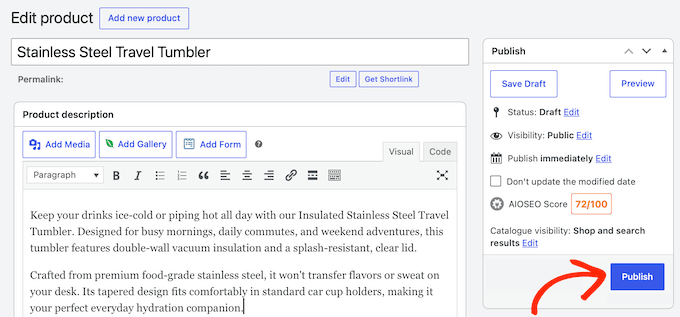
You can now simply repeat these steps to add more items to your store.
Step 6: Set Up Payments, Taxes, and Shipping
Now let’s get your store ready to take orders, starting with how you’ll collect payments from customers.
In the WordPress sidebar, go to WooCommerce » Settings and click on the ‘Payments’ tab.
Here, you’ll find basic, built-in offline options like Cash on Delivery and Direct Bank Transfer, plus WooCommerce’s own payment gateway (the service that processes card payments) called WooPayments.
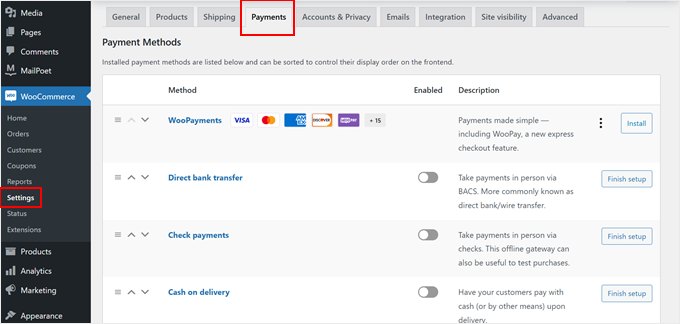
WooPayments is convenient and works out of the box, but it isn’t available in every country and some users report delayed payouts.
If WooPayments isn’t available where you are, FunnelKit’s free Stripe gateway is a solid alternative: customers pay by card without leaving your site, and it adds Apple Pay and Google Pay.
If you don’t want to use FunnelKit or WooPayments, then here are a few other ways to receive money in your online store:
- Let customers choose from several payment options.
- Accept credit card payments directly.
- Offer installment payments or Buy Now, Pay Later plans for bigger purchases.
Next, set up your sales tax by going to WooCommerce » Settings and clicking on the ‘Tax’ tab.
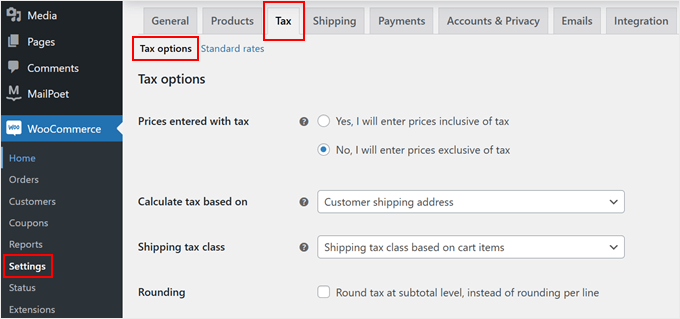
You can then decide whether to include tax in your listed prices, how to display it to shoppers, and what location to base your calculations on.
For most beginners, we recommend using the free WooCommerce Tax extension, which automatically calculates the exact right rate at checkout based entirely on the customer’s location.
While this plugin handles the math, we always recommend double-checking your local tax laws or consulting with an accountant to make sure your store is fully compliant.
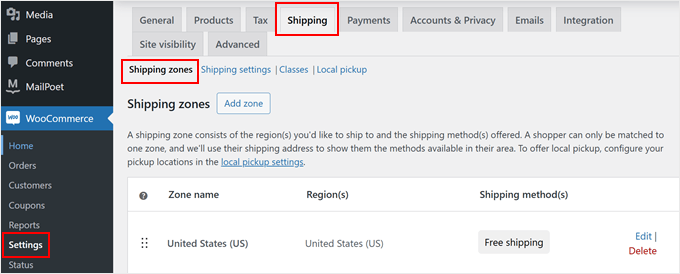
Finally, you can easily set up your delivery options under the ‘Shipping’ tab. You can use zones to clearly define where you’re willing to ship and set specific delivery methods for each area, such as free shipping or standard flat rates.
If you sell items that are vastly different in size, you can also set up ‘Shipping Classes’ to charge different delivery rates for heavier items.
One important tip is to avoid hiding your shipping costs until checkout, since surprise fees are a leading cause of abandoned carts. Being completely upfront about these costs is a great way to build trust with your customers.
To help your buyers keep track of their packages, you can also easily add shipment tracking to your store.
Step 7: Optimize for SEO and Speed
Your store is now online and ready to take orders.
However, there are two crucial factors that will determine whether your online business grows: getting found on Google and loading fast enough to keep buyers happy.
Boost Your Store’s Search Rankings
To help shoppers find your products, you’ll want to optimize your store for search engines. We recommend using AIOSEO because it’s a free plugin that helps your online store appear in the search results.
With AIOSEO, you can easily set a focus keyword for each product and get smart, clear suggestions on how to optimize your title, description, and content to rank higher and drive more sales.

The paid version of the plugin also gives you access to more WooCommerce SEO features like smart product schema, inventory status, and optimization for product categories.
For details, see our ultimate guide to WooCommerce SEO.
Keep Your Pages Loading Fast
Slow stores lose sales. Here are two quick ways to make your online store faster right away:
- Optimize Your Product Images: High-resolution photos are great for showing off your products, but huge image files will drag your site speed down. We recommend using a free image optimization plugin like Smush or EWWW Image Optimizer to automatically compress your images.
- Enable Caching: A reliable caching plugin creates static HTML versions of your pages so your server doesn’t have to load heavy scripts every single time a visitor clicks on a product.
For more information, check out our step-by-step guide on how to speed up WooCommerce performance.
Track What Buyers Are Doing
To make smart decisions for your online business, you need clear data. That’s where Google Analytics comes in.
Setting up eCommerce tracking lets you easily see what’s working, which pages and products are bringing in sales, and where shoppers are dropping off.
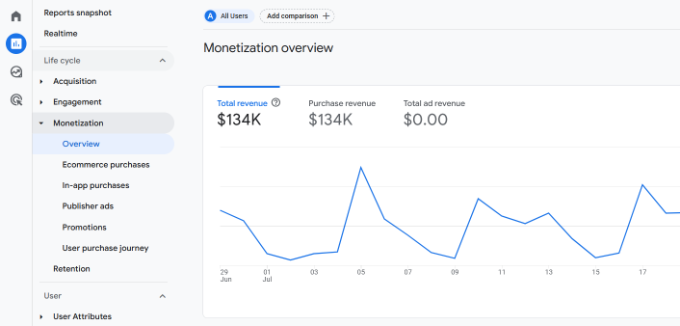
To get started, check out our guides on how to properly set up eCommerce tracking in WordPress, and how to set up WooCommerce conversion tracking.
Protect Your Hard Work with Backups
Losing your product data, customer details, or order history would be devastating, so set up automated backups for your store.
For step-by-step instructions, see our guide on how to back up your WordPress site.
How to Get Your Very First Customers
Opening your store is a huge milestone, but your work isn’t done yet. Now you need to give shoppers a reason to visit and build enough trust to convert them into paying customers.
Follow these steps to start converting your early traffic into loyal customers:
- Display Social Proof: Adding real customer reviews and testimonials to your site is one of the easiest ways to build instant trust with brand-new visitors. For more information, see our step-by-step guide on how to display WooCommerce reviews in WordPress.
- Start Building an Email List Early: Don’t let visitors leave without a way to reach them. Unlike social media followers, an email list is an asset you fully own. It gives you a direct line to your shoppers so you can send special offers, announce new products, and bring abandoned cart shoppers back to complete their purchase. Check out our expert showcase of the best email marketing services to find the right tool for your budget and goals.
- Create a Launch Discount: Give your very first visitors a reason to buy today by offering a launch coupon. Best of all, WooCommerce comes with a powerful coupon feature built right in. For details, see our guide on how to offer WooCommerce coupons.
- Drive Organic Traffic: Build long-term traffic using content marketing, search engine optimization, and social media. Check out our ultimate guide on proven ways to increase your WooCommerce sales for actionable strategies you can start today.
FAQs About Starting an Online Store
Can I start an online store for free?
Some eCommerce platforms offer limited free trials so you can get started without paying, but you’ll eventually need to sign up for a paid subscription once the trial period ends.
WooCommerce itself is completely free open-source software, but you’ll still need a domain name and a web hosting plan to get your store online, which do carry small upfront costs.
How much does it cost to start an online store?
The cost of starting an online store depends on your plan and budget. By using our exclusive link, you can launch your shop with Bluehost for just $2.99 per month while relying on free plugins and themes to keep your initial setup costs extra low.
We always recommend starting small and spending more on premium tools only as your business grows.
Can I create an online store without shipping products?
Yes. For example, you can use specialized dropshipping plugins to handle inventory, build an Amazon affiliate store to earn referral commissions, or run an online marketplace where other sellers handle their own order fulfillment.
Do I need to know how to code to run a WooCommerce store?
No. Everything in this guide, from initial setup to site design and payment processing, is done entirely through easy point-and-click settings and friendly plugins, so you never need to write a single line of code.
Video Tutorial
If you would rather watch than read, our video tutorial walks through how to start an online store from beginning to end:
We hope this guide helped you learn how to start an online store. You may also want to see our actionable tips to drive traffic to your new store or our comparison of the best business phone services.
If you liked this article, then please subscribe to our YouTube Channel for WordPress video tutorials. You can also find us on Twitter and Facebook.


John Springhetti
Hello We are trying to decide to use shopify or woocommerce we already have a website. We will be selling hobby shop items-drones &RC cars from our website. And our website was built on wordpress. I have heard that woocommerce is a little more technical than shopify. Our situation is one where we would like our web developer to build the initial ecommerce site & then train someone at our shop to maintain & sell/load products. We plan on a 100 or so SKUs to start & grow from there.
Which would you recommend woocommerce or Shopify & why please?
Deli
Hi,
Can you list Amazon products (dropship) through WooCommerce? If so, how?
Mands
Hi ,
I would like to have an ecommerce store but I am based in South Africa and will only be selling in S.A do I get a co.za Domain? And does stripe work with all credit cards? Can I also add Visa and MasterCard to receive payments?
Sarah
How to setup an order popup notification to visiting customers on woocommerce website????, just like wpforms.com. website.
WPBeginner Support
Hi Sarah,
WPForms.com uses OptinMonster for displaying popups.
Admin
samuel
Hi there, I like your articles. Nice read as usual. But 2 have one queries.
My site is largely a blog website and I have 5 major tabs on my menu bar.
1. I’ve installed the woocommerce but want to apply it only one of the menu bar(Page). Is it possible? If yes, please how do I go about it.
2. How do I access the information when my viewers comment on my blog?
WPBeginner Support
Hi Samuel,
1. You can add the shop page to your navigation menu.
2. You can see comments inside your WordPress admin area by clicking on the comments menu.
Admin
Bereket
Hello. Why do we need woocommerce and why do we have to pay for woocommerce
WPBeginner Support
Hi Bereket,
WooCommerce is an eCommerce software. It allows you to sell things from your WordPress website. Just like WordPress, you will need web hosting to run it which will cost you money.
Admin
Mario
Is there no simple solution? Woo Commerce is way too complicated to create simple shop pages ..
NIRAV HINGU
Hi , I want to set up my own e commerce site , read your whole article , its just wonderful , just have 2 query
1) What type of payment gateway is useful for both national and international customer like in India we have Instamojo , PayUMoney and RazorPay as provider whereas PayPal and CC Avenue is also nice option for International Transaction.
2) On creating e commerce website , will there a tab avail a space can be made in wordpress to create a separate TAB for Blog wherein i can upload the Blog related to my products to sell online on my portals.
3) And How far the Woo Commerce is compare to Shopify on parameter to Safety Layer , Payment Transaction ,Website functionality like buffering and loading and stopage /loading time on internet of e commerce site while creating in wordpress+woo-commerce.
WPBeginner Support
Hi Nirav,
1. It actually depends on your target customers. If you will be serving customers in both India and other countries, then you will need to find payment gateways convenient for your target customers.
2. Yes, you can add a blog to your ecommerce website in WordPress.
3. WordPress is quite secure. On your self hosted website you are responsible for keeping backups and performance. It is a little more work than Shopify but will give you freedom to choose the tools you want to use.
Admin
Bhadresh tandel
Thank you so much for the instruction!
Deepak Vaish
Hi, i already have a domain name. i like to start a website of price comparison. where from branded store i can display the amount of these product. i want to start with electronics items like mobile and some gadgets. this is a simple store making web design. would you please help me to create this website.
Anaely
Hi! I’m so happy I stumbled upon this article. I have a question, I already have a domain and hosting package with go daddy. Have had it for years. Can I do all this in godaddy or is it not compatible? Thank you!
WPBeginner Support
Hi Anaely,
Yes you can do that on GoDaddy. However, you will still need an SSL Certifcate which you’ll have to purchase.
Admin
Dawn
Hi there! I don’t have a credit card. Can I use my debit card, instead, for my registration? Thanks!
WPBeginner Support
Hi Dawn,
Please contact your bank to check if you can make online payments with your debit card.
Admin
Jeanne
Hi,
I have an existing wordpress.com site and want to convert it to bluehost wordpress + woocommerce combo.
My question is, what should be my sequence?
Do I first convert my wordpress.com to wordpress.org before setting up the woocommerce part? There can only be a single theme at any one point in time if I am not wrong?
Thank you.
Jeanne
WPBeginner Support
Hi Jeanne,
Yes, you should first start a WordPress.org website and move your content from WordPress.com. After that you can setup your store and start adding products.
Admin
Oluwaseun
Hi,
I have a wordpress site that is readily functioning but the them I have is not woocommerce compatible, I have tried hooking it up with woocommerce but the result is not what I want, so I am thinking of installing another instance of wordpress on a subdirectory as I want the url to be domain.com/store but the homepage and contact link will still go to the main page.
So do you think I should just create another directory folder and name it store then install wordpress there or I should use multi site functionality?
I hope I am on the right article to ask question
Regards
Sten Allen
I am now trying to join your beginner system but, I already have a domain name and I already have bluehost as my hosting service. I have already paid and I will be a member (?) for the next three (3) years. Can I still do/begin/learn from wpbeginner ? Please reply. Thank you,
Sten
WPBeginner Support
Hi Sten,
Yes, all our articles are free and don’t require you to register. You can also subscribe to our YouTube Channel for WordPress video tutorials.
Admin
Amanda Mefferd
Taxes in our state are determined by the shipping address of the product. Does WooCommerce have a tax option for that?
Maddox
How do you deal with stolen credit cards? Is there a way to prevent this issue?
praval bob
I want to create a Wordpress site that requires the user to first log in to Facebook or a Google account. This should redirect to a gateway that allows payment options that are mostly used in India. After which the user should be able to access the website as a premium customer. Please help.
Helen Theron
Hi there, thank you for the BRILLIANT guide! not sure I could have done most of the things on my site without all your wonderful guides.
Small problem though, I changed my http to https it then loaded my page once the settings were saved and gave me an SSL protocol error, How do I resolve this?
Must admit it has made me pretty nervous because I have just paid for three years in advance with Bluehost
Thanks in advance for your help!
WPBeginner Support
Hi Helen,
Please see our guide on how to How to Add SSL and HTTPS in WordPress.
Admin
Ernesto
Hi There, Why I have to upgrade to business plan to install plugings? I ca not install the woocommerce, asking to upgrade to business plan
WPBeginner Support
Hi Ernesto,
You are probably using WordPress.com. Please see our guide on the difference between self hosted WordPress.org vs free WordPress.com blog.
Admin
Robin Gonzales
I had a free wordpress.com website and upgraded so I can have an amazon store on my website. I don’t need the credit card and all the stuff you mentioned as the customers will be checking out on Amazon. I don’t see this discussed anywhere. Can I do that on Wordpress? Do I have to have another webhosting such as Bluehost or another one?
Thanks so much,
WPBeginner Support
Hi Robin,
You will be able to that with self-hosted WordPress.org site. Please see our guide on the difference between self hosted WordPress.org vs free WordPress.com blog.
Admin
Jim
Hi, I want to put a custom certificate on my Wordpress website that can be automatically customized with a user’s name and a date, then upon payment be able to download it and print it. How can I do this? Are there current plugins/programs that would allow me to do this or is this something I would have to hire someone to program for me?
Sheriff Subair
Hello,
Please, im having this error message when i try to start XAMPP. Kindly assist.
14:11:02 [Apache] Error: Apache shutdown unexpectedly.
14:11:02 [Apache] This may be due to a blocked port, missing dependencies,
14:11:02 [Apache] improper privileges, a crash, or a shutdown by another method.
14:11:02 [Apache] Press the Logs button to view error logs and check
14:11:02 [Apache] the Windows Event Viewer for more clues
14:11:02 [Apache] If you need more help, copy and post this
14:11:02 [Apache] entire log window on the forums
Susam
I purchased Domain and hosting through BlueHost – need simple online store for physical products and a blog. I cannot figure out how to set this up through WordPress; don’t see the Woo Commerce piece anywhere; none of the free themes work for an online store- big problem! Can I use your information without getting hosting through you – as I have domain and hosting already?
PS – this typeface is so pale I can’t read what I’ve typed.
WPBeginner Support
Hi,
If WooCommerce is not pre-installed on your site, then you can install it yourself. WooCommerce is available as a WordPress plugin, so you can install it like you would install any other WordPress plugin. See our step by step guide on how to install a WordPress plugin.
Admin
Jake H
Great post! Is there any information on Magento and how it would work and integrate with WordPress?
mosh
Hello WP Beginner. Would I need to pay a certain amount to use Stripe and PayPal on my WooCommerce WodPress site?
WPBeginner Support
Hi Mosh,
There are free WooCommerce extensions available for both PayPal and Stripe. However, both payment gateways will deduct their fees from transactions, please review Stripe and PayPal fees and policies for more information.
Admin
mosh
Okay. Thanks.
Siri
Hello,
I am building an E commerce site for a client who is from the Caribbean. He sells clothing for a living and he needs a website to sell them from. He wants to sell to anyone anywhere in the world. How would I set up the shipping, handling, and other related features on woo-commerce? What are your recommendations, and how would I go about doing that?
Thanks,
-Siri
Garrett Watson
Thanks for the great article! It helped me take the final steps in getting my own store up and running. I was a little unsure about how best to use categories vs. tags, but a quick search of your site turned up this helpful piece (for anyone else wondering about this):
https://www.wpbeginner.com/beginners-guide/categories-vs-tags-seo-best-practices-which-one-is-better/
Rick
I would like to have a landing page on my WordPress site to sell my books through amazon as an amazon affiliate. I would also like to be able to offer discounts/coupons. Is Woocommerce the way to go for this? If not, what do you recommend?
Lindsey
Thankyou for this article!
I have searched through various websites and no-one seems to be able to give me an answer on how I create one product with multiple options which will alter the prices, I am hoping you will be able to help. I have a cake shop and for a three tier cake I would like the customer to be able to alter the flavours of each tier but this means the prices can change from the default price. I can change colours and such like but it doesn’t seem to allow me drop down boxes which affect price. Is there a way to set this up in woo commerce or a particular plug in?
Any help would be much appreciated as its driving me mad!
WPBeginner Support
Hi Lindsey,
In the pricing section of the product page you can add variations and add variable pricing options.
Admin
Lindsey
Hi,
Thankyou for your reply.
I have done this in the past but this only allows me to have one product on the page, effectively I need to have three, as each tier of cake is its own product. This is what I am struggling with as I would like three separate products to have their own attributes. I don’t think this is currently available with woo commerce? Sorry if Im not making myself very clear.
Campbell
Hi! Thank you for this, it is very helpful. I am looking around at themes and was wondering if I could choose any theme and then apply WooCommerce to it? Or should I be looking for something specific before choosing a theme? Thank you!
WPBeginner Support
Hey Campbell,
You will be looking for WooCommerce ready themes. Please see our guide on how to select the perfect WordPress theme for your website.
Admin
campbell
Hi! Thanks for the article, very helpful. I am trying to find the best wordpress theme. Can I add WooCommerce to any theme? Or are there specific things I should be looking for when searching through themes? Thanks!
Bre
Thank you so much for taking the time to write this article. I’m in the process of opening up my first store and I’m not tech savvy AT ALL, but I did not want to use Shopify. This really helps!
Apple yeo
Hey there!
Thank you so much for posting all of these informations! It was a detailed blog post!
Anyway I have a question, as most of my buyers are from Japan, they usually use VISA/MASTERCARD for payment instead of paypal.
Can I know how do I set it up?
WPBeginner Support
You can use Stripe to accept credit card payments on your site.
Admin
ilyas
thank you for this great tutorial , where can i find products to promote in such a website if i dont own any personal products ? affiliate or drop shipping which one convert better ?
RODNEY TREVINO
I was following the directions on https://www.wpbeginner.com/wp-tutorials/how-to-start-an-online-store/ and it said to configure my domain for https changed it from http to https and clicked save. Now I cannot get to my dashboard and cannot log in. Tech support just told me to send and email to help @ wordpress.com. He does not know when or if they will get back to me. Can someone give me a path forward on this?
HAKIM
Happen to me too. Actually how long will it take to setup the SSL?. Been waiting for soo long yet nothing happen. Cannot open the website and “ERR_SSL_PROTOCOL_ERROR” message appear. Please help. been following all the step from the above and got stuck here.
Claire Settre
Hello,
I have the same issue. I tried to change the http to https and click save but I got an error message saying “This site can’t provide a secure connection”. Any suggestions of how to fix this?
Claire
Vanessa
Hi,
I have the same issue.
I tried to change the http to https and click save but I got an error message saying “This site can’t provide a secure connection”. How can I work in my site now?
Vanessa
Shaik Azeed
Hi, I have booked a domain in GoDaddy, now I would like to build an online store site, will I get free SSL certification from Bluehost for my site
Amy Bollana
Hi,
Can you tell me how to start off if I already own my domain name? Can I switch it to Bluehost?
Thanks!
WPBeginner Support
Hi Amy,
Yes you can. You will have to point your domain to Bluehost after you signup for hosting.
Admin
Ruben
Hi Author, which address should I give on woo commerce plugin setup wizard, should I give my personal address or what if I don’t have shop. Can it be associated with affiliate marketing services like Amazon,flipkart.
SyedHasan
Hello greetings from Kuwait.
I like everything bits of your information. Kindly tell me can I integrate ( sell ) a local currency like KWD ( Kuwaiti Dinar ).
Kindly reply at your earliest convenience.
Thank you
WPBeginner Support
Hi SyedHasan,
You will have to check which payment providers are available and support your local currency. WooCommerce supports PayPal, Stripe, and many other payment gateways which are available in many countries and countries.
Admin
Viveen
Hi..i
Great website. l was wondering if you customize websites? Your guides are very comprehensive, but
I’m still struggling to get my head around certain issues.
regards
Roz Tidman
Really good tips which I am working through. Unfortunately following instructions to add SSL certificate has now locked me out of my site. Any advice to get back in???
WPBeginner Support
Hi Roz,
Please take a look at our guide on what to do when you are locked out of WordPress admin area.
Admin
Terrell
Wish the developers of Wordpress would consider setting up physical stores in The United States (just like the Apple Stores) so any small biz startup needing an Ecommerce site could by appointment, come to the store have a customized Ecommerce site built. This sure would create a “clear path” for Wordpress to dominate Ecommerce, and to “operate in the black.” Those who wish to build their own Ecommerce sites, etc, can continue to do so if they wish. Personally, my wife & I own a small, licensed business in need of an Ecommerce site, but we shy away from Weebly, Wix, and other do-it-yourself ideas. We’ve been using Facebook for advertising up until now.
WPBeginner Support
Hi Terell,
There are many small and large web design and development agencies with offices in most cities. You can call them to get an appointment. You can also find WordPress developers on many freelancing websites. However, both options will cost you more money.
In our experience, we have seen many small business owners starting out on their own with no technical skills. There is a small learning curve as you familiarize yourself with the platform. Most beginners go through this phase with the help of free resources like WPBeginner.
Facebook is a good platform, but it gives you limited control on who can see your ads. With WordPress, you get complete control on how you bring new users, and how you convert them into loyal customers.
Admin
Ben
Is there a reason I’m not seeing WooCommerce on by WordPress Dashboard? I followed the steps for set up through BlueHost. Thank you for your help!
WPBeginner Support
Hi Ben,
You can go to Plugins page to see if you have WooCommerce installed. If you don’t, then you can install it. For more details, see our step by step guide on how to install a WordPress plugin.
Admin
siddhant
I get no privileges when i try to create table in data base
Victoria
Hi,
I should have started with this article! Earlier this month I purchased hosting (bluehost), registered my domain name, and installed WordPress. I purchased domain privacy, site backup, and site lock security. How do I add WooCommerce and the SSL certificate now? Do I need to start from scratch?
WPBeginner Support
Hi Victoria,
You can upgrade your account without starting from scratch. Please contact BlueHost support, and they will be able to assist you better.
Admin
Afeefa
I cant see the woocommerce option when i installed wordpress in Wamp… Isnt it possible?
WPBeginner Support
For Local Server (WAMP) you will have to install WooCommerce by visiting Plugins » Add New page. However, please note that it will not be an online store, it will be just a store on your local computer. You will not be able to sell anything untill you move your installation to a live server.
Admin
Richard
Another grand article from WPBeginner. Thanks to the gang.
Now if I could just find a supplier of some niche products …… ?
Bev
Thanks for this brilliant resource. I’m UK based and will only be selling online to people in the UK, would I be better of with hosting in the UK? I have heard that it is best to have your site hosted in the country you are trading in and that there are disadvantages in overseas hosting?
Mike
I’m a rockstar! I have set up VPS server through BlueHost. I have SSL on the site with eCommerce. I get how to add products that I am holding in inventory, but how do I take a data feed from a drop ship company and load it to my ecommerce site?
SIBSANKAR SUTRADHAR
Thanks for the post.Now I get the best way to start my online store. i have one question how to setup payment gateway in my store?
WPBeginner Support
Depends on which payment gateway you choose. By default WooCommerce comes with PayPal and Stripe support built in.
Admin