


We recently ran into a frustrating problem while helping a client launch a new online store: every single .com domain they wanted was already taken.
If you’ve ever tried registering a domain name, you know this pain all too well. But moments like this remind us of an important lesson we’ve learned from building hundreds of websites—the domain extension you choose (the part after the dot) matters just as much as the name itself.
The right extension can build instant trust and credibility, while the wrong one can confuse visitors or even hurt your brand. That’s why we put together this guide to the most popular domain extensions and what they’re best used for.
By the end, you’ll know exactly which options make sense for your website and how to choose a domain that sets your site up for long-term success.
What Are Domain Name Extensions? A Complete Overview
Domain name extensions are also called top-level domains or TLDs. They are the part of your web address that appears after the dot. For example, in ‘wpbeginner.com’, the extension is ‘.com’.
As WordPress developers with over a decade of experience, we’ve seen how important choosing the right extension can be for a website’s success.
According to ICANN (the organization that oversees domain names), there are now over 1,500 different domain extensions available. However, our experience shows that not all extensions carry the same weight or recognition with users.
Types of Domain Name Extensions
Domain extensions are grouped into a few key categories, but the three you’ll come across most often are:
- ✅ Generic Top-Level Domains (gTLDs): These are the most widely recognized extensions like .com, .net, and .org. Based on our analytics data from thousands of WordPress sites, these typically receive the highest trust ratings from users.
- ✅ Country Code Top-Level Domains (ccTLDs): These are two-letter extensions representing specific countries, like .us (United States) or .uk (United Kingdom). While primarily meant for geographic targeting, we’ve seen creative uses of these extensions for various purposes.
- ✅ Sponsored Top-Level Domains (sTLDs): These are restricted to specific organizations or communities, such as .gov (for government agencies) or .edu (for accredited educational institutions).
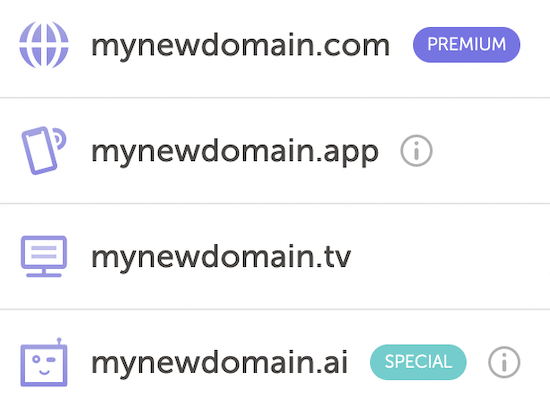
In recent years, we’ve seen an increase in new specialized extensions like .app, .technology, and .guru. Through our testing and monitoring of hundreds of WordPress sites, we can confirm that these newer extensions don’t negatively impact SEO.
However, our user behavior studies show that traditional extensions like .com still maintain higher recognition and trust levels.
🧑💻 Pro Tip: If you’re launching a new WordPress website, we strongly recommend choosing a familiar extension like .com or .org. Based on our experience managing hundreds of WordPress sites, traditional extensions typically receive better user engagement and trust.
Now that you understand the basics of domain extensions, let’s explore the top options, complete with real-world examples and performance data from our extensive WordPress development experience.
Top Domain Name Extension List
There are hundreds of different domain name extensions out there today, with more being added all the time.
It’s important to choose a domain name extension that matches your brand.
Note: If you want to register a new domain, we recommend using Network Solutions; it’s one of the best domain name registrars and lets you register every popular domain name extension. You can also follow our guide to learn how to get a free domain name.
1. .Com Domain Name Extension
The .com domain extension is the most popular TLD available.
It was initially used by for-profit businesses, but it has become the most popular domain name extension in the world. Over half of websites on the internet use the .com domain name extension.
Humans are creatures of habit, and most consumers have been typing .com domains into their browsers for decades. That means many of your customers will come to expect a .com domain for your website.
The .com is the most natural extension for visitors to type in when it comes to domain names. If they’re guessing your domain, then they will probably try the .com first.
We use the .com domain name extension here at WPBeginner and in our other companies.
If a .com version of your domain is available, then this should be your first choice. It is the best choice for most service-based businesses, local businesses, online stores, and even blogs.
2. .Net Domain Name Extension
The .net domain was originally used by ISPs (Internet Service Providers) and network services. However, it has grown to become the most popular alternative to the .com domain name extension.
It’s a great choice for technology / online companies since it refers to networks, tech, and other web-based businesses.
Popular websites like Behance.net and Sourceforge.net use this domain name extension.
You can always purchase multiple domain name extensions and forward them to your primary domain name. For example, if you type “wpbeginner.net” into your browser bar, then it automatically forwards to “wpbeginner.com.”
That way, you can capture traffic from visitors who accidentally type in the wrong domain extension.
3. .Org Domain Name Extension
The .org domain name extension was created for nonprofit organizations. However, it’s now available to most business owners today.
This is a standard domain name extension for nonprofits, political parties, and website owners who want to establish themselves as a source of trustworthy information. If you own a non-profit organization, having a .org domain extension can add a level of credibility, as many users perceive .org websites as more reliable, especially when looking for charities to donate to.
The .org domain extension is associated with brands like Wikipedia, WordPress.org, and more.
It’s also less popular than .com, so there’s a better chance the perfect domain name will be available.
4. .Co Domain Name Extension
The .co domain extension is the country code domain name extension (ccTLD) for Colombia. However, it has become a popular domain name extension for startups and other web-based businesses.
The .co TLD is a common acronym for companies and corporations, so it’s easy to see why it’s becoming popular for online startups.
The .co domain name extension is similar to the .com extension, but it’s shorter and can be seen as being more trendy.
5. .Edu Domain Name Extension
The .edu domain is a great example of a Sponsored Top-Level Domain (sTLD). This means it’s reserved for a specific community, in this case, accredited educational institutions and universities.
Only institutions that meet accreditation requirements can register a .edu domain.
To use this domain name extension, you need to operate or be part of an accredited educational institution.
.Edu domain name registrations are managed by a third-party organization called EduCause to verify the accreditation.
Note: You can create your own virtual classroom using WordPress. For more details, see our guide on how to run a virtual online classroom using WordPress tools.
6. .Us Domain Name Extension
The .us domain name extension is pretty popular as well. This domain name extension can only be registered by citizens and business entities based in the United States of America.
It’s a common choice for US-based non-profits, corporations, and full-time US residents.
While its use was more limited in the past, today it’s open to all U.S. citizens, residents, and organizations. This makes it a great choice for patriotic brands or businesses focused entirely on the United States.
If your new website or business is very American-focused or patriotic, then this could be a good domain worth using.
Tip: Using a country-code extension like .us, .uk, or .de sends a strong signal to search engines like Google that your content is specifically for that country. This can give you a small boost in local search results and help your site reach the right audience.
7. .Me Domain Name Extension
.Me is a country code domain name extension (ccTLD) for the country of Montenegro.
But it’s often used for personal or portfolio websites.
If you want to build a simple portfolio or site using your name, then the .me domain extension can be good for branding.
8. .Cn Domain Name Extension
The .cn domain name extension is for the country of China. Since China has the world’s largest population, it makes sense that this domain name extension is prevalent.
A country code top-level domain name can be helpful if you have a business tied to a certain area of the world.
9. .Uk Domain Name Extension
The .uk domain name extension is the ccTLD for the United Kingdom. This is a very widely used extension for UK-based businesses. It’s used by the major news outlet BBC.co.uk.
For a long time, businesses in the UK used the .co.uk extension. More recently, the shorter .uk extension became available. If your business targets the United Kingdom, we recommend registering both the .uk and .co.uk versions of your domain to protect your brand.
10. .De Domain Name Extension
The .de domain name extension is a ccTLD for the country of Germany. By registering the ‘.de’ domain name extension, you can build trust with potential German visitors.
This domain name extension has been widespread across the internet for a very long time.
Anyone can register a .de domain, but the German registry requires a local contact address. Don’t worry, though. Nearly all domain registrars offer a simple ‘trustee service’ that provides a local contact for you, making the process easy no matter where you live.
11. .Ly Domain Name Extension
The .ly domain name extension is the ccTLD for the country of Libya. However, it’s grown in popularity over the years thanks to URL shorteners like Bit.ly and other new startups.
It can be a great domain name extension to build a strong and unique brand, especially if you’re launching a new app or technology website.
Extensions like .me and .ly are also popular for creating clever ‘domain hacks’, where the extension forms the end of a word or phrase. Think of brands like about.me or visual.ly. This can be a creative way to get a short, memorable domain name.
12. .In Domain Name Extension
The .in domain name extension is the ccTLD for the country of India.
This domain name extension is becoming more popular and is an excellent fit for businesses serving the Indian market.
Anyone can register this domain name, no matter where in the world you live. It’s a shorter domain name, so it can be used for creative branding, too.
Registering a New Domain Name
There are two different ways you can get a domain name.
Choose the method that works best for you.
1. Get a FREE Domain Name with Bluehost
If you want to create a website, then you need website hosting plus a domain name.
For more details, see our guide on the difference between a domain name and website hosting.
Typically, a domain name will cost around $14.99 per year and $7.99 per month for hosting. When you’re just starting, this can be expensive.
Luckily, we’ve worked out a deal with Bluehost to offer our readers a free domain name and a 70% discount on web hosting.

→ Click Here to Claim Your Free Domain Name ←
2. Register a Domain with Network Solutions
If you don’t want to create a website right away, then you can still register a domain name and build a website later.
We recommend using Network Solutions. They’re one of the best domain name registrars that offer features like private registration, easy transfers, WHOIS privacy protection, and much more.
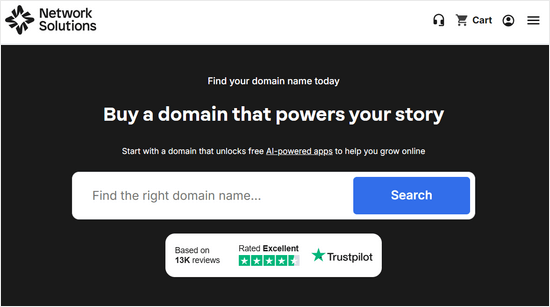
To get a 67% discount on your domain name, make sure to use our link to their site and our Network Solutions coupon code: NAMEBOY during checkout.
If this is your first time registering a domain name, then see our step by step guide on how to register a domain name.
Once you have registered your domain, you must take proper steps to protect it. Domain theft can be devastating for small business owners. You need to take proper security precautions like using a strong password, setting up 2-factor authentication, and ideally using an identity theft protection service for small businesses.
Frequently Asked Questions About Domain Extensions
As we help businesses build their online presence, we get a lot of questions about domain extensions. Here are answers to some of the most common ones we hear.
1. What is the best domain extension for my website?
For most businesses, blogs, and online stores, the .com extension is the best choice. It’s the most familiar and trusted extension among internet users, which can make your website seem more credible.
If your desired .com name isn’t available, then .net or .org are excellent alternatives.
2. Does the domain name extension affect SEO?
No, your domain extension does not directly impact your search engine rankings. Google has confirmed that all TLDs are treated equally in their algorithm.
However, your extension can indirectly affect SEO by influencing user trust. A familiar extension like .com might get more clicks in search results than a lesser-known one, which can signal to search engines that your site is valuable.
3. Should I buy multiple domain extensions for my business?
Yes, we highly recommend it. Registering variations of your domain (like the .net, .co, and .org versions) is a smart way to protect your brand. It prevents others from registering them and confusing your customers.
You can simply forward these additional domains to your main website. This also helps capture visitors who might accidentally type the wrong extension.
4. Can I change my domain extension later on?
You cannot edit the extension of a domain once it has been registered. If you decide you want a different extension, you must register it as a brand new domain name. You would then need to migrate your website to the new domain and redirect all traffic from your old address.
Additional Resources
We hope this article helped you choose the right domain name extension for your next domain name. You might find these other guides helpful for starting your website:
- How to Choose the Best Domain Name
- Free Business Name Generator
- Here’s How I Register Domain Names (& Get Some for Free)
- How to Move WordPress to a New Host or Server With No Downtime
If you liked this article, then please subscribe to our YouTube Channel for WordPress video tutorials. You can also find us on Twitter and Facebook.


Jiří Vaněk
Great comparison that can help anyone decide which domain extension to choose and what relevance it might have. For me, .com is obviously the clear winner due to its long-standing tradition. However, I’m personally drawn to the .me extension, especially for personal emails. You can create a really nice personalized domain with that extension, which is perfect for email addresses.
Dayo Olobayo
This is a great resource for anyone who is choosing a domain name. Another thing to consider is the length of the domain name extension. Shorter extensions are generally easier to remember and type.
Moinuddin Waheed
Choosing the right domain name and it’s right extension is the first step towards having a good online presence.
I have struggled at times to choose from the domain names and extensions and have settled to not so popular extension like .website and others.
I have a query regarding premium domain names.
many times when we find our favourite domain name available , it shows premium and costs too high.
Could please guide me why do they cost high and how a name becomes premium domain name?
WPBeginner Support
It would depend on the domain name and that normally happens when someone buys a domain specifically to sell it because they believe the domain is valuable.
Admin