


Do you think you need a separate server for every website you want to host? You don’t.
A single server can host multiple websites, and they can even share the same IP address. In many cases, you can simply add another website to your existing hosting plan without buying a new plan.
In this guide, we’ll show you three ways to host multiple websites on one server. You can add websites to your existing hosting plan, set up your own server, or use WordPress Multisite.
Three Ways to Host Multiple Websites on One Server
| Method | Best For | What It Costs |
|---|---|---|
| Add websites to your existing hosting plan | Anyone with a hosting account who want more than one site. | Usually included on plans above the entry tier. |
| Your own server (VPS) with virtual hosts or a free control panel | Developers and agencies who want full control or host many client sites. | A VPS from about $5 per month. CloudPanel is free. |
| WordPress Multisite | One owner running several related sites that share plugins, themes, and users. | Free. You need a hosting plan that allows it. |
How One Server Hosts Many Domains on One IP Address
Every server on the internet has an IP address. Think of it like a street address that tells browsers where to find the server.
Each domain name has a DNS record called an A record. This record tells the browser which IP address to connect to. When multiple websites are hosted on the same server, their domains can all point to the same IP address.
When someone visits your domain, their browser connects to that IP address and includes the domain name in the request. This tells the web server which website the visitor is trying to access.
The web server then matches the domain name to the correct website and serves files from that site’s folder. This setup is called name-based virtual hosting, which allows a single server and IP address to host many different domains.
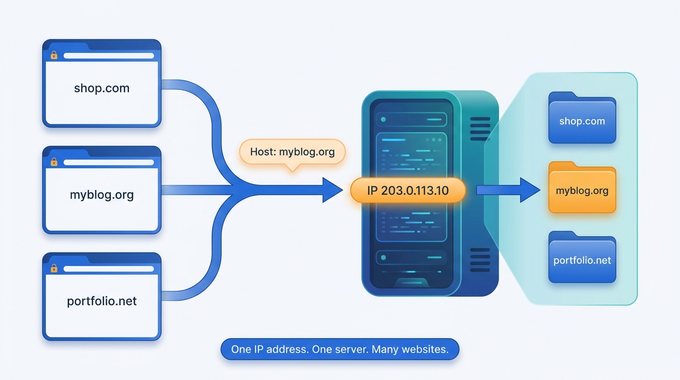
Your hosting company does all of this for you when you add a website or a domain in your hosting dashboard. Some hosts, and cPanel in particular, call these extra domains “addon domains.”
Each addon domain gets its own folder on the same server and its own free SSL certificate.
Method 1: Add Websites to Your Existing Hosting Plan (Easiest)
With this method, you keep the hosting account you already have and add each new website to it from your hosting dashboard.
Step 1: Check Your Hosting Plan’s Website Limit
Every hosting plan comes with a limit on how many websites you can host. Entry-level plans often support just one website, while higher-tier plans may let you host several or even dozens of sites.
The numbers vary a lot between hosts. At the time of writing, SiteGround’s entry plan covers one website, Hostinger’s allows three, and Bluehost’s allows ten.
You can look at your hosting dashboard to see how many domains you can host with your existing plan. If you are still choosing a host, you can check out our best WordPress hosting guide and compare hosting plans offered by different providers.
Step 2: Register the New Domain and Point It at Your Host
Once you know your plan has room for another site, the next thing you need is a domain name for it. You can buy one from any domain registrar for a cheaper price than your hosting providers.
But make sure you point the domain at your hosting server from your domain name registrar’s account. The easiest way is to change the domain’s nameservers to the ones your host gives you.
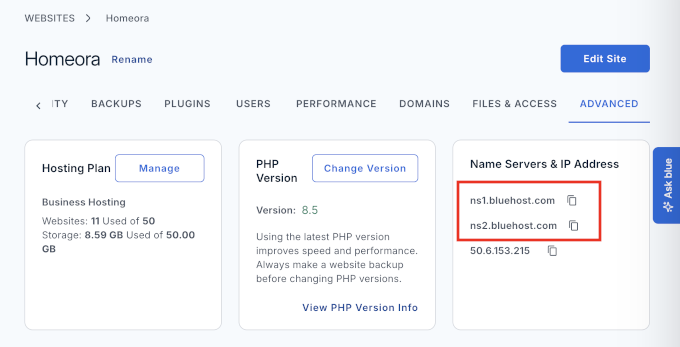
Nameservers are the servers that hold your domain’s DNS records. They tell browsers where to look for a website’s IP address. Switching them to your hosting provider points browsers to their servers. This also allows your hosting provider to add DNS records to your domain.
Your hosting provider will show you Nameservers in their support docs as well as hosting dashboard. It typically looks something like this:
ns1.bluehost.com
ns2.bluehost.com
If you’d rather keep DNS at your domain registrar, you can add an A record there instead and enter your server’s IP address. Simply edit the DNS records at your domain registrar and click on ‘Add New Record’.
| Type | Name | Value | TTL |
| A | yourdomain.com | 203.0.113.21 | Auto |
Our guide on how to change domain nameservers walks through both options.
Changes to your DNS records or nameservers can take up to 48 hours to take effect across the internet. You can continue with the next step while you wait.
Step 3: Add the Domain in Your Hosting Dashboard
With your domain pointed at your host, you can now add it to your hosting account. The exact steps vary between hosting providers, but the process is essentially the same.
Basically, you tell your host about the new domain, and it gives that domain its own folder on the server.
Here’s where you’ll find this option with some of the most popular hosting providers:
- Bluehost – In the Bluehost control panel, go to Domains » Add a Domain. Choose ‘Connect an external domain’ if you bought the domain elsewhere, or ‘Register a new domain’ to buy it from Bluehost. Then go to Websites » Add Site, choose WordPress, and pick that domain for the new site.
- Hostinger – In hPanel, go to Websites » Add website. Choose WordPress as the website type, then enter the domain you own or register one on the spot.
- SiteGround – In the Client Area, go to Websites » New Website. Choose ‘Existing Domain’, enter your domain, then choose ‘Start New Website’ and select WordPress.
The screenshots below come from one of our own Hostinger accounts, which runs two of our test sites on a single plan. On the Websites page, click the ‘Add website’ button next to your hosting plan.
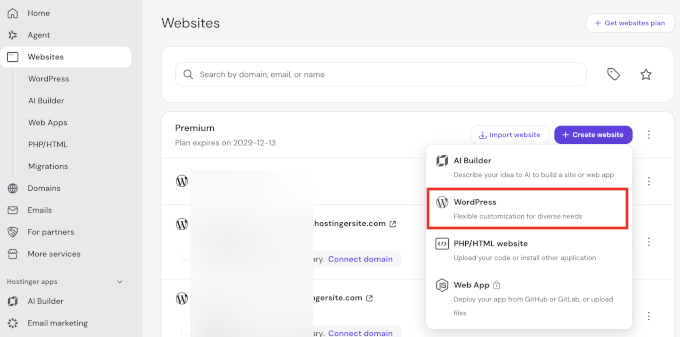
Next, choose ‘WordPress’ as the website type. hPanel then asks for the domain, and you can type a domain you already own or register a new one.
You can also start with a temporary domain and connect yours later.
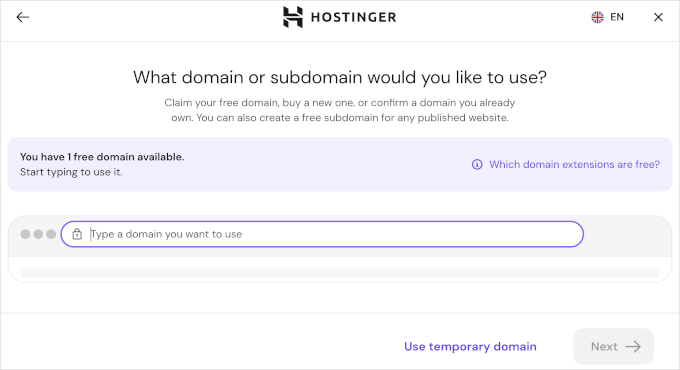
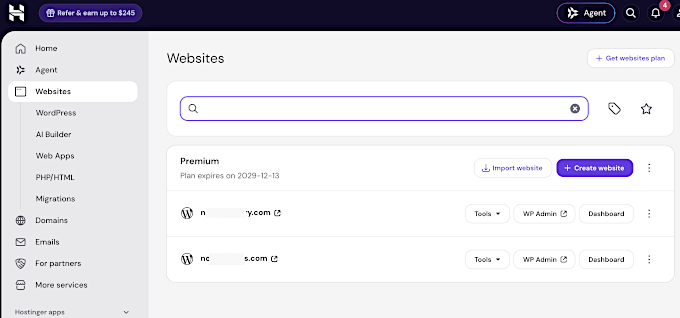
Once the setup finishes, the new site appears in your Websites list.
Both sites now live on the same server and share one hosting login. That is what you see in the screenshot below, with our two test sites listed under one plan.
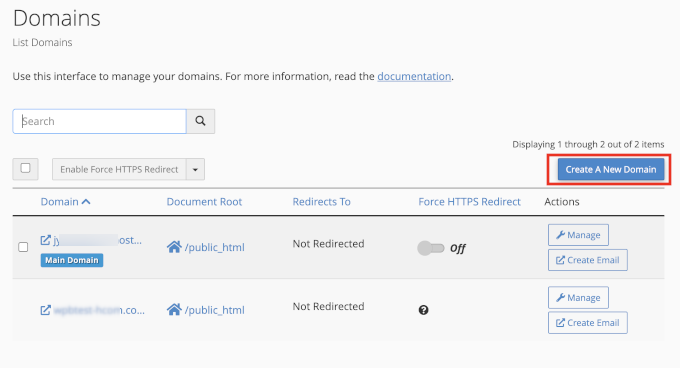
If your host uses cPanel instead, go to Domains » Create a New Domain and type the domain.
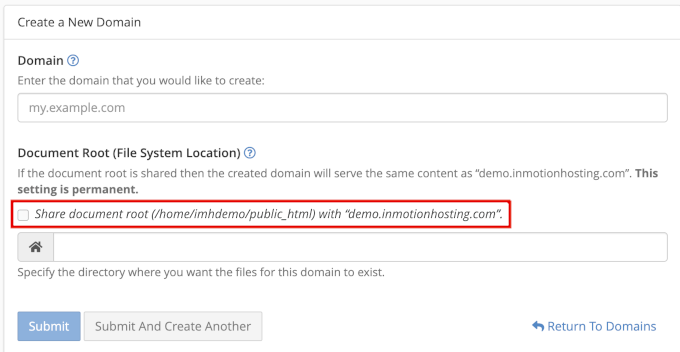
Uncheck the ‘Share document root’ option so the site gets its own folder.
Leaving that box checked turns the domain into an alias of your main site, and cPanel warns that this setting is permanent.
Step 4: Install WordPress on the New Domain
Your new domain now has its own folder on the server, and the last step is to install WordPress. Bluehost, Hostinger, and SiteGround automatically install WordPress for you as part of the add-website flow.
If your host doesn’t, use its one-click installer, which in cPanel sits under the Software section as ‘WordPress Manager’, ‘Softaculous’, or ‘WordPress Toolkit’.
Pick the new domain when the installer asks where to install. If you need help, see our complete guide on how to install WordPress.
That’s it! You have added another site to your hosting account. Repeat the same steps again if you need to add more websites.
Method 2: Set Up Your Own Server (Suitable for Advanced Users)
You can also rent a bare server and host your websites on it yourself. This route makes sense when you want full control over the server software, or when a shared plan’s limits get in the way of your client sites.
The server is usually a VPS hosting server, short for virtual private server.
It includes dedicated space and resources on a server that behave like your own computer in a data center. Plans start from $5 per month and pricing increases with additional resources such as more RAM or storage.
Hosting several domains on a VPS means creating one virtual host per domain. A virtual host is the configuration that tells the server which folder belongs to which domain.
You can write each configuration by hand in the terminal, which is where most beginners get stuck. The easier way is a control panel that writes those configurations for you.
We recommend CloudPanel because it is free and installs WordPress with one click. It also adds a free Let’s Encrypt SSL certificate per domain and lets you pick a PHP version for each site.
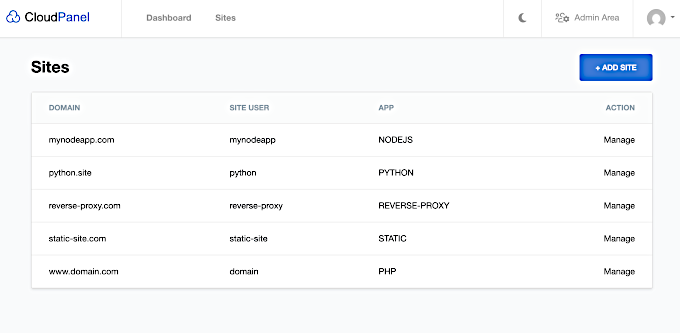
We don’t suggest cPanel here because of the price. A single-account cPanel Solo licence from the cPanel Store costs $29.99 per month on monthly billing, which is more than the VPS itself.
If this route sounds right for you, start with our comparison of the best VPS hosting providers, then check if they support CloudPanel.
Method 3: WordPress Multisite (One WordPress, Many Sites)
WordPress Multisite lets you run many websites from a single WordPress installation. You install WordPress once, turn on the network feature, and add new sites from the Network Admin dashboard.
A common misunderstanding is that Multisite only works with subdomains like blog.example.com. WordPress has built-in domain mapping, and you can give any site in the network its own domain name.
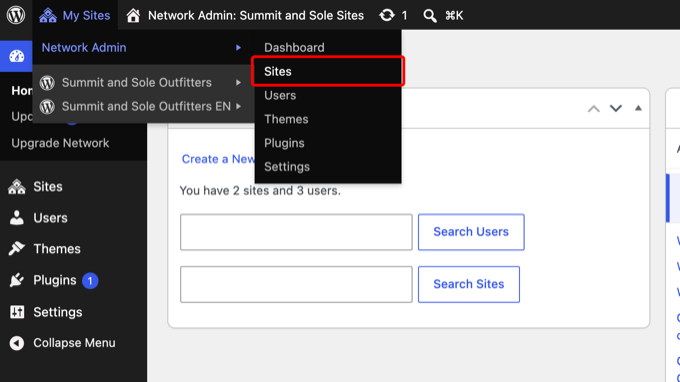
Multisite is a good fit when you own all the sites and want them to share plugins, themes, and user accounts. You update WordPress and every plugin once, and the whole network gets it.
It’s not an ideal choice for agencies considering it for client sites. Every site on WordPress multisite network shares one database and one set of plugins. It also struggles when sites need different plugin sets, or when one busy site slows down all the others.
To set it up, see our guide on how to install and set up a WordPress Multisite network. Then follow our tutorial on creating a WordPress Multisite with different domains to map a domain to each site.
Which Hosting Plan Do You Need for Multiple Sites?
The answer depends on how many sites you run and how much traffic they get. For two or three small sites, a shared plan one tier above the entry level is enough.
For business sites or online stores, we recommend managed hosting. Many of our partner brands run on Levamo, and its Business plan hosts 3 WordPress sites for $99 per month on annual billing.
The Starter plan covers one site, and extra sites cost $20 per site per month. Every plan includes the Cloudflare Enterprise CDN, and the Business plan and above add a Redis object cache for faster database queries.
To compare it with other managed hosts, see our guide to the best managed WordPress hosting.
FAQs About Hosting Multiple Websites on One Server
Here are the questions our readers ask most often about hosting several websites on one server.
Which host is best for hosting multiple websites?
Any host with a plan that allows more than one website will work. We keep the per-plan website counts up to date in our guide to the best WordPress hosting.
Is WordPress Multisite worth it?
Multisite is worth it when you own all the sites and want to manage plugins, themes, and updates in one place. Skip it for client sites or sites that need very different plugin sets, as Method 3 above explains.
How much does it cost to host websites on your own server?
A small VPS starts at about $5 per month, and the CloudPanel control panel is free. If you want cPanel instead, a single-account Solo licence costs $29.99 per month on monthly billing.
We hope this article helped you learn how to host multiple websites on one server. You may also want to see our guide on how much a domain name really costs and our pick of the best tools to manage multiple WordPress sites from one dashboard.
If you liked this article, then please subscribe to our YouTube Channel for WordPress video tutorials. You can also find us on Twitter and Facebook.


Oyatogun Oluwaseun Samuel
I have been looking to do this for my various clients in order to save cost and and significantly enhance efficiency. Thank you wpBeginner for this incredibly useful article.
The step-by-step instructions make it accessible even for beginners. The tips on choosing the right hosting provider and configuration of server are particularly valuable.
Dennis Muthomi
for someone starting with just one website for his business, would you still recommend going with a hosting plan that allows multiple sites right from the beginning?
or is it better to start with a basic single site plan and then upgrade later when expanding to more websites?
WPBeginner Comments
While this is up to you as the site owner, a basic, single site plan may be a better option in some cases due to being less expensive.
That said, more expensive plans often have more server resources, so you may want to weigh the server processing your site will need with the hosting costs as the site traffic grows.
Jiří Vaněk
Hi Dennis,
if you’re considering starting with one website and one domain, with the possibility of expanding into more businesses over time and needing more domains, it’s better to consider web hosting that allows for service expansion. That means starting with a basic plan and being able to upgrade it later when needed. Many providers offer flexible solutions with options to upgrade to better and more expensive website variants. It’s quite nonsensical to start immediately with an expensive website with a bunch of features that you won’t really use. That’s why I personally choose providers based on whether my website can grow along with the requirements I have for it. There’s nothing easier than asking customer support. At least you’ll immediately verify how quickly they respond to your inquiries
Jiří Vaněk
I would like to ask about this topic. I have one website and one database. On the site I am able to create subfolders for individual domains that I set as an alias. I will install wordpress in the subfolders in one database so that each one has a different prefix. Everything is simple here. But how to resolve that the alias displays the root of the main domain site, instead of the content of a specific subfolder? Is it possible to prepare rewrite rules that push the domain into a subfolder and at the same time the URL address will not be rewritten?
WPBeginner Support
For subdomains vs subdirectories as it sounds like that is what you mean, we would recommend taking a look at our article below for things to consider on which to use and we would not recommend trying to have it work as both at the same time.
https://www.wpbeginner.com/glossary/subdomain/
Admin
A Owadud Bhuiyan
Can I buy a hosting without a domain?
WPBeginner Support
It would depend on the hosting provider but some do have the option to do so
Admin
Ralph
Great guide for beginners. I have all of that due to my local hosting, but still good to know how to do that if I have to change. And I will as good an innovative hosting is becoming more and more expensive. Definitely will use it in few months while moving my websites!
Mark Paradis
In a multisite scenario, can you utilize different WP themes or are you stuck with one?
WPBeginner Support
You can use different themes that are installed on the super admin site.
Admin
ASHIKUR RAHMAN
apart from wp multisite installation. is it possible to host two different domain in two different php version? or it will share same php/mysql version?
WPBeginner Support
That would depend on your hosting provider, it would normally be the same versions.
Admin