


Moving your WordPress site to a new domain can feel risky. You don’t want to lose your hard-earned SEO rankings, and you need to make sure visitors who use your old domain are automatically sent to the new one.
In this guide, we will show you how to move WordPress to a new domain without losing your SEO. We have used these exact steps to migrate hundreds of websites, including our own.
Here is a quick overview of everything we will cover in this tutorial. You can click any link below to jump straight to that section:
- What to Know Before You Change Domains
- What You Need to Get Started
- Step 1: Create a Duplicator Backup of Your WordPress Site
- Step 2: Create a Database for Your New Domain Name
- Step 3: Unpack WordPress on Your New Domain Name
- Step 4: Set Up Permanent 301 Redirects
- Step 5: Notify Google About Your New Domain
- Changing Only Your Domain Name (Same Hosting)
- How to Move WordPress to a New Domain Without a Plugin
- Post-Migration SEO Checklist
- Frequently Asked Questions About Moving a WordPress Site
- Video Tutorial
What to Know Before You Change Domains
Not every domain change needs a full migration. Before you start, pick the scenario that matches your situation:
- You are moving your WordPress site to a new domain, including moving the site to a new hosting account or server. Follow the steps in this guide.
- You only want to rename your domain, and the website hosting stays exactly where it is. Skip to changing only your domain name.
- You are keeping your domain but switching hosting companies. This guide is not for you. See our tutorial on moving a WordPress site to a new host instead.
Switching domains will temporarily affect your search rankings and traffic while Google and other search engines adjust to the change. This happens to every website that changes its domain, and it is normal.
However, you can greatly reduce the SEO impact by setting up proper 301 redirects and notifying search engines the right way. That is exactly what the steps below do.
Lastly, if your old website is on WordPress.com, then you need to follow the instructions in our guide on how to move from WordPress.com to WordPress.org instead.
What You Need to Get Started
In this guide, we are assuming that you have your WordPress website set up on oldsite.com, and you are trying to migrate it to newsite.com.
Here is what you need before you start:
- Both domains added to your hosting account, with the new domain’s DNS pointing at the server where the new site will live.
- Access to your web hosting control panel.
- Basic familiarity with using an FTP client like FileZilla, or the File Manager app in your hosting dashboard.
If you still need hosting for your new domain, then Bluehost plans include a free domain name.
Step 1: Create a Duplicator Backup of Your WordPress Site
The first thing you need to do is create a full backup of your WordPress site. You will use this backup to create an exact copy of your website on the new domain.
While there are many WordPress backup plugins available, we will be using the free Duplicator Lite plugin for this tutorial. It does everything this migration needs, and you will not need a paid plan to move your domain.
Over 1,500,000 professionals use Duplicator, and it has worked reliably for us even on very large sites.
Let’s start by installing and activating Duplicator on your old domain. For more details, see our step-by-step guide on how to install a WordPress plugin.
Once activated, the plugin will add a Duplicator menu item in your WordPress admin. You need to go to the Duplicator » Backups page and then click on the ‘Create New’ button.
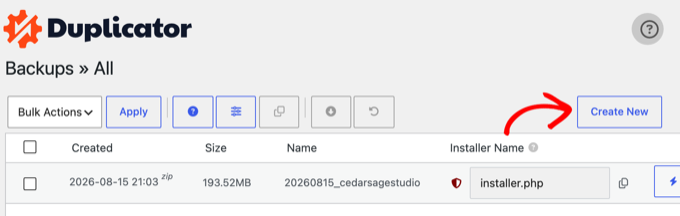
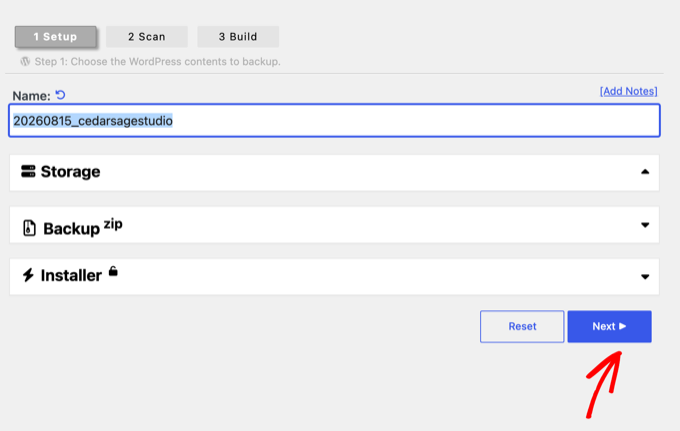
Duplicator will now start the backup wizard and automatically assign a name to this backup.
Click on the ‘Next’ button to continue.
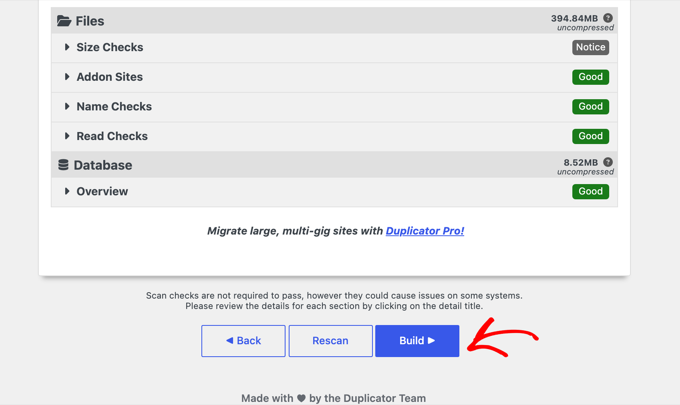
Duplicator will now scan your site to see if everything is in order. Items marked ‘Good’ passed the check, and a ‘Notice’ is just informational.
If the plugin finds a real issue, then you will see a warning with instructions on how to fix it.
If the results look good, then click on the ‘Build’ button.
The plugin will now package your website files into a backup. Depending on the size of your site, this may take a few moments.
Once finished, you will see the download options. Click ‘Download Both Files’ to save the installer and the archive to your computer.
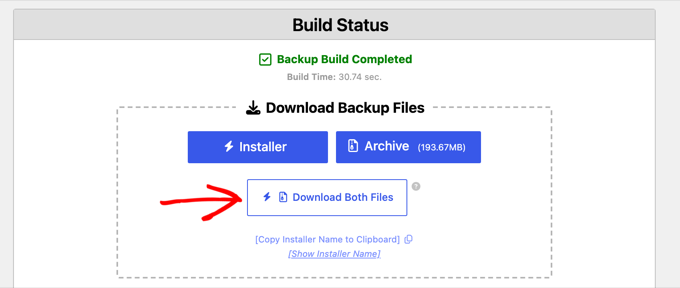
The archive file is a complete copy of your WordPress files. It includes your WordPress themes, permalink settings, plugins, uploads, and any other files created by WordPress plugins.
The installer script is a PHP file that will automate and run the WordPress migration by unpacking the archive file.
If you later want scheduled backups, cloud storage, or 1-click recovery, then the paid Duplicator Pro plan adds those features.
Step 2: Create a Database for Your New Domain Name
The two files you just downloaded contain a copy of your old site’s database. Before you unpack your files, create a fresh, empty MySQL database on your new domain.
If you have already created a database, then you can skip this step.
To create a database, you need to visit your hosting account’s cPanel dashboard and find the ‘Databases’ section.
We will show you how to locate it on Bluehost, but the basic instructions are the same and should apply to all hosting providers.
Log in to your Bluehost account dashboard and click on the ‘Manage Site’ button under your website.
Under your site settings, click on the cPanel button under the ‘Overview’ tab.
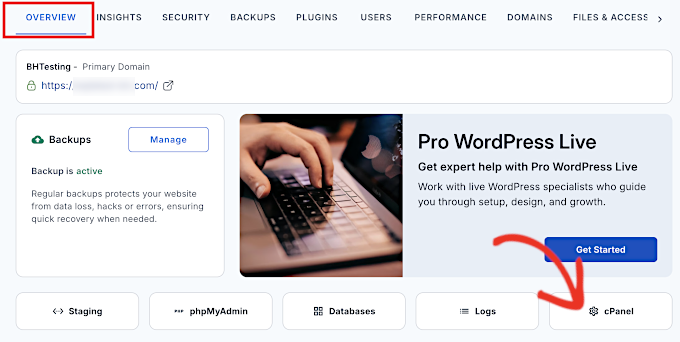
This will open the cPanel dashboard.
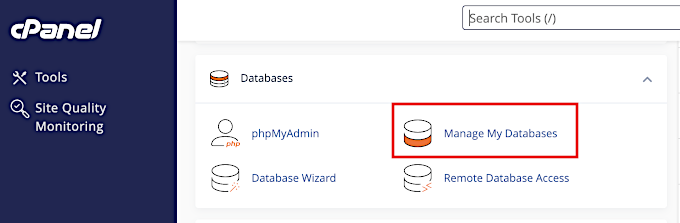
Scroll down to the Databases section and click on the ‘Manage My Databases’ option.
Provide a name for your database and then click on the ‘Create Database’ button.
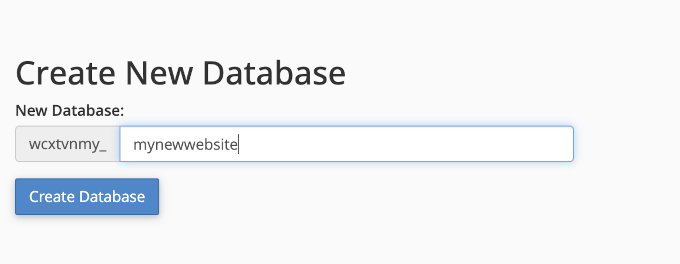
cPanel will now create a new database for you. After that, you need to scroll down to the MySQL Users section.
Next, provide a username and password for your new user and click on the ‘Create User’ button.
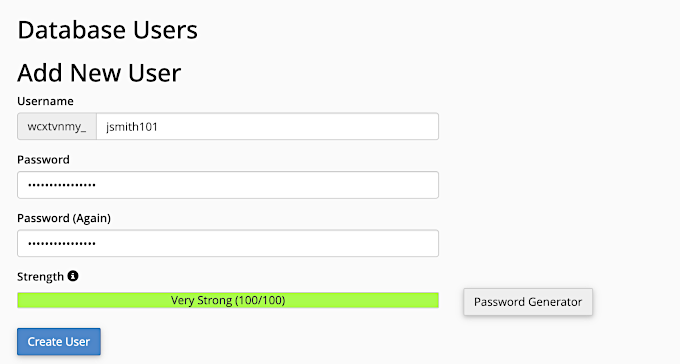
The new user you just created still does not have permission to work on the database. Let’s change that.
Scroll down to the ‘Add User to Database’ section. First, select the database user you created from the dropdown menu next to the ‘User’ field. Then select the new database you just created and click on the ‘Add’ button.
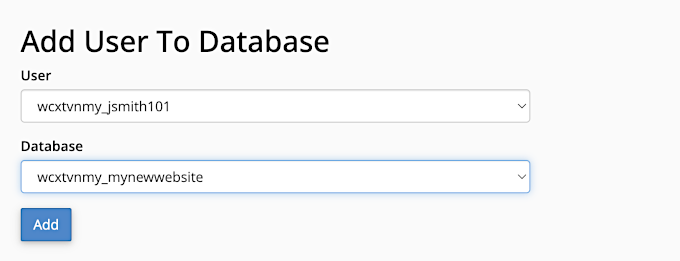
Next, cPanel will ask you to choose privileges for the user, which define what users can do with the database.
Select ‘All Privileges’ and click on the ‘Make Changes’ button to continue.
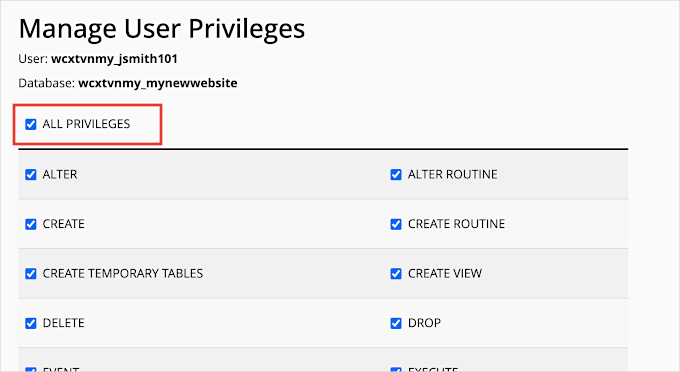
Your database is now ready, and you can use it to move WordPress to the new domain name.
Make sure to note down the database name, username, and password. You’ll need this information in the next step.
Step 3: Unpack WordPress on Your New Domain Name
Now, you need to upload the Duplicator files you downloaded earlier to your new domain name.
The Duplicator backup includes your WordPress installation as well, so you don’t need to install WordPress on your new domain.
First, connect to your domain name using an FTP client or the File Manager app in your hosting account. Once connected, make sure that the root directory of your website is empty.
After that, you can upload the archive and installer files to the root directory. This is usually called public_html.
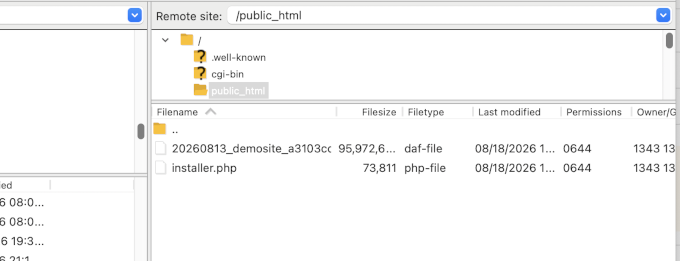
Once both files have finished uploading, you are now ready to unpack WordPress.
Open a new browser tab and go to the following URL:
https://newsite.com/installer.php
Don’t forget to replace newsite.com with your actual domain name. This will launch the Duplicator installer wizard, and you will see the ‘Step 1 of 2: Deployment’ screen.
Note: If your new domain doesn’t open or takes you to a different page, then you may need to wait for the DNS settings to update. This can take up to 24 hours, but it usually happens much faster.
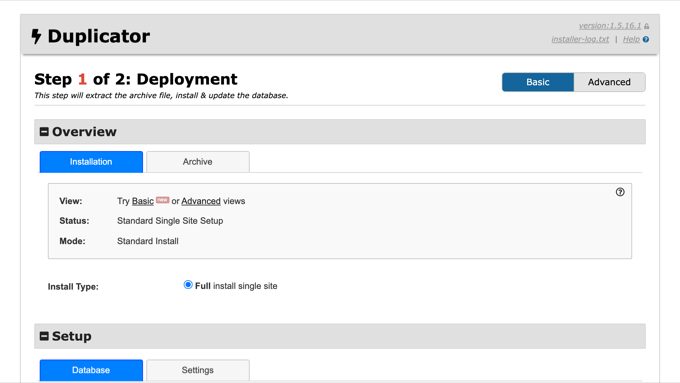
The installer will look for the archive file and then automatically select options for you on the screen.
Scroll down to the ‘Database Connection’ section under Setup. Here, you need to enter the information for the database you created in the previous step, then click on the ‘Validate’ button.
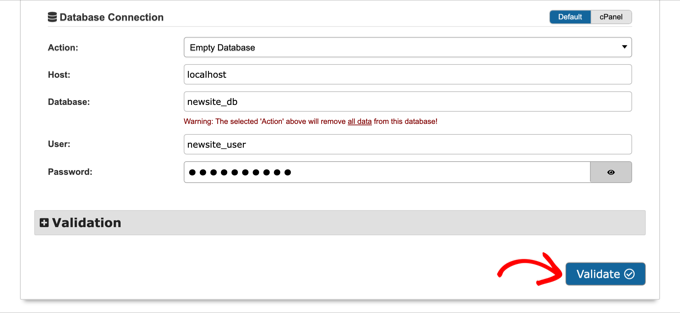
Duplicator will now attempt to connect to the database using the information you provided.
Upon success, it will show you a Validation Pass. Otherwise, it will show you a warning with details on how to fix it.
Click on the ‘Next’ button to continue.
Duplicator will now extract the archive, import your database, and automatically update the URLs to your new domain name. Once finished, you will see a success message with an Admin Login button.
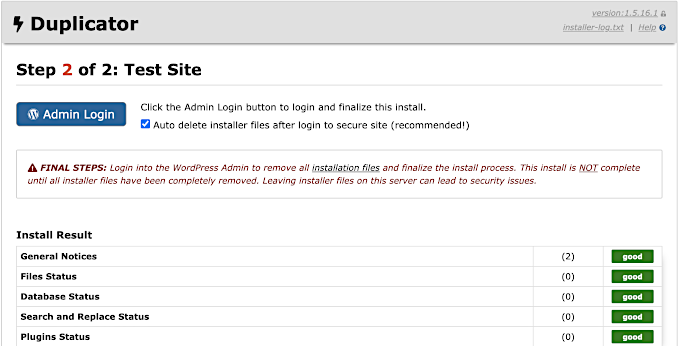
You can now click on the ‘Admin Login’ button to enter the WordPress admin area of your site on the new domain.
The installer turns on its ‘Auto delete installer files after login’ option by default. That means once you log in, Duplicator removes installer.php and the archive file for you.
Look for the notification confirming that Duplicator deleted these files, since leaving them on the server is a security risk. You can also remove them manually at any time from the Duplicator » Tools page.
Step 4: Set Up Permanent 301 Redirects
Your site is now live on the new domain, but anyone who types your old address still lands on the old site. So the next thing to do is to redirect them to the new domain.
You can do this by setting up 301 redirects. This is the most important step to protect your SEO.
Whenever someone lands on your old domain, a 301 redirect automatically sends them to the same post or page on your new domain instead of showing them a 404 error.
The redirect also tells search engines that the page has permanently moved, so the links and authority pointing at your old URL count for the new one.
At this point you have two websites: the original on your old domain and an identical copy on the new one, and you need to keep that old installation in place so it can keep redirecting visitors.
There are two ways to set up the redirects.
Method 1: Set Up 301 Redirects With .htaccess
With this method, you’ll edit the WordPress .htaccess file on your old domain. It works on Apache and LiteSpeed servers, which are widely used by WordPress hosting providers.
First, you need to connect to your old site using FTP or your host’s file manager.
You will find the .htaccess file in the same directory as your wp-includes and wp-admin folders. Open it and paste the following lines of code at the very top:
#Options +FollowSymLinks
RewriteEngine on
RewriteCond %{HTTP_HOST} ^(www.)?oldsite.com$ [NC]
RewriteRule ^(.*)$ https://www.newsite.com/$1 [R=301,L]
Make sure you replace oldsite.com with your old domain and www.newsite.com with your new domain in the above code. If your new site does not use www, then remove the www from the last line.
Once you save the changes, visit a few URLs on your old domain, including a blog post. Each one should automatically redirect you to the matching page on the new domain.
If nothing redirects, then your old site is likely on an NGINX server, which does not use .htaccess files.
In that case, you can use the redirect tool in your hosting control panel, since most hosts have one. Your hosting support can also add the redirect for you, or you can use Method 2 below, which works on any server because it runs through WordPress.
Method 2: Set Up a Full Site Redirect With All in One SEO (Pro)
If you would rather not edit server files, then the All in One SEO (AIOSEO) Pro plan can set up the full site redirect from a settings page. Most popular SEO plugins include a similar redirect feature, and we use AIOSEO on our own sites, so that is what we will show here.
First, you need to switch back to the WordPress dashboard of your old website. Then, install and activate the AIOSEO plugin there.
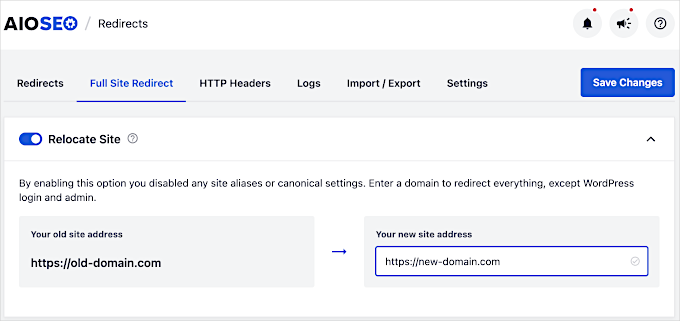
Upon activation on your old domain, you need to visit the All in One SEO » Redirects page and click on the ‘Activate Redirects’ button.
Next, you need to switch to the ‘Full Site Redirect’ tab and turn on the ‘Relocate Site’ toggle.
After that, you need to enter your new domain name and click the ‘Save Changes’ button.
Step 5: Notify Google About Your New Domain
Next, you need to tell Google about your change of address so that it can find your new domain quickly and start showing it in search results.
First, you need to add both your new and old domains to Google Search Console as two different properties. See step 1 in our Google Search Console guide for instructions.
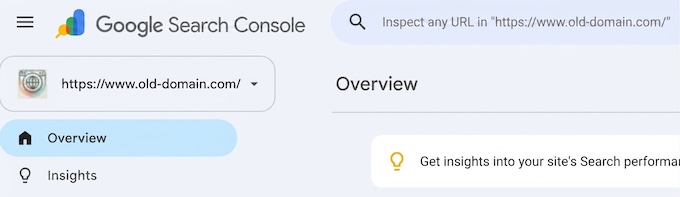
Next, you need to select the old domain name as the active property in your Google Search Console account dashboard.
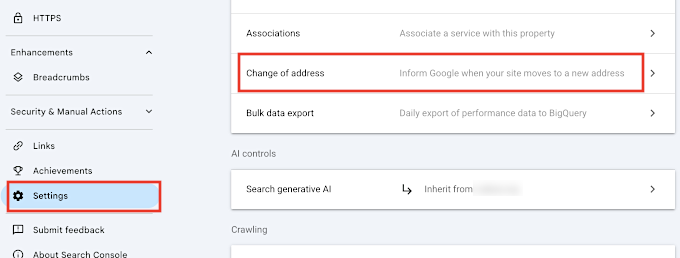
After that, click on the Settings menu from the left column.
Now, you can click on the ‘Change of address’ tool.
Now, you need to select your new domain from the Update Google section.
Then, you should click on the ‘Validate & Update’ button. Google will now validate that your old domain is redirecting to the new domain and save your changes.
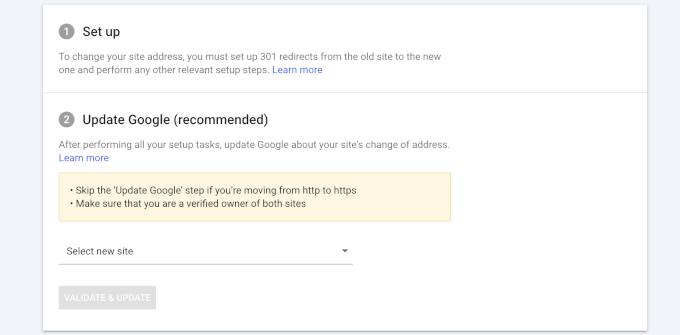
On the next screen, Google Search Console will show you a step-by-step wizard to submit your change of address request.
Before you leave Search Console, open the property for your new domain and submit your XML sitemap under the Sitemaps menu. This helps Google crawl your new URLs faster.
If you get search traffic from Bing, then you should also tell Bing about the move using the Site Move tool in Bing Webmaster Tools.
Changing Only Your Domain Name (Same Hosting)
Sometimes you only want your existing site to use a new domain name, and nothing else changes. If the site stays on the same hosting account, then you do not need a migration plugin at all.
You only need to point the new domain at your site and update the URLs.
First, add the new domain in your hosting dashboard and assign it to your existing website. Most hosts call this setting the ‘primary domain’ or ‘assigned domain’ for the site.
Your hosting documentation will show where to find this setting, and hosting support can also change it for you.
Next, log in to your WordPress admin area and go to the Settings » General page. Here, you need to replace the old domain with the new one in both the ‘WordPress Address (URL)’ and ‘Site Address (URL)’ fields.
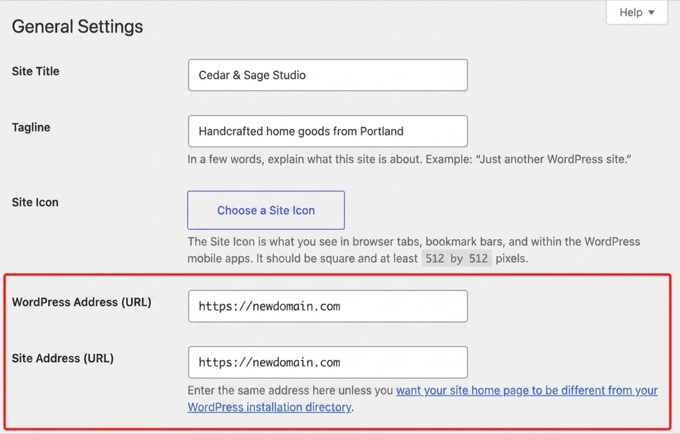
After you click ‘Save Changes’, WordPress will log you out. Log back in at the new domain to continue.
Note: If you cannot access the admin area, you can set the same values in your wp-config.php file instead by adding define( 'WP_HOME', 'https://newdomain.com' ); and define( 'WP_SITEURL', 'https://newdomain.com' );.
Your database still contains the old domain in post content, image URLs, and settings. The easiest way to fix all of them is with the free Search & Replace Everything plugin.
Install and activate it, then go to the Tools » WP Search & Replace page. Enter your old domain in the ‘Search for’ field and your new domain in the ‘Replace with’ field, and select all your tables.
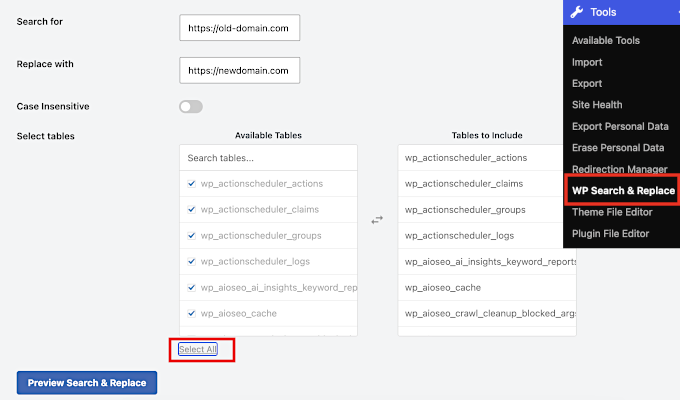
The plugin will find all instances of your old domain name in the database. You can then click on the Replace All button to replace them.
Or, if you are comfortable with the command line, then WP-CLI does the same job in one line:
wp search-replace 'https://oldsite.com' 'https://newsite.com' --all-tables
WordPress stores some settings in a special text format called serialized data, and editing it with plain SQL queries can corrupt it. Both tools above handle serialized data safely, which is why we recommend them over direct database edits.
Finally, your old domain still needs to redirect, and Google still needs to hear about the change.
Follow Steps 4 and 5 above, which work exactly the same for an in-place domain change.
How to Move WordPress to a New Domain Without a Plugin
You can move WordPress to a new domain manually, without any plugin. However, it has more steps, and a small mistake can break your website, causing downtime until you fix it.
So, keep your backup files until you confirm the new site works. Here is the short version of the process:
- Export your database. Open phpMyAdmin from your hosting control panel, select your site’s database, and use the Export tab. The Quick method with SQL format is fine.
- Download all your WordPress files from the old domain over FTP, including the wp-content folder and the hidden .htaccess file.
- Upload the files to the new domain’s root folder, usually public_html.
- Create a new database and user on the new domain’s hosting. Step 2 above shows exactly how.
- Import your .sql file into the new database using phpMyAdmin’s Import tab.
- Edit wp-config.php on the new domain and update the DB_NAME, DB_USER, and DB_PASSWORD values to match the database you just created.
- Update the URLs. The database still points at your old domain, so run a search and replace from the old domain to the new one. You can use the free Search & Replace Everything plugin or the WP-CLI command shown in the section above.
- Test the new site, then set up your 301 redirects and notify Google (Steps 4 and 5 above).
This is the same process Duplicator automates in Steps 1-3. But if you are comfortable with FTP and phpMyAdmin, the manual method works just as well.
Post-Migration SEO Checklist
The move is not finished when the new site loads. Work through this checklist over the first few days to protect your rankings:
- Test your redirects. Open several old URLs, including posts, pages, and a few images. Confirm each one lands on the matching new URL and not the homepage.
- Check your canonical tags. These tags tell Google which URL is the official version of a page. View the source of a few pages and make sure they point to the new domain, which your SEO plugin normally handles automatically.
- Update your Google Analytics property. In GA4, edit your data stream’s URL to the new domain so your traffic reporting continues without a gap.
- Update the links you control. Change the URL on your social media profiles, Google Business Profile, directory listings, and email signatures.
- Announce the move to your readers. Publish a short blog post and share it with your email newsletter and push notification subscribers. Ask readers to report anything broken, since they will often catch things you missed.
- Keep the old domain registered and redirecting for at least 12 months, or longer if you can afford it. If the old domain expires, every redirect breaks, and you lose any remaining SEO value.
Frequently Asked Questions About Moving a WordPress Site
Here are the answers to the questions we hear most often about moving a WordPress site to a new domain.
1. Will changing my domain name permanently hurt my SEO?
No. A temporary dip in rankings is normal while search engines process the change.
However, the 301 redirects and Search Console notification in this guide tell Google exactly where you have moved, so it can transfer your existing authority to the new domain.
You may also want to see our guide on how to verify your SEO is intact after WordPress domain migration.
2. How long does the entire domain migration process take?
You can typically complete the technical steps in this guide, from backing up your site to setting up redirects, in a few hours.
However, it will take longer for search engines like Google to fully crawl and index your new domain. While notifying Google speeds this up, it can take several weeks for your rankings to fully stabilize after the move.
3. Can I move my WordPress site without using a plugin like Duplicator?
Yes, you can transfer your files over FTP, export and import your database with phpMyAdmin, and then update the URLs. We cover the exact steps in the manual migration section of this guide.
A plugin like Duplicator simply automates the most error-prone parts, such as URL updates and database packaging, which is why most beginners find it faster and safer.
4. What is the main difference between moving to a new domain vs. a new host?
Moving to a new domain is like changing your business’s street address. Moving to a new host is like changing the company that owns the building, but your address stays the same.
This guide is for changing your domain, which has its own SEO requirements like 301 redirects.
5. How do I change the primary domain in WordPress?
If your site is staying on the same hosting account, point the new domain at your existing site from your hosting dashboard, and then update the ‘WordPress Address (URL)’ and ‘Site Address (URL)’ fields under Settings » General.
After that, run a search and replace for the old URLs and set up 301 redirects. The changing only your domain name section above walks through each step.
Video Tutorial
We hope this tutorial helped you move your WordPress site to a new domain name. You may also want to see our ultimate WordPress migration guide or our comprehensive guide on WordPress SEO.
If you liked this article, then please subscribe to our YouTube Channel for WordPress video tutorials. You can also find us on Twitter and Facebook.


Karina
How do you do with old 301s in htaccess that go from old sub-pages to new sub-pages in the old domain?Thanks for a very good guide!
WPBeginner Support
With how the redirect code is set up it should redirect all of your content on your site not only the home page.
Admin
Karina
But old 301 on the old domain then?
WPBeginner Support
Correct, create the 301 redirects on the old domain.
Jip Meertens
Great hands-on tut up to the almost-end of step 3.
Now did I oversee something? I am completely blank on how (which user/pw combination to use) to log in to the new WP admin?
Nowhere on the journey did I make a new WP installation, so I do not store any log-in credentials for the WP dashboard… Pls?
WPBeginner Support
You would use the same login information as the previous site as the user table would be duplicated in this process as well
Admin
shantell smith
I searched for two days until I came across your blog. I have tried 3 or 4 different codes and none of them worked. I tried yours and it worked like a charm. Thanks. But this post needs to be updated. You can no longer switch back to the old version of Console and I was unable to find a change of address option.
But still great posts. Thanks a bunch!
WPBeginner Support
Glad our recommendation worked, Google has changed where it is located but if you use their search for tools in your console you should still be able to use the change of address tool.
Admin
Viral
Many thanks for this very helpful tutorial. It has worked perfectly!
Just a small query… In the last step 5, Google Search Console says this ‘Change of Address’ function works only for root level domains (while I’ve a blog address in the form abc.co.in/example)
Hence, is there an alternative method that can be used here, or will the 301 redirects (incorporated in Step 4) suffice?
Many thanks again for the wonderful help throughout all the articles… Lots of good wishes!
WPBeginner Support
If it is not only the root domain then the 301 redirects would be what you want to stay with and should be good enough for now
Admin
Matt Pettitt
Hi, thanks – this is interesting.
Two weeks ago I migrated 3 sites into 1 new site, using the above process. All looks good as far as 301 re-directs are concerned but very few of the posts on the new domain are showing in the SERP. Also, many still have the old domain – because of this, organic traffic is down about 60% currently.
Do you know how long it takes for Google to re-crawl, re-index and sort this stuff out?
WPBeginner Support
Sadly, when merging multiple sites rather than only changing the domain, it can vary from site to site for how long it takes.
Admin
Samson Ogola
This tutorial is always my go-to piece whenever I’m moving or redirecting a website. A life-saver I must say.
WPBeginner Support
Glad our guide can help
Admin
John Akpama
Thanks for being such an immense help. I have a challenge in using Duplicator. I went as far as creating the package and uploaded it to the new domain (a subdomain actually). The problem is when I try to install it I get a 403 error that keeps me stuck at the 1st step. How do I resolve this please?
WPBeginner Support
There are a few possible reasons, you would want to take a look at our article here: https://www.wpbeginner.com/wp-tutorials/how-to-fix-the-403-forbidden-error-in-wordpress/
Admin
Ibrahim Garba
I’m so excited! Finally moved my wp site without any issue. Thanks
WPBeginner Support
You’re welcome, glad our guide could help
Admin
Himanshu Nishad
Here, you told the old domain is redirected to the new domain.
If I have to show a website in the old domain name. I will be able to upload website old domain name?
WPBeginner Support
You would need to clarify your question. If you redirect the old domain but want a site on the old domain then you would need to remove the redirection for the site content to show
Admin
zeeshan malik
as usual very well explain each step. i want to add one more point some websites leave a message in old domain when someone visit to old domain he
reads about website transferred to an other domain like stumble upon when i visit to this site i read stumble up move to mix.
i want to know is it possible to move data like classified ads from one website (website created in WordPress to another website with same domain name but CMS platform change to Joomla or Drupal or in reverse? without effecting website SEO?
WPBeginner Support
Changing platforms will always have a temporary effect on your SEO but overall there shouldn’t be any long-lasting effects on your site’s SEO
Admin
Ana
Best articles on the planet! Thank you WPBeginner for making life so much easier for the non-tech website owners!
Keep up the good work
WPBeginner Support
Thank you, glad you like our articles
Admin
Alix
Thank you so much for this!
I always thought this was a daunting task but you have made it so very easy.
Great article.
WPBeginner Support
Thank you, glad we could help simplify the process
Admin
Paul Therond
How long do you recommend keeping the old website domain redirecting to the new domain for the purposes of SEO? Is it best to keep it forever or is there a point where all the juice from the old domain has been passed onto the new one and the old domain can be discarded?
Thanks for your article it gave me the push to finally do the rebrand launch!
WPBeginner Support
Sadly, that question varies from site to site and what works best for the individual
Admin
Michael Chibuzor
Thorough content. Thank you. My question is, in Step 3 you said “make sure the root domain is completely empty.” I’m a bit confused here. I want to be able to move an old site to a new one site, these are not empty domains but functional websites with about 50 pages each.
The reason why I want to merge Site A and Site B (the main site becomes Site B) is because they’re both in the same industry, so I want to stay focused.
Can I still use this tutorial to migrate my old site to the new site — seeing the root domain isn’t completely empty?
Please help me.
WPBeginner Support
For what it sounds like you’re wanting to do, you wouldn’t want to use this guide, you would want to import your content on to the site where you want it to appear and then have your hosting provider set the secondary domain to point toward your primary domain.
Admin
Martin
Hi. This is not redirecting the main domain (e.g example.com) but only every other link after it. How to redirect even the main domain?
WPBeginner Support
You may want to check with your hosting provider to ensure they’re not preventing the redirect in some way
Admin
Cassandra
I am stuck at step 3. I try to go to example.com/installer.php (yes I use my domain name) and nothing happens. It just takes me to my site welcome page saying a new webpage will be built soon. I cannot get the duplicator app to come up. I saw other comments on here to use www. first but that also does not work. Help please!
WPBeginner Support
You may want to check with your hosting provider to ensure they don’t have a plugin or temporary page that would be preventing you from seeing the location or logging into a pre-installed WordPress site.
Admin
Arup
Well described.
But I am not using any cPanel right now. What I supposed to do on that step. Pls help.
WPBeginner Support
It would depend on what your host is using for the steps you need.
Admin
chandranath shetty
Great Article
What if i wanted to keep the some artcile in old domain and move around 200 articles to new domain
Will 301 redirects are sufficient to pass the link juice
WPBeginner Support
It will keep some of the SEO, however, if you’re not transferring the entire site then you would lose any weight your domain added to your articles.
Admin
Corina
Hi! Thanks so much for your help and guidance. I’ve just written to the Google Search Console community.
Corina
Corina
I followed the steps you guys mentioned above and I got to step 5 – notify Google. After verifying my new domain, I tried the change of address from my older one to the new one and I got stuck. When I go to the “change of address” page/ pick your new site from the list, it does not show me the new site. I clicked on “add it now” and it does show up on that page along with the older domain. Yet, I cannot pick it from the list (it does not show no matter what I do). I verified the site several times with TXT and via Bluehost.
WPBeginner Support
You may want to check with Google’s search console that you are the owner of both domains in the system as that can sometimes be the issue.
Admin
Corina
Hi! Thanks for getting back to me.
I am the owner of both domains. I checked for each domain in Google Search Console/ Settings/Ownership verification. It says “you are a verified owner” for both of them.
Sorry, I’m not a technical person, so I don’t know what I don’t know and I’m at a loss.
Thanks so much for your help with this!
Corina
WPBeginner Support
Sadly, you may need to reach out to the support forums for the Google search console and let them know you’re domain is not a selectable option
joei
Hello, do you have tutorial how to make sub.mysite.com to newname.com without losing SEO hope you reply i needed this tutorial.
Thank you.
WPBeginner Support
You should be able to use the same method as in this article or follow the steps in our article here: https://www.wpbeginner.com/wp-tutorials/how-to-get-rid-of-wordpress-from-your-wordpress-site-url/
Admin
Lee
Is this the same process if I want to move only my all posts to a new domain?
WPBeginner Support
You could certainly follow this method and then remove everything that isn’t a post. Another option would be to set up a new site then export only your posts under Tools>Export to import them on the new site using Tools>Import
Admin
Odidi Junior Meshach
This article helped me alot brooo. I have bookmarked it.
Today was able to move my old domain to my new one
Thanks alot wp beginner ☺.
WPBeginner Support
You’re welcome, glad our guide could help
Admin
Eddie
Hi, how about domain redirect from domain provider dashboard (namecheap as example)?
I don’t want continue pay old hosting, because is expensive.
WPBeginner Support
You would want to reach out to your new hosting for their method to transfer the domain as each provider can have a slightly different method.
Admin
Leo
Hello:
I need to design a new wordpress site with a new theme.
I want to do it in a subdomain while the original website keeps working.
I have thought that when finished designing the whole site, migrating it to the main domain, overwriting the former site.
Is it possible?
Does this keeps the SEO ranking of the original site?
I’d be very grateful if somebody could answer.
Best
WPBeginner Support
You would want to check with your hosting provider for if they have an option for a staging environment to do what you’re wanting. Depending on the changes you make it could affect your SEO.
Admin
Raúl Morales
Hi! Thanks for this article.
I followed the instructions with a test site and everything worked perfectly. But now that I’m trying to move my main site (7+ GB), Duplicator shows error after error related to my hosting. I’m trying to move both to another host and another domain. Any ideas on alternatives to Duplicator?
Best
WPBeginner Support
We do not have an alternative recommendation at the moment but if you reach out to the plugin’s support they may have a recommended workaround.
Admin
Fred
moving all business under parent X to Z
x.com to z.com
content from X into sub folder of Z
any particulars to be aware of?
WPBeginner Support
The plugin should handle moving the content to the correct url
Admin
john
Hi,
I am currently running a wordpress site which i built 4years ago. Now my client wants to change the feel of the website. i just bought another theme for the for the new website. 1. How do i build the new website without disrupting the old site? 2. How do I easily switch the new site with the old site ? Any answers
WPBeginner Support
You may want to check if your hosting provider has built-in support for a staging site and if not you could create a local installation of your site with: https://www.wpbeginner.com/wp-tutorials/how-to-move-live-wordpress-site-to-local-server/
Then replace the current site when ready using:
https://www.wpbeginner.com/wp-tutorials/how-to-move-wordpress-from-local-server-to-live-site/
Admin
Narendra
Hi!
I only want to change hosting. While wanting to keep the same domain. For that we need to build the database on new hosting Or upload the old one.
WPBeginner Support
For how to move hosts, you would want to take a look at our article here: https://www.wpbeginner.com/wp-tutorials/how-to-move-wordpress-to-a-new-host-or-server-with-no-downtime/
Admin
Nourdin
Can i change my dmain name to be with www.
With the same name
The exisiting one does not have www
But i am planinig to move it to be with www.
Both names has almost the same DA, PA and moz rank.
I am worry about the rankning in google?
Best Regards
Nourdin
WPBeginner Support
For www vs the non www alternative, you would want to take a look at our article here: https://www.wpbeginner.com/beginners-guide/www-vs-non-www-which-is-better-for-wordpress-seo/
Admin
Eyad
I did this successfuly 2 years ago when I changed my business name and domain. As far as SEO goes, do I still need to keep my old site hosted after 2 years? The old site is still redirecting to new site. please let me know, thanks!
WPBeginner Support
After two years it normally becomes personal preference on if you should maintain the old site, it is not required.
Admin
Saweel ur Raheem
Thank you for creating such an article.
I have redirected my 1st website with 301 (Permanent) to the 2nd website. Its been almost 5 months and my second website isn’t at the same Domain Authority.
Why not all Domain Authority of my old domain has transferred to my new domain?
WPBeginner Support
There are too many possible reasons for a change in domain authority, it could be anything from a Google algorithm change to any other factors.
Admin
Jimmy
This is really an awesome guide. Just a question.
Since the site is relatively new and not much traffic is coming, After the files have been moved to a new domain, instead of redirecting 301, can I just delete the old site?
I really need your thoughts on this guys!
WPBeginner Support
If you’re not worried about traffic to the old domain, you could certainly do that
Admin
Eyad
I did this successfully two years ago because I changed business name and domain, but I have a question regarding my old domain (which is still redirecting to new domain). I did this to keep all SEO from old site. Should I still continue to keep my old site hosted? Or is it safe, after two years, to remove hosting from old site.
WPBeginner Support
After 2 years it is normally safe to remove the old site completely.
Admin
Javed Isaac
Hi Thanks for sharing this awsome guide. Can i know you that how much it will take time to moving old domain to new domain url in google. And, I have DA PA high of .com domain now i have move on .net some cause of issue. So my old domain DA PA will move on new one i mean on .net.?
WPBeginner Support
For the change of address, if both domains are verified then it should take effect once you submit.
Following this guide will minimize the effect to your domain authority and page authority but no matter what, if you change your domain you will take a hit even if it is a small hit.
Admin
Kwabena Okyire Appianing
I just want to know if i move the entire files from the old domain to the new domain, will it affect the site
i did that with the cpanel move tool
WPBeginner Support
Doing that you would have moved the files, you would want to ensure you update the urls for your site and in your site’s content as well as inform Google of the move
Admin
Farukh Hussain
Hello, Thankx for helping my all life with each and every WordPress issue. I dont have words to thank for your all efforts to make our life easier with Wordpress.
I also just changed my domain name with your most helpful step by step guide. I am stuck at one point. To redirect my old urls to my new URLs. Do I need a hosting plan for the old domain??
WPBeginner Support
If you use the method in the article you would want hosting for the old domain for some time. If you check with your hosting provider, some of them have methods to point the old domain to the new one.
Admin
chris
Good day Wpbegginer, thanks for this insightful article, I have one question though, Am running a WordPress multisite with sub-directories and I wish to change the domain name of the multisite, my confusion is during the migration will my subdirectories be carried along and change to the new domain i.e (newdomain/subdiretory1) or do I need to add them manually all over again, thanks..
George
I have completed all the steps to move the website to a new domain.
The front end works fine: articiles, links, etc.
The problem: when I try to do to admin dasboard or any link from Admin, I get a blank page: HTTP ERROR 500
Any solution?
Thanks!
Patrick Alvarez
I’ve done a 301 redirect of an entire website from oldsite.com to newsite.com. Can I know delete wordpress and all of the files on the old site?
WPBeginner Support
Hi Patrick,
If you have setup redirects using .htaccess file on your old site, then yes you can backup your old WordPress files and then delete them.
Admin
Tan_veer
Intaller.php is not opening after putting mynewdomain.com/installer.php, it’s showing 404 error. But I uploaded installer and package on new domain using FTP. I want to transfer existing domain to new domain on existing host and I register the new domain under my existing host as an addon domain.
WPBeginner Support
Hi Tanveer,
Try accessing installer with and without www in the URL.
Admin
David
i want to move my blog to a new url, but on the same host, how can i go about that
WPBeginner Support
Hi David,
If you want to add a new domain name, then you will need to register the domain name and then add it to your hosting account. Visit the cPanel dashboard and under domains sections you will find the option to add new domain.
Admin
Davies
I uninstalled the host under the old domain and installed it on a new domain and also imported the backup on the new domain, but am having issue redirecting the old domain to the new one, here are the domains and the new one (new)
Juan Pablo Silva
Hy.. I opened a new domain to improve my blog because I was using wordpress.com. Now I want o ensure that all my post are automatically redirected to my new domain. I have a very successful post and I don’t want to lose my SEO. Its possible to do this in the same way???
WPBeginner Support
Hi Juan,
Please see our article on how to move from WordPress.com to WordPress.org.
Admin
Kiran Bulbule
Your all tutorials are great. I almost learn full wordpress from webeginner. Now, about this tutorial i think you should create a tutorial on All in one migration plugin it is very simple and easy.
Mike
Great article but needs to be updated. Google sites changed a lot, especially Webmasters, which is just a meta category for few other tools. There is no changing site adres as shown above or maybe it moved to non-findable location? Also new tools are available so almost everything has changed…
kunal kumar
Sir, i want to ask a question please see this first and answer me ASAP. i read your article/blog thats why i ask this question.
I was using a domain and a wordpress site is running on it.
last month in may2018 the mistake happen renewal of hosting is done but domain renewal was skipped. and now that domain become approx one lakh rupee domain, which is not in mu budget. so i think when it will skipped by godaddy after redemption period then i will purchase it.
Till then i purchased a new domain j”only s added”. and now i want my old site data and its seo all will come on this new domain.
i repeat now i have no any access of old domain but i can access web hosting where my data is held
so how i will migrate this or transfer old website data to new domain without loosing seo .please help
WPBeginner Support
Hi Kunal,
You just need to point your new domain name to the folder where your old website files are stored. We are assuming you have added the new domain name on the same hosting account. Go a head and edit your domain settings, contact your hosting provider for support.
After that you will have to update URLs in your new WordPress site.
Admin
walter rios
When simply changing domain name to current site, does any changes had to be made to nameservers?
Raju
I also want to follow the same steps but Do I need to buy new hosting?
Do I need to delete old site content?
How can I access old site .htaccess file?
Thank you
Mohammed
Hi,
Thanks for the article.
I have been wondering, after all the process and 301 redirects what happens to my old domain?
Best regards,
Mohammed
WPBeginner Support
Hi Mohammed,
You need to keep the old domain alive as long as possible so that you don’t miss any traffic. However, if you don’t want to, then you can let your old domain expire after at least 6 months.
Admin
Jeremie
Hi,
Thank you for your tutorial.
I’m having an issue with Google.
When I want to notify the change of address, the 3rd step to verify my website always failed. The weird thing is, if I remove the redirection, the verification goes through (but then the 2nd step where Google checks the redirection fails).
Any idea what I’m doing wrong?
Thanks for your help!