


While some people think RSS feeds are a thing of the past, we’ve found they are still one of the most powerful tools for distributing content and growing an audience. In fact, platforms like RSS feeds remain an excellent way to reach readers who prefer organized, distraction-free content.
Ignoring your RSS feed is a huge missed opportunity for boosting traffic and improving your SEO. A properly optimized feed protects your work from content scrapers and makes it easier for new readers to find you.
In this guide, we’ll walk you through the simple, battle-tested tips we use on all our sites to get the most out of our WordPress RSS feeds. These quick tweaks can make a big difference.
Why Optimize Your WordPress RSS Feeds?
Many website owners think RSS feeds are outdated technology, but we’ve found they’re still incredibly valuable for content distribution and audience engagement.
RSS (which stands for Really Simple Syndication) might sound technical, but it’s simply a standard way for your content to be shared across different apps and platforms.
Think of it as your content’s passport to travel across the internet. The better optimized it is, the more people it can reach effectively.
A well-optimized RSS feed does more than just syndicate your content. It helps protect your posts from content scraping, improves your site’s SEO potential, and makes your content more attractive in feed readers like Feedly.
We’ve found it’s also an excellent way to drive more traffic back to your website and create better content syndication opportunities with other platforms.
We’ve seen firsthand how optimized RSS feeds can transform content distribution and reader engagement. While social media might get all the attention, RSS remains a reliable backbone for content syndication and distribution, helping you reach more readers.
Now, let’s dive into our expert tips that will help you optimize your WordPress RSS feed for maximum impact.
- Create an RSS Feed Sitemap
- Edit Your RSS Feed Before and After Content
- Protect Your RSS Feed From Content Scrapers
- Show Excerpt Instead of Full Article in RSS Feed
- Add a Featured Image to Posts in RSS Feed
- Add Custom Post Types to Your RSS Feed
- Add Additional Text to Post Titles in RSS
- Allow Users to Subscribe to RSS Feed via Email
- Allow Users to Subscribe to Categories in RSS Feed
- Add Custom Field Data to Your RSS Feed
- Delay Posts From Appearing in RSS Feed
- Add Social Buttons to Your WordPress RSS Feeds
- Frequently Asked Questions About WordPress RSS Feeds
- Additional Resources & Further Reading
1. Create an RSS Feed Sitemap
An RSS sitemap is different from an XML sitemap. RSS sitemaps only contain your most recent content, which helps Google to keep your content fresher in search results.
If you publish content frequently, then this can lead to a boost in your search engine rankings.
All in One SEO allows you to add an RSS sitemap to your website easily without having to code.
The first thing you need to do is install and activate the All in One SEO plugin. For more details, see our step-by-step guide on how to install a WordPress plugin.
Upon activation, you will be prompted to set up the plugin. You can follow the guided steps in the setup wizard or see our guide on how to set up All in One SEO for WordPress.
AIOSEO enables RSS sitemaps automatically, so there’s nothing else you need to do.
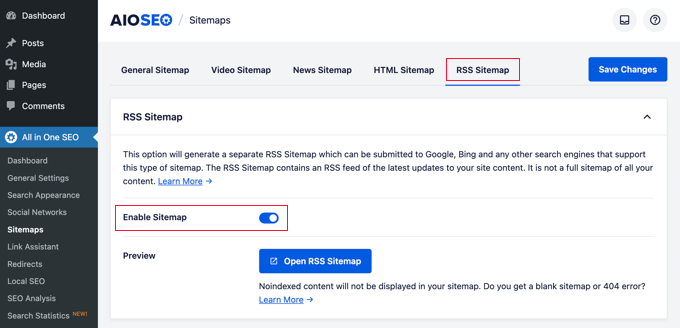
If you’d like to double-check, simply go to All in One SEO » Sitemap and then click on the ‘RSS Sitemap’ tab.
You can see that the ‘Enable Sitemap’ toggle in the ‘RSS Sitemap’ box is already enabled.
You can also set the number of posts and the post types you want to include in the ‘Sitemap Settings’ box.
We will leave the default settings, but you can include more posts (links) or only include certain post types or taxonomies.
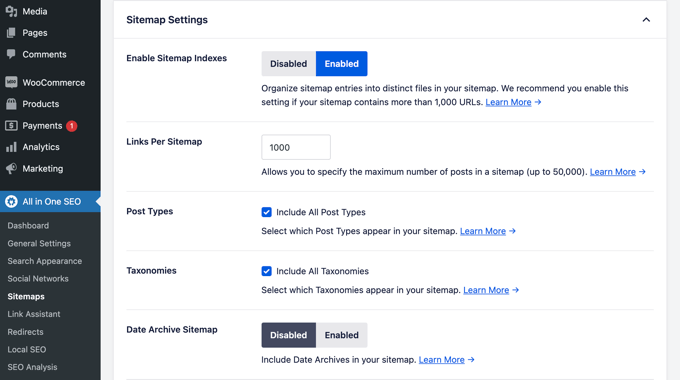
Before you leave the screen, make sure to click the ‘Save Changes’ button.
Now you have enabled your RSS sitemap for your website.
To submit your new RSS sitemap to Google, you can see our guide on how to add your WordPress site to Google Search Console. It’s the same process as submitting an XML sitemap.
2. Edit Your RSS Feed Before and After Content
By default, WordPress RSS feeds will show your recent post content, and there’s no built-in option to customize that content for your readers.
Luckily you can use the All in One SEO plugin to easily customize your RSS feed before and after content.
Simply follow the same steps as above to install, activate, and set up the plugin.
After that, navigate to All in One SEO » General Settings and then click the ‘RSS Content’ menu option.
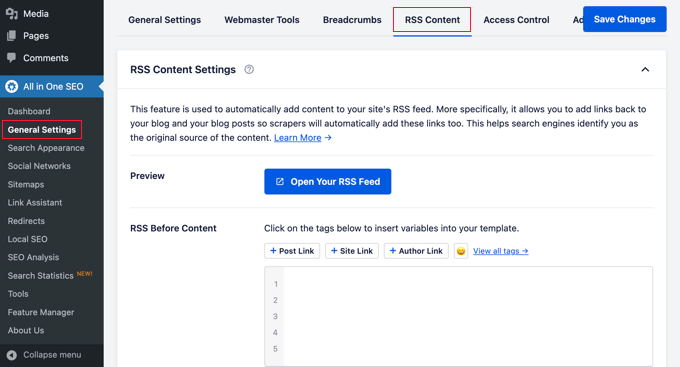
On this screen, you can add any content you want to display before and after each post in your RSS feed.
You can add HTML, smart tags for links, and other metadata to each section. For example, in the ‘Content After Posts’ box, you could add the following to automatically include a credit link back to your original article:
<p>The post <a href="%post_link%">%post_title%</a> appeared first on <a href="%site_link%">%site_title%</a>.</p>
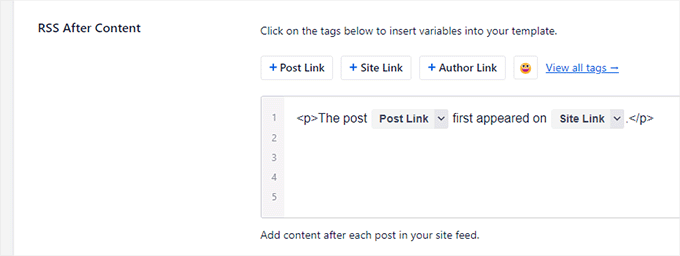
Once you are happy with your changes, make sure to click the ‘Save Changes’ button to save your RSS feed.
3. Protect Your RSS Feed From Content Scrapers
Content scraping is when content is taken from your site, usually via your RSS feed, and republished on someone else’s site as their own.
It can be very frustrating to see someone stealing your content, monetizing it, and even outranking your website in the search results.
Luckily, by customizing your RSS feed to include a link back to your original articles (like we showed in the previous tip), you can ensure you get proper credit and valuable SEO backlinks even when your content is stolen.
For more details, see our beginner’s guide to preventing blog content scraping in WordPress.
4. Show Excerpt Instead of Full Article in RSS Feed
Showing your full article in the RSS feed lets your users read the entire article in their feed reader. This can negatively affect your page views, advertising revenue, and conversion rates.
By showing the article summary instead of the full article in your RSS feed, you require readers to come to your WordPress website to read the full post.
WordPress comes with a built-in solution. Simply go to Settings » Reading in your WordPress admin dashboard.
Then, scroll down to the section titled ‘For each post in a feed, include’ and select the ‘Excerpt’ radio button.
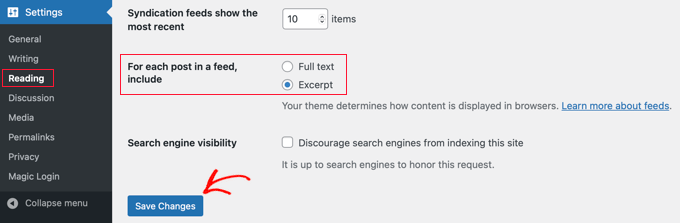
You can also control the number of posts that display in your RSS feed as well.
In the ‘Syndication feeds show the most recent’ box, simply enter a number into the box.
Before you leave this screen, make sure to click the ‘Save Changes’ button to update your RSS feed settings.
5. Add a Featured Image to Posts in RSS Feed
By default, your WordPress RSS feed does not show featured images for posts. You can easily add them by using a code snippet that’s included in WPCode’s library.
Simply navigate to Code Snippets » + Add Snippet and then search the library for ‘rss’. You can then hover over the snippet named ‘Add Featured Images to RSS Feeds’ and click the ‘Use Snippet’ button.
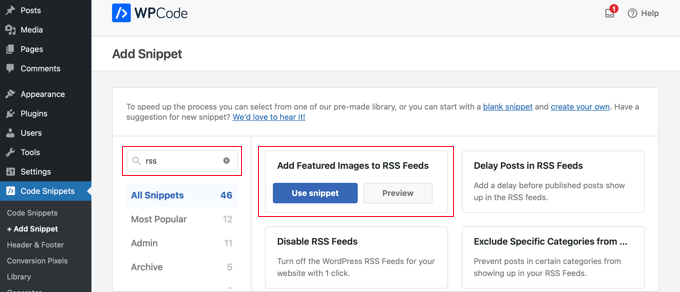
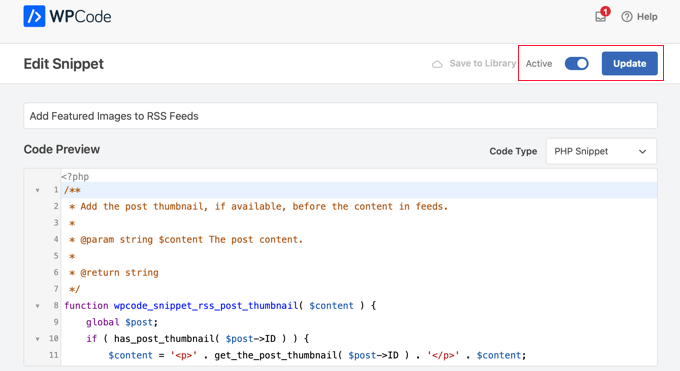
Now all you need to do is switch the ‘Active’ toggle to the On position and then click the ‘Update’ button.
Featured images have now been added to your RSS feeds.
Alternatively, you can add featured images by adding a code snippet to your site. We recommend doing this with the free WPCode plugin, which is the safest way to add custom code without editing your theme’s functions.php file.
function wpb_rsstutorial_featuredimage($content) {
global $post;
if(has_post_thumbnail($post->ID)) {
$content = '<p>' . get_the_post_thumbnail($post->ID) .
'</p>' . get_the_content();
}
return $content;
}
add_filter('the_excerpt_rss', 'wpb_rsstutorial_featuredimage');
add_filter('the_content_feed', 'wpb_rsstutorial_featuredimage');
This code simply checks if a post has a thumbnail (featured image) and displays it along with the rest of your post content.
6. Add Custom Post Types to Your RSS Feed
Many WordPress sites use custom post types to create separate sections from regular blog articles.
For example, here at WPBeginner, we created separate custom post types for our Deals and Glossary sections.
If you publish a lot of content using different custom post types, then you will want to add these to your main feed.
To do this, you can add a simple code snippet to your site. We strongly recommend using the free WPCode plugin, which makes it easy to add custom code without editing your theme’s functions.php file.
function myfeed_request($qv) {
	if (isset($qv['feed']) && !isset($qv['post_type']))
		$qv['post_type'] = array('post', 'books', 'movies');
	return $qv;
}
add_filter('request', 'myfeed_request');
This code adds two custom post types, ‘books’ and ‘movies’, to the main RSS feed. Make sure you replace these with your own custom post types.
7. Add Additional Text to Post Titles in RSS
Adding additional text to your post titles in RSS can be helpful if you create multiple kinds of post content.
For example, this can help your readers distinguish between guest posts, regular blog content, and sponsored content.
Here’s a code snippet you can use to display the post category in the title:
function wpb_rsstutorial_titlecat($content) {
$postcat = "";
foreach((get_the_category()) as $cat) {
$postcat .= ' ('.$cat->cat_name . ')';
}
$content = $content.$postcat;
return $content;
}
add_filter('the_title_rss', 'wpb_rsstutorial_titlecat');
For more details and examples, see our guide on how to completely customize your WordPress RSS feeds.
8. Allow Users to Subscribe to RSS Feed via Email
Not all your users want to use a feed reader to subscribe to your posts. A lot of people will prefer to subscribe by email instead. That’s one reason why having an email newsletter is important.
To send RSS emails automatically, we recommend using Brevo (formerly Sendinblue). It’s a popular email marketing service provider that has a forever-free plan to send up to 300 emails a day.

Once your email list is set up, you can automatically send RSS emails when you publish a new blog post.
For more details, see our guide on how to notify subscribers of new posts in WordPress.
9. Allow Users to Subscribe to Categories in RSS Feed
Each category on your WordPress site will automatically have its own RSS feed. If you run a massive blog with many diverse categories, then this lets your readers only subscribe to categories that interest them.
However, a lot of users don’t realize they can easily subscribe to specific categories. You can make this easier for your readers by highlighting this on your website.
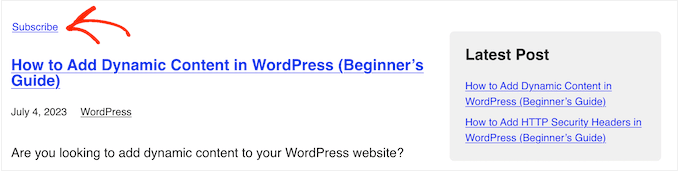
For more details, see our guide on how to make separate RSS feed for each category in WordPress.
10. Add Custom Field Data to Your RSS Feed
Custom fields let you add extra metadata to your WordPress posts and pages. However, this metadata isn’t included in your default RSS feed.
To display custom fields in your RSS feed, you can add the following code snippet to your site. The safest and easiest way is to use the free WPCode plugin.
function wpb_rsstutorial_customfield($content) {
    global $wp_query;
    $postid = $wp_query->post->ID;
    $custom_metadata = get_post_meta($postid, 'my_custom_field', true);

    if(is_feed()) {
        if($custom_metadata !== '') {
            // Display custom field data below content
            $content = $content."<br /><br /><div>".$custom_metadata."</div> ";
        } else {
            $content = $content;
        }
    }
    return $content;
}

add_filter('the_excerpt_rss', 'wpb_rsstutorial_customfield');
add_filter('the_content_feed', 'wpb_rsstutorial_customfield');
This code checks if the custom field is being used and if the RSS feed is being displayed. After that, it will add the custom field data below the post content.
11. Delay Posts From Appearing in RSS Feed
Delaying posts from appearing in your RSS feed can save you from accidental publishing and can help you beat content scrapers if that’s an issue you regularly face.
When you delay posts from appearing in your RSS feed, you give the search engines time to crawl and index your content before it appears elsewhere.
Plus, you can check for any typos before it gets sent out to RSS subscribers.
To do this, you can use the following code snippet. We recommend adding it to your site using the free WPCode plugin to avoid any risk of editing your theme files.
function publish_later_on_feed($where) {

	global $wpdb;

	if ( is_feed() ) {
		// timestamp in WP-format
		$now = gmdate('Y-m-d H:i:s');

		// value for wait; + device
		$wait = '10'; // integer

		// http://dev.mysql.com/doc/refman/5.0/en/date-and-time-functions.html#function_timestampdiff
		$device = 'MINUTE'; //MINUTE, HOUR, DAY, WEEK, MONTH, YEAR

		// add SQL-sytax to default $where
		$where .= " AND TIMESTAMPDIFF($device, $wpdb->posts.post_date_gmt, '$now') > $wait ";
	}
	return $where;
}

add_filter('posts_where', 'publish_later_on_feed');
This code will add a 10-minute delay before posts appear in your RSS feed. You can change it to your own needs by changing the 10 and MINUTE values.
12. Add Social Buttons to Your WordPress RSS Feeds
Most RSS feed readers don’t have social sharing features, or they are not very noticeable. However, you can add your own social media icons to your RSS feed to encourage sharing.
First, you will need to create image icons for the social media networks you want to add. For this tutorial, we created images for Facebook and Twitter and uploaded them by going to Media » Add New.
After you upload your image files, you need to copy the ‘File URL’ and paste it into your favorite text editor to save it for the next step.
For more details, see our guide on how to get the URL of images you upload in WordPress.
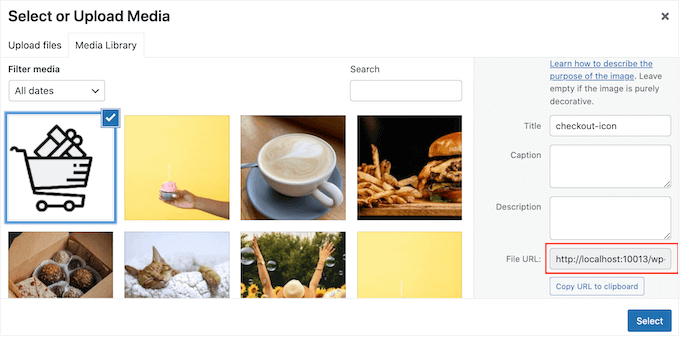
To do this, you can use the following code snippet. We recommend adding it to your site using the free WPCode plugin to avoid any risk of editing your theme files.
// add custom feed content
function wpb_add_feed_content($content) {

  // Check if a feed is requested
  if(is_feed()) {

    // Encoding post link for sharing
    $permalink_encoded = urlencode(get_permalink());

    // Getting post title for the tweet
    $post_title = get_the_title();

    // Content you want to display below each post
    // This is where we will add our icons
    $content .= '<p> <a href="http://www.facebook.com/sharer/sharer.php?u=' . $permalink_encoded . '" title="Share on Facebook"><img src="Facebook icon file url goes here" title="Share on Facebook" alt="Share on Facebook" width="64px" height="64px" /></a>   <a href="http://www.twitter.com/share?&text='. $post_title . '&url=' . $permalink_encoded . '" title="Share on Twitter"><img src="Twitter icon file url goes here" title="Share on Twitter" alt="Share on Twitter" width="64px" height="64px" /></a> </p>';
  }

  return $content;
}

add_filter('the_excerpt_rss', 'wpb_add_feed_content');
add_filter('the_content_feed', 'wpb_add_feed_content');
This code adds social sharing buttons for Twitter and Facebook. Be sure to replace both placeholder URLs in the code—"Facebook icon file url goes here" and "Twitter icon file url goes here"—with the actual image URLs you saved earlier.
If you have optimized your RSS feed and are seeing errors, then see our guide on how to fix RSS feed errors.
Frequently Asked Questions About WordPress RSS Feeds
Here are some of the most common questions we get asked about managing and optimizing RSS feeds in WordPress.
1. What is the main purpose of an RSS feed?
The main purpose of an RSS (Really Simple Syndication) feed is to provide an easy way for people and other websites to get updates from your site. Users can subscribe in a feed reader, and other platforms can use it to syndicate your latest content automatically.
2. How can I find my WordPress RSS feed URL?
You can typically find your main WordPress RSS feed by simply adding /feed/ to the end of your website’s domain name. For example, it would look like this: www.yourwebsite.com/feed/.
3. Why isn’t my RSS feed updating with new posts?
An RSS feed might not update due to a caching plugin that is serving an old version of the feed. It can also be caused by formatting errors in your XML file, which you can check with a feed validator tool.
4. Is it better to show a full post or a summary in the feed?
We strongly recommend showing a summary or excerpt in your RSS feed. This encourages users to click through to your website to read the full article, which helps increase page views, ad revenue, and conversions.
Additional Resources & Further Reading
We hope this article helped you learn how to optimize your WordPress RSS feed. If you want to dive even deeper into using RSS feeds on your WordPress site, we recommend checking out these helpful guides:
- Best WordPress RSS Feed Plugins Compared – A look at the top plugins to help you manage and extend the functionality of your RSS feeds.
- How to Fix WordPress RSS Feed Errors – Having trouble with your feed? This guide walks you through the most common RSS errors and how to solve them.
- How to Exclude Specific Categories from WordPress RSS Feed – Learn how to control which content appears in your feed, which is useful for sites with many different topics.
- How to Completely Customize Your WordPress RSS Feeds – A more advanced tutorial on manipulating your feed’s content with custom functions.
If you liked this article, then please subscribe to our YouTube Channel for WordPress video tutorials. You can also find us on Twitter and Facebook.




Jiří Vaněk
Your point number 3 was extremely helpful to me. I discovered that my website’s content was being stolen via RSS, and I couldn’t find a solution to prevent it. Your guide has finally helped me combat this issue, at least partially. It’s frustrating to spend hours on something only to have it stolen by someone else. So, thank you — this has been a significant help.
kzain
This is a great guide for anyone who wants to get more mileage out of their RSS feed!
Optimizing the feed with these tips definitely seems like a quick and effective way to keep readers engaged. Especially liked the tip about adding featured images. Thanks
Karim Twin
It’s very useful article to deal with rss feed. Thanks for your great efforts . Keep it up .
Hardik Sapkal
Bro thank you so much, you solved my problem.
WPBeginner Support
Glad our recommendations were helpful
Admin
Cezar
Hi,
4. Add Featured Image with WordPress Posts in RSS Feed is not working how is supose to work. Its showing full article instead of Summary (how i setup on Settings>Reading) and also showing 2 images check my website feed
danilo alba
Feedly conflicts with the sliders in the site, so if we have to choose between having a slider or having feedly