


There’s nothing quite as frustrating as clicking on a post you know exists—only to land on a 404 error page. We’ve run into this issue more than once, and it can feel confusing when nothing seems obviously broken.
The good news? In most cases, you can fix it in under a minute. Just go to Settings » Permalinks and click ‘Save Changes’—that simple step resolves the issue for the majority of WordPress sites.
If that doesn’t work, don’t worry. We’ve put together a step-by-step guide covering every common cause… from plugin conflicts to .htaccess issues so you can get your posts back online fast.
Why Are My WordPress Posts Returning a 404 Error?
A 404 error means the server couldn’t find the page you requested—even though it may exist in your WordPress dashboard. This disconnect usually happens because something has broken the link between your post’s URL and its actual content.
Here are the most common reasons your posts might show a 404 “Page Not Found” error:
- Plugin or theme conflicts: Some plugins or themes can interfere with how WordPress handles permalinks. This can lead to broken links and 404 errors on posts that were working fine before.
- Custom code issues: If you’ve added custom code to your site, even a small error can affect permalinks or cause conflicts that result in 404 errors.
- Problems with your .htaccess file: The .htaccess file controls how WordPress structures URLs. If this file is corrupted, missing, or misconfigured, your posts and pages may return 404 errors.
How to Find All WordPress Posts With 404 Errors
Before jumping into fixes, it helps to know if this error affects just one post or many. Understanding the scope makes it easier to choose the right solution.
We recommend using Google Search Console. If you haven’t set it up yet, see our guide on how to add your WordPress site to Google Search Console.
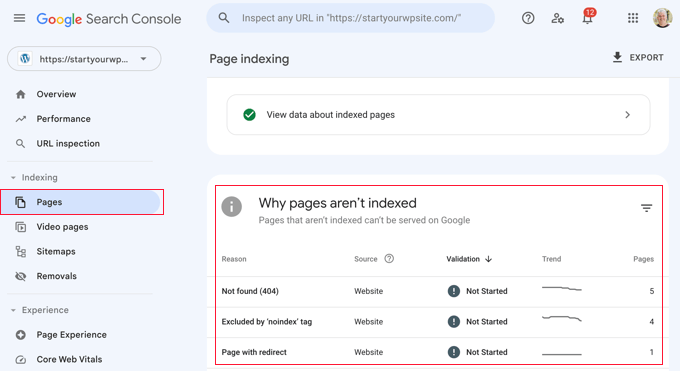
Once the Google bot has crawled your site, Search Console will show you detailed reports—including any 404 errors it finds.
To see which posts are returning errors, log in to your Search Console dashboard. Navigate to the ‘Pages’ report, and you’ll find a list of all flagged URLs.
For more help, check out our tips for using Google Search Console to grow website traffic, which includes advice on fixing 404 errors.
Now, let’s look at how to fix WordPress posts returning 404 errors. You can use the links below to jump to a specific method:
- Method 1: Check for Plugin or Theme Conflicts and Custom Code Issues
- Method 2: Fix Your Permalink Settings
- Method 3: Update the WordPress .htaccess File
- Method 4: Contact Your Hosting Provider
- Method 5: Enable mod-rewrite (Local WordPress Installation)
- Frequently Asked Questions About WordPress 404 Errors
- 🎁 Bonus: Additional Guide on Handing 404 Errors
Method 1: Check for Plugin or Theme Conflicts and Custom Code Issues
Plugins, themes, or custom code can sometimes interfere with permalinks and cause 404 errors. We’ve run into this ourselves when testing tools on our demo sites.
When we troubleshoot, we use a staging environment to safely deactivate plugins one by one. This helps us isolate the problem without affecting the live site.
To try this yourself, start by temporarily deactivating all your plugins. Then reactivate them one at a time, checking after each one to see if the 404 error returns.
If the error appears after activating a specific plugin, that’s likely the cause. You can search for solutions related to that plugin or contact the developer for support.
Your WordPress theme could also be the issue.
To check, temporarily switch to a default WordPress theme like Twenty Twenty-Three or Twenty Twenty-Four. Go to Appearance » Themes and click ‘Activate’ on a default theme.
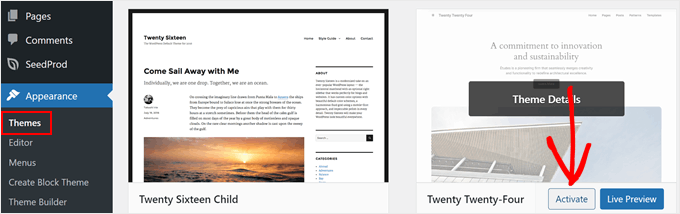
If the 404 error goes away with a default theme, your original theme is probably causing the conflict. You can troubleshoot it further or consider switching to a different theme.
For recommendations, check out our expert pick of the most popular WordPress themes.
If you’ve recently added code snippets to your website, review them carefully. Even small mistakes can cause 404 errors.
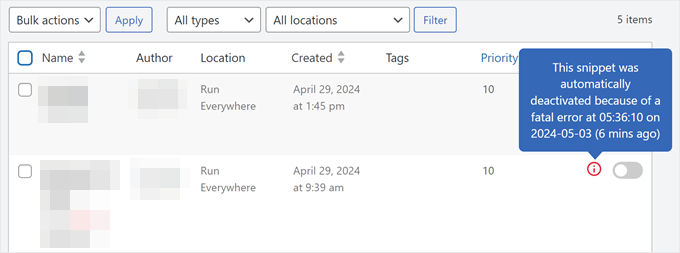
We recommend using the WPCode plugin for adding custom code. It lets you insert snippets without editing theme files directly, which reduces the risk of breaking your site.
WPCode also detects errors automatically. If something goes wrong, it deactivates the snippet and alerts you. You can even use testing mode to check your code before pushing it live.
If none of these steps fix the issue, move on to the next method where we’ll troubleshoot your permalink settings.
Method 2: Fix Your Permalink Settings
WordPress posts often return 404 errors because of problems with rewrite rules in your .htaccess file. In most cases, you can fix this by simply resaving your permalink settings.
Go to Settings » Permalinks in your WordPress admin and click the ‘Save Changes’ button.
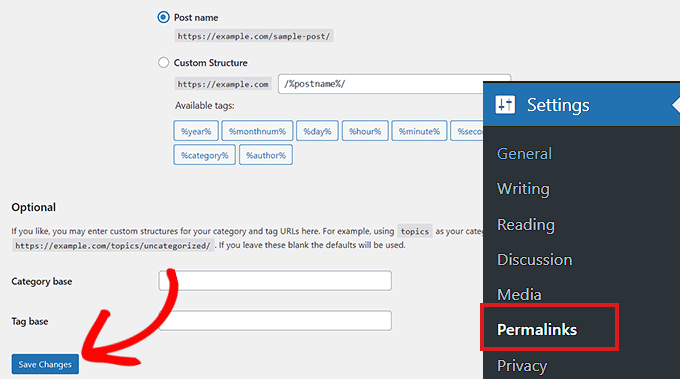
You don’t need to change anything. Just clicking ‘Save Changes’ flushes the rewrite rules (meaning WordPress regenerates the URL routing instructions that tell your server where each post lives).
This simple step fixes the 404 error for most WordPress sites. If it doesn’t work for you, you may need to update your .htaccess file manually.
Method 3: Update the WordPress .htaccess File
Before making any changes, we recommend backing up your WordPress site and your .htaccess file. If something goes wrong, you can easily restore the original.
You’ll need to connect to your server using an FTP client like FileZilla, or use the File Manager in your hosting control panel.
Next, find the .htaccess file (a hidden configuration file that controls how your server handles URLs) in your site’s root folder. This is the same directory that contains folders like /wp-content/ and /wp-includes/.
Right-click on the file and select ‘File permissions’ or ‘Change permissions’ from your FTP client.
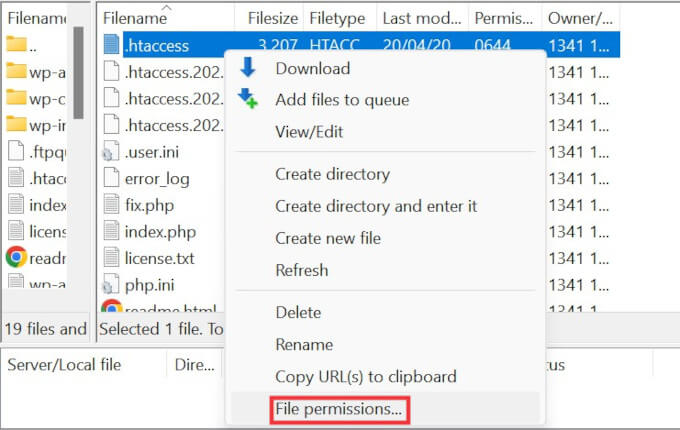
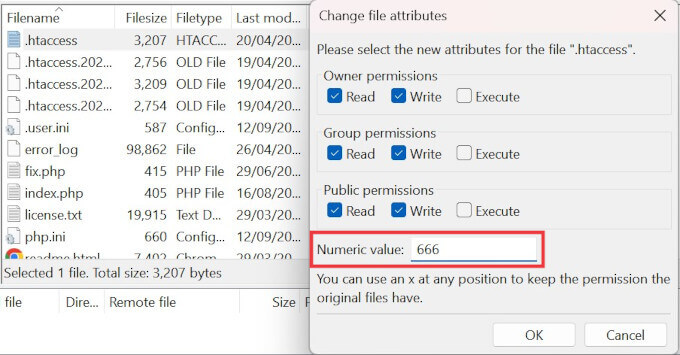
If WordPress couldn’t write to the file before, try changing the permissions temporarily to 666 to make it writable.
Important: Permission 666 means anyone can read and write to the file, which is a security risk. Only use this setting temporarily and change it back immediately after you’re done.
Now, return to your WordPress admin and resave your permalink settings (Settings » Permalinks » Save Changes). This lets WordPress regenerate a proper .htaccess file.
Once that’s done, go back to your FTP client and change the file permissions to 644. This setting allows WordPress to read the file while protecting it from unauthorized changes.
Alternatively, you can edit the .htaccess file manually.
Right-click on the .htaccess file and select the View/Edit option.
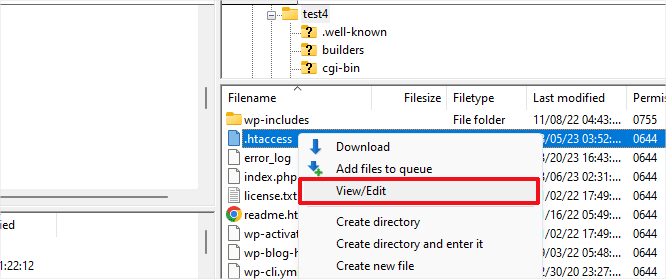
The file will open in a plain text editor like Notepad or TextEdit.
Add the following default WordPress rewrite rules:
# BEGIN WordPress
<IfModule mod_rewrite.c>
RewriteEngine On
RewriteBase /
RewriteRule ^index\.php$ - [L]
RewriteCond %{REQUEST_FILENAME} !-f
RewriteCond %{REQUEST_FILENAME} !-d
RewriteRule . /index.php [L]
</IfModule>
# END WordPress
Save the file and upload it back to your server. Then check if your posts are loading correctly.
Method 4: Contact Your Hosting Provider
If none of the solutions above have fixed the 404 error, we recommend contacting your WordPress hosting provider.
There may be a server-side issue on their end, or they can help you troubleshoot the problem further. In our experience, good hosting support teams can often spot configuration issues that are easy to miss.
For tips on getting help, see our guide on how to properly ask for WordPress support and get it.
Method 5: Enable mod-rewrite (Local WordPress Installation)
If you’re running WordPress on a local server for testing, you’ll need to enable mod_rewrite in your Apache configuration. This applies to MAMP, WAMP, or XAMPP setups.
Enabling mod_rewrite allows WordPress to generate clean URLs and prevents 404 errors on your local posts and pages.
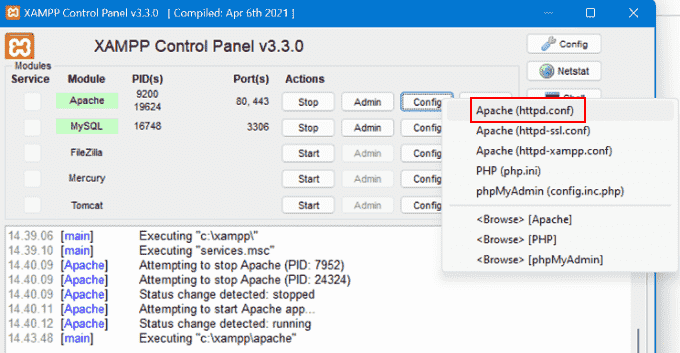
The steps vary by platform. If you’re using XAMPP, open the control panel and click the ‘Config’ button in the Actions column. Then select ‘Apache (httpd.conf)’.
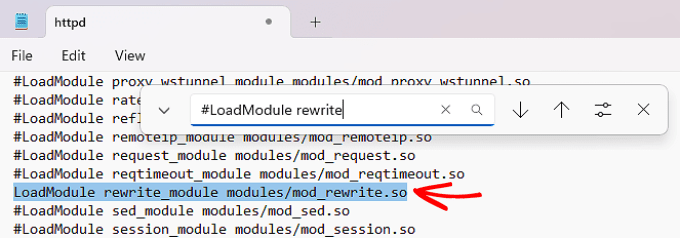
Find this line: #LoadModule rewrite_module modules/mod_rewrite.so
Remove the ‘#’ at the beginning to uncomment it. This enables the mod_rewrite module.
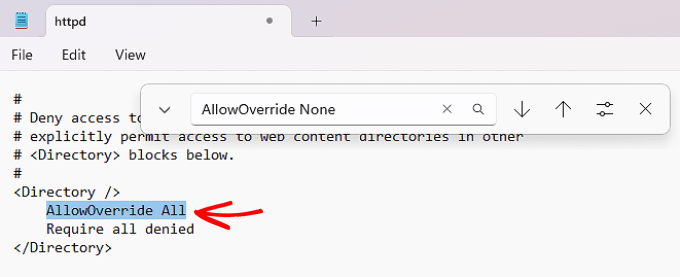
Next, look for lines that say AllowOverride None and change them to AllowOverride All. This tells Apache to allow .htaccess files to control URL routing.
You’ll typically find these inside <Directory> blocks, especially the one pointing to your site’s folder (like htdocs in XAMPP). For local testing, it’s usually safe to apply this change wherever you see it.
Save the httpd.conf file and close it. In the XAMPP control panel, click ‘Stop’ on the Apache module, then click ‘Start’ again to restart it.
Now go back to your WordPress admin dashboard and check if your permalinks are working.
Video Tutorial
If you prefer visual instructions, watch the video below.
Frequently Asked Questions About WordPress 404 Errors
Running into 404 errors on your WordPress site can be confusing. Here are answers to common questions that can help you troubleshoot more effectively.
Why am I getting a 404 error on my WordPress posts?
A 404 error on WordPress posts usually means the server can’t find the page at the requested URL. This can happen due to broken permalinks, a corrupted .htaccess file, deleted posts, or a plugin/theme conflict that changes how URLs are handled.
How do I fix a 404 error in WordPress?
The fastest way to fix a WordPress 404 error is to resave your permalink settings. Go to Settings » Permalinks and click ‘Save Changes’. If that doesn’t work, check your .htaccess file, disable plugins, or switch to a default theme to rule out conflicts.
How can I find all 404 errors on my WordPress site?
Google Search Console is the best way to find 404 errors on your WordPress site. It shows you a list of all 404 errors that Googlebot encounters. You can also use plugins like Broken Link Checker to spot broken links and missing pages.
What does the .htaccess file do in WordPress?
The .htaccess file in WordPress is a configuration file that controls how URLs are processed. WordPress uses it to manage permalink structure and route URLs to the correct content. If this file is missing or corrupted, your URLs may stop working correctly.
How do I safely edit the .htaccess file?
You can safely edit the .htaccess file using an FTP client or your hosting file manager. Always create a backup first. After editing, make sure the permissions are set to 644 so it stays readable and secure.
Why do my WordPress category or tag pages show 404 errors?
WordPress category or tag pages may show 404 errors if your theme doesn’t support archive templates or if permalink settings are misconfigured. Resaving permalinks and checking your theme’s archive support can usually fix this issue.
How do I fix 404 errors for custom post types?
To fix 404 errors for custom post types, go to Settings » Permalinks and click ‘Save Changes’ to refresh rewrite rules. Also check that your custom post type is registered with the correct rewrite settings and has archive support if needed.
Can I redirect 404 pages to my homepage or another page?
Yes, you can redirect WordPress 404 pages using plugins like Redirection. This lets you create 301 redirects from old or broken URLs to new ones. You can also create a custom 404 page to guide users back to useful content.
🎁 Bonus: Additional Guide on Handing 404 Errors
Here are more resources we’ve put together to help you manage 404 errors and other common WordPress issues:
- How to Improve Your 404 Page Template in WordPress (2 Ways)
- Best WordPress 404 Error Page Design Examples
- Best Free 404 Redirect Plugins for WordPress
- How to Get Email Alerts for 404 Errors in WordPress
We hope this article helped you fix WordPress posts returning 404 errors. You may also want to see our guide to the most common WordPress errors and how to fix them, along with our expert picks for the best WordPress plugins to grow your site.
If you liked this article, then please subscribe to our YouTube Channel for WordPress video tutorials. You can also find us on Twitter and Facebook.




Abs
It helps.. just on permalink, already fix my error..
Thanks for this article..
Julius
Mine is a little different. All the pages are working fine but I get “page not found” when working in some places in the dashboard. Let’s say for example I’m creating a new page from the dashboard. When I click on publish I get a 404 error.
And I’ve tried everything above but it’s not working.
Iron65
Thanks for the tip!! the permalink really saved me!!! In case if any other suffered this by updating Yoast SEO or by just deleting cache, try that one, it will fix it
Monica
I have been trying to fix this permalink issue in my site for months and now I did it with your instructions. I don’t know why I did everything you said already and after writing the 644 permissions to fix the httaccess file, it went back to non-writeable. Now I did it and fixed the permissions and wrote your code and it worked. i really don’t know which was the difference but this time it did. Maybe that I already fixed the httaccess in the original folder where I have a subfolder with my blog. That is the only thing I did differently. Thanks a lot
Rais Dar
I am getting a 404(page not found) on my site. What should i do as i tried your methods but still error persists
Chetan
I had faced the same kind of problem. I used to get 404 Page Not Found error for a page. But the reason was that I and used a permalink slug that was associated with some default page in WordPress. e.g. http://example.com/posts – This is WRONG. Because I cannot use ‘posts’ as permalink slug. It is already reserved for some WordPress page. When I changed it to ‘my-posts’, so that now my permalink read: http://example.com/my-posts, the error was gone!
md
hi ,
i had same htaccess .,however , i delete it and import new one but still same .
dumb
hay guys ….
when i change the permalink to anything other than default, my pages wont work i get this error message
“The requested URL /wordpress/home/ was not found on this server.
Apache/2.4.9 (Win64) PHP/5.5.12 Server at localhost Port 80”
pl help me out
Ian Scofield
I just had this with one of my websites. All of my posts worked fine except for one though. Something was bad about the URL. I had to change the post URL.
neelesh
thanks a lot… ur website has helped me a lot of times and u guys are doing great job. i cant resist myself from thanking you…..
Hardik
Hi Wpbeginner,
Actually I just have migrated from hostinger to one of paid hosting. After migration all things are going good. But when I have tried to edit one my post it regularly shows the following error.
“Page not found error” ‘Apologies, but the page you requested could not be found. Perhaps searching will help.
When I have landed here I have tried all the solutions which you have share.
But nothing is working for me.
Please Help.
Thanks in advance
Hardik
Adrienne
Question? I have an url site, but the data is all new. so there are about 100 old posts that are not longer valid but linked to other sites.. How do I change it to forward to main website, so that Google Search Console can update they crawl records.
I’m looking, but I don’t see anything for posts that have been deleted and getting a 404 error.
Thanks,
David
Thanks was having exactly that issue and this fixed it perfectly!
Mark
Thank you! So nice to find such an easy fix for such a frustrating mysterious problem.
Xavier
Woohoo! Thanks for this. I thought my site content had gone to the birds. Doing the permalink “Save Changes” worked instantly for me.
Pablo
What if it doesn’t work no matter what you do?
HELP!
Fida
Hi Pablo Which server do you use? Shared server or VPS?
Steve Jackson
Thank you for this tip, it was a lifesaver and worked perfectly!
John
Thank you !!!!
abhishek
thank you very much it saved my links pretty well
Hugo Nascimento
Hello guys,
I have the same issue with a client blog. i’m trying to build a custom form inside post page and when I enable the custom permalinks, the form cannot be accessed.
When I change permalinks to default, it works out! :/
Really strange. :/
Sarah
Changing permalinks to default solved my problem too! Thank you!
mojamalenkost
Thank you so much!!!
victor
I have this problem .I can’t login to my WordPress dashboard, each time I try to it keeps giving me Error 404 not found. please help me fix this.
Dont Ask Real Name
Your tip was a life saver. All our posts were just not visible. Your tip helped a lot.
What i did:
Updated .htaccess set CHMOD to 666 instead of 660
Clicked – > Settings -> Permalinks
Clicked on Defaults and clicked Save Changes
Again,
Clicked on Post name and clicked on Save Changes. (since i used custom url that’s why)
You just saved me a ton of headache…
Clive Wales
That was a real life-saver – thought I’d totally screwed up a replacement site I’ve been working on, after trying to be clever with an .htaccess redirection. Thank you!
Marko Liuksiala
Great, that worked – thank you!!
Bill
I like the permalink structure of my posts and they seem to work. I have been using the same structure for several years.
However when I go to Settings–>Permalinks the actual structure is not even listed as one of the options available anymore.
Is this a problem?
Emily
Hi I am having this problem and to be honest, I feel sick because I don’t know what to do. I am a novice really and scared I am going to kill my website more than I already have.
Can someone please tell me what my custom permalink should look like and what I SHOULD hav in my .htaacess file? Right now it seems blank?
WPBeginner Support
Go to Settings » Permalinks choose a permalink structure that you like and then save your changes. Open your .htaccess file and you will notice that WordPress has automatically updated it. If it is blank and your chosen permalink structure is not working, then you can manually add this code into your .htaccess file:
# BEGIN WordPress
RewriteEngine On
RewriteBase /
RewriteRule ^index\.php$ – [L]
RewriteCond %{REQUEST_FILENAME} !-f
RewriteCond %{REQUEST_FILENAME} !-d
RewriteRule . /index.php [L]
# END WordPress
Admin
Viktor
Yes, that was the solution! Thanks a lot. My hosting service changed these settings as I changed the URL to custom error pages but just clicking on the permalink settings fixed that.
Matthew Shelton
“Go to Settings » Permalinks, and simply click on Save Changes button” – fantastic, that worked right away – thanks a lot!!
WPBeginner Staff
Check the .htaccess file.
Gretchen Louise
What about for a single post permalink that got changed and somehow created an internal redirect, and now it cannot be changed back without creating a 404 error? Trying to troubleshoot an issue for a client and wondering where those internal redirects are stored and where in the world to clear them. Thank you.
Thembi Ngema
Dudessss. You guys are legends :)…. Must say I have learnt a lot from you in the past week
bhupendra
hi
thanks I just updated parmalinks structure and site started working
Arpee Lazaro
i just updated t he permalink structures are pictured in this solution and it worked like a charm. thanks!
WPBeginner Staff
Please contact your web host.
Attiq Haroon
I tried the solutions you mentioned in you post bhut it didn’t seems to be working. What happened actually is that I wanted to add a rule to .htaccess file so I downloaded that files from FTP and edited it and uploaded that file again replacing the original one, and then the problem popped up. I have tried a couple of fixes such as deleting and putting new .htacces with default code, removing .htacces file, etc. The only fix that is making the posts accessible is to set the permalink to default option. This makes the posts to work but it can not be a permanent Fix as it is not recommended as an SEO prespective
Please try to find a working solution on that problem
WPBeginner Staff
backup your .htaccess file. Then delete the one from your server. Now log into WordPress admin area and go to Settings -> Permalinks choose your desired permalink structure and hit save changes.
After that connect to FTP and see if WordPress has created a new .htaccess file and it is not blank.
Attiq Haroon
I tried that solution, It created a .htaccess file which looks fine but doesn’t work.
gui
If you have Yoast WordPress SEO or any SEO plugin installed, check your SEO permalink section…
Tim Topham
Hey guys – I recently received an email from Google crawl as I suddenly had a heap 500+ of lost links. It seems that at some stage I must have changed the permalink structure so that lots of the links on old posts have the post date and then post name where as they now just have the post name.
Before I go mad trying to fix 500 links in my articles manually, is there an easy way to update the hyperlinks in articles when this sort of thing happens?
Cheers,
Tim.
Manuel Moreira
I was going insane with this 404 thing after a server move. Thanks for the help guys.
Cindy
thank you! My sites were hacked and all internal pages showed a 404 error. saving the permalink settings fixed it! cheers!
Joe Cutroni
Hi all, I’ve scoured the web to find help to resolve my issue, but
for the life of me cannot get anything to work. Starting just a couple
of weeks ago, all of my back end pages (home page was fine) started
turning out 404 errors on them.
The permalink that I have always used is “Custom structure” (/%category%/%postname%/)…here are some things that I’ve tried:
1 . Gone into my permalinks, clicked “save settings”, and that method provides a temporary fix, maybe for an hour or two, then the 404 errors return on all secondary pages. I’ve also set my permalinks to a different option, such as “Default”, but still get 404 errors shortly after.
2. Completely deleted my htaccess.php file, then went back and saved permalink settings…less than an hour later, 404 errors returned.
3. Commented out this line of code in my function.php file, also completely removed it altogether:
“$wp_rewrite->flush_rules();”. That didn’t do anything. I’ve tried
using both “//” and “#” before it and tested…still get 404 errors.
4. De-activated all of my plugins to see it one of them was the culprit,
but after a short time, my 404 errors resumed while none of the plugins were active.
Like I said, this issue just start a few weeks ago. I use Securi
Security and had them scan my site for any malware, etc…and the site
is clean.
Can someone PLEASE help me with this? Would bigtime appreciate it!
Kyle
Hey Joe,
Did you ever find a workable solution for this? I’ve gone through the same issues that you listed.
David
Hey Guys!
Did you find a solution to the returning 404-error as listed above by JOE CUTRONI?
I’m dealing with the same issue?
Some Feedback would be awesome!
Thank you!
Greetings from Germany,
David
Paul
Hey guys,
you are likely to have a virus on your site.
good luck
Paul
Katie
This is the problem I am having. I moved from Wordpress.com to .org and I am at my wits end. I understand the directions that say got admin—> settings —> permalinks. In fact, I remember when I was setting this up that I messed with that particular setting. Here’s my issues: WHERE do I find this admin–> settings–> permalinks?? Is it on my host, in the cpanel? Is it back on WP.com, or if it’s WP.org? And if it’s on WP.org I don’t have a clue how to get to all the admin features of my blog now. When I log in, it shows me my personal profile and allows me to edit it. But not any blog administration. I am at a loss and really losing my head.
Gabriel
If I’m understanding you correctly, just type in the domain name that you activated the wp.org tool and follow it up with “/wp-admin” (for instance “www.example.com/wp-admin”)log in and on the lower left hand side you would find the settings option.
mali suresh
how can change localhost paramalink step by step help me
Srihari K
I had the same problem.. adding the below line in httpd.conf and restarting apache fixed it.
Options +FollowSymLinks
Kym Penrose Clayton
Thank you thank you thank you
Iris Fritschi-Cussens
THANK YOU from the bottom of my heart! I had to delete my .htaccess file due to a hack and then just when I thought everything was fine again nothing worked apart from the home page. Pressing Save Changes on the permalinks solved it in one.
disqus_Hct2NXneXJ
Thanks Man. The Permalink Solution Fixed my Problem. Thanks & Cheers for You!
MEMEME
Thanks! You are God.
L
thanks! I was close to panic…
Thai
Thanks for the post! But sadly I tried these with on the local and nothing worked.. Any other tips?
SemLavana
Thank you. Saved my weekend!