


Picking the wrong website builder can lock you into a platform you’ll outgrow in a year, and make moving your site painful when you do. That’s why a lot of people ask whether they should use WordPress or Weebly.
At WPBeginner, we use WordPress for our blog and online stores because it offers the features and customization we need to build our websites the way we want.
Weebly is easier to start with, but it gets restrictive as your site grows. We’ve helped plenty of users migrate from Weebly to WordPress once they hit those limits.
In this comparison, we’ll share our real-world experience with both platforms to help you choose the right website builder for you.
We’ll break down exactly how WordPress and Weebly stack up in terms of ease of use, flexibility, cost, and more. This way, you can make the right decision for your website.
👨🏽💻 Note: This article compares Weebly with self-hosted WordPress.org sites, not WordPress.com blogs. See our guide on the difference between WordPress.com vs. WordPress.org for more information.
Here’s the short version: WordPress is the better choice for almost everyone in 2026 because it’s more flexible, cheaper long-term, and still actively developed. Weebly only makes sense if you already use Square for payments and want the simplest possible drag-and-drop builder.
In a rush? Here’s a quick overview of our comparison between Weebly and WordPress:
| Weebly | WordPress | |
| Hosting | Hosted platform | Self-hosted |
| Ease of Use | Beginner-friendly | Slight learning curve |
| Features & Plugins | Limited apps supported | Supports 63,000+ plugins |
| Design & Layout | Drag & drop builder | Full Site Editor + Theme Customizer |
| eCommerce Support | Limited support | Extensive support |
| Data Portability | Very difficult | Very easy and smooth |
| Pricing | Free + Paid | Free |
Weebly vs. WordPress: Hosting and Platform Type
Choosing the right website builder is a big decision, and one of the first things to consider is whether you prefer a self-hosted or a fully hosted platform. Let’s break down what that means for both Weebly and WordPress.
Weebly – Hosted Platform
Weebly is a completely hosted service. This means that your website lives on the Weebly servers, and you have to follow their terms of service.
The problem is that you don’t truly own all your content. If Weebly decides to change their policies and your content violates their terms of service, then you could lose all your data.
Weebly’s admin dashboard, by contrast, is designed to be user-friendly, providing all the tools you need to build, edit, and manage your Weebly website.
However, a significant drawback of a hosted platform like Weebly is that if you ever decide to move your website to a different platform, the migration process can be extremely difficult.
WordPress – Self-Hosted Platform
In contrast, WordPress is free, open-source software that you install on your own web hosting account.
This means that you own 100% of all your content, and you don’t have to worry about relying on a third-party service to host your website. What’s more, WordPress makes it relatively straightforward to switch to different platforms or hosting providers, should you ever decide to do so.
The good news is that there are lots of WordPress hosting services to choose from. Many of these providers even come with WordPress pre-installed or offer a simple one-click installation process. Opting for a self-hosted platform like WordPress gives you greater flexibility and freedom in managing every aspect of your website.
You can see our guide on how to start a WordPress blog (step by step) for more information.
Winner: WordPress
Weebly vs. WordPress: Ease of Use
A user-friendly platform matters, especially if you’re not planning to hire a developer every time you want to update your site.
If the platform has a steep learning curve, you’ll end up spending valuable time trying to figure out how it works instead of focusing on growing your business.
So, let’s take a close look at how WordPress and Weebly compare when it comes to ease of use.
Weebly – Ease of Use
Weebly offers a simple and neat interface for users. You get to choose different options from the dashboard, whether you are building a website or viewing reports.
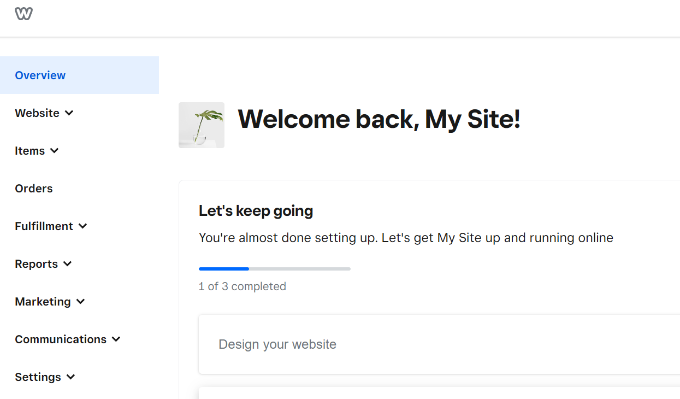
A key feature of Weebly is its intuitive drag-and-drop interface. This lets you visually build your website without needing any coding knowledge. Setting up a website is quick and straightforward, and Weebly manages all the hosting and security for you.
If you need some extra help, then Weebly has a detailed knowledge base filled with helpful support articles. These can be very helpful for beginners who might need a solution if they get stuck during the setup process.
WordPress – Ease of Use
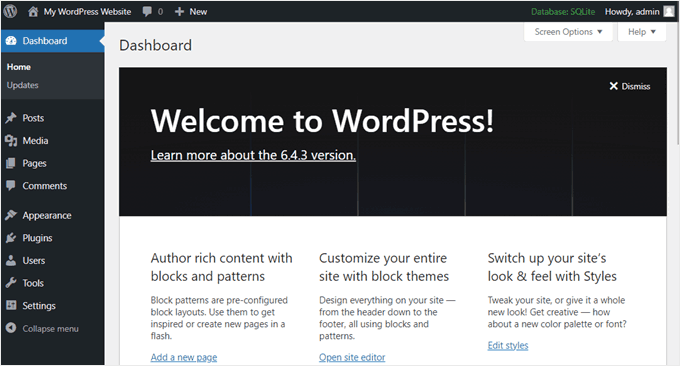
WordPress also offers a user-friendly dashboard and visual editor for creating content. You can easily manage your website from the admin panel.
For instance, it lets you access your blog posts and pages, view comments, manage plugins, and choose a theme from the dashboard.
The sheer number of themes and WordPress plugins means you have almost limitless customization possibilities, especially when you compare it to Weebly’s more restricted set of options.
One area where Weebly has a slight advantage over WordPress is that it comes with a prebuilt drag-and-drop visual builder. While the WordPress block editor is intuitive when it comes to creating content, you’ll typically need to install a separate page builder plugin to get true drag-and-drop flexibility.
However, WordPress benefits from a massive and active community and a robust support system. You’ll find an endless supply of tutorials, articles, and videos dedicated to WordPress, making it easy to find solutions to any issues you might encounter.
Winner – Weebly
Weebly vs. WordPress: Features and Plugins
At some point, you’ll need to add extra functionality to your website to accomplish a specific task. In this section, we’ll compare how WordPress and Weebly handle features and the availability of add-ons (plugins for WordPress, apps for Weebly).
Weebly – Features and Plugins
Weebly comes with a good selection of built-in tools. You can use them to create various kinds of websites, including an online store, blog, portfolio, business site, or event page.
However, if you require a feature that isn’t already part of their platform, you’re quite limited. Unlike WordPress, you can’t just hire a developer to build a bespoke solution to extend what Weebly can do.
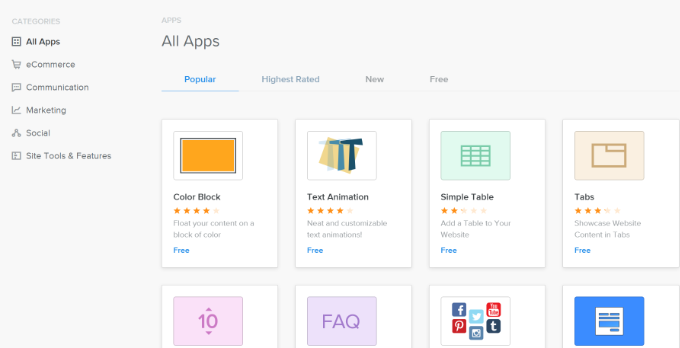
Weebly does offer different free and paid applications, but the selection is limited and not as extensive as WordPress.
WordPress – Features and Plugins
WordPress, on the other hand, has a plugin for almost anything you’d want to add — contact forms, memberships, online courses, bookings, you name it.
For instance, you can easily add features for online stores, contact forms, galleries, portfolios, SEO, and more. While many of these features aren’t built into the core WordPress software, you can easily add them using plugins.
There are over 63,000 free plugins available in the official WordPress plugin directory alone. Not to mention, there are countless other premium plugins available from third-party websites.
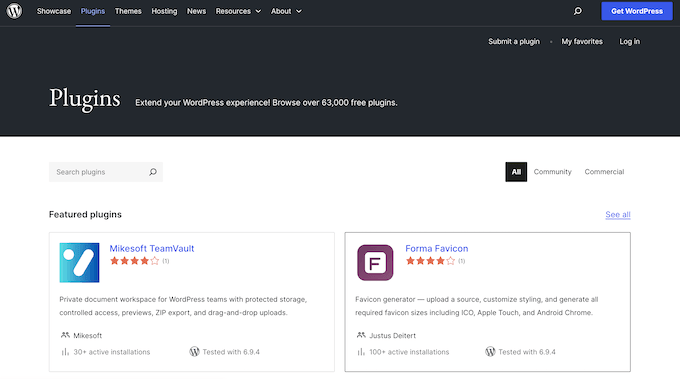
If you can think of a feature, there’s a very good chance that a WordPress plugin already exists to provide it. For example, if you need to create a contact form without writing code, then you can use WPForms.
Also, if you’re looking to optimize your site for search engines, create sitemaps, and fix broken links, then plugins like All in One SEO (AIOSEO) are extremely useful.
Winner: WordPress
WordPress vs. Weebly: Design and Layout Choices
Next up, let’s consider the design and layout options each platform offers. You’ll want a platform that’s easy to use and provides plenty of visual design choices to make your site stand out.
So, let’s see how Weebly and WordPress compare when it comes to design flexibility and customization.
Weebly – Design and Layouts
Design is where Weebly is strongest, and its best feature is its intuitive drag-and-drop page builder.
You can choose from different elements in the left menu. From here, simply drag and drop the elements on your template.
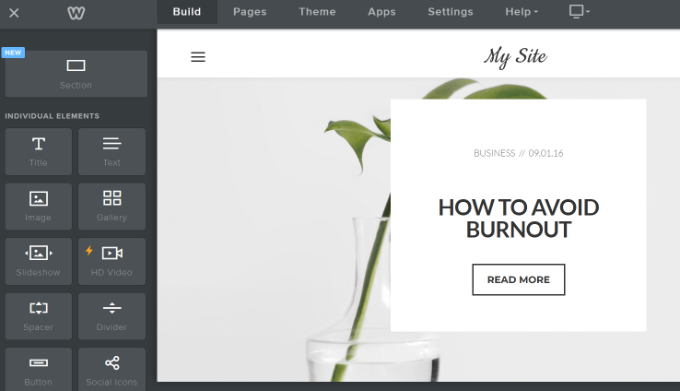
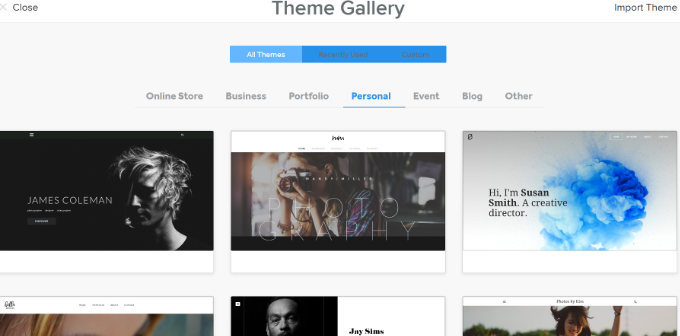
Weebly also offers a good selection of themes that you can further customize using these same drag-and-drop tools.
For example, you’ll find themes specifically designed for stores, business websites, online portfolios, personal websites, events, and much more.
WordPress – Design and Layouts
WordPress also has a huge library of design options, with over 14,000 themes available. You can find themes for all sorts of websites, such as an eCommerce store, business site, wedding website, personal site, and more.
WordPress does not come with a built-in drag-and-drop page builder. However, the newest themes do support the full-site editor, which uses blocks to help you customize your site. It’s similar to the WordPress content editor, where you can add different blocks to edit your site’s appearance.
You can see our list of the best block themes for full site editing in WordPress.
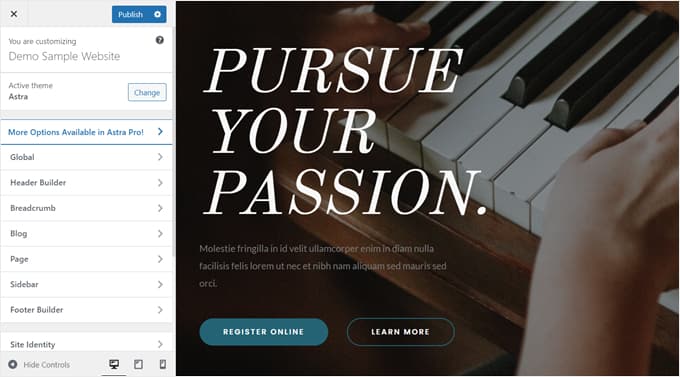
That said, there are some WordPress themes that still use the theme customizer. Depending on the theme you’re using, you can change the background colors, edit your menus, widgets, homepage settings, add custom CSS, and much more.
For more details, you can go through our detailed guide on how to use the WordPress theme customizer.
If you want full design control without paying for a premium theme, SeedProd‘s drag-and-drop builder lets you design every page visually, with no code or theme files required.
It is the best WordPress page builder and helps you create landing pages, coming soon pages, and more. It even comes with an AI website builder that allows you to create an entire website in less than 60 seconds.
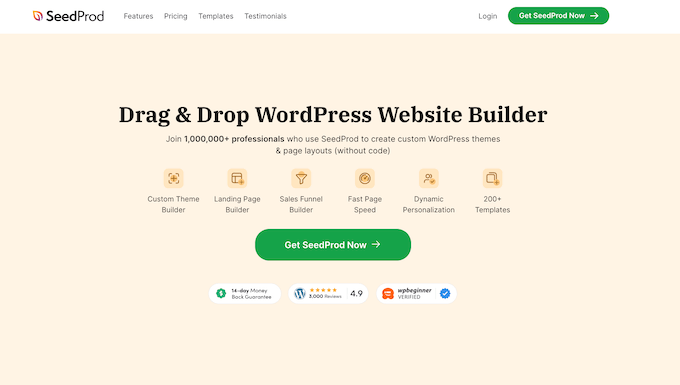
We’ve used SeedProd to design many of our partner sites and have always been happy with the results. To learn more about our experiences with this page builder plugin, check out our detailed SeedProd review.
There are also thousands of pre-made themes that offer drag-drop functionality. You can find many free options in the official WordPress.org themes directory, while others can be purchased from theme shops like aThemes, Themify, and ThemeLab.
Winner: Tie
WordPress vs. Weebly: Pricing
Cost is always an important factor when you’re deciding which website platform to go with. To help you choose between WordPress and Weebly, let’s take a look at their different pricing structure.
Weebly – Pricing
Weebly offers 3 premium pricing plans:
- Personal: $13/mo – connect to a custom domain
- Professional: $15/mo – more customization options
- Performance: $32/mo – more features for growth and performance
You get free SSL certificates in all the plans, including the free option. However, if you want a free domain, unlimited storage, password protection, and other advanced features, then you’ll need to select the Professional or Performance plans.
Weebly also offers a free version, but it has limited features. Plus, your website will have the Weebly branding.
WordPress – Pricing
In contrast, WordPress itself is a free and open-source platform. All you need is a web hosting service and a domain name to get started. However, the total cost of creating a WordPress website will vary depending on your needs.
For instance, you can get a domain and hosting for as low as $2.99 per month, along with a free domain and SSL certificate if you pick a provider like Bluehost. Plus, there are many free WordPress themes and plugins – your initial outlay could be as low as around $10 per year.
However, if you need more advanced features and choose to use premium plugins and themes, your annual costs could potentially exceed $500 per year.
The beauty of WordPress is that you have control over what you spend and can scale your investment as your website grows. You could even partner with a team of experts who can work out a budget and create a WordPress website for you.
Winner: WordPress
Weebly vs. WordPress: eCommerce and Business
Are you looking to start an online store and wondering whether WordPress or Weebly is the better platform for your eCommerce venture?
Let’s compare the eCommerce and business features that both platforms offer to help you make the right choice.
Weebly – eCommerce and Business
Weebly does allow you to set up an online store. However, its eCommerce features are quite basic, and you’ll find there isn’t a great deal of flexibility when it comes to customizing your shop.
One of the positives we noted is that Weebly offers some attractive themes specifically designed for online stores. You can then use their familiar drag-and-drop builder to tweak these themes and add various product display elements.
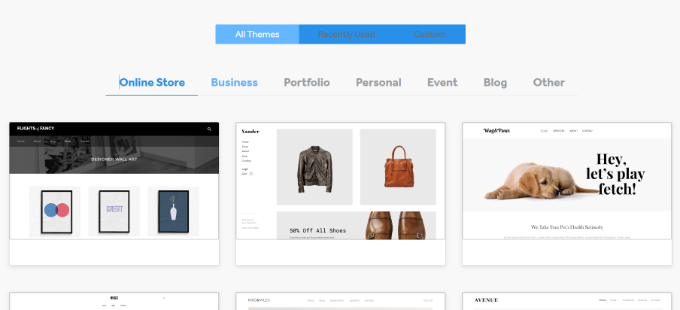
That said, a significant drawback is that Weebly charges a 3% transaction fee on every sale you make. This is in addition to the fees charged by your chosen payment processors, such as Stripe and PayPal. So, you end up paying double transaction fees, which can eat into your profits.
You can avoid this extra fee by upgrading to their Performance plan, which costs around $26 per month.
One thing to keep in mind: even if you upgrade to the Performance plan to avoid the 3% fee, your payment processing still runs primarily through Square (which acquired Weebly back in 2018).
That’s fine if you already take Square payments in person, but it limits your gateway options compared to a WordPress + WooCommerce setup, where you can pick from dozens of providers like Stripe, PayPal, Authorize.Net, Apple Pay, and regional gateways without platform restrictions.
WordPress – eCommerce and Business
WordPress, on the other hand, has several powerful and flexible eCommerce plugins that allow you to create your own fully featured online stores. Popular options include WooCommerce, Easy Digital Downloads, and several others.
WooCommerce is particularly popular and is one of the leading eCommerce platforms for WordPress. In fact, it powers nearly 33% of all online stores. The best thing about a WooCommerce store is that it’s free to use, beginner-friendly, and highly flexible.
Plus, WooCommerce integrates seamlessly with popular website and page builder plugins like SeedProd, giving you complete control over your store’s design. You can choose from a wide range of themes and tailor them to your exact requirements.
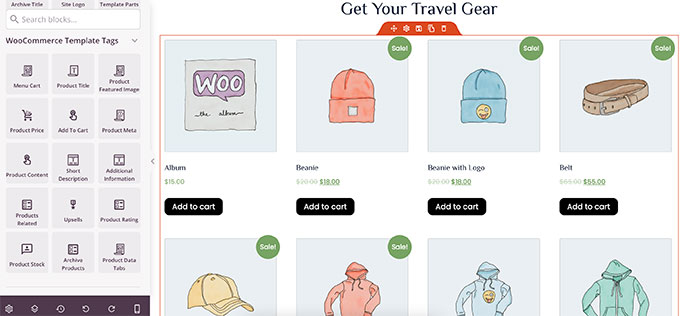
Most WordPress eCommerce platforms also come with dozens of pre-made themes. You can add coupons, customize receipts, and basically do everything you want to do in your online store.
Crucially, WordPress itself does not charge any additional transaction fees on your sales. All you’ll pay are the standard processing fees charged by your chosen payment gateway – which you would have to pay regardless of the platform you use.
To learn more, please see our guide on WooCommerce Made Simple: A Step-by-Step Tutorial [+ Resources].
Winner: WordPress
WordPress vs. Weebly: SEO Capabilities
Search engine optimization (SEO) is the process of helping your website rank higher in Google and other search engines. Without solid SEO, even the best-looking site will struggle to bring in visitors.
While both platforms cover the basics, they take very different approaches to how you optimize your content.
Weebly – SEO Capabilities
Weebly covers the basics of on-page SEO quite well. From the settings panel, you can edit page titles, meta descriptions, and image alt text without touching a single line of code.
The platform also generates a basic XML sitemap (a file that helps search engines find and index your pages) and adds an SSL certificate to every site by default, which is a major ranking factor.
However, you might find the platform a bit limited if you’re looking for advanced tools.
Weebly’s SEO toolkit hasn’t seen meaningful upgrades in years. You won’t find advanced options like rich schema markup (to get those “star ratings” in Google results), internal linking suggestions, automatic redirect management, or deep content analysis tools.
If you’re serious about ranking for highly competitive keywords, you’ll struggle to achieve that with Weebly.
WordPress – SEO Capabilities
By contrast, WordPress gives you full technical control over every aspect of your site’s SEO.
Unlike closed platforms, you can set custom permalinks, edit your robots.txt file (the file that tells search engines which pages to crawl or ignore), and fully optimize every individual page or post.
While the core software is solid, the real magic happens when you install a dedicated SEO plugin. We recommend AIOSEO because it adds the advanced features that site builders like Weebly lack.
💡 We use AIOSEO across our own sites and have shared the full story in our post on why we switched from Yoast to AIOSEO.
For a beginner-friendly walkthrough, our WordPress SEO checklist covers everything you need to set up. If you want to go deeper into the technical side, our technical WordPress SEO framework walks through every advanced setting.
Winner: WordPress
WordPress vs. Weebly: Security
Security is one of those things you don’t think about until something goes wrong. Let’s look at how WordPress and Weebly handle it.
Weebly – Security
Because Weebly is a hosted platform owned by Square, all the server-level security is managed for you. Every site gets a free SSL certificate, including the free plan, so your visitors connect over HTTPS without any setup on your end.
Weebly also doesn’t have a third-party plugin marketplace, which means you avoid the plugin and theme vulnerabilities that cause many WordPress site hacks.
However, the tradeoff is that you have no control over your own defenses. You can’t add a firewall, malware scanner, or two-factor authentication, and you’re trusting Square to patch issues quickly. That’s a fair concern.
WordPress – Security
WordPress is self-hosted, so security is shared between you and your hosting provider. Your host typically provides a free SSL certificate, and WordPress core has shipped automatic security updates since version 4.0.
Plus, you can harden your site with security plugins like Wordfence and Sucuri, which add firewall and malware scanning. You can also require two-factor authentication on logins and run scheduled backups with a plugin like Duplicator so you can roll back fast if anything goes wrong.
The risk surface is plugins and themes, which is why we recommend installing only well-reviewed options and keeping everything updated.
Winner: Tie
WordPress vs. Weebly: AI and Automation
AI tools have become a big part of how people build and run websites. So, let’s see how WordPress and Weebly compare on this front.
Weebly – AI and Automation
Weebly does not have a native AI website builder or AI content assistant. Square has been pushing users toward Square Online, which offers some AI help for product descriptions, but Weebly itself has not shipped anything comparable.
If AI is something you want to use while building or running your site, Weebly will leave you wanting more.
WordPress – AI and Automation
WordPress itself doesn’t ship with built-in AI features. However, the plugin ecosystem more than fills the gap.
You’ll find AI content and SEO plugins, AI image generators, AI-assisted page builders, and even AI site builders that can generate a full WordPress site from a single prompt.
For example, AIOSEO includes AI-powered features like content analysis and internal link suggestions to help you write and optimize posts faster. That’s just one slice of a much larger ecosystem you can mix and match.
Winner: WordPress
WordPress vs. Weebly: Data Portability
Data portability is something that many website owners don’t think about when they’re first choosing a platform. However, it’s a crucial factor that determines how easily you can export and import your website content and other important data should you ever need to switch platforms.
WordPress – Data Portability
When you host your website on an open-source platform like WordPress, you can easily export your data into many formats. You can export your WordPress site as an XML file, export your database, or download your files and content.
You can also easily migrate your WordPress site to any other platform that you like. This freedom gives you complete ownership and control over your online presence, which provides significant peace of mind.
Weebly – Data Portability
In contrast, Weebly’s data portability options are quite limited. While they do allow you to download your website as a zip file, this download typically only contains your basic HTML pages and images.
Crucially, if you had a blog on your Weebly site, those posts would generally not be included in the export. Similarly, any slideshows or other advanced features you might have implemented likely wouldn’t function correctly on the exported site.
Essentially, moving a website away from Weebly can be a very difficult and often incomplete process.
Recognizing this challenge, we decided to tackle the problem head-on and created a free Weebly to WordPress Importer. For full instructions, see our complete guide on how to move from Weebly to WordPress.
Winner: WordPress
WordPress vs. Weebly: Customer Support
Building a website always comes with questions, especially if you’re a beginner.
Choosing a platform with strong support resources can save you hours of frustration when something goes wrong. With that said, let’s see how Weebly and WordPress compare on the support front.
Weebly – Customer Support
Weebly offers a traditional support model including a written knowledge base, email, and live chat. However, the level of help you receive is strictly tied to your monthly bill. Paid users get priority response times, while free users often have to wait.
In our experience, support quality on Weebly has slipped since the Square acquisition.
Long-time users frequently report delayed replies and scripted answers that don’t always address the root of the problem. Because Weebly is largely in maintenance mode, newer technical issues or bugs may not receive the same urgent attention they would on an actively developed platform.
WordPress – Customer Support
WordPress doesn’t have a single corporate support team because it’s open-source software. Instead, you get something arguably more useful: a massive global community.
The official WordPress.org support forums are staffed by volunteers and contributors who answer thousands of questions every day. On top of that, you’ll find a huge ecosystem of free tutorials, video guides, and blogs (like WPBeginner) that cover virtually every WordPress topic.
To get the most out of these resources, see our guide on how to properly ask for WordPress support.
If you want hands-on help, your WordPress hosting provider will often handle technical issues for you. Providers like Bluehost include 24/7 chat support specifically for WordPress users. Premium plugins and themes typically come with their own dedicated support channels too.
For larger projects, you can also hire a specialist team. Our list of the best WordPress support agencies covers vetted options for ongoing maintenance and emergencies.
You can also see our guide on how to contact WordPress support for a full breakdown of every channel available.
Winner: Tie
Weebly and Square: What You Need to Know in 2026
Before making your decision, there’s an important development you should know about. Weebly was acquired by Square (now Block, Inc.) in 2018. Since then, Square has been gradually shifting its focus to its own website building product called Square Online.
As of 2026, Weebly has not received any major feature updates since 2024. Square has stated they have ‘no plans to discontinue the Weebly website builder at this time,’ but the platform is widely considered to be in maintenance mode.
What does this mean for you? If you’re choosing a platform for a new website, you should consider whether it’s wise to build on a platform that may not be actively developed in the future. With WordPress, you’re building on open-source software that has been actively developed and improved for over 22 years.
If you’re currently using Weebly and want to move to WordPress, we’ve created a complete guide on how to move from Weebly to WordPress that walks you through the entire process step by step.
You might also want to explore other alternatives. You can see our comparisons of Squarespace vs. WordPress and Wix vs. WordPress for more platform options.
WordPress vs. Weebly – Which One Should You Choose?
After taking a good look at both Weebly and WordPress, our conclusion is that Weebly looks good from the outside, and it can be suitable for small websites.
However, it falls short when it comes to creating a proper blog or running a fully functional online store. That simple drag-and-drop builder might catch your eye at first, but appearances can be deceiving.
WordPress, by contrast, gives you the freedom and flexibility to create practically any kind of website. Crucially, WordPress also gives you complete ownership of all your content.
With WordPress, you’re not stuck with one company that could change its terms or shut your site down. If you’re building something you plan to stick with, that control matters.
Plus, with Weebly now in maintenance mode under Square, WordPress is an even stronger choice. You’ll get a platform that’s actively developed, supported by a massive community, and gives you full control over your website’s future.
Pick WordPress if you want full control of your site, plan to grow (blog, store, membership, or anything beyond a basic brochure site), care about SEO, or want to keep your costs predictable over the long term.
You can get started by following our guide on how to create a WordPress website.
Pick Weebly only if you already run a Square business, you need the absolute simplest drag-and-drop builder, and you’re confident your site will stay small and static.
Frequently Asked Questions About WordPress vs. Weebly
Is WordPress better than Weebly?
Yes, WordPress is better than Weebly for the vast majority of users. WordPress gives you 100% ownership of your site and access to a massive ecosystem of over 63,000 free plugins and thousands of themes.
While Weebly is slightly easier to set up initially, it’s a closed platform, meaning you’re limited to the features they provide. By contrast, WordPress is completely open, so you can build anything from a simple blog, right through to a massive online store.
Is Weebly still being updated in 2026?
Technically, Weebly is still online, but it’s in maintenance mode. Since being acquired by Square, the platform has not received a major feature update since 2024.
Square is now focusing its resources on Square Online. While Square is still supporting Weebly as of 2026, there is no active roadmap for new features. For a future-proof website, we recommend starting with WordPress.
How much does WordPress cost compared to Weebly?
WordPress itself is free open-source software. To get started, you only need a domain name and web hosting.
- WordPress: You can start for as little as $2.99/month with a hosting provider like Bluehost (which includes a free domain).
- Weebly: Paid plans typically range from $13 to $26 per month.
Because WordPress allows you to use free plugins for features that Weebly charges extra for, WordPress is almost always the more affordable option in the long run.
Is Weebly good for eCommerce?
Weebly offers basic eCommerce tools, but it’s best suited for very small shops. One major downside is that Weebly charges a 3% transaction fee on its lower-tier plans.
With WordPress and WooCommerce, you don’t pay any platform transaction fees. Plus, WooCommerce gives you unlimited flexibility to add payment gateways, custom shipping rules, and advanced product variations that Weebly simply doesn’t support.
Do I need coding skills to use WordPress?
No, you don’t need any coding skills to use WordPress. With drag-and-drop page builders like SeedProd and the built-in block editor, you can build any type of website visually. WordPress is also backed by a huge library of tutorials and resources to help beginners.
Which is better for SEO, WordPress or Weebly?
WordPress is the clear winner for SEO. Weebly offers basic settings like meta titles and descriptions, but that’s about it.
By contrast, WordPress gives you full control over your site’s technical SEO. By using a plugin like AIOSEO, you can easily manage schema markup, XML sitemaps, internal linking suggestions, and local SEO.
We hope this article helped you compare WordPress vs. Weebly and pick a platform for your next website. You may also want to check out our comparison of Squarespace vs. WordPress and how to choose the best blogging platform.
If you liked this article, then please subscribe to our YouTube Channel for WordPress video tutorials. You can also find us on Twitter and Facebook.



Ana
A quick correction: Wordpress has free plug-ins, but you have to pay more starting at $300/yr to be allowed to use plug-ins on your site.
WPBeginner Support
That would be if we were talking about WordPress.com, our article here is about WordPress.org. For the differences between the two you can take a look at our article here: https://www.wpbeginner.com/beginners-guide/self-hosted-wordpress-org-vs-free-wordpress-com-infograph/
Admin
david
I had a client who paid for a nice, dynamic Wordpress website with nice clean polished look. Worked great on mobile and responsive. The client felt it’d be cheaper to have an in-house person maintain the website, they realized Wordpress was to much for them and switched to a Weebly account with a Weebly designed website. The website is no longer coherent, does not allow them to make it work as nicely as it did when it was on Wordpress, it’s obvious the designer doesn’t know how to take control or Weebly doesn’t allow as much customization.. Needless to say the new website is god awful compared to what it was, and the users of the gym have not been thrilled with the dozen extra steps to sort certain pages… I’ve looked at Weebly before I jumped into Wordpress, frankly Weebly might be fine for the individual or small business who knows nothing and doesn’t care about the small things or even big things and are okay with just the basic actions, a waste of money and time, but they are able to convince those who don’t know better and those who are cheap to go with their service. pos in my opinion
karel
Do not use Weebly for a European website!
I made a capital mistake by using weebly. Not at the start but afterwards I realised following:
-They do not connect to European payment methods and do not want to implement this. Unbelievable.
-Not an efficient solution for translations
As weekly was not willing to solve these blocking issues I had to go through the tremendous effort to move my website to a new platform. Please do not make the same mistake as me if you are based in Europe.
Renny
This is a wordpress site!!
Howard
I am totally confused. I was ready to take weebly for blog/web use. I read huge articles how Wordpress.org is more ideal for everything; except the learning time and support maintenance. Now I see themify and headway give you an EASIER drag/ drop solution with Wordpress!! I don’t get it? What is the learning differences between Wordpress and headway vs. weebly, square space, etc. besides all the attributes I know come with understanding how to use Wordpress and the time…. It takes to learn the darn program? ( it’s work enough writing good content which is why I opted to try, FINALLY , to try weebly after racking my brain for a month???????
Thanks
Howard
Suzanne Naranjo
I have used Weebly to build simple websites. I am scared of WP. Weebly is easy as long as you pay for at least the Starter version. Don’t bother w the free version. Whatever you want to do in Weebly, go to their support or google your question. Follow the steps, and you will be able to do a lot.
Weebly doesn’t have their own calendar. If you want a calendar, you have to create one, for example using Google. Adjust the Google settings to share the calendar. Then go into Weebly and tell it to use the calendar as a page. Your viewers won’t be able to tell that the calendar is separate.
Faye
I just started working with Weebly and to say that it’s a nightmare is putting it lightly. I’ve worked with Wordpress, Joombla, Wix, and some other smaller template site but non gives me as much grieve. Weebly is SOOO simple that it became “hard”. I can’t seem to do ANY customization that should have been an easy thing to do in any other platform. You either 1) don’t do any customization at all, just plug in the theme and drag drop that’s it…so basic a 10 year old can do. OR 2) you have to be a programmer of sort to get into all those codes to change things manually from a theme…there just seem to be no in between. I know some codes but it’s still quite difficult. I’m seriously thinking of reverting back to Wordpress…if my client hasn’t already purchase a theme from Weebly I wouldn’t even bother.
Hemang Rindani
Nice article.
Weebly is a CMS with drag and drop functionalities that can create websites and E-commerce stores easily. It comes with user friendly dashboard and that even a non-technical person can use and design a god looking website. The scope of Weebly is limited as it has few modules and doesn’t suit large scale custom development process.
WordPress on other hand is a powerful content management System that comes with number of modules that suits any complex business scenario and has the ability to make your digital dream a reality. WP importantly provides framework that makes a consistent design and have responsive modules that works well with any device. There are number of plugins that supports the design and with a little technical knowledge they can be further customized to satisfy business needs. WP is considered as one of the most user friendly CMSes and rightly so as it comes with a dashboard that can handle anything from a single screen.
No Doubt that WordPress makes it a great choice for a full-fledged websites.
Ji Choi
I think what this is really saying is Word Press has more features to optimize your webpage, however Weebly makes things a lot easier. So if you are very technical or have a lot of money to hire people to do things for you, go with Word Press, but if you’re starting out and want something you can personally work with, go with Weebly.
Grace Huang
explained very through, thanks
Anty
This comparative is unnecessary because the difference is so obvious and even no any common sense to compare them.
In case you want comparation here is mine:
Think on this as comparing Car and Public Buss where WordPress is a Car and Weebly is a Public Buss.
With Wordpress (Car): your own comfort, you choose your way, you can customize your way….
Weebly (Buss): You have just a seat in the buss, you can just pray driver to stop the buss or your pants will get wet…
Matt
This is not necessary aimed at the article, but rather a commentary on the whole web design/build community and my thoughts on Wordpress vs Weebly.
I’ve heard if you know code you shouldn’t use a website builder for clients for various reasons but the main one seems to be that if I use a website builder that they can just do it themselves.
And that is absolutely true! Why pay someone when you can do it yourself.
Here’s the thing though, people/businesses don’t necessarily want to take the time to learn, they don’t mind paying someone to do it for them and they don’t care how you get it done or the platform you use – they just want it to look good, do what they want it to do and not worry about it.
Often for clients on a budget I use weebly. I know it well enough that I don’t need to spend a lot of time on code, and can spend the majority of my time creating and implementing their content and features and I can charge less than I would if I had to work with wordpress.
Wordpress Definitely has more features, flexibility and control over content and plug-ins, but some of my clients are scared of plug-ins or have heard horror stories of the plug-ins not working right, breaking, not being updated, etc. Or they plug-in they want costs money.
The way I work it is if a client is interested in editing themselves at some point and has some knowledge of wordpress or if they wish me to do edits and updates and they have a budget that is within my price range, then I use Wordpress.
If a client knows nothing about websites, but wants to edit it themselves and only needs a few features, or doesn’t have a lot to spend on their site, but just wants something basic, I use weebly or another comparable site.
Again, for me it’s all about what they need, their price, and their overall goal. Platform is definitely important, but it’s just one portion of the overall train.
I think as Web Curators (be it developers, designers, or Content Managers) we tend say things like “Wordpress is easy” without really gauging with who we talking to. At least I found myself saying that and then realizing when a question arises that maybe it’s not as easy as it looks. Every platform has some kind of learning curve, and I try and remember that with wordpress, weebly and other things as well. Sure Wordpress can be learned with time and patience, but the same can be said for many other skills.
I also really wish my hosting had the one-click installation when I first started on wordpress. Then again kind of glad it didn’t because I was able to learn FTP.
LT
Thank you. That was a really god reflective analysis.
Robbin Block
Most of my SMB clients are fairly non-technical, and they’re just getting started or evolving to the next level, so Weebly makes a lot of sense for them. They don’t have a big budget for maintenance, and rather than having to learn how to use Wordpress, Weebly’s drag and drop functionality fits the bill.
I recommend Wordpress for those who know it or are willing to learn it, and especially if their business revolves around blogging. It’s hard to beat for that. And there are a huge number of third party designs available. Unlike what you mention, Weebly is weak in the template area. However, it’s highly customizable, as they provide simple tools for changing colors, fonts and layouts. You can also access the CSS and it allows for easy embeds for additional functionality.
As for ecommerce, for the most part I’d recommend an integrated platform with ecommerce built in from the ground up, like Shopify. Plugins can work on either Wordpress or Weebly; you just need to find the ones that work with each platform.
And let’s not forget Squarespace — elegant designs, relatively easy to manage, however with their most recent upgrade I’d say it’s getting more challenging to use. I wouldn’t recommend it for ecommerce.
Suzanne Conyers
Hi there. You had said that you are not able to customize weebly sites. Well, you totally are. You can add code anywhere you want making it completely customized. I didn’t see how long ago this was written so maybe that’s something weebly has changed.
Mushfique
Thanks for sharing information. I don’t have experience about weebly may be it should be good.
But as per my experience in Wordpress is best for blog and also ecommerce website. Wordpress is more flexible about customization and developement. A large community of Open source community is still working in wordpress for better improvement for wordpress as well as plugins development.
Anthony Smith
Thank you for this. I actually did redesign my website. Coming from Weebly and rebuilding it in Wordpress, I am VERY happy with the look and the functionality. If you would like to take a look at it, please visit. The only issue that I seem to have is my galleries take a while to load. Maybe if I switch the slide show, then it may work better. But again, thank you for this article. Wordpress to the world…….
Nick Jubrey
Thats like comparing vacations to Mondays! Seriously though it’s nice to have the info. When clients tell me I’m out of their budget I like to give them options instead of hanging up the phone.
Chuck
Thank you for this post. Your first stamen about migrating is to me the most important part of this whole post. So many hosting co’s have invested in so much in hardware they are looking for anything that will keep customers tied to their systems. Much like .net, weebly is hardware dependent and really is a way for hardware investors to keep people using their hardware. I try to explain this to customers all the time and it is a hard concept for people to understand. But once I mention the same thing you did about not being able to move from hosting platform to another hosting platform they start to get it. I am not a huge fan of word press my self because I prefer to straight code, but out of all the CMS systems I think Word press is by far one of the best and is supported by a wide variety of people and in large numbers. This makes it easy to get help with out paying for it. Nice article.
Jason Witt
Stop comparing WordPress to site builders. WordPress is a CMS platform not a build your own website App like Weebly. The cannot be compared at all.
Nick
Why not?
Todd Lohenry
I was intrigued by Weebly a couple of weeks back. To your list I would add no support for xml-rpc which means no external blog editors like Windows Live Writer, etc. and no blogging via email or phone like wordpress.com. Those issues are non-starters for me…
I will say the ecommerce integration was attractive, however, for beginners. Tech support — lacking at WordPress — was also good. I might consider putting lower skilled clients or those who don’t have plans to really engage in content marketing.