


Every SEO tool promises the same thing, higher rankings and more traffic. When you first compare Semrush, Ahrefs, and Moz, they all seem to offer almost the same core features.
The real differences only show up after you’ve been using a tool for a while. That’s when you hit keyword limits, discover essential features locked behind paid add-ons, or find gaps that slow your workflow down. By then, you’ve already invested time and money into a tool that doesn’t fit your needs.
My goal is to help you skip that expensive lesson. We’ve spent years using Semrush and Ahrefs to grow our own websites, and we’ve also evaluated Moz alongside them for this comparison. In this guide, we’ll show you where each tool excels, where it falls short, and which one is the best choice for your goals and budget.
Semrush vs. Ahrefs vs. Moz – A Quick Overview
Semrush was founded in 2008 as a competitive research tool and has evolved into one of the most comprehensive digital marketing platforms. In 2026, Semrush was acquired by Adobe but the product has remained independent.
Ahrefs, on the other hand, was launched in 2011 with a strong focus on backlink analysis. It quickly became the industry’s go-to tool for link building and competitor research. They also claim to have the second most active web crawler after Google.
Moz began in 2004 as SEOmoz, one of the first companies dedicated to educating businesses about SEO. It helped popularize industry-standard metrics like Domain Authority and became a favorite among beginners.
While Moz still offers a solid SEO toolkit, it hasn’t expanded as aggressively as Semrush or Ahrefs, leaving it with a smaller feature set overall.
If you’re in a hurry? No worries! Here is a quick overview of Semrush vs. Ahrefs vs. Moz.
| Semrush | Ahrefs | Moz | |
| Best for | All-in-one digital marketing | Backlink & competitor research | Low budget with minimal features |
| Ease of use | Moderate | Easy | Easy |
| Toolset breadth | SEO, AI visibility, PPC, content, social, & more | Deep on backlinks and lighter on PPC & local SEO | Deep on local SEO |
| Backlink index | Large, but still trails Ahrefs | Deepest and most comprehensive | Smaller / less deep (trails Ahrefs) |
| Organic search data | Most complete data | Comparably large | Smallest data set |
| Native MCP / AI connector | Yes (~50k API units on entry tiers) | Yes, on every paid tier (100k API units on Lite) | Still on Beta |
| AI-search visibility | $99/mo add-on | $199 for one AI platform per mo. | No addon needed, but limited features |
| Entry price | $139.95/mo | $129/mo | $49/mo |
| Free trial | 14-day trial for WPBeginner readers | No free trial, but a limited $29 plan is available | 30-day free trial |
1. Ease of Use: Which Interface Works Best?
The best SEO tool is the one that’s easy to use every day. If finding the report you need feels complicated, you’re less likely to use it consistently.
Semrush
Semrush comes with a a lot of functionality in one portal. Because it covers PPC, content marketing, social media management, and local SEO listings alongside core SEO, the navigation menu can feel overwhelming on day one.
We’ve been using it as one of our primary SEO tools for the last decade. We get the same reaction from every new person and client when we show them Semrush for the first time: there is just too much to take in all at once.
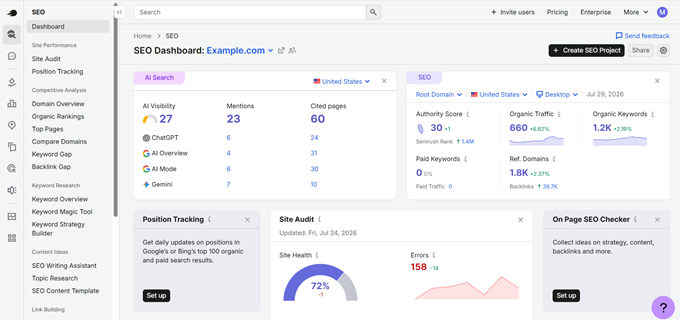
However, if you stick to the core SEO dashboard and skip the add-ons, navigating your projects is smoother than it first looks. Semrush Academy also makes the learning process easier, with genuinely good free training built right into the platform.
Ahrefs
Ahrefs gets the best balance between technical depth and an easy-to-use interface. The layout is simple and built around three main tools, which are Site Explorer, Keywords Explorer, and Site Audit. When we need an answer fast, Ahrefs gets us there in the fewest clicks of the three.
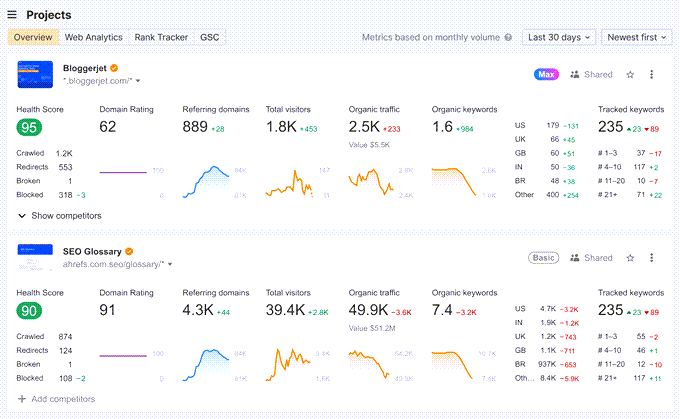
The trade-off is that Ahrefs expects you to know the basics from day one, like what Domain Rating (DR) means and why referring domain trends matter. Once you understand those concepts, Ahrefs is the easiest of the three to make a confident decision in.
Moz
Moz remains the most approachable platform for beginners. We ran a trial of it for this comparison, and the onboarding flows guide you step-by-step through setting up your first campaign, which makes it exceptionally low-stress for anyone who isn’t an SEO specialist.
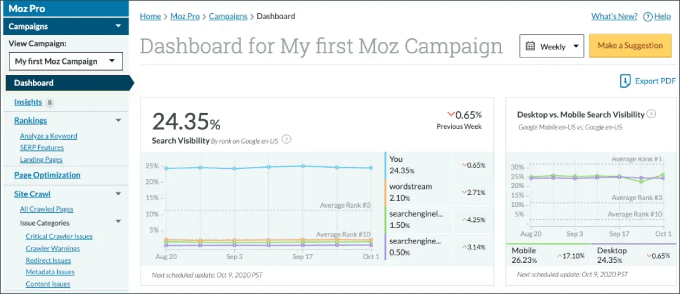
However, that simplicity comes at a cost. For example, its Site Crawl prioritizes technical issues into easy-to-understand action items. But as your WordPress SEO needs become more advanced, you may find yourself wanting deeper diagnostics and more comprehensive data than Moz provides.
Winner: Ahrefs. The interface is the cleanest of the three, with the most efficient user experience and the least clutter in the workflow.
2. AI Integration & MCP: Easily Connect with ChatGPT or Claude
Model Context Protocol (MCP) lets AI assistants like ChatGPT, Claude, and Gemini pull data straight from live SEO software. That makes API access worth checking before you buy.
Semrush
Setting up your AI agent with Semrush is super easy. Sign in, type @Semrush inside ChatGPT, Claude, or Perplexity, and you’re connected. Developers can go the other route through Cursor, VS Code, or the Gemini CLI using a Semrush API key.
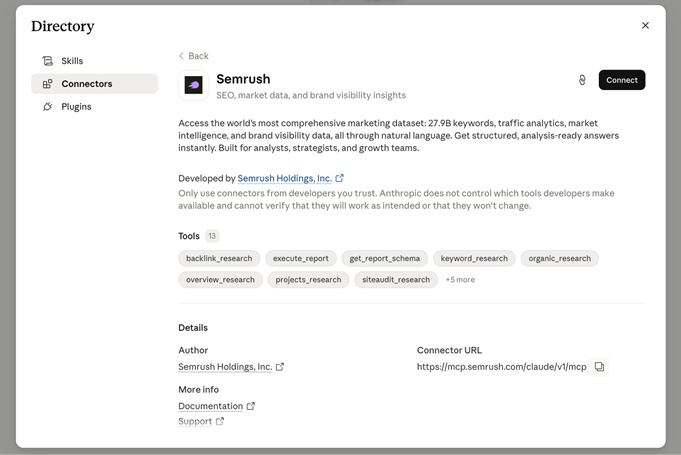
What we love about it is that you can ask something like “which high-volume keywords does [Competitor] rank for that I don’t?” and the gap analysis comes back formatted right in the chat.
But the one thing you need to keep an eye out for is that while the standard chat app integrations work smoothly, the local command-line integrations such as Claude Code consume your account’s API units.
Ahrefs
Just as Semrush, connecting with AI agents is super easy with Ahrefs too. They offer native integrations for ChatGPT, Claude, Cursor, and Copilot Studio.
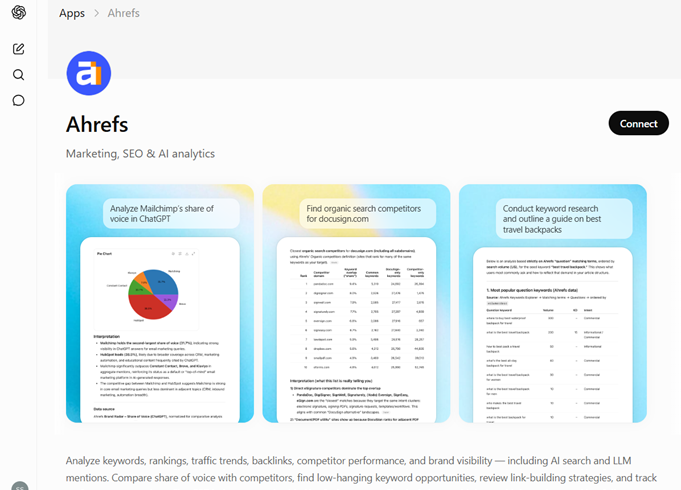
That means with your favorite AI tool, you can ask what new backlinks a competitor gained this month and what anchor text they used, and Ahrefs pulls real-time index data into your prompt within seconds.
Ahrefs is also the most generous on access: MCP is included across all paid plans, with 100,000 API units per month on Lite (100 rows per request), scaling up to 2 million units per month on Enterprise tiers.
Moz
Moz has official MCP endpoints, but access is still in Beta and only the main account owner can use it. Team members on seats can’t connect the MCP yet, which rules it out for anyone working as a group.
It does work with Claude Desktop, ChatGPT Desktop, and Claude Code using bearer tokens, and queries route through separate endpoints for Moz Data and Moz Local. You’ll also need an active subscription to either the Moz Data API or Moz Local on top of your plan.
Winner: Ahrefs. Offering 100,000 API units on the entry-level tier makes it the most accessible option for AI-driven workflows.
3. SEO Core Features & Data Depth
Every SEO tool covers keywords and backlinks. The difference is how much data each one has and how many SEO tasks it can handle.
Semrush
Semrush groups search terms into topics you can build content around, and it ships with a content marketplace and a writing assistant on top of that. From our experience, we believe its real edge is competitive intelligence, and nothing else here covers as much ground.
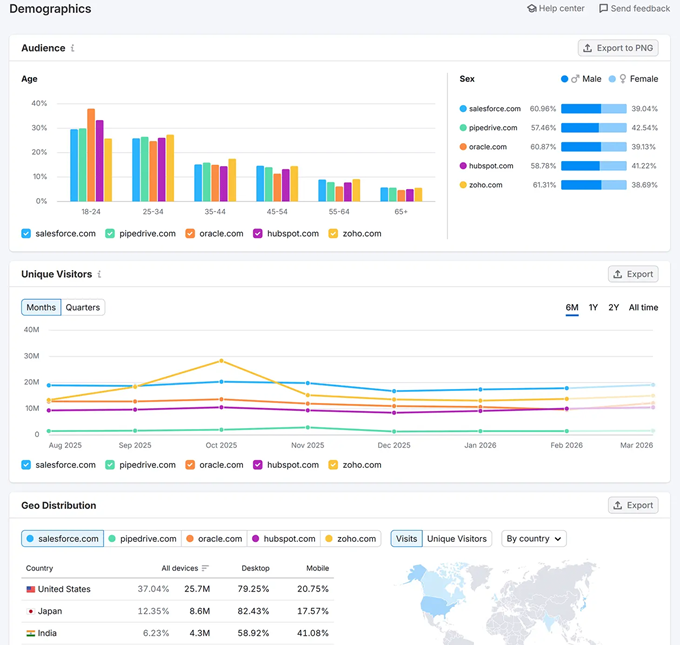
In a single session, you can inspect a rival’s organic rankings, read their Google Ads copy, estimate their paid traffic spend, and evaluate global market trends. The audit engine is highly customizable, too, with JavaScript rendering on the higher plans.
Then there’s everything sitting outside SEO: social media scheduling, local citation management, PPC ad intelligence.
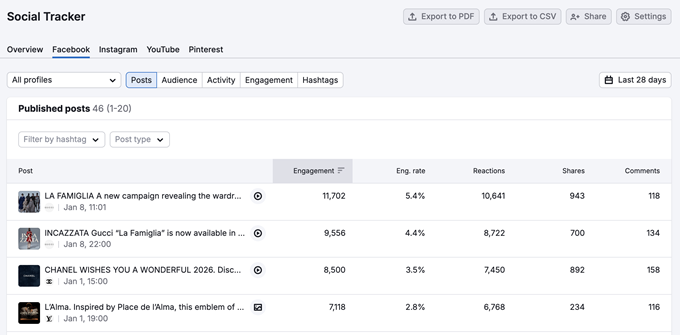
Keep in mind that some of those modules operate as standalone paid add-ons rather than being part of your plan. We keep Semrush for one reason above all others… it answers questions we’d otherwise need three separate subscriptions to answer.
Ahrefs
Ahrefs runs one of the most active web crawlers in existence, and that shows up anywhere backlinks matter. On thorough backlink audits, disavow reviews, and link-building campaigns, it consistently uncovers referring domains that other tools miss.
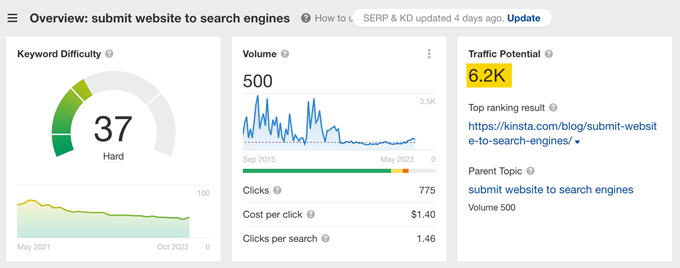
On the organic side, Traffic Potential is the report we often rely on the most. Instead of the volume on a single keyword, it shows what a whole topic could realistically bring in, so you get an honest read on whether a page is worth writing at all.
Another thing we like about Ahrefs is its Site Audit. The audit runs constantly and flags technical errors on its own, without eating into your project credits.
Moz
Moz is well known for its Keyword Explorer report, which comes with a clean Keyword Difficulty score and organic click-through rate estimates. However, its data volume trails behind Semrush and Ahrefs when researching long-tail or niche queries.
Its Link Explorer and Link Intersect provide quick diagnostic insights, but the underlying backlink database refreshes slower than its competitors.
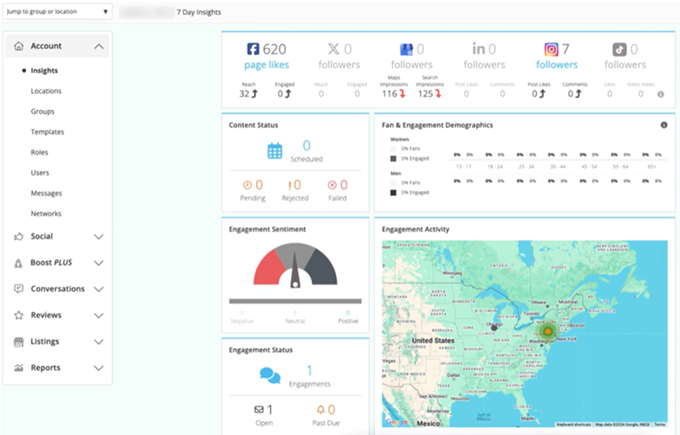
While its SEO toolkit isn’t as comprehensive as Semrush or Ahrefs, Moz stands out with Moz Local. It’s an excellent tool for businesses with physical locations that want to improve their local search visibility and manage their online listings.
Winner: Semrush for the overall feature list.
4. AI Visibility Tracking: See Your Brands in Generative Search
Search is moving toward Generative Engine Optimization (GEO), which means your brand now has to show up inside AI answers, not just in organic search results.
Semrush One
Semrush gives you a solid starting point, showing how often your site gets recommended across AI Overviews, ChatGPT, Gemini, and Perplexity. It tracks sentiment: favorable versus unfavorable, alongside your share of voice against the competitors you name.
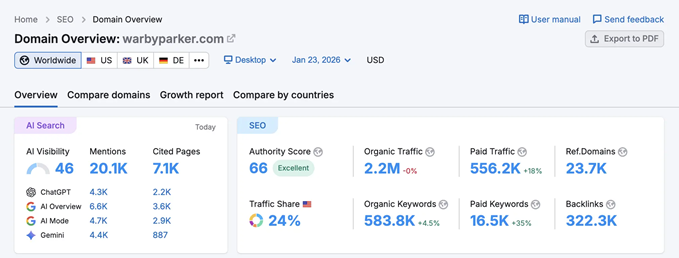
You can buy it as a $99/mo add-on, or get it bundled directly inside the Semrush One plan at $199/mo. You can read our complete Semrush One review.
Ahrefs (Brand Radar)
Brand Radar goes deeper on citation tracking across LLM platforms, covering AI Overviews, ChatGPT, Copilot, Gemini, Perplexity, and Grok. Its best feature is showing you the exact prompts that trigger a mention, plus which sources the AI pulled from when it answered. That’s the version of this data you can actually act on.
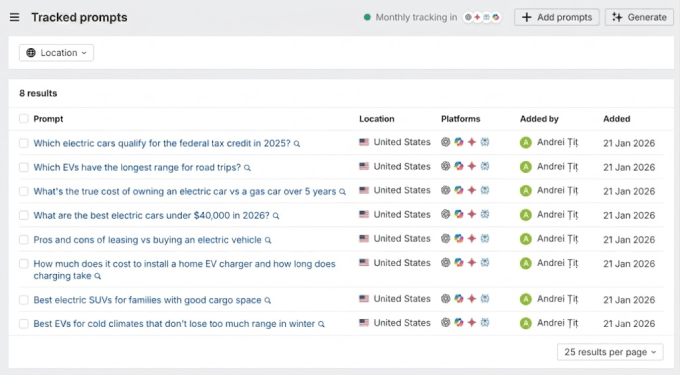
Pricing is the catch. It’s available exclusively as an add-on, so you either buy platform tracking individually at $199/month per platform or step up to an all-platform bundle.
Moz
Moz builds foundational AI tracking directly into its standard interface, with no separate portal to log into. It sticks to baseline presence, measuring how frequently your brand appears alongside competitors in ChatGPT and Gemini over time.
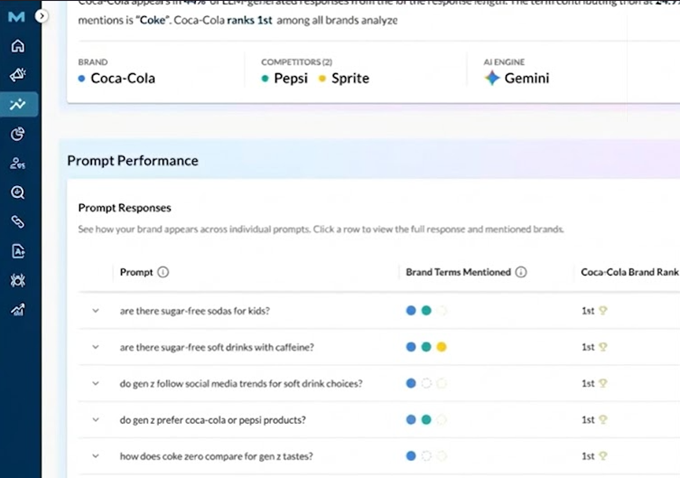
It’s included within core subscriptions at no extra charge, which is the most honest pricing of the three even though the data is the thinnest.
Winner: Semrush. The Semrush One bundle at $199/mo gets you the full SEO toolkit plus AI tracking for about what a single platform costs in Ahrefs.
5. Pricing, Free Trials, and Value for Money
With SEO tools, the display price and the real price are two different numbers. Seats, add-ons, and credit systems are where the budget actually goes, so here’s what each one costs once you’re using it properly.
Semrush
SEO Pro starts at $139.95/month, covering 500 tracked keywords and 5 projects, and the Semrush One bundle starts at $199/month. The standard trial is 7 days, though the WPBeginner audience can get a 14-day free trial instead.
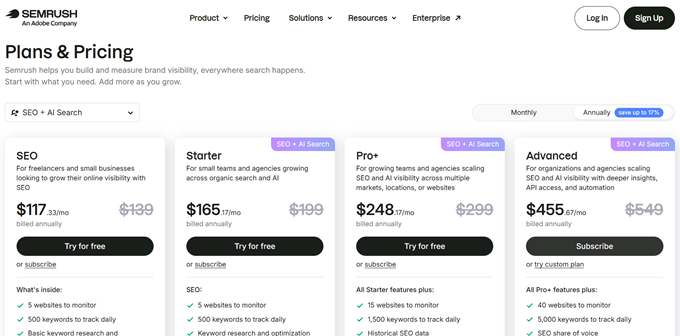
With Semrush, additional user seats cost $45 to $100/month, and add-on tools like the Agency Growth Kit or extra local tracking can quickly scale up your monthly cost. Seats are what caught us out early on… the plan price is not the team price.
Ahrefs
There’s a $29/month Starter tier with strict usage caps, which is really a testing plan rather than a working one. Dedicated usage begins at $129/month for Lite and $249/month for Standard, and annual billing reduces the overall cost by around 17%. There’s no free trial on the standard plans.
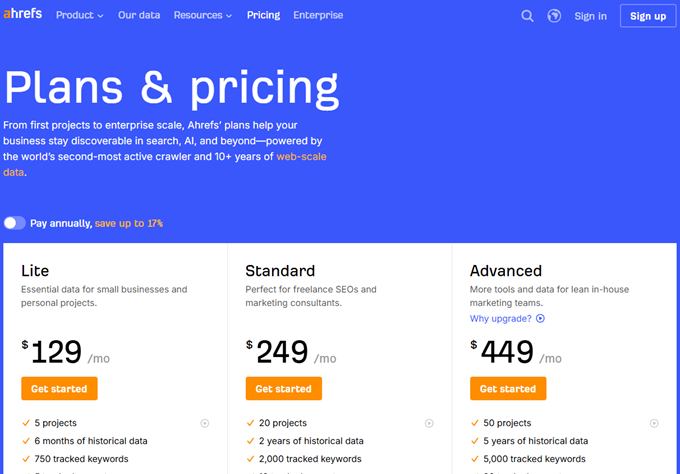
You will want to be mindful of the credit system on the lower tiers, because actions as small as setting a filter or changing a date range will consume credits. The unlimited reporting within fair use starts at the Standard plan which means if you’re doing SEO work daily, you’ll need to consider a Standard or higher plan.
Moz
Moz is the most budget-conscious entry point. Starter begins at $49/month for one site, and Standard runs $99/month ($79/mo annually, for 3 sites and 300 keywords). The free trial is 30 days, the longest of the three by a wide margin, and it’s what we used to judge Moz for this comparison. A month is genuinely enough time to know whether it fits.
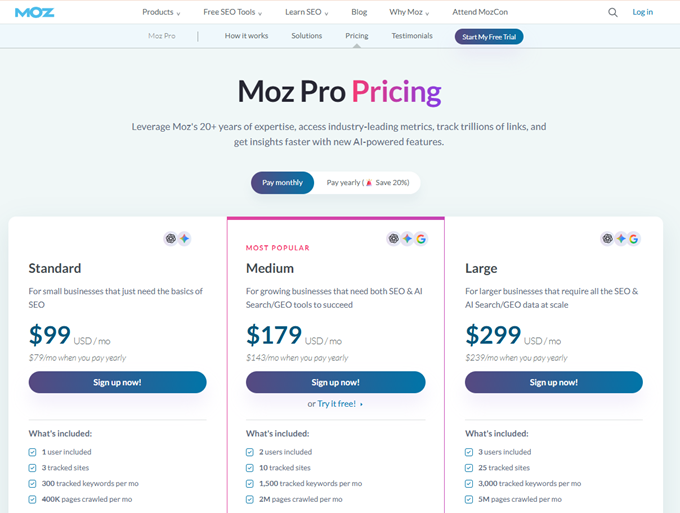
The caveat is growth. That 300-keyword cap on Standard arrives sooner than you’d think, and once you’re upgrading tiers the price advantage erodes quickly.
Winner: Semrush for overall value for money and trial access.
Final Verdict: Which SEO Tool Should You Choose?
We spent years with both Semrush and Ahrefs in our own workflow, and tested Moz extensively for this comparison. We’d recommend Semrush for most website owners, and growing businesses.
It covers more of the SEO work you’ll do every week. Instead of paying for several separate tools, you can manage almost everything from one place. Check out our complete Semrush Review.
Choose Ahrefs if most of your work is competitor research, serious link building, and wiring SEO data into AI tools through MCP. It’s the best toolkit for full-time SEOs who care most about backlink depth and clean data.
Unless you’re on a very tight budget or primarily need local SEO through Moz Local, we think Semrush or Ahrefs are better long-term investments. You’ll get a much broader toolkit without needing to switch platforms as your SEO needs grow.
Frequently Asked Questions About Semrush, Ahrefs, and Moz
Here are the answers to some of the most common questions we get asked about these top SEO platforms.
Do I need an SEO tool if I already use Google Search Console?
Google Search Console is essential, but it only shows data about your own website. Tools like Semrush, Ahrefs, and Moz let you research competitors, discover new keyword opportunities, analyze backlinks, and identify ranking gaps that Search Console can’t provide.
Can I use more than one SEO tool?
Absolutely. Many professional SEOs use both Semrush and Ahrefs. Semrush is often used for keyword research, content planning, and marketing insights, while Ahrefs is used for backlink analysis and competitor research.
Which SEO tool gives the best value for money?
For most businesses, Semrush provides the best overall value because it combines SEO, keyword research, competitor analysis, PPC, content marketing, local SEO, and AI visibility tracking in a single platform. Buying separate tools to cover those features usually costs more.
Can I switch from Moz to Semrush or Ahrefs later?
Yes. Your website and rankings aren’t tied to any SEO tool. You can cancel one subscription and move to another at any time. The main inconvenience is recreating projects, keyword tracking, and reports.
You may also want to see our full expert pick of the best WordPress SEO plugins and tools that we recommend for all businesses.
If you liked this article, then please subscribe to our YouTube Channel for WordPress video tutorials. You can also find us on Twitter and Facebook.



Jiří Vaněk
Thank you for a great comparison of these SEO tools. I have recently started working in SEMEUSH, but it is good to know the differences between the individual tools.
Ghanshyam Harsh
Thanks for your comparison stats. i was looking for the same report.
WPBeginner Support
Glad you found our guide helpful
Admin
Muhammad Junaid
I am managing SEO Service Agency. I have used all these three tools and I found ahrefs is the best SEO Tool if comapre with SEMrush and MOZ.
aioseo is the new one in my knowledge so I will definitely try it.
Abhishek Kumar
Hello!
Undoubtedly, Semrush is a fully loaded SEO tool with lots of features. Well, one thing I must agree here is that among all available SEO tools in the marketplace choosing Semrush is always a valuable investment. Ever since I’m in the internet marketing business I use Semrush for all SEO research.
Daniel Segun
Nice comparison.. I always thought that Moz was the leader of the pack.