


You’ve just launched your new WordPress site, but it doesn’t appear in the results when you search for it on Google. That feeling of confusion and frustration is something we’ve heard about from thousands of our readers.
They often wonder if they missed a critical step, and the answer is usually a simple one: connecting their site to Google Search Console. It’s the single most important tool for understanding how Google sees your website.
At WPBeginner, we connect every new site to Search Console on day one, and it’s easier than you might think. We’ll guide you through the exact process we use, step by step.
This will help you get your site properly indexed and showing up in search results.
What Is Google Search Console?
Google Search Console (formerly known as Google Webmaster Tools) is Google’s free control center for your website’s search presence. Think of it as your direct line of communication with Google about how your site appears in search results.
Here’s why it’s important for your website’s success:
- Search Performance Tracking: Monitor which keywords your content ranks for and how many clicks you’re getting from Google
- Technical Health Checks: Get instant alerts about mobile usability issues, security problems, or technical errors that could hurt your rankings
- Indexing Management: Make sure Google can find and index all your important pages
- Security Monitoring: Receive immediate notifications if Google detects malware or suspicious activity on your site
As WordPress SEO experts who’ve helped thousands of websites improve their search visibility, we can’t stress enough how essential Search Console is.
In fact, we consider it a day-one requirement for any new WordPress website. It’s that important for your site’s success in search results.
The best part? It’s completely free and gives you access to data you can’t find anywhere else. Let us show you how to properly set up Google Search Console for your WordPress site.
Adding Your WordPress Site to Google Search Console
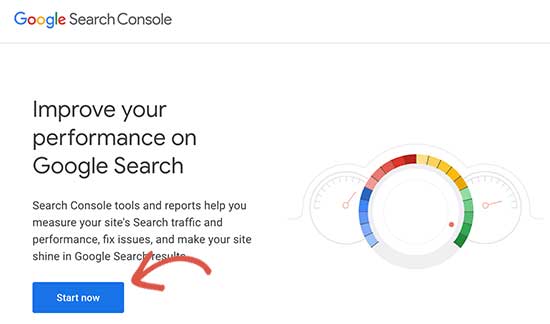
First, you need to visit the Google Search Console website and click on the ‘Start Now’ button.
Next, you’ll need to sign in with your Google / Gmail account.
Once logged in, you’ll be asked to enter your website URL.
There are two methods to verify your site: Domain and URL Prefix. The Domain method covers all versions of your site at once (including www and non-www), but it requires you to edit DNS records, which can be intimidating for beginners.
For this guide, we’ll use the URL Prefix method because it’s easier to set up with a WordPress plugin. The most important thing is to make sure you enter the full, correct URL of your site!
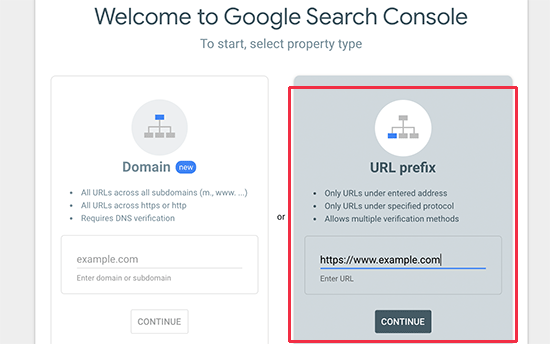
Keep in mind that Google considers HTTP and HTTPS as two different protocols. It also considers https://www.example.com and https://example.com as two different websites.
You need to enter the correct website URL used by WordPress.
If you are unsure, then there is an easy way to find out the exact URL you need to enter. Simply log in to your WordPress admin area and go to Settings » General page.
There you will see your website’s URL in the site address field.
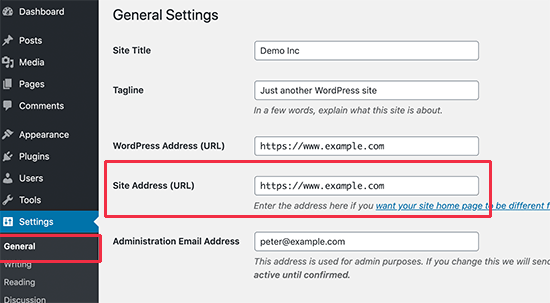
After entering your correct website address in the Google Search Console setup process, click on the ‘Continue’ button to go to the next step.
Now, you’ll be asked to verify ownership of your website. There are several ways to do that, but we will show the HTML tag method because it is the easiest one.
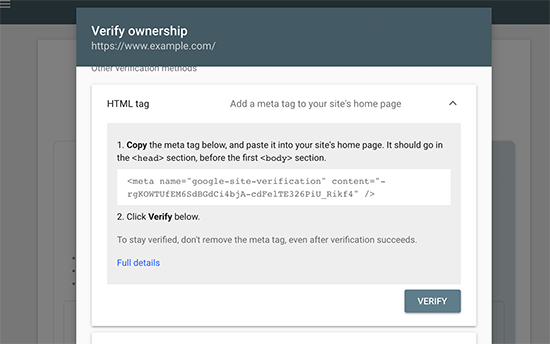
Click on the HTML tag to expand it and then copy the code inside it.
Now, you need to add this Google site verification meta tag in WordPress, so Google can verify that you are the owner of the website.
Most WordPress tutorials will guide you to just edit the header.php file in your WordPress theme and add the code just above the <body> tag.
However, we don’t recommend this method because if you update or change your theme, then the HTML tag will disappear.
Google periodically checks for the HTML tag and will disable your access to the site data in the search console if it cannot find the verification tag.
Here is how to make sure that Google can always verify your ownership of the website.
First, you need to install and activate the All in One SEO plugin. For more details, see our step-by-step guide on how to install a WordPress plugin.
Upon activation, go to All in One SEO » General Settings » Webmaster Tools page and click on “Google Search Console”.
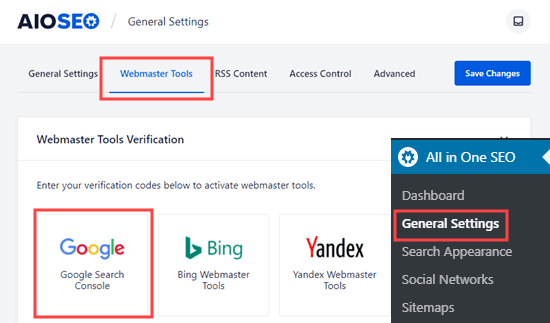
Then paste the code you copied from Google Search Console into the “Google Verification Code” box.
Don’t forget to click on the ‘Save Changes’ button to store your changes.
You can now go back to Google Search Console settings and click on the ‘Verify’ button.
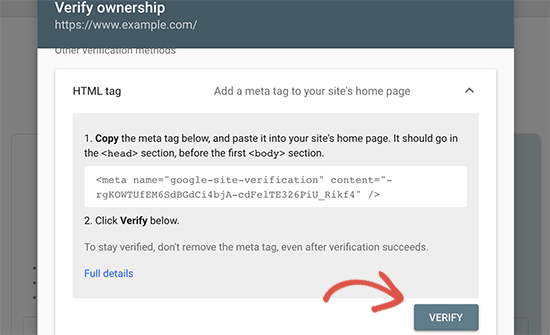
Google Search Console will now look for the HTML tag in your website code and will show you a success message.
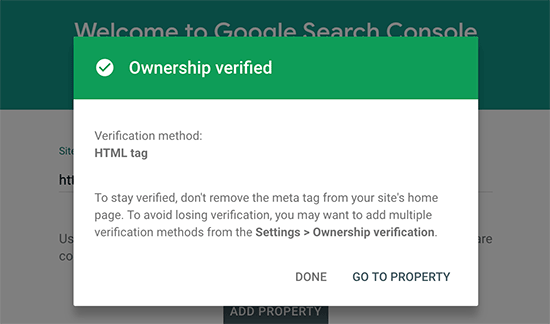
Note: If you don’t see a success message, then you need to clear your WordPress cache. This will ensure that Google can fetch the latest version of your website.
That’s all. You have successfully added your site to the Google Search Console (Webmaster Tools). You can now click on the ‘Go to Property’ link to visit your Google Search Console dashboard.
Heads up! After you verify your site, it can take Google some time—from a few hours to a few days—to start collecting and showing you data. Don’t worry if your reports are empty at first. This is perfectly normal! 😊
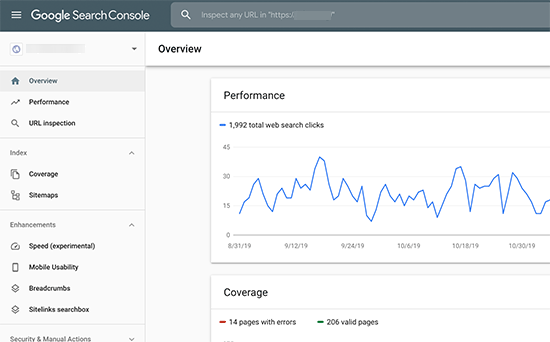
From here, you can see your website’s performance reports and index coverage.
Before you do that, let’s tell Google a little bit more about your website. This will help Google crawl your website a bit more efficiently.
Add XML Sitemap to Google Search Console
An XML sitemap is a file that lists all your website content in XML format, so search engines like Google can easily discover and index your content.
The good news is, if you installed the All in One SEO plugin in the steps above, you’ve already added an XML sitemap to your site automatically.
To see your sitemap, go to All in One SEO » Sitemaps. From here, you can see the sitemap is automatically enabled for you.
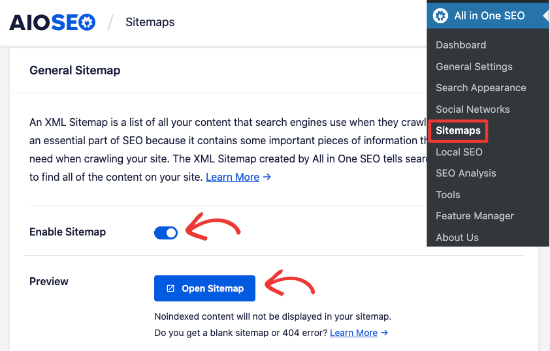
Next, you need to get the XML sitemap link. Simply click on the ‘Open Sitemap’ button, and you will see a link to your XML sitemap.
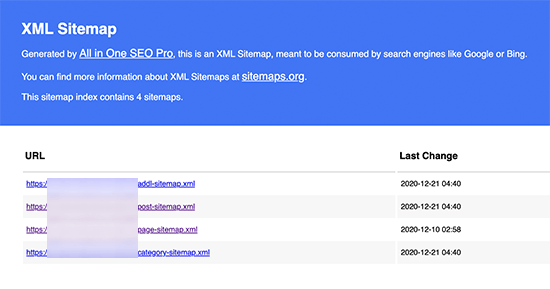
From here, you can just copy the URL from your browser’s address bar.
Alternatively, you can directly access your XML sitemap by adding sitemap.xml at the end of your website address. For example:
https://www.example.com/sitemap.xml
Now that you have the XML sitemap ready, let’s help Google find it quickly.
Simply switch to the Google Search Console dashboard and click on the Sitemaps menu from the left column.
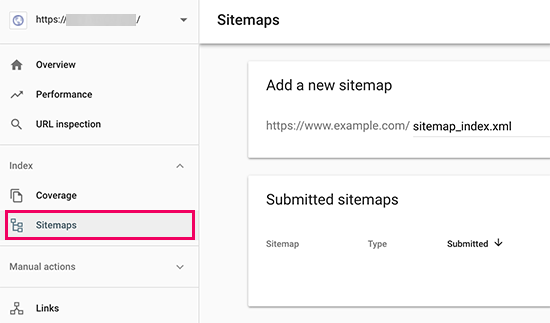
After that, you need to add the last part of your sitemap URL under the ‘Add new sitemap’ section and click the Submit button.
Google will now add your sitemap URL to your Google Search Console.
AIOSEO also includes specialized sitemaps for video, news, and RSS feeds. Submitting these helps Google discover and understand all your different content types, which can improve your site’s visibility in search results.
The process of submitting those sitemaps is the same as above.
That’s all, you have successfully added your website to Google Search Console.
View Google Search Console Data Inside WordPress with AIOSEO
The next step is to learn how to use the treasure trove of information in Google Search Console to grow your business.
We have an ultimate Google Search Console guide for beginners, which shows you how to make the most out of the data.
But you can also easily view a lot of this important data right from your WordPress dashboard using the AIOSEO Search Statistics addon.
With AIOSEO’s Search Statistics, you can track your keywords, view your top-performing content, discover valuable search statistics, and more, inside WordPress. This saves you time by bringing your most important SEO data right into your WordPress dashboard, where you’re already working.
Once Search Statistics is connected to Google Search Console, simply click on ‘Search Statistics’ in the AIOSEO menu from your WordPress dashboard.
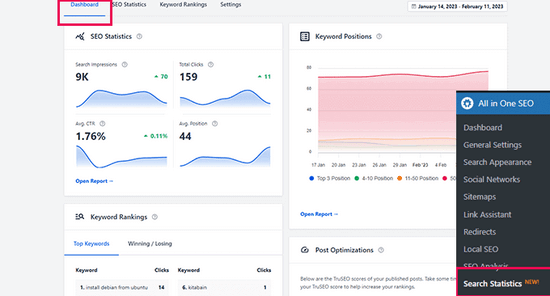
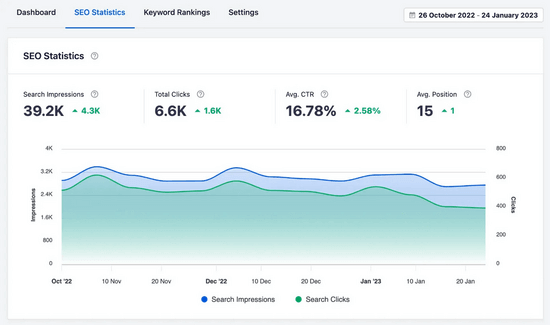
This will bring you to the Search Statistics dashboard. From here, you can see SEO Statistics, such as the search impressions, total clicks, average click-through rate (CTR), and average position of all of your content.
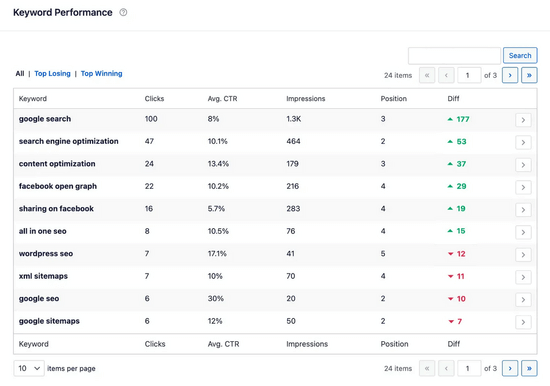
You can also use the Keyword Performance report to see which keywords your website content is ranking for in Google search results. By clicking on the ‘Top Winning’ and ‘Top Losing’ tabs, you can see what keywords have seen the biggest position changes.
In addition, with the powerful Content Rankings report, you can easily spot content decay and important content performance trends.
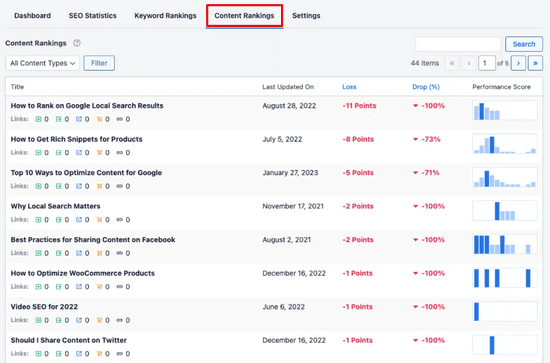
It will show you the date a URL was last updated, details about the rate at which your content is decaying, and other essential SEO and content marketing metrics.
Using AIOSEO’s built-in SEO recommendations, you can easily optimize your decaying content to boost your rankings again.
You’ll also get helpful reports for improving the user experience (UX) on your site, tips for troubleshooting issues that are negatively affecting your SEO, and more.
Video Tutorial
Google Search Console and WordPress FAQs
Having helped thousands of readers add and verify their websites in Google Search Console, we have seen just about every question you can think of. Here are the answers to some of the most frequently asked questions.
1. How can I upload a Google HTML verification file to my WordPress blog?
Google Search Console allows a few different ways to verify website ownership. In this article, we covered the easiest method, which is to use the Google site verification meta tag. However, some website owners prefer to upload the HTML file to verify site ownership.
To upload the Google search console HTML verification file to WordPress, you will need to log in to your WordPress hosting cPanel or connect to your hosting account using FTP.
Next, you need to upload the HTML verification file inside the /public_html/ folder of your website. This is the root directory where you’ll see other WordPress folders like /wp-admin/, /wp-content/, etc.
2. Should I use a Google Site verification plugin for WordPress?
There are many WordPress plugins that are designed specifically to help you with Google site verification. However, you don’t need to use them because you’ll likely need to verify ownership on other webmaster tools and platforms like Bing, Yandex, Pinterest, etc.
It’s much better to use the All in One SEO plugin because it lets you add site verification for all platforms (in a single plugin). Not to mention, it also has a ton of other WordPress SEO features to help you rank better and get more traffic.
3. How can I become a power user of Google Search Console?
Google Search Console has a lot of useful information that you can use to grow your business. We created an ultimate Google Search Console guide that shows you how to become a power user.
4. I’m running into problems. Is there a Google Search Console phone number that I can contact?
No, there’s no Google Search Console phone number that you can contact. If you’re running into problems with Google Search Console, then you can use their online support center. For specific questions about WordPress, you can always join our free WordPress help group to ask your questions.
Additional Resources
We hope this article helped you learn how to add your WordPress site to Google Search Console. Now you’re ready to use its data to grow your website.
Here are a few extra guides to help you take the next steps:
- The Ultimate Google Search Console Guide: Learn how to use all the powerful features inside Search Console to improve your SEO and find new content ideas.
- How to Increase Your Blog Traffic: Discover 27 proven tips that we use to get more visitors to our websites.
- WordPress SEO Made Simple: A complete step-by-step guide to help you properly optimize your website for search engines.
If you liked this article, then please subscribe to our YouTube Channel for WordPress video tutorials. You can also find us on Twitter and Facebook.





sulman
You did a very good job and you just eased the word for any new SEO student who want to learn it for professional purpose and please carry on your work. Thanks
Jckson
Thanks for this
Lilly
Hi! I was just wondering if you delete the plugin again after having verified the website?
Munna Hossain
Informative article. It is really important to submit your site on google webmaster tools. Thanks you for sharing with us.
Ann
Thank you!!
Spent so much time trying to get the right solution and your easy to watch video showed me in minutes!
Jay
Spent an hour on other sites trying to figure this out with no luck. This worked first time. Thank you!
Mursaleen Kamal
How Much Time Google Take to Shows Proper Sitemap on Search Engine Here Is My Website Which is Approx 6 Month Old
from Karachi, Pakistan.
WPBeginner Support
If you are using Google Search Console (webmaster tools) then you can submit your sitemap directly. Your sitemap is not shown in the search results. Instead it is used to prioritize how search engines crawl and prioritize your content.
Admin
Raghav
Thanks. This was really helpful
Manish
I was using search console when i was in blogger and now i have shifted to wordprss so i need to delete my blogger search console and make a new one for my wireless site.?
Rahul khurana
I am trying to add my property in Google Search Console .
i am doing step by step , i add HTML code in Insert and footer plugin but when i verify it , msg returns we could not find the meta tag .
Anto Navis
Use alternate method to download the google site verfication html file add the respective file on your server using your cpanel or FTP.
Once you upload the file correctly on your server, Then verify your ownership on google webmaster tools.
You will surely Verified the Ownership of your website
Pratiksha
Thank You!
aatif riaz
Very helpful post. I appreciate your effort.
Abiodun
Please how do I see my own meta tag line?
ibu solihatun
The article is very interesting. Helped me understand many things and will be happy soon to write like again
Kevin
Extremely helpful video that goes straight to the point. I love it when a process I’m trying to implement works out perfectly on the first try.
Thank you.
Kevin
Allison
What if I am hosting my site with Wordpress.com and don’t have access to plugins? Is there another way to get the code on my site?
Wendy
Thank you so much! That was so clear and helpful. I’m going to do it right now.
John
thanks for sharing all the great tips and guidelines on how to set up these SEO tools i have used them as instructed n now my sites are ranking higher than my competitors
WPBeginner Support
Glad you found it helpful.
Admin
Amazing
Hi, can I remove the plugin after I have activated webmasterstool? I don’t want any more plugins then I already have
vi
Should I deactivate the seo plugin after the submission
Eliza Beck
This was brilliant and very helpful, I always forget how to do this and come back to the site time and again!
Ryan VanRiper
THANK YOU!!! I have been messing around for hours with this. This video got me verified in minuets. THANK YOU!!
Sahil
help me
my website do not show plugin option
WPBeginner Support
Please see our guide on the difference between self hosted WordPress.org vs free WordPress.com blog.
Admin
John Dolan
You guys are great, and VERY helpful. Thank you!
John
Gaurav Singh
Can I use one one gmail account for multiple website
WPBeginner Support
Yes, you can.
Admin
Paul Maddock
It’s probably worth adding to the article that WMT allows you to verify your site through Google Analytics code as well now, which is much easier than the methods listed above for verification.
Jason Coleman
Or you can use SEO by Yoast which generates your sitemaps for you and then just add them to GWT that way. Just a thought.
Julie Jordan
I’m having a problem verifying with Google that I own my website (and I do, and have since 2012). When I log into my GoDaddy account INSIDE the Google verification page, it rejects my password, yet, at that exact same time, I’m logged into GoDaddy with no problem.
Oh, and the instructions inside the Google verification are outdated. For starters, there’s no LAUNCH button in GoDaddy any more.
Not being a computer guru, I’m pretty much stymied and don’t know what to do now.
Duy Tuan
If you register domain in GoDaddy then it’s easier, Webmaster tool is integrated with Godaddy then when you click veryfy, it will ask you to login to your Godaddy account and everything is automatically processed.
David
Simply thank you Been driving me nuts!! Used the Insert Headers and Footers thingy and all sorted in less than a minute
Aryan
Those are so amazing. Thank you for publishing.
XButt
does it work in wordpress free version without installling wordpress
because i dont see plugins button please help
WPBeginner Staff
Please checkout our guide on the difference between WordPress.com vs Self Hosted WordPress.org.
Naveenraj
Thank you so much….
WPBeginner Staff
Maria, first thing you should note down is that your website’s URL is the one you see in WordPress Admin area under Settings >> General. So whenever you are submitting your website anywhere use the URL in your WordPress settings.
Also note that www and non-www URLs are not the same. WWW is actually a subdomain. Eventhough search engines are smart enough to understand that example.com and http://www.example.com could mean the same. However, due to the technicalities they need to differentiate between the two and take them as two different locations.
We would recommend you to start over. Delete your site from Google webmaster tools and then add it again. Hope this helps.
Maria
Hi, I verified my site both with www and without www. But then I read
that I had to put http:// such as http://www.example.com/. I didn’t it.
When I navigate on my site http:// doesn’t appear, but only
http://www.example.com is shown.
I tried to verify the sites again but
Google only recognizes the first I put. Can it be a problem?
Odell
Thanks so much. This was tremendous help.
Rachel
Thank you so much! Your tutorial was the first of many that actually gave me the plug-in to activate in order to enter in the header information. Do you know how long it takes to be searchable on google, once the site is verified? Thank you again!
mm
Very helpful. However, the meta-tag information was under “alternate methods” when I did it. I pasted the tag under “recommended” and wondered why it wasn’t working.
J Ey
Thank you so so much. I found it extremely helpful. For the life of me I could not figure out where to upload that link until I saw that extra step in your video. I always appreciate a great tutorial!
rafil
is does not works for me i don’t know why i tired my blog still not verified
Chintan Shah
informative
Junaid
Thanks Once again.
Theresa
Hi,
I just tried to upload your plugin, Insert Headers and Footers, for my wordpress site which; a Twenty Ten theme and 3.8.1. But it said your plugin wouldn’t work on the site. Do you have a newer version of this plugin that would work on my site? I’ve been trying to get my sites verified by google for a few months now. Any help would be appreciated!
Jeff K.
Thank You so much. I tried about 5 or 6 different ways, most the wordpress site recommended, and I finally got it to work by using the headers method you described. I just wish I’d have seen this site sooner. Thanks Again. Jeff
Aamir
I was in a fix how to submit my sit int Google Web Master Tool………Bust you mention Step By Steps Point Thanks A Lot
Louise
Thanks for the tutorial. I just added my site, however I stupidly did the recommended method when I verified it so I didn’t get the code to add to the wordpress SEO plugin. Will this effect how effectively the SEO plugin works or doesn’t it matter as long as your site is set up/verified on google webmaster tools? Would really appreciate your help!
WPBeginner Support
No it will not affect the performance of the SEO plugin as long as your site is verified on Google webmaster tools.
Admin
Johnny
Thank you I have followed the tutorial but cannot really get it to work on my site can you please help.
Sadi
Thank you for this great tip. I have also added my site to google webmaster tools.
Shannon
Thank you so much! This is just what I was looking for!!!
Daniel
Nice tut, thanks.
Praveen Prasad
What about others Webmasters Tools like Bing, Yahoo, Pinterest and Alexa ?
The process is same or any other method?
Abhisek
For Bing, Yahoo, Alexa The process is pretty same, after signing-up for webmaster’s you’ll provided with a code to be pasted in your header.php and the get verified. I don’t think there is any such requirement for pinterest. Just make a pinterest account, link with your website and you are ready to go.
Praveen Prasad
Thank You