


Checking your site analytics and seeing a massive spike in traffic is an incredible feeling. Often, this unexpected surge comes from Google Discover rather than traditional search results.
Trying to get your articles featured there can feel like a frustrating puzzle. You might pour hours into creating great content, only to feel ignored when that wave of Discover traffic never arrives.
After refining this process on our own websites, we learned that there are actionable steps you can take to increase your chances of getting featured.
In this guide, we will share the exact strategies we use to optimize our WordPress posts for Google Discover. Here are the proven tips to help get your content in front of a wider audience.

What Is Google Discover, and Why Is It Important?
Google Discover is a mobile-only feed, so it’s important that your WordPress site is mobile-responsive. Using a responsive WordPress theme that automatically adjusts itself based on the user’s screen size is a good start.
A great way to check this is with Google’s PageSpeed Insights tool. It’s free and will not only test how fast your site loads but also check if it’s easy to use on a mobile device.
Instead of showing results for a search query, Google Discover uses your past web searches, location history, settings, and activity across different Google platforms to automatically generate a mobile feed.
It is an intelligent system that learns how you search and what you like. Using this information, you can see content based on your interests, hobbies, and topics you follow.

Getting your WordPress website listed in Google Discover can help boost your organic traffic. People can discover new content, and you can reach new audiences through Google Discover.
If your content aligns well with what users are interested in, it has the potential to help you boost your visibility to a wider audience.
However, before getting your site into Google Discover, you’ll need to ensure that it meets the content policies.
For example, your content shouldn’t be dangerous, deceptive, manipulated, misleading, or hateful. Plus, advertising and promotional material on a page shouldn’t exceed your content.
With that in mind, we will walk you through how to get your site to appear in Google Discover. Since there is no single way of getting your site into Discover, you can try the following methods:
- Ensure Your WordPress Site is Mobile Responsive
- Uncover Your Audiences Interests
- Cover Timely and Popular Topics
- Add High-Quality Images to Your Content
- Embed YouTube Videos in Your WordPress Blog
- Improve Your E-E-A-T
- Use Open Graph Title in WordPress
- Set Up Knowledge Graph Information in WordPress
- Frequently Asked Questions About Google Discover
- Additional Resources to Boost Your SEO
Ready? Let’s get started!
1. Ensure Your WordPress Site Is Mobile Responsive
Google Discover is a mobile-only feed, so it’s important that your WordPress site is mobile-responsive. Using a responsive WordPress theme that automatically adjusts itself based on the user’s screen size is a good start.
Besides that, you should also ensure your site loads quickly. With site speed now part of the Google ranking factor, you must have a fast-loading website.
For instance, you can switch your website hosting, use a content delivery network (CDN), optimize your images, install a caching plugin, and more. You can check out our ultimate guide to boosting WordPress speed and performance.
In the past, Google AMP (accelerated mobile pages) was highly recommended for this. While AMP is an option to make pages load almost instantly, it is no longer a requirement. Focusing on a highly optimized, fast-loading standard mobile site is often the best approach today.
2. Uncover Your Audience’s Interests
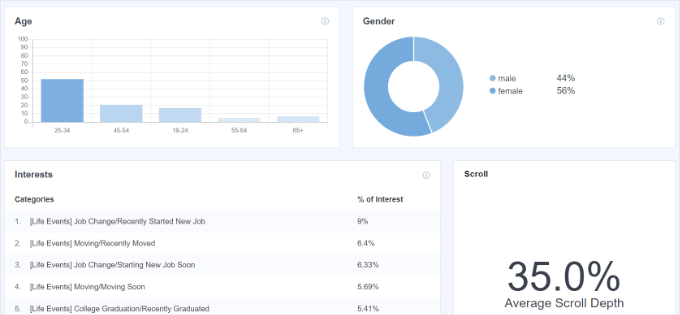
One of the ways Google shows content in the ‘Discover’ feed is based on user interests. Finding out your audience’s interests can help you cover new content topics and increase your chances of getting into Google Discover.
With Google Analytics, you can enable demographics and interest reports and see what your visitors are interested in. This way, you can write blog posts, create videos, start a podcast, and produce other forms of content your audience likes.
If you’re using MonsterInsights, then you can easily view the report inside your WordPress dashboard. Plus, you can install Google Analytics in WordPress without editing code.
3. Cover Timely and Popular Topics
While your content should be based on users’ interests, Google suggests producing timely content to get into the ‘Discover’ section.
This means that you should cover trending or popular topics in your industry. For example, you’ll find the latest news, recent updates about sports you follow, and other blog posts that cover trending topics in Google Discover.

A simple way to uncover new and trending topics in your niche is by using Google Trends.
It’s a free tool by Google, and you can enter different search queries to find out if they’re trending or not. You can adjust the time period, location, category, and more.
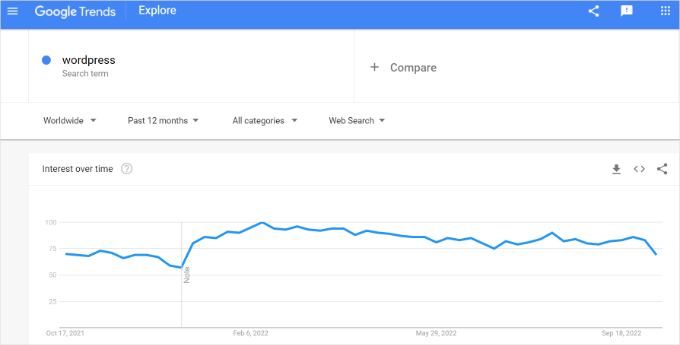
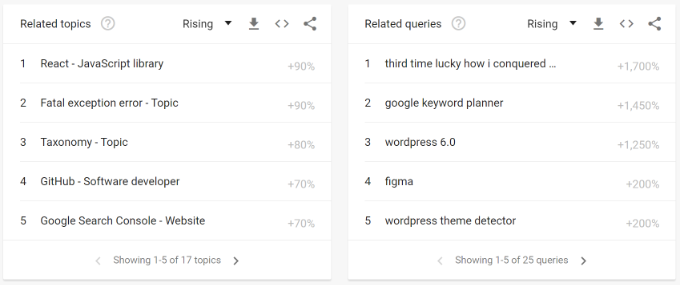
Not only that, but if you scroll down, you’ll also see related topics and queries for your keyword.
These are additional topics and search terms that are trending right now. Covering them on your website will increase your chances of being discovered by Google Discover.
For more details, you can see our guide on how to use Google Trends to improve SEO.
4. Add High-Quality Images to Your Content
Next, you should use unique, high-quality images for your content. In Google Discover, pictures get a lot of attention, and using compelling photos can help you get more clicks.
Google recommends using large images that are at least 1200 px wide. You also need to ensure this is enabled by the max-image-preview:large meta tag on your site. The good news is that SEO plugins like All in One SEO handle this for you automatically to help your images stand out.
Since large, high-quality images can slow down your website, we highly recommend compressing them or using next-generation formats like WebP. For more details, you can refer to our step-by-step guide on how to optimize images for web performance.
5. Embed YouTube Videos in Your WordPress Blog
Aside from images, Google Discover also shows multiple YouTube videos in the feed.

By embedding YouTube videos in your WordPress blog, you can boost the chances of getting them to appear in Google Discover.
If you need help adding videos to your site, then you can read our guide on embedding videos in WordPress blog posts.
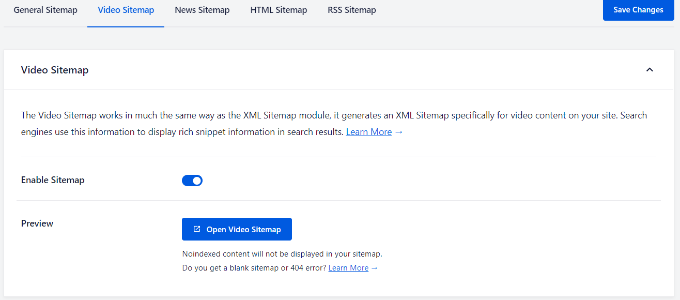
That said, you can take it one step further and create a video XML sitemap in WordPress.
A video sitemap helps search engines like Google to easily find and index content with embedded videos. As a result, your videos will appear in search results and featured snippets and eventually get picked up by Google Discover.
Using the premium version of All in One SEO (AIOSEO Pro), you can quickly create a video sitemap and adjust its settings.
All you have to do is enable the video sitemap option, and the plugin will automatically find video embeds in your content and add them to a special sitemap for search engines. It’s the best SEO plugin for WordPress, and it helps you optimize your site for search engines without hiring a professional.
For more details, you’ll want to read our tutorial on how to set up video SEO in WordPress.
6. Improve Your E-E-A-T
E-E-A-T is a term Google uses for its quality guidelines. It stands for Experience, Expertise, Authoritativeness, and Trustworthiness.
In simple terms, Google wants to feature content from sites that are reliable, trustworthy, and written by people who know their topic well. This is a very important signal for getting into Google Discover.
The ‘Discover’ guidelines suggest simple ways to showcase your site’s E-E-A-T. For instance, you can provide exact publishing dates and add bylines and author information to your content.
Plus, you can improve transparency by including contact information, the company or network behind your publication, and providing other details to build trust with visitors.
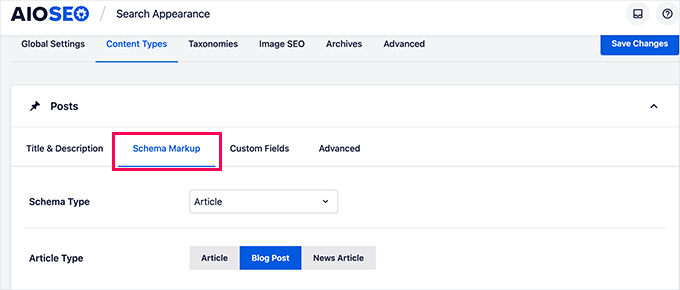
Another way to boost your E-E-A-T is by adding schema markup in WordPress. It helps provide more information to search engines and better understand your site. This will help Google better display your content in Discover and search results.
With All in One SEO (AIOSEO), you can add schema markup in WordPress. At WPBeginner, we use AIOSEO’s FAQ schema markup when including frequently asked questions in our articles.
For more ways to enhance your E-E-A-T, you can also see our ultimate WordPress SEO guide for beginners.
7. Use Open Graph Title in WordPress
Another interesting way to get your site to appear in Google Discover is to use the Open Graph title. Many users have observed that Google is picking their ‘Open Graph’ title for ‘Discover’ instead of the main H1 headline.
Open Graph metadata helps you control how your website is displayed when shared on different social media platforms. It makes your content look more attractive on social media feeds, allows users to see what the content is about, and increases brand visibility.
If you are using All in One SEO (AIOSEO), adding an Open Graph title to your blog posts and pages is extremely easy.
In the WordPress content editor, you can scroll down to the AIOSEO ‘Settings’ meta box. Under the ‘Social’ tab, the plugin gives an option to enter a title for Facebook and Twitter.
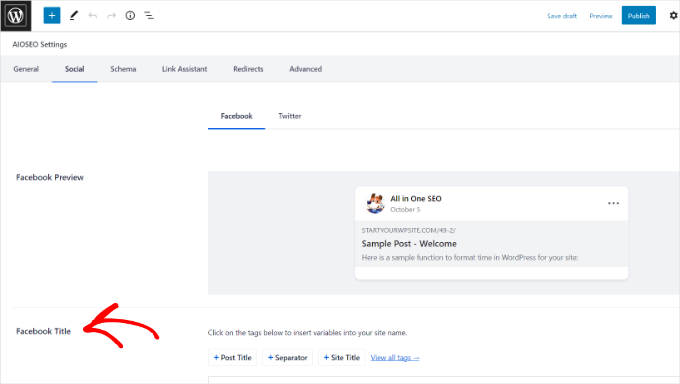
By setting a compelling Open Graph title, you improve how your content looks when shared on social media. This can also influence the headline Google chooses for your article in Discover, so it’s a great practice to optimize it.
For more details, you can see our tutorial on how to add Facebook Open Graph metadata in a WordPress theme.
8. Set Up Knowledge Graph Information in WordPress
When you search for a brand or keyword in Google on mobile, you’ll see a notification icon next to it. Clicking the icon will allow you to follow the topic and see articles in the ‘Discover’ feed.
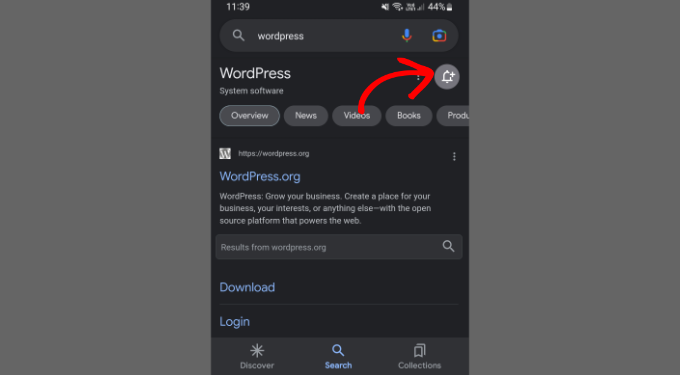
You may notice this ‘Follow’ button appears for well-known brands and topics. This happens when Google recognizes a site as a trusted entity in its Knowledge Graph.
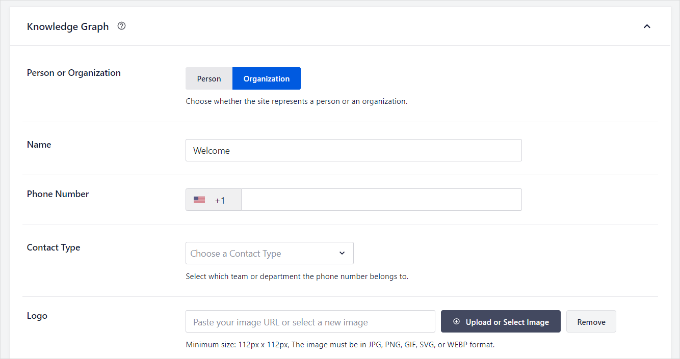
You can add knowledge graph information in WordPress to increase your chances of being featured in search results and displaying a follow icon.
Luckily, you can easily enter the ‘Knowledge Graph’ details using the All in One SEO (AIOSEO) plugin. There are options to enter your business name and phone number, specify whether it is a person or an organization, add a logo, and more.
You can also check out our guide on how to get a Google-featured snippet with a WordPress site for more ideas.
That said, Google Discover is still a big unknown. You can try each of these tips and enhance your chances of getting your website into the ‘Discover’ section. While results aren’t guaranteed, persistence and consistency are some of the key factors in catching Google’s attention.
Frequently Asked Questions About Google Discover
Below are some of the most common questions we get asked about getting a WordPress site featured in Google Discover. This can help clear up any confusion and set the right expectations.
1. How long does it take to get into Google Discover?
There is no specific timeline for getting featured. Some websites see their content appear within a few days of publishing, while for others, it might take several weeks or months of consistent effort. The key is to regularly apply the best practices we’ve outlined.
2. Can I pay to get my site into Google Discover?
No, you cannot pay for placement in Google Discover. It is an organic feature, not an advertising platform. Your content is selected by Google’s algorithms based on its quality, relevance to user interests, and your site’s overall authority.
3. Is Google Discover the same as Google News?
They are similar but different. Google News primarily focuses on timely, journalistic content from approved news publishers. Google Discover is a more personalized, interest-based feed that can include a wider variety of content, including evergreen blog posts, videos, and how-to guides.
4. How do I know if my traffic is coming from Google Discover?
You can track this traffic using Google Search Console. In your dashboard, go to the ‘Performance’ report. If your site is getting Discover traffic, you will see a separate ‘Discover’ tab appear where you can view clicks, impressions, and click-through rate.
Please note that this tab only shows up after your site has received a minimum number of impressions in Discover.
Additional Resources to Boost Your SEO
Now that you know how to optimize for Google Discover, you may also want to check out these other guides to further improve your site’s visibility and traffic:
- What is Content Decay? (And How to Fix It)
- Best Internal Linking Plugins for WordPress (Automatic + Manual)
If you liked this article, then please subscribe to our YouTube Channel for WordPress video tutorials. You can also find us on Twitter and Facebook.


Kenneth Young
Should the slug represent the particular blog post?
Fow example one post is on Woodcarving and another post is on a particular woodcarving tool.
Kenneth
WPBeginner Support
When possible yes, by default WordPress would use your post title so you shouldn’t need to focus on customizing the slug for your content.
Admin
Edwine Ogada
I have always wondered why I get lots of article recommendations on my timeline, which made me so curious to know why my website isn’t appearing as others’. It’s been Google Discovery; a sophisticated system that unlocks realtime organic traffic for authentic publishers, and well-optimized website for users. These eight tips are one of the bestest that I must implement to break the traffic lockdown for my website. Thanks for the writer, but I would want to know more about doing the same for Bing users.
Dennis Muthomi
Frankly, I had no idea there were actually ways to get a blog featured in Google Discover!
I kind of assumed Google only “favored” major websites and media outlets in that feed.
I’m new in the SEO and blogging space, so yeah
This guide is super valuable in showing that even smaller blogs and websites can get visibility there, kinda.
I think Point 2 and 3 -> Understanding what content resonates with my readers while tapping into popular topics seems like the perfect recipe for Discover success.
I’ll definitely try implementing the Open Graph title technique too – optimizing how my posts show up on Discover is a interesting .
A million thanks for putting this together! I’ll do more research on this too.
WPBeginner Support
You’re welcome, glad you found our guide helpful
Admin
Moinuddin Waheed
This is a new concept for me as I never knew that we can have our wordpress websites on Google discover as well increasing the chances of getting more traffic and conversions.
Thanks for the steps mentioned to get our website on Google discover.
as mentioned that Google discover knows about our browsing history, location, likes and dislikes and shows content accordingly, is it then that what our website get into the Google discover, it will be shown to people with similar interests that targets our website?
WPBeginner Support
Yes it should.
Admin
Jiří Vaněk
Thank you for the valuable advice. I also have Google Discover/Google News on my website and struggle with not being displayed there frequently. According to GSC, I do appear there, but unfortunately not as often as I’d like. Therefore, every piece of advice in this regard is valuable to me. For instance, I didn’t expect YouTube videos could be helpful in this context.
WPBeginner Support
You’re welcome, glad we could give some more insight into this.
Admin