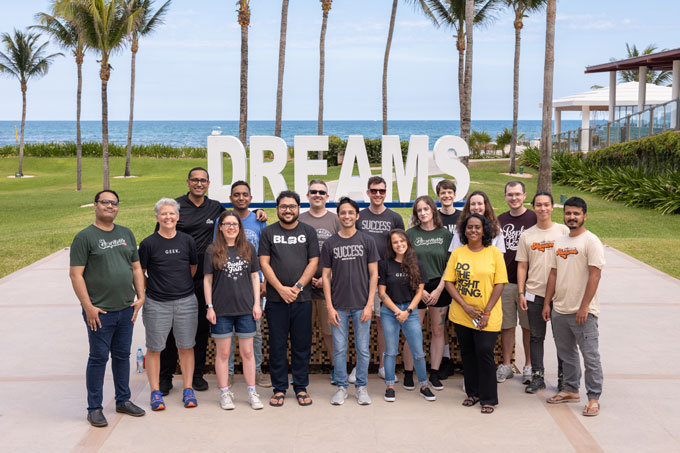
The most experienced team of WordPress experts and educators.
Over 16+ years of WordPress and web development experience.
The team that advises some of the largest WordPress plugins in the industry used by over 25 million websites.
Led by WPBeginner founder, Syed Balkhi, a well-respected WordPress expert.
Experience
Our editorial staff includes a dedicated team of programmers, writers, video creators, and editors with over 16 years of experience in WordPress, web hosting, eCommerce, SEO, and online marketing.
Our editorial team manages every piece of content we publish at WPBeginner. Unlike other copycat tutorial websites, every person in our team is a true WordPress practitioner. You can learn more about our Editorial Process here.
The team is led by the most well-known and well-respected WordPress expert in the world, Syed Balkhi. He graduated from University of Florida and have been building WordPress websites since 2006.
Syed is also the founder of some of the most popular WordPress plugins in the market.
About WPBeginner
WPBeginner is the largest free WordPress resource for beginners to learn WordPress. We are part of the Awesome Motive family and reach over 100 million visitors every year. Our content is fact checked and reviewed by our Editorial team for accuracy and integrity. You can learn more about us and our editorial process.
WordPress URL Structure by default is not the most Search Engine Friendly, and it is also not very user friendly. In this tutorial we will show you how to make SEO Friendly URL Structure for WordPress that are also user friendly. If you see us use Permalink structure instead of URL structure, you should know that they are synonymous.
Want to leverage the power of social proof on your WordPress site? A well-designed customer reviews page can be your secret weapon. We’ve seen firsthand how a great customer reviews page can build trust and boost sales. After a lot of testing on our own… Read More »
Your WordPress blog probably has dozens of great older posts, but new visitors only ever see your most recent ones, while everything else remain buried in your archives. Displaying random posts is an easy way to fix that. Every page load surfaces different content, which… Read More »
Seeing a 404 Not Found error on your WordPress site isn’t just annoying. It’s a fast way to lose visitors who were ready to read, click, or buy, only to hit a dead end. The good news is that you don’t have to live with… Read More »
If you use password-protected posts for premium content or members-only areas, you might’ve noticed something frustrating: WordPress hides these posts from your blog feed and archive pages. This means that visitors have no idea what valuable content is waiting behind the password wall. And that… Read More »
You spend hours editing a photo only to have it look dull and washed out once uploaded to WordPress. We have faced this exact frustration many times with our own featured images. This problem usually happens because of a simple mismatch between color profiles. Luckily,… Read More »
Navigating a website should feel effortless, but short menu labels sometimes leave visitors guessing where a link leads. This uncertainty can frustrate users and make them hesitate to click on important content. At WPBeginner, we have found that adding title attributes is a quick fix… Read More »
Dense, hard-to-read text is one of the most common reasons visitors leave a site quickly, even when you’ve spent hours crafting something valuable. If your bounce rate is high, this is often the overlooked culprit. Here at WPBeginner, we learned that clear, simple writing is… Read More »
Nothing burns quite like seeing your original photos and graphics being used on someone else’s website without permission. If you’ve ever spent hours creating the perfect image only to find it stolen later, you know exactly what we’re talking about. Unfortunately, many WordPress users either… Read More »
We recently received a question from a reader that we hear quite often around here: “How do I disable the REST API on my WordPress site?” And honestly, it’s a valid concern. When WordPress version 4.4 was released with the JSON REST API, it opened… Read More »
Used to store interaction and conversion data for campaigns in conjunction with Revenue Attribution.
1 year
_gat_omTracker*
Set, controlled and used by Google Analytics to collect and store data and then send that data to Google Analytics. OptinMonster provides the name if there is no existing tracker found on that page.
-
omCountdown-{id}-{elementId}
Used for countdown elements {elementId} in campaigns {id} to determine when it should complete.
-
om-{id}-closed / omSlideClosed-{id}
Used specifically with slide-in campaigns {id} to determine if it has been closed or not by a visitor.
30 days
om-success-cookie / omSuccessCookie
Used to determine if a visitor has successfully opted in to any campaign on your site to unlock content when using our Content Locking feature.
365 days
om-success-{id} / omSuccess-{id}
Used to determine if a visitor has successfully opted in to a campaign with the ID of {id} on your site.
365 days
omSeen-{id}
Used to determine if a visitor has been shown a campaign by the slug.
30 days
om-{id}
Used to determine if a visitor has interacted with a campaign ID of {id} on your site.
30 days
_omappvs
Used to determine when a new visitor becomes a returning visitor.