


A single high-resolution image can take longer to load than all the text on your page combined. When your site feels sluggish, it’s usually because unoptimized photos are hogging your bandwidth and slowing down your visitor’s experience.
I’ve found that proper image compression can cut file sizes by more than 50%. This keeps your pages fast without your visitors ever noticing a drop in image quality.
I tested dozens of image compression plugins on live sites to find the ones that actually deliver results. In this guide, I’ll share the 7 best options to speed up your site, improve SEO, and create a better experience for your visitors.
⚡ Quick Summary: If you want the absolute best balance of privacy and performance, then EWWW Image Optimizer is my top choice.
For photographers who need beautiful galleries with built-in compression, Envira Gallery is the best option. If you are looking for a maintenance-free cloud solution, Optimole is an excellent pick.
🏆 Best WordPress Image Optimization Plugins Compared
Before diving into detailed reviews, here’s a quick side-by-side comparison of the best WordPress image optimization plugins:
| # | Plugin | Best For | Free Version | Starting Price |
|---|---|---|---|---|
| 🥇 | EWWW Image Optimizer | Privacy-friendly, automatic image optimization | ✅ | $80/yr |
| 🥈 | Optimole | Automatic image optimization with CDN | ✅ | $19.00/mo |
| 🥉 | ShortPixel Image Optimizer | Strong image compression at a low cost | ✅ | $8.33/mo |
| 4 | reSmush.it | Simple, 100% free image compression for beginners | ✅ | Free |
| 5 | TinyPNG | Excellent image quality with JPEG/PNG compression | ✅ | Pay per image |
| 6 | Envira Gallery | Photo galleries with built-in compression | ✅ | $99.50/yr |
| 7 | WP Rocket | Caching + image optimization | ❌ | $59/yr |
Why Do I Need a WordPress Image Compression Plugin?
You need an image compression plugin because heavy images are the biggest cause of slow WordPress websites. These plugins automatically reduce image file sizes behind the scenes so your pages load faster and your search engine rankings improve.
Images are larger in size than plain text, which means they take longer to load and can slow down your website. But they’re important because they make your content more engaging and interactive.
To boost your WordPress website speed, you need to optimize your images for the web. When images load faster, it helps improve your WordPress SEO and boost traffic.
Now, one of the most popular solutions is to use Photoshop or another image editing software before you upload the image to WordPress. This gives you a lot more control over the quality of images on your website.
But optimizing every single image you upload is a lot of work.
Luckily, there are several WordPress image compression plugins that can help you with that. These plugins optimize your images by automatically compressing them and using the smaller-sized version on your website.
🧑💻 Expert Tip: If you install multiple image optimization plugins, then they can conflict with each other, leading to distorted images or slow server performance. I recommend choosing one reliable tool and sticking with it.
Inside My Testing of the Best WordPress Image Compression Plugins
For this roundup, I went beyond comparing feature lists. I installed each image compression plugin and used it on real WordPress sites with active media libraries, large image uploads, and ongoing content updates to see how they perform in everyday conditions.
Here’s how I test and review image compression plugins:
- 🖼️ Compression quality – I looked at how much each plugin actually reduced image file sizes and whether the images still looked good after lossy, glossy, and lossless compression
- ⚡ Performance impact – I checked how image optimization affected page load times and Core Web Vitals, specifically Largest Contentful Paint (LCP). I also watched for common issues like images loading too late or causing Cumulative Layout Shift (CLS).
- 🛠️ Reliability and consistency – I paid attention to how reliably each plugin optimized images across the site and made sure there were no missing images or display issues.
- 🧑🎨 Different site needs and use cases – I grouped plugins based on what they’re best at. Some work well if you just want automatic image optimization, while others are better for photographers, high-traffic sites, or users who want more control.
This approach helps me recommend WordPress image compression plugins that perform well on real sites, not just on paper.
Why Trust My Recommendation?
For this roundup, I tested image compression plugins on live WordPress sites to see how they perform in everyday situations.
My evaluation focused on practical results, such as:
- How much image file sizes are reduced.
- Whether visual quality is preserved.
- How smoothly they work across different themes, hosting environments, and traffic levels.
I also consider long-term reliability, including bulk optimization, image backups, and CDN scaling. See our complete editorial guidelines to learn more.
Now, let’s take a look at the best WordPress image compression plugins and how they stack up in terms of image optimization, performance, and quality.
1. EWWW Image Optimizer

| Pros of EWWW Image Optimizer | ✅ Automatically compresses images on upload and in bulk ✅ High compression with minimal visible quality loss ✅ Supports JPG, PNG, GIF, and PDF ✅ Can optimize images outside the media library ✅ Includes scaling, lazy loading, and WebP conversion ✅ Image optimization via CDN on paid plans ✅ Free version lets you optimize on your own server (good for privacy) |
| Cons of EWWW Image Optimizer | ❌ Best features (CDN, multi-site) require a paid plan ❌ Can be overkill for very small or low-traffic sites |
| Pricing | Free EWWW Image Optimizer plugin is available Starts at $80 per year for unlimited images; higher-priced plans needed for multiple sites |
| Best For | WordPress site owners who want a powerful, affordable, “set it and forget it” image optimization solution with CDN and privacy-friendly options |
EWWW Image Optimizer is the best WordPress image compression plugin. It’s easy to use, privacy-focused, and can automatically optimize images you upload on the fly. This plugin supports JPG, PNG, GIF, and even PDF optimization.
We have thoroughly tested EWWW Image Optimizer to see how it compares to other solutions. To read more about our experience, see our complete EWWW Image Optimizer review.
🧑💻 Expert Tip: Because some optimization modes send your images to external servers for processing, you should tell users about this in your Privacy Policy to follow GDPR rules.
My Experience
When I tested EWWW Image Optimizer, I simply installed the plugin, chose my preferred settings once, and let it run.
It automatically picked up my existing images and handled the bulk optimization in the background while we kept working in the dashboard.
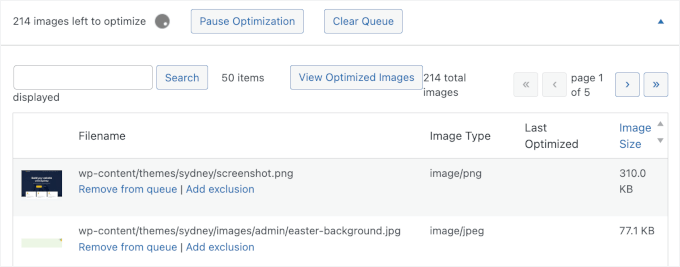
The visual quality difference was almost impossible to spot, even on larger hero images. That said, I saw a clear drop in file sizes and faster page load times.
I also liked that it could resize images based on our theme’s layout to fit the right size page and device. Then, it even converts them into the modern WebP image format without breaking any image URLs.
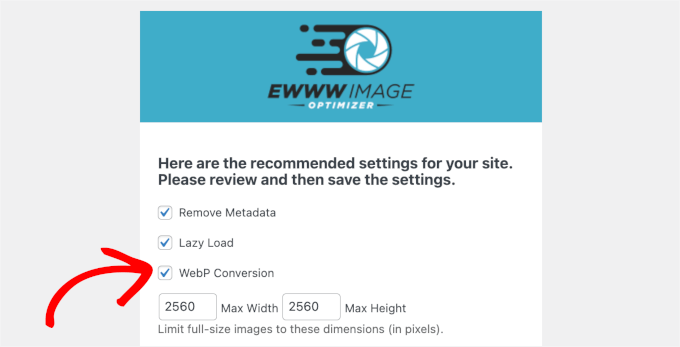
Plus, you can also optimize images generated by other WordPress plugins and stored outside your media library folders.
You can also use the free EWWW Image Optimizer plugin. But sites with a lot of images or sites that get a lot of traffic will want to opt for the paid plan, since it includes an image-optimizing CDN. It’ll automatically compress and convert images as they are viewed.
🌟 Why I recommend EWWW Image Optimizer: Based on my findings, EWWW Image Optimizer is the best overall solution for automatic compression. It allows you to optimize unlimited images for free on your own server, which is great for privacy.
2. Optimole
| Pros of Optimole | ✅ Image CDN for fast global delivery ✅ Real-time image optimization and resizing per visitor/device ✅ Central dashboard to view and manage optimized images ✅ Control over compression quality, resizing, and lazy loading ✅ Built-in watermarking (great for photographers) |
| Cons of Optimole | ❌ Requires account creation and API key setup ❌ Pricing based on visitors per month, which can increase costs as traffic grows |
| Pricing | Free Optimole plan is available for up to 5,000 visitors/month Paid plans start at $19.00 per month (billed annually) for up to 48,000 visitors per month |
| Best For | Sites that want a CDN-based, fully automated image optimization workflow, especially portfolios and photography sites needing watermarking |
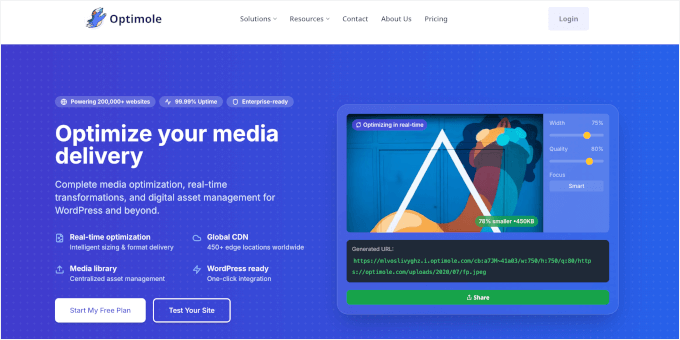
Optimole is a cloud-based image optimization plugin. It uses its own CDN to automatically deliver perfectly sized and compressed images to every visitor.
For more details, see our complete Optimole review.
My Experience
In my tests, getting started with Optimole only required a quick account creation and API key setup.
Once enabled, it immediately began serving my images through its CDN, helping them load quickly no matter where visitors are located.

You can turn on lazy loading and watermarking with just a few clicks.
Lazy loading makes sure images load only when they’re about to appear on the screen. This helps pages load faster and reduces unnecessary data usage.
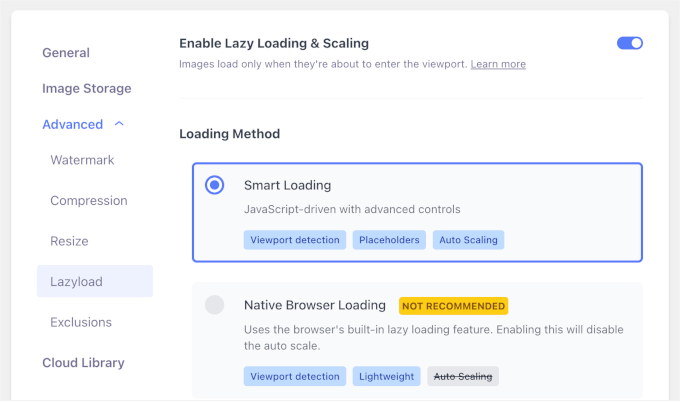
And I found the autowatermark is great for photographers who are trying to protect their work.
From the dashboard, I could easily see how many images were optimized and how much bandwidth we were saving. When switching between devices and screen sizes, Optimole automatically delivers the correct image size without needing to configure multiple versions.
🌟 Why I recommend Optimole: After testing, I recommend Optimole if you want a complete “hands-off” solution. Its built-in CDN makes sure your images load fast for visitors all over the world, and the free plan is perfect for starting out.
3. ShortPixel Image Optimizer
| Pros of ShortPixel Image Optimizer | ✅ Automatically starts compressing after activation ✅ Multiple compression options and formats ✅ Stores original images in a separate folder for backup ✅ Easy PNG ⇄ JPEG conversion ✅ Compatible with WooCommerce, NextGEN Gallery, and WPML ✅ Cloudflare integration to auto-update optimized images ✅ Very affordable for high image volumes |
| Cons of ShortPixel Image Optimizer | ❌ Requires API key setup with email ❌ Per-image limits mean heavy users will need a paid plan |
| Pricing | Free ShortPixel version is available for 100 images/month Paid plans start at $8.33 per month (billed annually) for unlimited optimizations |
| Best For | Users who want strong compression and image conversion at a low monthly cost, including WooCommerce stores and image-heavy blogs |
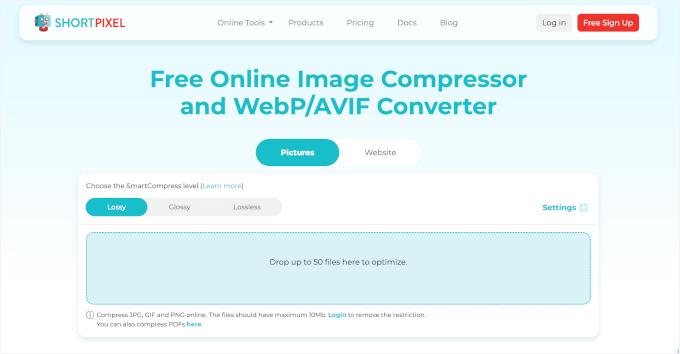
ShortPixel Image Optimizer is a feature-rich image compression plugin that gives you detailed control over image formats, quality levels, and how aggressively your images are optimized.
It includes advanced features and lets you choose different compression formats.
My Experience
When I tried ShortPixel, getting started was straightforward. I activated the plugin, entered my API key (because I’m using the free plugin), and it was ready to go. It immediately began compressing new image uploads.
I also ran the bulk optimizer on an existing media library with dozens of images.
The basic free account allows you to compress up to 100 images per month, and you’ll need to upgrade to their paid plans to increase this limit.
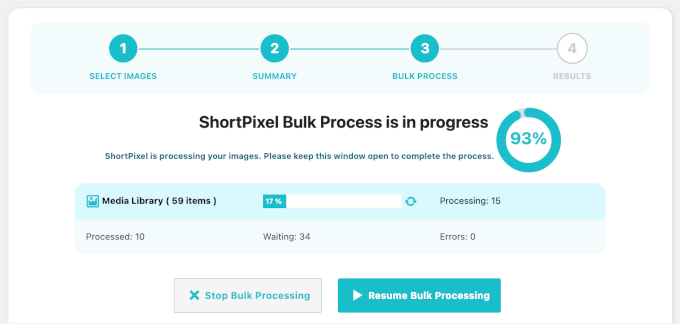
ShortPixel keeps backups of original images, which made it easy for me to test lossy, glossy, and lossless compression safely. In my tests, the lossy setting offered the best balance between smaller file sizes and good visual quality.
I also found that the built-in PNG to JPEG conversion and Cloudflare WordPress CDN integration worked smoothly. Images were updated on the front end automatically, without requiring any manual steps.
Also, it’s compatible with WooCommerce, NextGEN Gallery, and the WPML translation plugins.
🌟 Why I recommend ShortPixel Image Optimizer: ShortPixel Image Optimizer is a great option for users who need high-quality compression on a budget. It is also an excellent choice if you have a lot of PDF documents that need optimization.
🧑💻 Expert Tip: Remember that cloud-based optimizers often charge based on the number of ‘thumbnails’ generated, not just the original upload.
A single high-res photo could consume 5–10 credits, depending on how many image sizes your WordPress theme requires.
4. reSmush.it

| Pros of reSmush.it | ✅ Automatically optimizes images on upload ✅ Bulk optimization for existing images ✅ Simple slider to control image quality and compression ✅ Uses reSmush API for straightforward optimization ✅ Ability to exclude specific images from compression |
| Cons of reSmush.it | ❌ No separate compression presets (uses a single quality slider) ❌ Only optimizes images under 5 MB ❌ Less flexible than some other tools for power users |
| Pricing | Free |
| Best For | Users who want a free, simple, and quick way to compress images without lots of complex settings |
reSmush.it is a lightweight, free image optimization plugin that focuses on simple bulk and automatic image compression without overwhelming you with settings.
It’s ideal if you want to enable it once and let it work quietly in the background.
My Experience
During my testing, reSmush.it was one of the quickest plugins to set up. I activated it, adjusted the quality slider, and it immediately started optimizing new image uploads.
I found that running the bulk optimizer on older images was straightforward, too. It processed my media library smoothly without slowing down my site.
I also liked that I could exclude specific images when full quality was needed, such as logos or detailed infographics.
The downside is that it doesn’t have different compression levels. It also limits optimization to uploads lower than 5MB in size.
🌟 Why I recommend reSmush.it: I recommend reSmush.it for beginners who want a completely free and simple tool. It is the easiest way to reduce image file sizes without dealing with complex settings.
5. TinyPNG

| Pros of TinyPNG | ✅ Automatic compression on upload ✅ Bulk optimization for older images ✅ Choose which WordPress image sizes to optimize ✅ Can set a maximum upload size and auto-resize larger images ✅ Option to preserve metadata (date, copyright, GPS) in JPEGs |
| Cons of TinyPNG | ❌ Requires account creation ❌ Free plan is limited to 500 credits per month (roughly 100 images) ❌ Paid plans are credit-based, which can be hard to budget |
| Pricing | Free version is available (500 images/month) Paid plans start at $0.009 per image after the free tier |
| Best For | Small to medium sites that mainly use JPEG/PNG and want simple controls over sizes and metadata |
The TinyPNG plugin automatically sends your images to the TinyPNG service and returns highly compressed JPEG and PNG files with almost no visible quality loss, all from your WordPress dashboard.
My Experience
When I tested the TinyPNG plugin, connecting it to my TinyPNG account was the only setup step. After that, every new image upload was automatically sent to their servers, compressed, and then returned to my media library.
I configured the plugin to optimize only the image sizes actually used by my theme, which helped reduce unnecessary processing. I could also set a maximum size for my original uploads.
The bulk optimization tool handled large batches of existing images reliably, and I could see before-and-after file sizes directly inside the media library.
In my visual checks, even heavily compressed images still looked sharp enough for blog posts and featured images. I also found that I could save image data like time and date, copyright information, and GPS location on JPEG files.
🌟 Why I recommend Compress JPEG & PNG: I found this plugin great for users who prioritize image quality above all else. The compression algorithm is excellent at reducing file size without making images look grainy.
6. Envira Gallery

| Pros of Envira Gallery | ✅ Full-featured, responsive gallery plugin with built-in compression ✅ One-click enablement of compression inside galleries ✅ Multiple compression levels: lossy, glossy, lossless ✅ Automatically compresses gallery images after setup ✅ Extra features: watermarking, proofing, printing, protection, zoom, and more ✅ Free version available (core gallery features) |
| Cons of Envira Gallery | ❌ Image compression feature only available on Pro plan ❌ More than just a compression plugin, so it may be overkill if you only want optimization |
| Pricing | Free version of Envira Gallery is available The Pro plan with image compression starts at $99.50 per year |
| Best For | Photographers, creatives, and businesses needing beautiful galleries with built-in compression, watermarking, and image protection |
Envira Gallery, the best photo gallery plugin for WordPress, is the only tool that combines high-end visual displays with built-in image compression to prevent large photos from slowing down your site.
To learn more, see our detailed Envira Gallery review.
My Experience
In my Envira Gallery tests, I created several galleries using high-resolution photos and enabled the image compression add-on from the settings.
For most image galleries, the glossy option struck the best balance between image quality and performance.
When I switched between lossy, glossy, and lossless compression, it was easy to see how aggressive I could be before noticing any loss in quality.
For existing gallery images, Envira automatically recompressed them, so I didn’t need to re-upload anything. Combined with watermarking and image protection, it gave me a complete workflow for managing client galleries and portfolios in one place.
🌟 Why I recommend Envira Gallery: I highly recommend Envira Gallery specifically for photographers and portfolio sites. It handles compression, watermarking, and beautiful gallery layouts all in one powerful plugin.
7. WP Rocket
| Pros of WP Rocket | ✅ Leading caching plugin that significantly speeds up WordPress ✅ Built-in lazy loading to delay image loading until in view ✅ Tight integration with Imagify for powerful image optimization ✅ Imagify can bulk optimize, resize on the fly, and restore originals ✅ Full control over compression settings to match your quality needs |
| Cons of WP Rocket | ❌ No free version ❌ Image compression relies on the separate Imagify plugin ❌ Can be more than needed if you only want image optimization without caching |
| Pricing | Starts at $59 per year for a single-site license |
| Best For | Businesses that want an all-around performance boost, caching + image optimization, and are comfortable using both WP Rocket and Imagify together |
WP Rocket is the best WordPress caching plugin on the market. It’s very beginner-friendly and will help to make your site very fast.
We use WP Rocket on WPBeginner for speed optimization. To read more about our experience, see our complete WP Rocket review.
My Experience
During testing, I enabled lazy loading for images and saw an improvement in perceived load times, especially on long blog posts with lots of images. Images loaded only as I scrolled down the page, which significantly reduced the initial page weight.
They also developed a plugin called Imagify. When I paired WP Rocket with Imagify, I had a complete performance setup. Imagify handled image compression and resizing, while WP Rocket took care of caching, file optimization, and content delivery.
I also liked that the default settings worked well out of the box, so I only needed to fine-tune a few options to match my WordPress theme.
🌟 Why I recommend WP Rocket: If you want to speed up your entire website, not just your images, then WP Rocket is a good option. While it works best with the Imagify plugin, the combination provides the ultimate performance boost for WordPress.
Bonus: Jetpack

| Pros of Jetpack | ✅ All-in-one plugin for security, performance, and marketing ✅ One-click enablement of image optimization (very beginner-friendly) ✅ Uses a CDN to serve optimized images and reduce server load ✅ Image compression available in the free version ✅ No complex settings to manage |
| Cons of Jetpack | ❌ Feature-heavy plugin; may feel bloated if you only need image optimization ❌ Less granular control over image compression behavior ❌ Some users prefer separate, lighter-weight tools for each function |
| Pricing | Free Jetpack version is available Paid plans for the Security Bundle start at $9.95 per month (billed annually) for the first year |
| Best For | Beginners and users who already use Jetpack for security/performance and want a simple, CDN-based image optimization feature built in |
Jetpack is a powerful WordPress plugin suite that combines important WordPress features into a single plugin. The primary focus is security, performance, and marketing.
At WPBeginner, we used to use Jetpack for image optimization before switching to other solutions. To read more about our experience, see our complete Jetpack review.
My Experience
In my Jetpack tests, turning on image optimization (‘Site Accelerator’) was as simple as flipping a single switch.
As soon as I enabled it, images started loading from WordPress.com’s CDN instead of my own server. I checked several posts and confirmed that the image URLs were updated automatically, with no broken media.
On slower hosting, this made a noticeable difference in how quickly image-heavy posts appeared.
Since there are no extra compression settings to manage, it’s an easy recommendation if you’re already using Jetpack and want faster images without adding another plugin.
If you like the idea of Jetpack, but are looking for plugins to replace all of Jetpack’s features, then see our guide on the best alternatives to the WordPress Jetpack plugin.
🌟 Why I recommend Jetpack: Jetpack can be a good option for users who want a simple, maintenance-free solution. If you are already using Jetpack for security or backups, then enabling image optimization is easy.
Comparison Test Scores for Image Compression Plugins
Now that you know about the different WordPress image compression options, let’s take a look at how they compare in terms of performance.
We ran our tests by uploading the same image using each plugin. To keep the results as fair as possible, we used each plugin’s default settings and tested how they handled the same image file.
Some plugins apply image compression globally across WordPress, while others only optimize images in specific contexts, such as inside galleries or through a companion plugin.
In those cases, we tested the image using the plugin’s recommended setup so the results reflect how most users would actually use it.
How I Tested JPEG Image Compression
I used the following JPEG image for my tests. It is 118.3 KB in file size.

I didn’t touch any of the plugin settings and tested the compression with out-of-the-box settings. Here are my test results:
| Plugin | Compressed Size | Saved (%) | Method |
|---|---|---|---|
| EWWW Image Optimizer | 64 KB | 54.24 | Lossless |
| Optimole | 64 KB | 54.24 | Lossless |
| ShortPixel Image Optimizer | 72 KB | 39.30 | Lossless |
| reSmush.it | 78 KB | 20.81 | Lossless |
| TinyPNG | 118.1 KB | 2 | Lossy |
| Envira Gallery | 98 KB | 17.16 | Lossy |
| WP Rocket (with Imagify) | 41.40 KB | 65.02 | Lossless |
How I Tested PNG Image Compression
Next, I wanted to test a PNG image to see how my contenders optimized it.
I used the following PNG image for the test, and it is 99.4 KB in file size.

Here are my test results:
| Plugin | Compressed Size | Saved (%) | Method |
|---|---|---|---|
| EWWW Image Optimizer | 97 KB | 1.9 | Lossless |
| Optimole | 41 KB | 64 | Lossless |
| ShortPixel Image Optimizer | 36 KB | 56 | Lossless |
| reSmush.it | 36 KB | 56 | Lossless |
| TinyPNG | 34.3 KB | 54 | Lossy |
| Envira Gallery | 83 KB | 16.5 | Lossless |
| WP Rocket (with Imagify) | 20.06 KB | 79.8 | Lossless |
Which is The Best Image Compression Plugin for WordPress?
If you are looking for the best image compression plugin, then EWWW Image Optimizer is the best choice.
It offers high levels of compression that don’t sacrifice image quality, plus it’s equipped with an image CDN and other features that will optimize your website for speed.
Another great option for sites that get less traffic is Optimole. It operates entirely in the background and takes care of image optimization for you, plus it’s free up to 5,000 visitors per month.
If you’re looking for an affordable plugin that offers high levels of compression and image conversion, then ShortPixel is worth checking out.
FAQs About Image Compression Plugins
To help you get the most out of image compression plugins, here are answers to common questions about how they work, when to use them, and what to watch out for.
Do image compression plugins reduce image quality?
Most image compression plugins are made to shrink image file sizes without hurting how they look. In my tests, lossy compression usually gives the best balance between smaller files and good-looking images. For more control, many plugins also offer glossy or lossless options.
Can image compression plugins optimize existing images?
You can, but you don’t have to. A good image compression plugin will automatically optimize images after you upload them, including all the different image sizes WordPress creates. This saves time and keeps everything consistent.
Should I compress images before uploading them to WordPress?
Ideally, yes, compressing images before uploading gives you the most control. However, the entire point of using a compression plugin is to automate this process so you don’t have to do it manually.
Do I still need image compression if I’m using a CDN?
Yes. A CDN helps images load faster, but it doesn’t make image files smaller by itself. Image compression and a CDN work best when used together. Compression reduces file sizes, and the CDN delivers those images quickly to visitors around the world.
Next Steps for Using Images on WordPress Sites
I hope you found this comparison of the best WordPress image compression plugins useful.
You may also want to see our other guides on:
- Image SEO to Optimize Images for Search Engines
- How to Do Basic Image Editing in WordPress (Crop, Rotate, Scale, Flip)
- Image Alt Text vs Image Title in WordPress – What’s the Difference?
- How to Optimize Images for Web Performance Without Losing Quality
- Best Featured Image Plugins and Tools for WordPress
If you liked this article, then please subscribe to our YouTube Channel for WordPress video tutorials. You can also find us on Twitter and Facebook.


Jiří Vaněk
So far, I’ve been using online converters, first converting images to the WebP format and then uploading them to my website. This isn’t optimal, especially time-wise, since most of my images are in PNG, and I have to do the entire process manually. A while ago, I started looking into some kind of conversion plugin for the website. This article came at the perfect time, and I quite like the EWWW Image Optimizer plugin. I’ll definitely try the free version first, but if it really starts saving me time and resources, I’ll likely go for the paid version as well.
Moinuddin Waheed
image compression plugin is a must for having blazing fast websites.
most of the website slow speed is caused by having heavy images on that.
I have used image optimizer and lately I was anxious about its usage.
But after my confusion about plugin and its role in website performance, I am optimistic about using it.
Brad Scott
Can you please explain why you recommend EWWW, considering that it performs so poorly compared to the others in your PNG compression test? Thanks.
WPBeginner Support
Our recommendation was based on the JPEG as that is what most users tend to add to their site instead of PNGs
Admin
mike
Nice article but is there a way to delete the original unoptimized image ? because you’ll use the optime one in its place
is there a way? a hook , something?
thanks
WPBeginner Support
Depending on the plugin you use there is an option to remove the original image in the plugin’s settings.
Admin
mehedionion
Personally I am using ShortPixel.
I have one question:
can I use two of them in the same website?
thank you for the very useful article!
WPBeginner Support
We would not recommend more than one image compression plugin on the same site to prevent certain compression issues.
Admin
Janice
I’m torn between getting the Shortpixel plugin or just continue to use the Shortpixel website tool. (One less plugin). Are there extra advantages to having the plugin? All my photos to date were already optimized with the Ewww Image Optimizer (which I have now deleted).
WPBeginner Support
Unless we hear otherwise, the benefit of using the plugin mainly means that you would not go to their site to optimize your images.
Admin
Ondrej
thank you for the very useful article! I have one question:
If I optimize the images before upload, do I need then any image optimization plugin?
WPBeginner Support
If you already optimize the image, you do not need to worry about adding a plugin to help you optimize them again.
Admin
Rico
Hello ,
Thanx for the article and share.
I do have a question about this if I used a compression plugin and used another one on the same website.
How will this affect the image?
Will this be a compression on a compression if I used another plugin>?
Thanxx
WPBeginner Support
Yes, it would likely cause that issue, we would recommend keeping the compression to a single plugin for the time being.
Admin
Sara Meyers
The short pixel image optimizer is fantastic. Thanks.
WPBeginner Support
Glad you liked the recommendation
Admin
festus
Great article to date compared to other content out there. I think my best is shortpixel.
Do you still think it is among the top five this month?
WPBeginner Support
We still recommend these plugins
Admin
Iain
I sell prints on Storefront. They all have white backgrounds. An image (eg a car) takes less than half the page space and is surrounded by white. The white surround (requiring zero resolution) adds to size but shows depth and space for mounting and framing. If I crop the white space a buyer will not see the print in context. How can one manage this conflict between large areas of “dead” space that serve a purpose and the reduction of image sizes for uploading to Wordpress?
WPBeginner Support
The image compression plugins should not remove the white space that you say is required, they would only reduce the size of the data that makes up the images.
Admin
Enry
reSmushit hasn’t been updated in 10 months and its support forum is filled with unresolved tickets saying it doesn’t work any more. Looks abandoned unfortunately.
WPBeginner Support
Thank you for reaching out, it appears the plugin was recently updated and they are replying to tickets. The plugin does not appear to be abandoned.
Admin
Una
Thanks so much for this article – it’s really helpful! I’m going to install reSmush.it now thanks to your recommendation.
WPBeginner Support
You’re welcome, glad our recommendation could be helpful
Admin
Owen Jones
Hi,
Thanks for the info, it was very useful.
I needed compression because my blog had ground to a halt, and support told me mo optimise ‘image and js files’.
Do you have a suggestion for the latter too?
Thanks for your help,
Owen
WPBeginner Support
You would likely need to reach out to the support for the plugin that has the JS file that is giving you trouble but for some tips, you may want to take a look at our article here: https://www.wpbeginner.com/wordpress-performance-speed/
Admin
Owen Jones
Thanks for replying.
I absolutely no idea which js file is causing problems, or even whether any are at all.
That is beyond my current ability
Regards,
Owen
WPBeginner Support
You would want to take a look at the article in our previous reply and that should help with the process
David
If I were to try a few of the different free plugins will each re-optimize the images? This is for a photo website, images already optimized using Photoshop “Save for Web” feature. I use the NextGen Pro plugin. When I run a test on GTMetrix I keep seeing a note to optimize my images. I’ve tried EWWW Image Optimizer, Smush and Imagify.
My concern is that trying these different plugins keeps optimizing the images over and over. Do each of the plugins store their own version of the optimized original?
Thanks for the article and any comment!
WPBeginner Support
It would depend on the plugin for how they handle the original but you are correct. If you are using an image optimization plugin, you would only want to use one to prevent multiple types of compression on an image.
Admin
Amir Abbas
Thanks for sharing list of cool compression plugins. I downloaded smush.it
WPBeginner Support
Glad our list was helpful
Admin
Stéphane
I would be interresting to see the WordPress default compression results in your comparison list. At my knowledge, WordPress use jpeg compression at 80% or something, but does not recompress the various thumbnails sizes so it slows down the admin dashboard a bit. For best visual results, I already tried Photoshop manual compression and disabled the WordPress compression. Because even if you work hard to display the perfect image with Photoshop, WordPress will recompress it in the upload process.
Donna McMaster
I don’t understand how these percentages can be meaningful without evaluating the quality of the resulting product. I can reduce images by 20-80% in Photoshop by changing the JPEG quality, but at some point they degrade and below that they look awful. Did you compare the quality of the results, looking for artifacts, color changes, perceived sharpness?
Thanks,
Donna
WPBeginner Support
Hi Donna,
All these plugins attempt to compress images without quality loss. They keep their settings lower to ensure minimal quality loss. However, when you do the same thing in Photoshop you can compress more to the point where quality is acceptable to you.
Admin
Eamon Moriarty
I prefer Imsanity.
Not only can you set the images to various levels of compression, but it will also resize huge images to more manageable sizes for web.
Frankly Frank
I’d like to point out that the PNG compression by ReSmush.it is NOT lossless. I checked their API and while JPGs can be lossless, PNG compression is NOT. Article needs to be updated to reflect that.
In addition, ReSmush.it’s interface is vague in compression options because the only thing you can set is image quality value, which is default at 92. There’s no way to tell if that means lossless compression or not. I checked their site again and they indicate anything below 90 will result in loss of value, so I’m ASSUMING then that an image quality value of 90+ will be lossless.
BUT because they didn’t explain it clearly and because there’s no option to use lossless PNG compression, I’ve had to look for another plugin solution.
Nayeem
reSmush.it use my hosting CPU to compress the image???
prince
hi ! after reading this article, i downloaded the resmush.it plugin on my few site, and activate it, and compressed all my images. according to it’s dashboard worked perfect and save more than 50% but when i checked the size of my images on my site they are still same, and mysql database also.
sorry for my bad english, i hope you will understand.
bye take care
WPBeginner Support
Hi Prince,
Please try other plugins mentioned in the list.
Admin
Prince
hi !
thanks for your reply. yes i will try other plugins
bye tk cr
prince
hi ! please help . i deleted the resmush.it plugin from stayfitpros.com site. Now images are not showing on desktop . images are present but not showing. if you click any product and go to their main page images are not displaying.
WPBeginner Support
Hi Prince,
You can reinstall the plugin. You can also ask plugin author for support.
prince
hi !
i contacted with my theme developer , he told me to deactivate all the cache plugins. I deactivated cache plugin and also wp loader option from speed tab of cloudflare now problem is solved.
bye tk cr
ranjot singh
such a great article
Andrzej
Great article, thank you. I’ve got WP Smush, but after that, I’m going to try reSmush.it
I hope it be better.
Best regards
Tim Bowers
ANDRZEJ, I’m not sure if you’re using the free or premium one here. If using the pro you would see savings of around 47.4% on the first image and on the full image it’s 55.5%.
http://take.ms/IVUBa
On the second image, it’s 78.6% for the full one and overall with thumbs it’s 72.3%.
http://take.ms/WpgS0
One last thing to mention is that we’re close to releasing a new version that will offer further improvements to your image optimisation percentages and get your site loading even quicker.
Just wanted to throw this out.
Andrzej
Thank you Tim. I’m using free version… for now. But I’m thinking about premium
Json
Thanks for comparision
Jules Webb
Great comparison, thank you. I was hoping to see Imagify in the lineup and am curious how it would stack up against the others.
Norman Zee
Hi,
I use Imagify (from WP Rocket team)
Very easy to use you can optimize JPGs, PNGs & GIFs in 3 compression levels
Isn’t Free but purpose interressing One time plans.