


There are dozens of WordPress security plugins that promise the same thing: firewall, malware scanning, login protection, etc.
But what actually separates them is where the protection runs. Some block attacks before it reaches your server, while others catch it once it’s inside. We’ve dealt with our fair share of hacked WordPress site cleanups to know the right security plugin and settings vary based on your business needs.
In this article, we’ll compare the best WordPress security plugins, what each one is genuinely good at, and which we’d recommend for your site whether that’s a personal blog or an online store taking payments.
Quick Picks for The Best WordPress Security Plugins
If you are in a hurry, here’s our expert pick for the best WordPress security plugin based on your needs. For most sites, Cloudflare is the best starting point because its free plan blocks attacks before they ever reach your server.
| Plugin | Best For | Pricing |
|---|---|---|
| 🥇 Cloudflare | Free network-level firewall, DDoS protection, and CDN | Free / $20+ per month |
| 🥈 Wordfence | Budget-friendly, all-in-one firewall plugin | Free / $149 per year |
| 🥉 Patchstack | Automatic vulnerability patching | Free (alerts only) / from $5 per site per month |
| MalCare | In-depth malware scanning and removal | Free / $99/yr detection only; removal from $299/yr |
How I Tested and Reviewed WordPress Security Plugins
You want a security plugin that scans your site for vulnerabilities and malware, blocks brute-force attacks, and protects it from hackers. To help you find the best solution, I tested the most popular WordPress security plugins, one by one.
I paid special attention to the following criteria:
- How it blocks malicious traffic – There are different techniques used by firewalls to block bad requests from affecting your site. Some are good for your site’s performance and others not so much.
- Whether the plan includes cleanup – Plenty of tools can detect malware. Only few remove it automatically, and I checked which tier you actually need for that.
- How current the free tier’s threat data is – A free plan that delays vulnerability updates by weeks leaves your site exposed to known threats.
- Whether the vendor runs its own security research – Tools backed by an in-house research team or a bug bounty program tend to catch new threats earlier than ones that rely on public disclosures.
Those four criteria come from over 17 years of managing WordPress sites ourselves, including the eCommerce stores where downtime costs us money. We run our own businesses on WordPress and have personally used and tested these tools on live websites. For details, you can see our editorial process.
For this article, I’ve grouped my recommendations into 3 tiers: all-in-one plugins that cover the basics, hardening tools that close specific weak points, and single-use plugins that do one job well. Almost every site will need the first tier, so start there and add from the others only if something is still missing.
Use the quick links below to jump to any section:
Best All-in-One WordPress Security Plugins
An all-in-one security plugin handles firewall protection, malware scanning, and login security in one package.
1. Cloudflare
Best for: a free network-level firewall and CDN.
My experience: We’ve been using Cloudflare on WPBeginner for years.

Cloudflare sits in front of your site as a network-level firewall and filters malicious traffic before it ever reaches your server.
We switched to Cloudflare few years ago, and we noticed immediate improvement in page speed and overall stability on WPBeginner. While we use their Business plan, I genuinely believe that even the free plan is excellent for most small to medium-sized websites.
The free plan already includes unmetered DDoS protection (which absorbs the huge volumes of fake traffic attackers send to make a site stop responding), Cloudflare’s free Managed Ruleset, a free SSL certificate, and its global CDN (Content Delivery Network).
Cloudflare provides a clear advantage over any other firewall tool because they have a massive network of CDN servers in every corner of the globe, and a large portion of internet traffic goes through its servers. The firewall rules run on the cloud, so the threats are discovered and eliminated quickly.
To activate Cloudflare, you will need to point your domain to their network by updating your domain’s nameservers. It’s a one-time change, and most hosting support teams will walk you through it.
For details, see our tutorial on how to set up Cloudflare free CDN in WordPress.
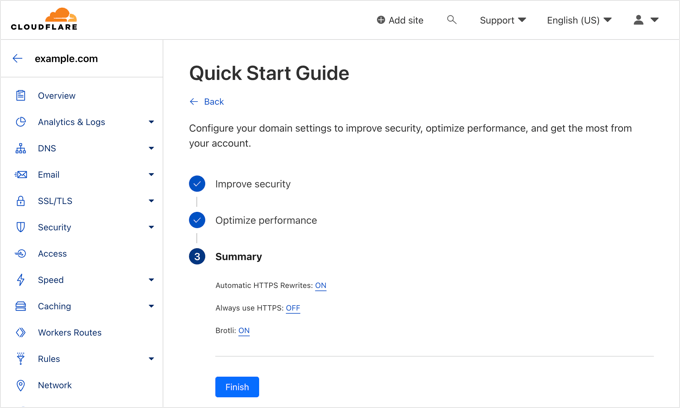
Cloudflare also has a free WordPress plugin that lets you purge the cache, adjust the security level, and view traffic analytics without leaving your WordPress dashboard.
DNS records, SSL certificates, and detailed firewall rules still live in your main Cloudflare account dashboard.
Pros of Cloudflare:
- I love Cloudflare’s Turnstile CAPTCHA feature, which uses simple, non-intrusive challenges to protect your site. It doesn’t ask visitors to solve complex puzzles.
- DNSSEC protects your domain name from spoofing and tampering.
- Cloudflare’s bot management tools help you identify and block malicious bots.
- Their DNS response time is the fastest in the world.
- Their DDoS protection is among the best that we tested.
Cons of Cloudflare:
- The free plan’s firewall only covers Cloudflare’s narrower Free Managed Ruleset. The broader Cloudflare Managed Ruleset, and custom rules, need a paid plan.
- Cloudflare protects your site at the network level, but it doesn’t scan your WordPress files for malware. You’ll still want a scanner like MalCare if malware ever makes it onto your site.
Why I recommend Cloudflare – Cloudflare is my top pick because of the cloud firewall feature which blocks threats before they even touch your website. This not only keeps your website secure but also improves its performance. We use it ourselves to protect WPBeginner from malicious attacks.
2. Wordfence
Best for: a free, all-in-one firewall and malware scanner.
My experience: I tested Wordfence hands-on before recommending it here.

Wordfence is a free WordPress security plugin that includes a malware scanner, exploit detection, and threat assessment. It’s used by over 5 million websites.
The plugin will automatically scan your website for common threats, but you can also launch a full scan anytime. Wordfence alerts you if it finds signs of a breach, and it includes instructions to fix them.
Wordfence also comes with a built-in firewall that runs on your server just before loading WordPress. This makes it less effective than a DNS-level firewall like Cloudflare, since malicious traffic still reaches your server before Wordfence can block it.
Wordfence free and premium plans don’t include malware removal service. However, users can upgrade to their Care plan ($590 / year) which includes malware removal and site cleanup services.
Pros of Wordfence:
- The plugin adds two-factor authentication to your login.
- When using the plugin on my website, I liked the ‘Live Traffic Insights’ feature. This feature offers real-time visibility into website traffic and potential threats.
- If you have multiple WordPress sites, then you can manage their security from a single dashboard using Wordfence Central.
- It lets you block specific IP addresses and restrict access based on visitors’ location.
Cons of Wordfence:
- Premium Wordfence users get new malware signatures and real-time IP blocklists instantly, whereas the free users get them 30 days later.
- Wordfence runs on your own server, so it can slightly slow down your WordPress site.
- The free version also lacks access to its real-time IP blocklist of active attackers.
Why I recommend Wordfence: Wordfence is a solid choice for site owners on a tight budget who want a free, all-in-one firewall and malware scanner. It’s also a good option if you want to manage the security of multiple WordPress sites together.
3. Patchstack
Best for: automatic vulnerability patching.
My experience: We use Patchstack in production on our own websites.

Patchstack takes a different approach than a traditional firewall or malware scanner. Instead of just blocking bad traffic, it automatically patches known vulnerabilities in your plugins and themes before you install the official update.
These ‘virtual patches’ shield the vulnerable code without touching your files. So, your site stays protected even if you haven’t updated a plugin yet.
Patchstack runs its own bug bounty program and holds CVE Numbering Authority (CNA) status. This means it often has vulnerability data before other security vendors do.
That’s also why so many WordPress hosting companies, like Levamo (formerly Rapyd Cloud), bundle Patchstack into their own security stack. For our eCommerce websites, we use Levamo, so we get PatchStack protection as part of their Advanced Site Shield.
Pros of Patchstack:
- It’s very light on your server. Virtual patches are targeted firewall rules, so Patchstack doesn’t run heavy file scans in the background.
- It warns you about abandoned plugins and plugins that WordPress.org has removed from its directory. A normal update check never surfaces either problem.
- You can manage every site you own from a single Patchstack dashboard and turn on auto-updates for vulnerable plugins right from there.
Cons of Patchstack:
- The free Personal plan only alerts you to vulnerabilities, and it won’t actually block anything.
- Patchstack focuses on vulnerability patching, not general malware scanning or removal. You’ll still want a scanner for that.
- It’s hard to purchase it directly as their pricing model is built for hosting companies and agencies. Although if you’re using Levamo or other hosts that bundle it, it’s easier to get started.
Why I recommend Patchstack: If your site runs a lot of third-party plugins, Patchstack protects you as soon as a vulnerability is discovered in one of them. It’s especially worth it if your host already offers it as an add-on.
4. MalCare
Best for: malware scanning and removal.
My experience: I tested MalCare hands-on before adding it to this list.
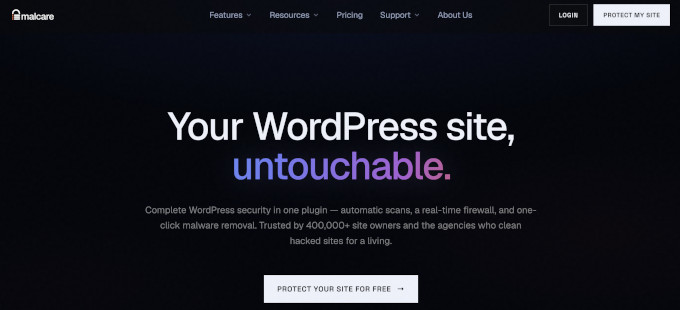
In-depth malware scanning and removal is MalCare‘s whole focus. When I tested it out on my demo websites, I found its malware scanner caught issues that other tools missed.
On the paid Protect plan and above, the scanner runs automatically every day and checks every part of your WordPress site, including files and the database. The free plan only scans weekly.
Unlike other security plugins, MalCare scans on its own servers instead of yours, which keeps your website fast and responsive during a scan.
This off-site processing is a massive advantage if you are on a shared hosting plan that strictly limits resources. You get enterprise-level deep scans without ever triggering server timeouts or slowing down the experience for your visitors.
Pros of MalCare:
- It comes with powerful brute-force protection.
- On the Repair plan and above, you can track all the changes made to your site using the Activity Log feature.
- MalCare’s vulnerability scanner flags potential vulnerabilities on your website.
- MalCare features an Atomic Security layer, which means it blocks bad traffic and login attempts at the server level before they can even load your WordPress files.
Cons of MalCare:
- The free plan only tells you if your site has malware. It won’t remove it.
- Even the cheapest paid plan, Protect at $99/year, is detection and alerts only. Instant cleanup requires the $299/year Repair plan.
- Some user reviews report that MalCare missed malware or failed to remove it, so it’s not foolproof.
Why I recommend MalCare: MalCare is great for sites with limited server resources, since scanning happens on its own servers instead of yours. Just budget for the Repair plan if you actually want one-click cleanup, not just detection.
WordPress Security Hardening Tools
The following tools cover specific gaps that a general firewall or scanner doesn’t handle well on its own.
5. ActiveLayer
Best for: spam protection on WordPress forms and comments without a CAPTCHA.
My experience: We use ActiveLayer on our own business websites.
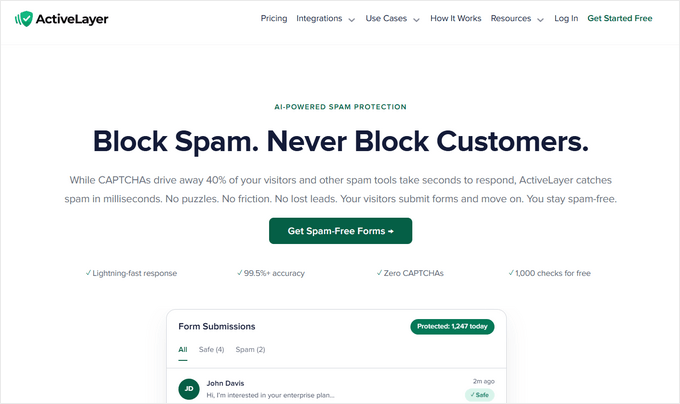
ActiveLayer is a complete spam protection solution that detects spam in user-submitted content and block them without using CAPTCHA.
It connects natively with WordPress comments and all popular form builders, including WPForms, Contact Form 7, and more. The moment a user submits a comment or form, ActiveLayer analyzes it and delivers a verdict within milliseconds.
To catch bot submissions and human spammers, it weighs multiple signals together, like content patterns, submission behavior, and known spam fingerprints.
Everything happens quietly in the background, so your real visitors never see a puzzle, a checkbox, or a “prove you’re human” screen. And because nothing is ever blocked silently, you can review every flagged submission from your WordPress dashboard and release anything caught by mistake. You can read more in our ActiveLayer review.
Pros of ActiveLayer:
- Every plan covers unlimited sites. Most spam protection tools charge per site, and that gets expensive fast if you run more than one website.
- Paid plans start at $4 per month (billed yearly) for 5,000 checks, which makes it the most affordable spam protection tool.
- In the worst-case scenario, if the service is ever unreachable, submissions pass through normally, so your forms never break because of it.
Cons of ActiveLayer:
- The free plan’s 1,000 checks are a one-time allowance, not a monthly limit, so you’ll hit the paid tier fast on an active site.
- It doesn’t offer a money-back guarantee on the paid plan.
Why I recommend ActiveLayer: I highly recommend ActiveLayer to protect all your WordPress forms, especially lead generation forms where using a CAPTCHA will sabotage conversions.
6. Duplicator
Best for: backups and migrations.
My experience: We use Duplicator to back up our own websites.
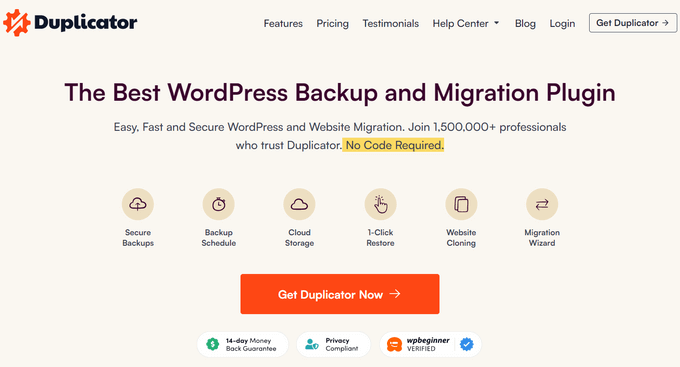
Duplicator is a WordPress backup and migration plugin used by over 1,500,000 professionals. Reliable off-site backups are an important part of WordPress security, and we highly recommend every website owner to have a good backup strategy.
Unlike your hosting backups which are stored on the same server and can be corrupted in the event of a security incident, Duplicator allows you to automatically create and store backups on 3rd-party storage including Duplicator Cloud, Google Drive, Amazon S3, and more.
You can run daily, weekly, or even hourly backups to ensure you have the most up to date backup in the event you need to restore it. What makes Duplicator stand out is the quick restore. Most backup plugins are good at making backups, but they are really slow with restore. This is where Duplicator really stands out.
For details on setting it up, see our guide on how to back up your WordPress site.
Pros of Duplicator:
- The free version already covers manual backups and full site migrations.
- Paid plans add scheduled backups, off-site cloud storage destinations, and one-click restores.
- The Elite plan bundles an Activity Log add-on, so you don’t need a separate tool if you’re already on that tier.
Cons of Duplicator:
- The free version requires manually triggering each backup, and it saves to the same server by default. You’ll need a paid plan for scheduled automatic backups and off-site cloud storage. Duplicator Pro costs $69 per year.
Why I recommend Duplicator: It’s the simplest way to make sure a hack, a bad update, or a hosting failure doesn’t cost you your entire site. If you’d rather use a different backup plugin, then UpdraftPlus is a solid alternative.
7. WP Activity Log by Melapress
Best for: a free activity log.
My experience: I tested this plugin thoroughly for this review.
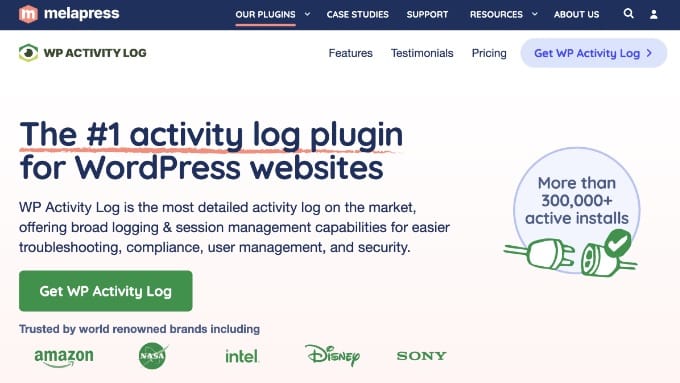
A good activity log helps you find what actually went wrong after an incident, instead of guessing. WP Activity Log, built by Melapress, records logins, content changes, plugin and theme updates, and user actions across your site.
The entries are detailed, too. Instead of a vague ‘post updated’ note, each event shows which user made the change, their role and IP address, and the exact time it happened.
If an attacker compromises a user account, then the log shows you exactly what that account touched, which makes cleanup much faster.
The same trail is just as useful for everyday problems. When a page breaks or a setting changes overnight, the log tells you whether it was a plugin update, a teammate, or something more serious.
Note: If you use shared hosting, keep in mind that unlimited logging creates unlimited rows in your database. On a busy site, this log table can grow rapidly and slow down your website.
Pros of WP Activity Log:
- The free version logs unlimited activity, and you set how long entries are kept.
- All log data stays in your own WordPress database, so you are not sending your site’s activity to a third-party service.
- Premium adds real-time alerts by email, SMS, or Slack when something suspicious happens.
Cons of WP Activity Log:
- The free version has no automated alerts, so you have to remember to check the log yourself.
- Searching and filtering the log is a premium feature. On the free version, you have to scroll through entries manually to find what you need.
Why I recommend WP Activity Log: It’s the more complete standalone activity log if you’re not already on Duplicator’s Elite plan. If you are, then its bundled Activity Log covers this without adding another plugin.
8. Two-Factor Login
Best for: free two-factor authentication if your main security plugin doesn’t include it.
My experience: We use this plugin on our own websites.

Cloudflare and Patchstack does not offer login 2FA at all, so this fills that gap. If you’re already running Wordfence, then its built-in 2FA covers the same job.
Most successful hacks start with a stolen or guessed password. The Two-Factor plugin adds a second login step using an OTP code from an authenticator app, so a stolen password alone isn’t enough to get in.
WordPress core contributors maintain the plugin, and it feels like a native part of WordPress. Its settings live right on each user’s profile page, with no separate dashboard to learn.
It supports several login methods – OTP codes from an authenticator app, email codes, and even a hardware security key. It also generates backup codes for when your phone isn’t available.
Pros of Two-Factor:
- It’s completely free, with no premium upsell.
- Setup takes just a few minutes per user with an authenticator app you already have.
- It works with any standard authenticator app, so you don’t need to install a specific one.
Cons of Two-Factor:
- It only covers login security. You’ll still need a firewall or malware scanner for everything else.
- There is no central screen to enforce 2FA for everyone. Each user has to set it up on their own profile page.
Why I recommend Two-Factor: It’s the simplest way to stop a stolen password alone from being enough to break in, and it costs nothing to set up.
Single-Use WordPress Security Plugins
These tools are nice to have depending on your specific setup, not something every site needs.
Each one solves a narrow problem, so pick the ones that match your situation:
- Disable XML-RPC. XML-RPC is an older WordPress feature that attackers use for brute-force and DDoS attempts, but blocking it can also break Jetpack features like Stats and Publicize. If you are comfortable editing site files, you can skip the plugin and block it with a short .htaccess rule instead. See our guide on how to disable XML-RPC in WordPress.
- CAPTCHA 4WP. A CAPTCHA on your login and registration forms blocks automated brute-force attempts, and it’s worth the small amount of friction here. Only add it if brute-force attempts are an actual problem for you. See our guide on how to add CAPTCHA to your WordPress login and registration form.
- Members plugin. Useful if you have multiple team members who need custom permissions, so you’re not giving everyone Admin-level access. It only manages what your own team can do. It does nothing against outside attackers.
- Login for Google Apps. Lets users log in with their Google account instead of a separate WordPress password, with 2FA already built into Google’s login. Helpful for larger organizations that want centralized login security, especially if your team uses Google Workspace. We use this for our internal websites.
- Limit Login Attempts Reloaded. Blocks an IP address after too many failed login attempts, which stops brute-force attacks on your login page. It won’t stop an attacker who’s already inside through a plugin vulnerability. That’s the job Patchstack and MalCare handle.
- Inactive Logout. Automatically logs out users after a period of inactivity, which matters most right after a hack when you want stale sessions closed. It’s a convenience-versus-security tradeoff for everyday use, since frequent logouts can be annoying on a site you use all day.
WordPress Security Plugins I Don’t Recommend (and Why)
You may notice that some well-known WordPress security plugins are missing from the list above. I didn’t want our recommendation to lead to choice paralysis. Here’s what kept each of them out:
- Sucuri. Sucuri’s free plugin only scans and audits your site, but it doesn’t include a firewall at all. The actual firewall is a separate paid service from $9.99 per month, so the free plugin alone doesn’t do the network-level blocking that Cloudflare’s free plan already covers.
- SolidWP (formerly iThemes Security). In May 2026, its parent company Liquid Web folded SolidWP into Kadence Security. They have committed to critical security patches for the absorbed brands only through April 2027.
- AIOS (All-In-One Security). AIOS’s free version doesn’t include malware scanning at all, and its developer doesn’t run a public bug bounty program the way Wordfence and Patchstack do. So, new threats reach it later.
- Jetpack Protect. The free plan scans for vulnerabilities, but Jetpack locks the automatic firewall that actually blocks them behind the paid Jetpack Security or Complete plans which can get pricey.
- BulletProof Security. Its own developer describes the built-in MScan scanner as a basic, general-purpose checking tool, and most of its protection comes down to .htaccess rules you could add yourself. Even paid users only get community forum support, not direct support from the developer.
What Is the Best WordPress Security Plugin?
Cloudflare is my top pick, since its free plan alone covers firewall protection, DDoS protection, and a CDN.
If you want your plugins and themes automatically shielded against known vulnerabilities, then Patchstack is the better fit. For in-depth malware scanning and removal, choose MalCare instead.
If you’re on a tight budget, then Wordfence is a good choice.
Frequently Asked Questions About WordPress Security
Here are some questions that our readers frequently ask about WordPress security plugins.
Can I use more than one WordPress security plugin?
Yes, but stick to one, or at most two that cover genuinely different jobs. For example, a network-level firewall like Cloudflare pairs well with a malware scanner like Wordfence or MalCare. However, two plugins that both scan files or filter traffic just waste server resources without adding real protection.
How often should I scan my website for malware?
Daily, and most security plugins handle it automatically once you switch scanning on.
Leave the automatic scan running, but don’t treat a clean scan as proof your site is fine. Some of the most widespread WordPress malware families now show clean pages to scanners while redirecting your actual visitors.
Watch for the symptoms a scan can’t see, like spam pages appearing for your domain in Google, visitors reporting redirects to sites you don’t recognize, or a security notice in Google Search Console.
Is WordPress itself secure?
The core software has a strong track record. Patchstack counted only 6 vulnerabilities in WordPress core in 2025, against more than 11,000 across plugins and themes.
The July 2026 core exploits were the rare exception, and even then, the patches shipped days before the wave of attacks started. Attackers took over only the sites that had not updated in time.
In practice, your plugins are where attackers get in. That is why fast updates matter more than which security plugin you choose.
Can I rely solely on a security plugin to protect my website?
No, a security plugin is just one part of a comprehensive security strategy. Regular updates, strong passwords, and backups are equally important for securing your website.
For more details on all of this, you can see our ultimate WordPress security guide.
I hope this article helped you choose the best WordPress security plugins for your site. You may also want to see our guide on how to speed up WordPress and how our pick of the must have WordPress plugins that we recommend for all websites.
If you liked this article, then please subscribe to our YouTube Channel for WordPress video tutorials. You can also find us on Twitter and Facebook.



lorrima rooney
Where does Jetpack rank on this list?
WPBeginner Support
If you are only using it for security we would not recommend it due to how many different functions that are included in the plugin, for more on this we would recommend taking a look at our article below:
https://www.wpbeginner.com/plugins/best-alternatives-to-the-wordpress-jetpack-plugin/
Admin
Jiří Vaněk
Of the solutions mentioned above, I’m most satisfied with Cloudflare, which I now use almost everywhere. I started using it primarily because I have my own server and was concerned about DDoS attacks. It filters these attacks brilliantly, and on top of that, I receive monthly reports. Another great feature is their CDN, which significantly boosted my site’s speed and loading times, especially in areas distant from the Czech Republic, where the data center hosting my server is located. They offer top-notch services. Lastly, I recently switched from Google reCAPTCHA to their Turnstile CAPTCHA solution. I find it much less intrusive for users, and it works perfectly. As a bonus, the WP Rocket cache plugin works flawlessly with them—when I clear the cache on my site, the cache on the CDN is also purged. Absolutely brilliant. So for me, Cloudflare is currently an outstanding solution for website security, both for my own server and shared hosting.
Moinuddin Waheed
I have used wordfence and found it to be very useful in protecting my website.
I think for the most users it entirely is a pure choice to choose from these available alternatives.
More or less all of these gives same sort of protection to the website.
But for larger websites with heavy traffic and brand, it is wise to choose the best solution like sucuri and should take additional precautionary measures.
I really appreciate the in-depth comparison of all the security plugins alternatives.
Kzain
I wanted to install Wordfence but many people noticed it slows the site and takes a lot usage so I think I will be using solid security it’s light and does all the job more than a free version of Wordfence. Just what I feel and as above mentioned it’s up to everyone’s standards and option in a website
Dennis Muthomi
For me I use Wordfence to secure my WordPress site.
I’ve used it for over a year because I really like the threat detection alerts and firewall features it provides to protect my site from attacks.
Just wanted to share the security plugin I use.
WPBeginner Support
Thank you for sharing what you use
Admin
Dayo Olobayo
I appreciate the in-depth comparison of these different security plugins. It’s clear that there’s no one-size-fits-all solution and the best plugin for you will depend on your individual needs. One thing I would like to add is the importance of having a strong password and keeping your WordPress core and plugins up to date. Even the best security plugin can’t protect your site from everything if you don’t take these basic precautions.
Mrteesurez
Yes, you are right, and I especially agree with your last point. Security plugins are valuable tools, but they can only do so much but they are not a complete solution. As the adage goes, “Prevention is better than cure.” It’s crucial for everyone to use strong passwords, perform frequent updates, and avoid bad practices, including the use of nulled items.
Maintaining the ultimate security of your website involves a comprehensive approach that includes preventive measures and regular vigilance. I appreciate the insights you’ve shared, thanks for highlighting these important aspects.
RICHARD AGUILAR
Hey, I like the information here. Thanks a lot. I have a question. What is the security plugin or plugins that wpbeginner is using right now?
WPBeginner Support
At the moment we are still using Sucuri
Admin
Fahad
Yes, it’s a good overview article about WordPress security plugins. thanks WPbeginner your articles are awesome
WPBeginner Support
Glad you found our list helpful!
Admin
Prosenjit Sarkar
Is it possible to secure my WP website without any security plugin?
WPBeginner Support
While it is possible, it is not something we would recommend for beginners and we would still recommend using a security plugin in one way or another to help keep your site secure.
Admin
Syed Saadullah Shah
I prefer using Sucuri security because of its lightweight and super fast reliability.
WPBeginner Support
Thanks for sharing your preference
Admin
aakash baliyan
can i use wordfence and sucuri at the same time
WPBeginner Support
You would only want to use one security plugin at a time to prevent conflicts.
Admin
Alishia
I want to mention one thing about WordFence, it monitors your plugins and informs you if any plugin has been removed from plugin repository.
WPBeginner Support
Thank you for sharing that
Admin
Vickylove
Any security plugin i used with user role editor plugin in my website, i discover other user can not login into their the back-end. when i deactivate the security plugin, the users were able to login. how can i solve this?
WPBeginner Support
It would depend on the specific error and plugin, if you reach out to the security plugin’s support for the one you’re using they should be able to help
Admin
Rishabh Raj
Hello Sir,
My WordPress site is trying to log in again and again, while I have changed the login url of my site, even though the log-in attempts are increasing,
When I scanned the site with the i Theme Security plugin, then there are some file shows happening, which were not previously scanned
Sir please help me
WPBeginner Support
It sounds like your site may be receiving a brute force attack, in which case you could take a look at our article here: https://www.wpbeginner.com/wp-tutorials/how-to-protect-your-wordpress-site-from-brute-force-attacks-step-by-step/
Admin
Bram Stoker
Thanks for sharing list of such awesome security plugin, in my view Wordfence Security plugin is the best, I learned about it through Wpblog and really it indeed made my website secure.
WPBeginner Support
Glad you liked our list and Wordfence is working for you
Admin
John
Hi, thx for nice article.
But you should add to your security plugins list a nice plugin which i used about 1 year. This is WP Cerber Security. You should try it
Erim
I use Wordfence personally and it’s great. But for anyone who uses a different plugin, I would still recommend signing up for their newsletter. They do some pretty interesting research and test cases on various security issues and it’s pretty interesting/enlightening.
Max
Hi,
I read a lot of articles from you.
This one is also great and helpful.
But first you updated only your article from an earlier version right?
Second why you do not write about how Wordpress can be secured on a deeper level?
For example secure php, install fail2ban, install htaccess files, and so on.
The question is if you host Wordpress on your own server wich possibilities and security mechanism you have to secure Wordpress without plugins?
Kind regards
Editorial Staff
Hi Max,
Actually this is a brand new article. With that said, there are several other articles on our website that we keep up to date.
We also have a more in-depth guide on improving WordPress security that you can read.
Admin