


Have you ever spent hours updating your old articles, only to realize nobody is seeing them? WordPress sorts content by the original publish date, so your fresh tips often get buried deep in the archives.
When your site hides valuable updates, it looks outdated even if you are working hard behind the scenes. The solution is to create a specific list of your most recently modified posts.
This simple change spotlights your best content and helps visitors find relevant information faster. In this guide, I will show you how to display a list of last updated posts in WordPress using two easy methods.
Why Display Last Updated Posts in WordPress?
Displaying your last updated posts in WordPress helps you showcase your freshest content to visitors and search engines. It keeps your important, recently updated articles from getting buried deep in your blog archives.
Most WordPress themes show posts in reverse chronological order based on their publication date. While this is logical for a standard blog, it means an article you updated yesterday might be buried on page 10 of your archive, even though it contains your most current information.
This creates a poor user experience. Your visitors miss out on your best work, and you don’t get the full value from your content maintenance efforts.
On the other hand, creating a dedicated space for your most recently modified articles makes your site more engaging for visitors.
To help you get this set up, I’ll walk you through two different methods. You can use the quick links below to jump straight to the solution that works best for you:
Method 1: Using a Plugin to Display Last Updated Posts
The easiest way to display a list of your most recently updated posts is by using a plugin. This method is perfect for beginners because it doesn’t require any code and gives you visual control.
I recommend using the free Kadence Blocks plugin. I picked this one because it’s one of the most popular block plugins available and adds a suite of powerful new blocks to the editor. It works perfectly with any WordPress theme, classic or modern block-based.
I’ll show you how to use its highly customizable ‘Posts’ block because it can easily be configured to show recently modified posts instead of recently published ones.
Install and Activate the Plugin
First, you need to install and activate the Kadence Blocks plugin. For more details, see our step-by-step guide on how to install a WordPress plugin.
The great thing about using a block is that you can add it almost anywhere on your site. Next, I’ll show you how to add it to a single page, a classic theme widget area like the sidebar, or a block theme template part.
Add the Posts Block to a Single Post or Page
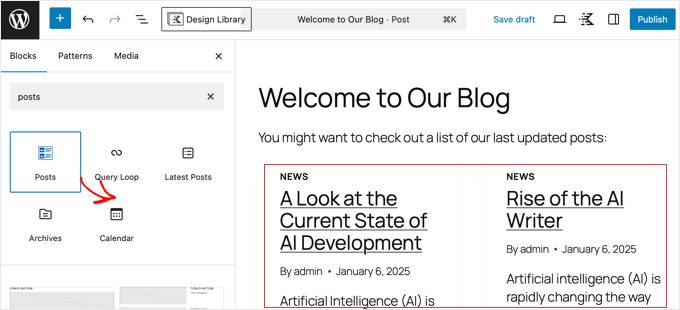
If you want to add the list to a single page or post, simply open it in the WordPress editor. Once there, click the plus (+) icon to add a new block.
In the search bar, type ‘Posts’ and then drag the Kadence Posts block onto the post or page.
Add the Posts Block in a Classic Theme Sidebar or Footer
If you have a classic theme, then you can add the block as a widget to display it across your site.
From your WordPress dashboard, go to Appearance » Widgets.
Find the widget area you want to edit, like your ‘Sidebar,’ click the plus (+) icon, and add the Kadence ‘Posts’ block using drag and drop.

Add the Posts Block In a Block Theme Sidebar or Footer
For modern block themes, you will use the Full Site Editor.
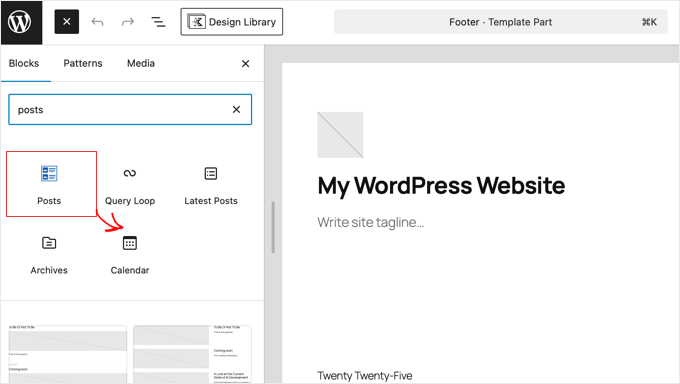
Go to Appearance » Editor from your dashboard. In the editor’s left menu, select ‘Patterns’ and then find the Template Part you want to edit, such as your ‘Footer‘ or ‘Sidebar.’
Simply drag and drop the Kadence ‘Posts’ block where you want your list to appear.
Configure the Block to Sort by Last Modified Date
Now for the important part. With the Posts block selected, you will see its settings in the right-hand sidebar. This is where we’ll tell it to order posts by the last updated date.
Under the ‘General’ tab in the block settings, find the setting labeled ‘Order By’. Click the dropdown menu and change it from ‘Newest to Oldest’ to ‘Modified Descending’.

The block will instantly update to show your recently updated posts.
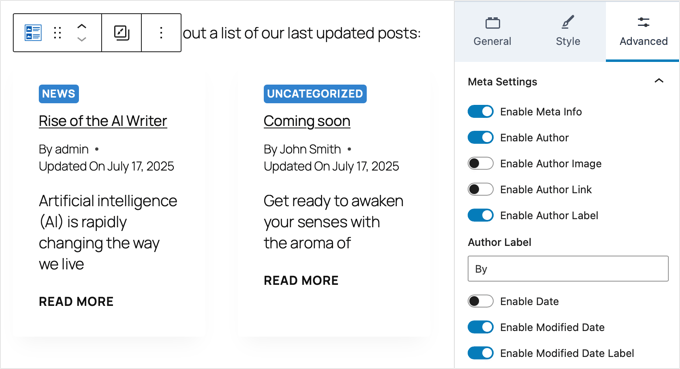
You can also customize many other settings here, like the number of posts to display and whether to show the featured image or post excerpt.
⚠️ Important: By default, the Kadence Posts block might display your posts in a grid. If you prefer a simple list, just look under the ‘General’ tab in the block settings for the ‘Layout’ options and select a list style.
When you’re finished, just click the ‘Update’ or ‘Save’ button. You can now visit your website to see your list of last updated posts live on your site.
Method 2: Using Custom Code to Display Last Updated Posts
If you’re comfortable with adding a bit of code and want complete control over the appearance of your list, then this method is for you. You can customize the exact HTML output, which is great for advanced styling.
The safest way to add code to your site is by using the free WPCode plugin. It’s the plugin I always use for custom snippets because it prevents you from making mistakes that could break your site and keeps your code safe during theme updates.
Note: The free version of WPCode has everything you need to follow this tutorial. As you get more comfortable with code, you can upgrade to the Pro version, which gives you helpful features like a cloud library for your snippets and smart conditional logic.
Step 1: Install WPCode and Create a New Snippet
First, install and activate the free WPCode plugin. If you need help, see our guide on how to install WordPress plugins.
Next, go to Code Snippets » Add Snippet from your dashboard and select ‘Add Your Custom Code (New Snippet)’.
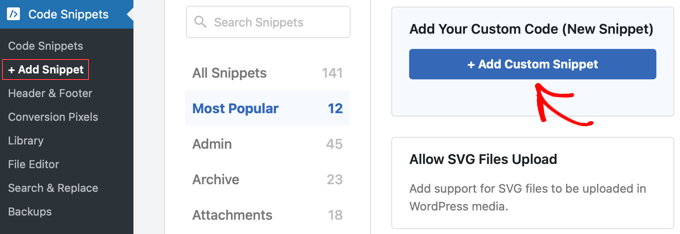
Next, you will need to choose your snippet’s code type. At the bottom of the screen, simply click the ‘PHP’ option.
Step 2: Add the Custom PHP Code
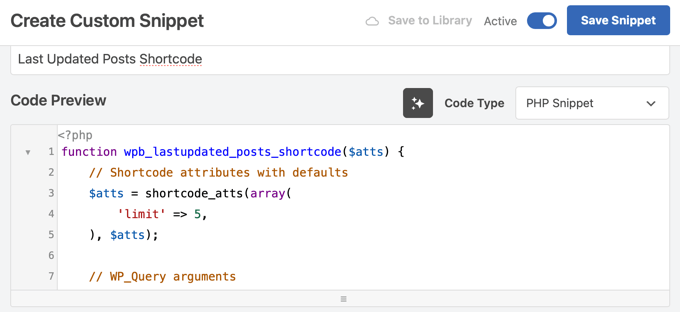
On the next screen, give your snippet a title, like ‘Last Updated Posts Shortcode’.

Then, in the ‘Code Preview’ box, paste the following code:
function wpb_lastupdated_posts( $atts ) {
    // Initialize the output string to prevent "Undefined variable" warnings.
    $output_string = '';

    // Parse the shortcode attributes.
    // 'limit' is the attribute name, and 5 is its default value if not provided.
    $atts = shortcode_atts( array(
        'limit' => 5,
    ), $atts, 'lastupdated-posts' );

    // Sanitize the 'limit' attribute to ensure it's a positive integer.
    $posts_limit = intval( $atts['limit'] );
    if ( $posts_limit <= 0 ) {
        $posts_limit = 5; // Fallback to default if an invalid limit is provided.
    }

    // Query Arguments for WP_Query.
    $lastupdated_args = array(
        'orderby'             => 'modified',         // Order posts by their last modified date.
        'ignore_sticky_posts' => 1,                  // Exclude sticky posts from the list.
        'posts_per_page'      => $posts_limit,       // Set the number of posts to display based on the 'limit' attribute.
        'post_status'         => 'publish',          // Only retrieve published posts.
    );

    // Create a new WP_Query instance.
    $lastupdated_loop = new WP_Query( $lastupdated_args );

    // Check if there are any posts found by the query.
    if ( $lastupdated_loop->have_posts() ) {
        // Added the 'last-updated-posts' CSS class to the <ul> tag.
        $output_string .= '<ul class="last-updated-posts">'; // Start the unordered list with a CSS class.

        // Loop through each post found by the query.
        while ( $lastupdated_loop->have_posts() ) :
            $lastupdated_loop->the_post(); // Set up post data for the current post.

            // Append each post as a list item with its link, title, and modified date.
            $output_string .= '<li><a href="' . get_permalink() . '">' . get_the_title() . '</a> ( ' . get_the_modified_date() . ') </li>';
        endwhile;

        $output_string .= '</ul>'; // Close the unordered list.
    } else {
        // Optional: Message to display if no recently updated posts are found.
        $output_string .= '<p>No recently updated posts found.</p>';
    }

    // Reset post data. This is crucial to restore the global post data
    // to the main query after running a custom query.
    wp_reset_postdata();

    // Return the generated HTML string.
    return $output_string;
}

// Add the shortcode.
// This registers the 'lastupdated-posts' shortcode to be handled by the 'wpb_lastupdated_posts' function.
add_shortcode( 'lastupdated-posts', 'wpb_lastupdated_posts' );
Let me quickly break down what this code does. It creates a function that uses ‘WP_Query‘, which is WordPress’s standard way to fetch posts from your database. We’ve set the orderby argument to ‘modified’ so the most recently updated content appears first.
We also added ignore_sticky_posts. This ensures that any featured posts you have pinned to your homepage don’t clutter this specific list.
Then, it wraps this function in a shortcode, [lastupdated-posts], that you can use anywhere on your site.
Finally, wp_reset_postdata() restores the main WordPress query. This is an important best practice that prevents our custom code from accidentally breaking other functions on the page.
Now, scroll down to the ‘Insertion’ section and make sure the method is set to ‘Auto-Insert’ and the location is ‘Run Everywhere’. This is the standard setting for shortcodes and ensures WordPress will recognize it anywhere on your site.
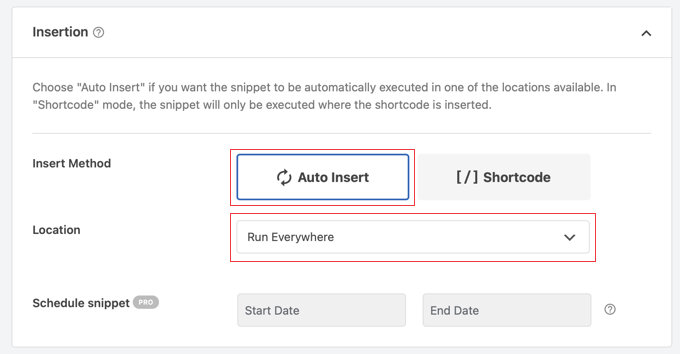
The ‘Auto-Insert’ method with the ‘Run Everywhere’ location is the correct setup. This ensures WordPress will recognize your shortcode no matter where you decide to use it on your site.
Finally, toggle the switch at the top to ‘Active’ and click the ‘Save Snippet’ button.
Step 3: Add the Shortcode to Your Site
You can now add your list anywhere on your site that accepts shortcodes.
Simply edit a post or page, add a Shortcode block, and type in:
[lastupdated-posts]
This will display the default of 5 posts.
To show a different number, you can use the ‘limit’ parameter like this:
[lastupdated-posts limit="10"]
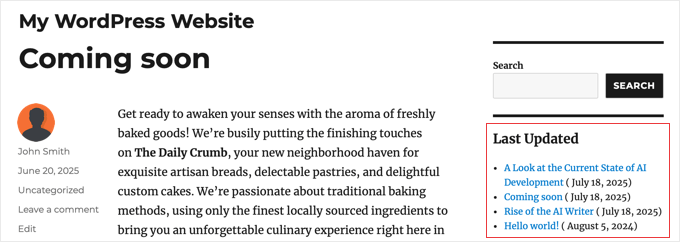
The code will produce a simple, unstyled list that inherits your theme’s default styling.
Note: Some WordPress themes intentionally strip bullet points and margins from lists. If your list looks squashed, you may need to add custom CSS to the .last-updated-posts class to style it.
This is how it looks in a sidebar on my test website:
Bonus: How to Display a ‘Last Updated’ Date on Single Posts
Besides showing a list on your homepage or sidebar, it’s also a great idea to display the ‘Last updated on’ date at the beginning of your articles. This immediately tells readers that the information is current and trustworthy, which I find builds a lot of credibility.

Many popular themes have this option built in. Check your theme’s settings under Appearance » Customize. Look for settings related to Post Meta or Blog/Post Layout.
If your theme doesn’t have this option, you can easily add it. For a complete walkthrough, see our guide on how to display the last updated date for posts in WordPress.
Note: If you make these changes and don’t see your list appear right away, you may need to clear your WordPress cache.
Frequently Asked Questions About Showing Recently Updated Posts
Here are answers to some of the most common questions we get about showing recently updated posts.
1. Will updating a post affect its URL or SEO?
No, simply updating the content of a post does not change its URL (permalink). In fact, updating and improving your old content is a highly recommended SEO best practice that can improve your search rankings.
2. Can I exclude certain posts from the last updated list?
Yes. The Kadence block plugin we mentioned allows you to include or exclude specific categories right from the block settings. If you’re using the custom code method, you can modify the WP_Query arguments in the code snippet to exclude posts by a specific ID, category, or tag.
3. How is the modified date different from the published date?
The published date is when the post first went live. The modified date is when it was last saved.
It is important to note that for a brand-new post, the modified date is usually the same as the published date. This means your brand-new articles will also appear at the top of this list until you update older content.
Additional Resources
I hope this guide helped you learn how to display last updated posts in WordPress. Here are some other guides to help you manage your content and improve your site’s SEO:
- How to Display the Last Updated Date of Your Posts in WordPress
- How to Add Related Posts with Thumbnails in WordPress
- Most Useful WordPress Widgets for Your Site
- Should You Keep or Delete Old Content in WordPress? (Expert Opinion)
- Must Have WordPress Plugins for Every Website
If you liked this article, then please subscribe to our YouTube Channel for WordPress video tutorials. You can also find us on Twitter and Facebook.


Bidhan Acharya
Is there any way to display dates in such way like fandom. Instead of saying “x date” it would be better as x hour or x days ago.
WPBeginner Support
Our article below should help with setting that up!
https://www.wpbeginner.com/plugins/how-to-display-relative-dates-in-wordpress/
Admin
Thomas Mirke
Hi,
i modified the code from “modified” to “date”. Then i noticed, that $lastupdated_loop->have_posts() is limited to the number of last posts which is presented on the main page. What is to do to get an (independent) number of f.e. 50 last posts? Instead of 6 as stored in the wp settings?
WPBeginner Support
You should be able to change from line 12 of the code the section ‘&& $counter < 5' and change the 5 to the number of posts you want to show.
Admin
Thomas Mirke
Thank you, you can be sure, that this was the first thing i did. But notice that when you change the number in your code it is without result. Write f.e. ‘&& $counter <20' – this does not work as there is f.e. 6 in the wordpress settings. So the question is how to overwrite those settings temporarily or to find any other solution that works without corresponding to the max-posts-per-page settings in wordpress.
WPBeginner Support
With your theme overriding the query that way, you could try adding a comma to the end of line 6 and on the next line add ‘posts_per_page’ => 20 to work on overriding your theme’s posts per page.
Mewaram jat
I want to show the list of the Latest updated Products, instead of Posts. is it possible? How?
WPBeginner Support
You would want to check with your eCommerce plugin for what options they would recommend as they normally have a widget or similar option.
Admin
Aditya
How can I list more than 5 , say 30 post, recently modified post ?
WPBeginner Support
If you are using the code from this article, you would change the 5 to a 30 for that
Admin
Sascha
Thank you for the instructions. That was exactly what I was looking for! Finally I can show the latest updates in my sidebar.
rren
How do you include only updated posts and exclude pages?
Gwénaël
Hi,
It works well, but it does not respect the content permissions of the page. It turns all the content visible to anybody…
Des
Hi,
I followed you ‘How to Create a Custom WordPress Widget’, including ‘Creating a Site-Specific WordPress Plugin’ and that works perfectly. Great tutorial as I now have the ‘Hello world’ text displaying as a sidebar.
But this one has me completely stumped. I followed the tutorial as best I could but it just displays my ‘Hello world’ text, never any list of updated posts.
Where in my custom plugin file do I put the function wpb_lastupdated_posts()? Where do I put the ‘add_shortcode’ and where do I put the ‘if (function_exists(wpb_lastupdated_posts)) : ‘ statement?
Many thanks,
Des
Patrick Fortino
Code works but displays only 1 post?
Gaurav Singh
It is not working for genesis framework,
sagun khadka
How can i keep thumbnail of post when i keep it in widget ?
Benedito Carneiro
I created one site-specific plugin like you teached in your article What, Why, and How-To’s of Creating a Site-Specific WordPress Plugin, inserted function wpb_lastupdated_posts in the plugin, but had to add this line to the plugin to make text-widget shortcode work:
add_filter(‘widget_text’, ‘do_shortcode’);
WPBeginner Support
Great, thanks for sharing.
Admin
Aida
Thanks much, this article saved me. Code is working perfectly….
Tommy
Installed the code as stated. When using the short code- I add it to the bottom of the post. but when view the code- it puts the information on the top of the post. weird.
WPBeginner Support
@Tommy, thanks for notifying us. We have updated the code. Please use the new code and it will resolve the issue.
Admin
SebastienSerre
Hello
Is it possible to have the last modificated page too?
Many thx
Marceli
Same request here. I’m interested in listing recently updated Pages + showing the last_modified date. Ideally with some excerpt or number of characters from page.
jerik
Great code, but is there anyway to get this exact same function but based on comments made by specific user (admin) and list the most recent comment made as the top of the threads in the list?
Thanks!
Alberto Aguilar
Hi… great post…. Yet I was wondering if you could give me a hand on something: I need to take the picture and title of the last three published posts and arrange them in some kind of Gallery (Just to show the latest three published articles, Any idea if there’s a plugin for that, I assume I can use the code you just placed above, but Im not quite sure on the DB structure)
Thanks in advance… =)
Mark Devlin
Hi, how do I add code to display the category and the user who made the update?
Norberto Vargas
The second code?
Norberto Vargas
Hello
By the way nice article, so I have a doubt.
Where to put this code:
“”
thank you
WPBeginner Support
In your template files where you want to display the list of last updated posts.
Admin
Pierre Guimond
I do not know how to change the office location address on my WordPress web site. Try as I may, I cannot reach it to change it. http://www.mastheadpa.ca I would appreciate simple and straight answer. I can do most of the upkeep but that address change eludes me and i have not seen the key in the WP information and tutorials. help.
WPBeginner Support
@Pierre your office location is stored inside a widget. Inside your WordPress admin area, go to Appearance » Widgets. On your right hand column you will see a list of widgets currently in use on your site. Look for Footer Widget Area and there you will see Get in Touch widget which you can edit and save your changes.
Admin
Steve
Hi, love this article but I don’t quite get what is meant to be updated when you mention ‘use it like this:
1
Which file is this?
Steve
WPBeginner Support
Some users might want to display last updated posts into different templates of their WordPress themes. Those users can use this code to add it. Other users can use the shortcode to add it in their posts, pages, and widgets.
Admin
erricgunawan
Instead of using
$counterfor your loop, why don’t you just use the'posts_per_page'attribute on theWP_Queryargs ?Mine goes like this:
$lastupdated_args = array(
‘orderby’ => ‘modified’,
‘ignore_sticky_posts’ => 1,
‘posts_per_page’ => 5
);
Also, when I try the above code, it only give me one last modified post (not five as it should be).
Wonder why …
Mary
I love your articles but this one is way over my head. Are there any plugins for this?
Sorry but I dont know the “innards” of the website and have broken my site when I tried a few things.
It is a great idea though.Thanks for all you great work. Mary
Rudd
The code above is actually a ‘plugin’. Simply copy and paste the first code in functionality plugin. Then, there are two ways to display the list of posts, either using template tag or the easiest, using [lastupdated-posts] shortcode.
Tommy
yes. but why does it add the content above the post wen using it as a short code?
tommy
I want the content- then the shortcode info.