


If you run a WordPress site, then you know that spam is a real annoying problem whether it comes to contact forms, WordPress comments, or user registrations.
The good news is that stopping spam in WordPress is a lot easier than you probably think, and you don’t need expensive tools either.
We have spent over 16 years testing anti-spam plugins, tools, and refining strategies to keep WPBeginner and our other business websites safe from daily spam attacks.
In this ultimate guide, we’ll walk you through how to block each type of WordPress spam, step by step from the basics to advanced modern automated spam protection. These are the exact methods we’re using to protect our own websites.
We’re covering a lot of ground in this ultimate guide, so use the quick links below to jump straight to the section you want to learn about first:
- 1. Free Built-In Settings to Turn On First
- 2. Set Up Modern AI-Powered Spam Bot Protection for WordPress
- 3. Power-User Tips for Stopping WordPress Comment Spam
- 4. Stopping WordPress Contact Form Spam (Best Practices)
- 5. Stopping Spam User Registrations in WordPress (Best Practices)
- 6. Add a Site-Wide WordPress Firewall
- 7. Cleanup WordPress Spam and Ongoing Monitoring
- Frequently Asked Questions About WordPress Spam Protection
1. Free Built-In Settings to Turn On First
WordPress comes with several anti-spam options that can protect your site against spam. These built-in options won’t stop every bot, but they will remove the easiest targets right away.
We always recommend turning these settings on first, because they cost nothing and take only a few minutes to set up.
Tighten Your WordPress Discussion Settings
To prevent comment spam, the built-in discussion settings in WordPress act as your first line of defense. They allow you to control who can post, what kind of links are permitted, and how much control you have over the conversation.
To configure these anti-spam controls, go to Settings » Discussion in your WordPress dashboard.
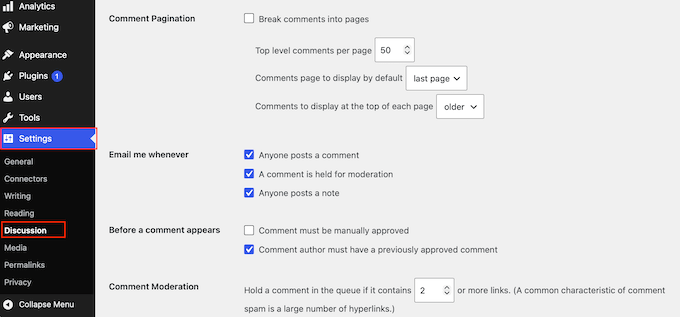
The most useful tool on this screen is the comment moderation queue. This tool acts as a holding area that keeps submissions hidden from the public until you have a chance to look them over.
Because nothing goes live automatically, spam never reaches your visitors, even if it manages to get past your other filters.
To turn this on, scroll down to the ‘Before a comment appears’ section and check the box next to ‘Comment must be manually approved.’
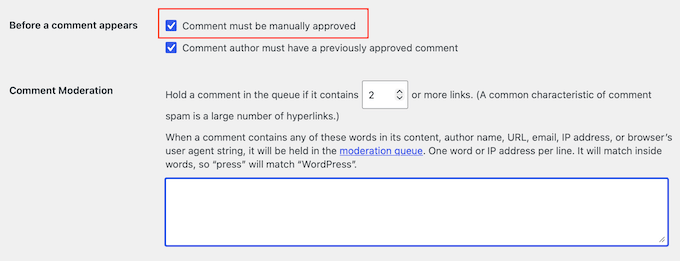
If you want, you can also enable ‘Comment author must have a previously approved comment.’ This lets returning commenters post without waiting for approval. However, be sure to review your published comments regularly since they won’t appear in your moderation queue.
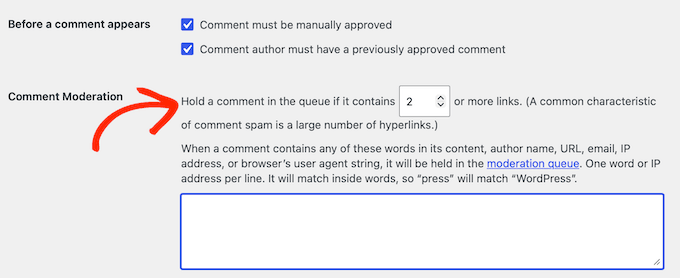
After that, scroll to the ‘Comment Moderation’ box, where you’ll find a setting that limits links. Because spam comments almost always contain web addresses, WordPress can automatically hold any submission that includes too many links.
The field labeled ‘Hold a comment in the queue if it contains [X] or more links’ is set to 2 by default. Lowering that number to 1 will help you catch even more junk.
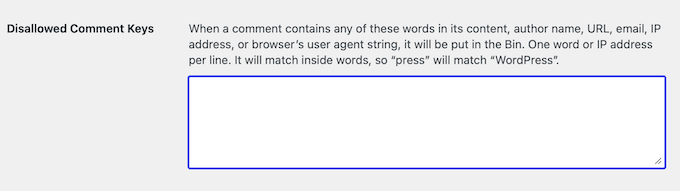
On the same screen, you can use the comment blocklist to automatically filter out unwanted content. This tool looks for specific words, names, email addresses, or web addresses and sends any matching comment straight to the trash.
In the ‘Disallowed Comment Keys’ box, you can paste your own trigger words, putting one on each line, and then save your changes.
Require a Name and Email, and Hold First-Time Commenters
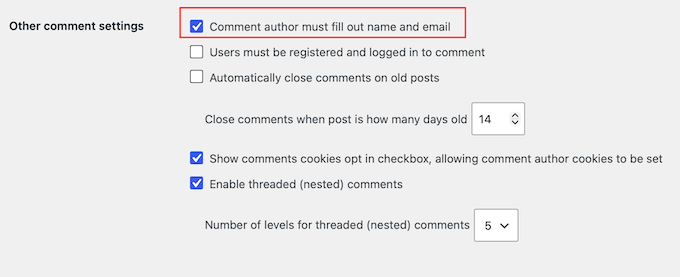
Healthy discussions start with real people. Requiring commenters to enter a name and email encourages more thoughtful conversations and discourages anonymous drive-by comments.
Most genuine visitors won’t mind providing these details, and it helps create a more welcoming and trustworthy community around your website.
To enable this, scroll to the ‘Other comment settings’ section and check the box next to ‘Comment author must fill out name and email.’
If you want to master the review process and manage your queue efficiently, our beginner’s guide to moderating comments in WordPress covers the full workflow.
Disable Comments Where You Do Not Need Them
Depending on the type of website you have, you may not need a comment section at all. If that’s the case, then you can simply disable comments entirely and that’ll get rid of the WordPress comment spam problem once and for all.
The most thorough option is the code method, which disables comment support across your entire site at once. It’s safest to add the snippet with a free code snippets plugin like WPCode rather than editing your theme’s files directly, so a theme update can’t undo it.
add_action('admin_init', function () {
    // Redirect any user trying to access comments page
    global $pagenow;

    if ($pagenow === 'edit-comments.php') {
        wp_safe_redirect(admin_url());
        exit;
    }

    // Remove comments metabox from dashboard
    remove_meta_box('dashboard_recent_comments', 'dashboard', 'normal');

    // Disable support for comments and trackbacks in post types
    foreach (get_post_types() as $post_type) {
        if (post_type_supports($post_type, 'comments')) {
            remove_post_type_support($post_type, 'comments');
            remove_post_type_support($post_type, 'trackbacks');
        }
    }
});

// Close comments on the front-end
add_filter('comments_open', '__return_false', 20, 2);
add_filter('pings_open', '__return_false', 20, 2);

// Hide existing comments
add_filter('comments_array', '__return_empty_array', 10, 2);

// Remove comments page in menu
add_action('admin_menu', function () {
    remove_menu_page('edit-comments.php');
});

// Remove comments links from admin bar
add_action('init', function () {
    if (is_admin_bar_showing()) {
        remove_action('admin_bar_menu', 'wp_admin_bar_comments_menu', 60);
    }
});
Our guide on how to completely disable comments in WordPress walks through that snippet along with the other options.
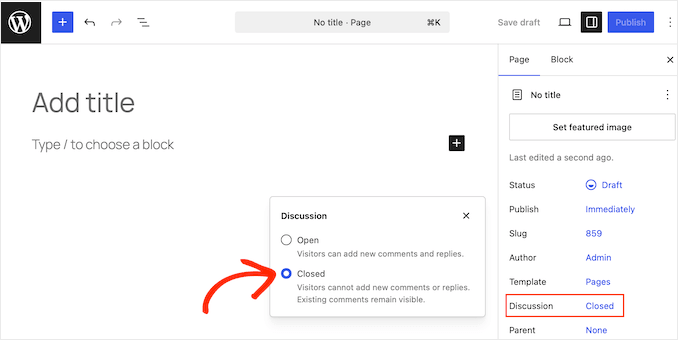
If you’d rather not go site-wide, you can also turn comments off on individual pages. This is handy when you only want them gone on specific pages, like your Contact or About pages, which rarely need a comment section.
To do this, open the page in the WordPress content editor. Then click the ‘Discussion’ option in the right-hand sidebar and select ‘Closed.’
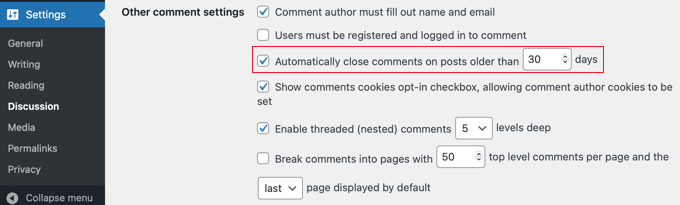
You can also stop spam from piling up on older content without touching your newer posts. If you don’t expect comments on old posts, then WordPress can close them automatically after a set number of days.
This gives spam bots fewer chances to target your archived content.
To set this up, head to Settings » Discussion and find the ‘Other comment settings’ section. Check the box next to ‘Automatically close comments on posts older than [X] days’, then set a sensible limit such as 30 or 90 days.
Disable Trackbacks and Pingbacks
Trackbacks and pingbacks notify you when another website claims to have linked to one of your blog posts.
While they were originally designed to help bloggers connect conversations across different websites, they’re now commonly abused by spammers to send fake link notifications.
Turning this feature off completely removes a whole category of junk notifications from your dashboard.
To disable these notifications, go to the Settings » Discussion screen in your WordPress dashboard. Here, uncheck the box next to ‘Allow link notifications from other blogs (pingbacks and trackbacks) on new posts.’
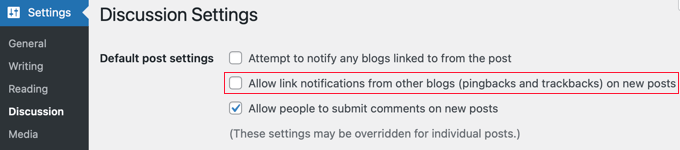
With that done, don’t forget to click ‘Save Changes’ at the bottom of the screen.
Just be aware that changing this option only protects the posts you publish from this moment forward. If you want to clean up the content you’ve already published in the past, you can follow our step-by-step guide on how to disable trackbacks and pings on existing WordPress posts.
2. Set Up Modern AI-Powered Spam Bot Protection for WordPress
In the era of AI where automated spam is increasing, the best defense against it is a modern AI-powered spam protection for WordPress.
These spam filtering solutions automatically detect and block spam on your WordPress comments, contact forms, and user registrations without the use of CAPTCHA which can hurt conversions.
On WPBeginner, we use ActiveLayer for this. It is AI-powered and runs server-side, so it stops spam invisibly, without a CAPTCHA and it’s GDPR compliant.
In the last 30 days, it has blocked over 25,739 spam comments and contact form submissions on our website. It even shows you a confidence score, and the reason behind every submission it flags, not just a pass-or-fail verdict when you look at their logs.
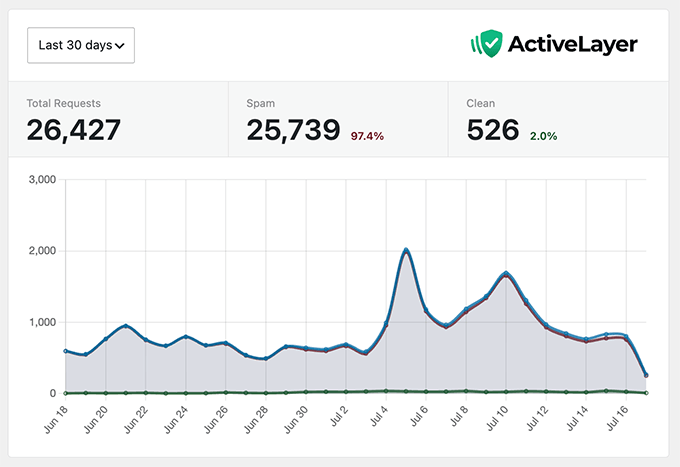
The free plan includes 1,000 spam checks with no credit card, and paid plans start at around $4 per month billed yearly.
The two other popular spam filtering plugins for WordPress you could try are Akismet or CleanTalk.
Akismet is very popular and still is a good fit for personal blogs, where its “name your price” plan can be free for non-commercial sites. But they have raised their prices significantly for commercial sites which is quite expensive for smaller businesses. For a business site, we would point you to either ActiveLayer or CleanTalk.
Whichever tool you choose, stick to just one, because running two spam filters at once can conflict and block real visitors. The benefit of these spam protection plugins are that they integrate with all other popular contact form plugins by default.
3. Power-User Tips for Stopping WordPress Comment Spam
So far we’ve configured the built-in spam prevention settings in WordPress, and an automated spam filtering plugin for WordPress. The combination of these two should block most spam.
However if you are not able to set up modern AI spam protection due to costs or another reason, then you can use one of these tips below to combat comment spam in WordPress.
Add a Free CAPTCHA to Your Comment Form
CAPTCHA is a simple test that most human visitors pass without any effort, while automated scripts fail it. We recommend adding Cloudflare Turnstile CAPTCHA to your WordPress comments because it’s free and fairly straight forward to set up.
To set it up, install and activate the free Simple Cloudflare Turnstile plugin. You will be asked to create a free account on Cloudflare’s website and connect it with the plugin.
Once that’s done, you can scroll to the ‘Enable Turnstile on your forms’ section. Simply check the boxes to protect all your WordPress forms and click ‘Save Changes’.
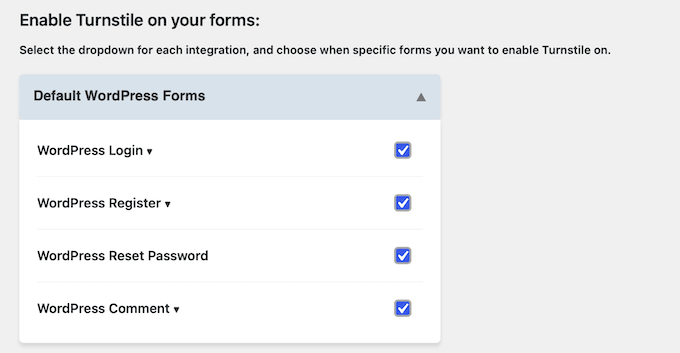
Here’s our detailed guide on how to add Cloudflare Turnstile CAPTCHA in WordPress.
Google reCAPTCHA is another option, which you can add with the Advanced Google reCAPTCHA plugin. We no longer recommend it because Google has capped their free tier at 10,000 assessments per month for your entire organization whereas Cloudflare Turnstile stay free without limits.
Limit or Require Login to Comment
Another really effective way to stop comment spam in WordPress is to control who’s allowed to participate in comments.
If your comment section is open to everyone, then spammers can continuously flood your forms with automated links. Restricting comments to registered account holders ensures that only verified users can post. This forces a level of accountability that most bots will not bother trying to bypass.
Because it requires readers to go through the extra step of creating and logging into an account, this approach is best suited for membership sites, online forums, and private communities.
If you run an open, public blog, then we’d recommend using an automated filtering service or a reader challenge instead as those add less friction.
If you do decide to turn this restriction on, go to Settings » Discussion in your WordPress dashboard. Under the ‘Other comment settings’ section, check the box next to ‘Users must be registered and logged in to comment.’
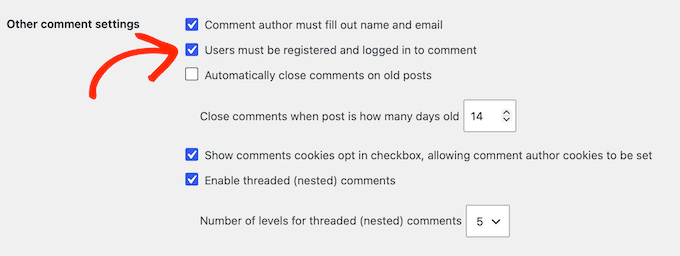
As always, don’t forget to save your changes.
Use Antispam Bee for Free Keyword and Pattern Filtering
Some spam slips through basic checks by mimicking human writing. This is where a dedicated filtering plugin can help protect your site.
Antispam Bee is an excellent free, privacy-friendly anti-spam plugin that doesn’t require an API key or account registration. Installing Antispam Bee gives you a powerful set of local rules to analyze comment data before it even hits your database.
Once it’s activated, you can configure your rules by going to Settings » Antispam Bee.
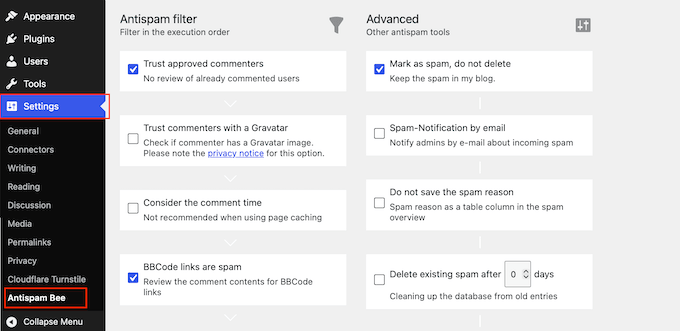
We recommend enabling the options to:
- Trust approved commenters.
- Mark as spam.
- Do not delete.
- Use regular expressions (which allows the plugin to scan for known text and link patterns).
You should also check the box to ‘Look in the local spam database.’ This allows Antispam Bee to cross-reference new submissions against previous spam history on your site.
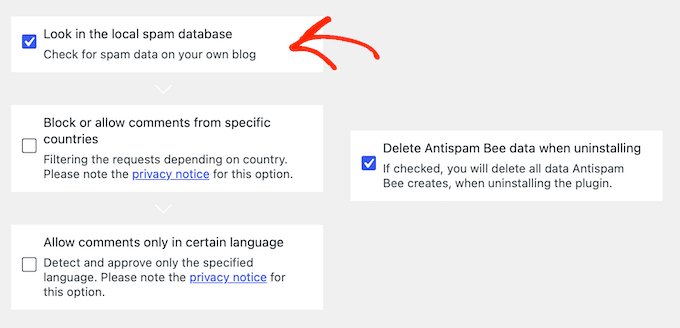
Under ‘Advanced,’ you can set Antispam Bee to delete existing spam after a set number of days, which keeps your database tidy without any manual effort.
We highly recommend leaving the email notifications for spam turned off in this section. A busy website can attract hundreds of automated submissions a day, and these alerts will quickly flood your inbox.
If you want to try one more free tweak, then you can remove the website address field from the comment form.
Our step-by-step guide on how to remove the website URL field from the comment form shows you how to do this in just a few quick steps.
4. Stopping WordPress Contact Form Spam (Best Practices)
Contact and lead forms are among the most attacked parts of any WordPress site. We know this firsthand because we once had to combat more than 18,000 spam entries flooding a single form.
We use WPForms to build forms on WPBeginner, and it’s a popular form builder plugin used by over 5 million websites. Their free version includes smart anti-spam protection, CAPTCHA integrations with Google / Cloudflare Turnstile, and the paid plans add the filtering options we cover below.
Other popular form builders like Gravity Forms and Fluent Forms have similar anti-spam settings, so check the options in whichever form builder plugin you use. We will show WPForms here because it’s what we use and consider the best fit for beginners.
Enable Default Anti-Spam Token (or Similar HoneyPot)
To combat lead form spam, WPForms silently attaches a unique, time-sensitive token to your form on every page load. The anti-spam token blocks automated scripts, which means spam entries are blocked before they reach your inbox.
It’s turned on by default for new forms, but it’s worth confirming.
Open your form, go to Settings » Spam Protection and Security, and make sure ‘Enable modern anti-spam protection’ is switched on.
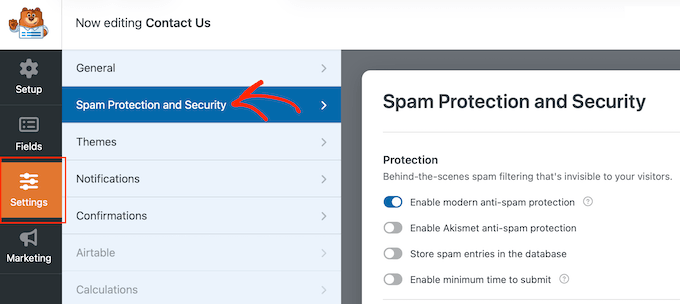
This is a modern version of the Honeypot technology which most WordPress form plugins come with, so it may be labeled as Honeypot in another form tool that you might be using.
Enable a CAPTCHA on Your Contact Form
More aggressive bots mimic human browsing and slip past the invisible token. Adding a visible CAPTCHA field stops them by forcing a challenge they can’t read or solve.
WPForms has both Cloudflare Turnstile and Google reCAPTCHA built in, and we default to Turnstile here. It’s free for everyone and runs its checks in the background, so most real visitors pass without solving a puzzle.
To set it up, go to WPForms » Settings » CAPTCHA and choose ‘Cloudflare Turnstile’.
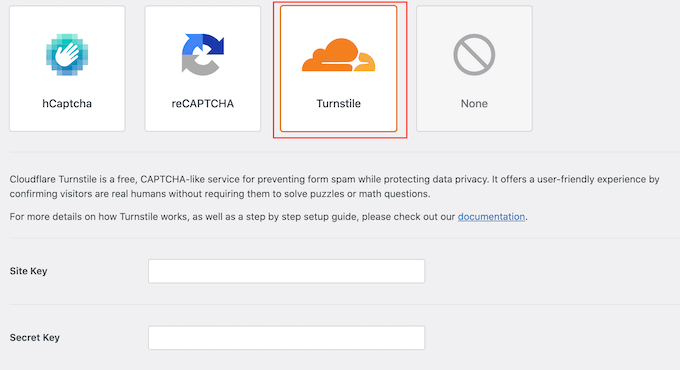
Then add the Site Key and Secret Key from your Cloudflare account, and save your settings.
Finally, add the CAPTCHA field to each form you want to protect.
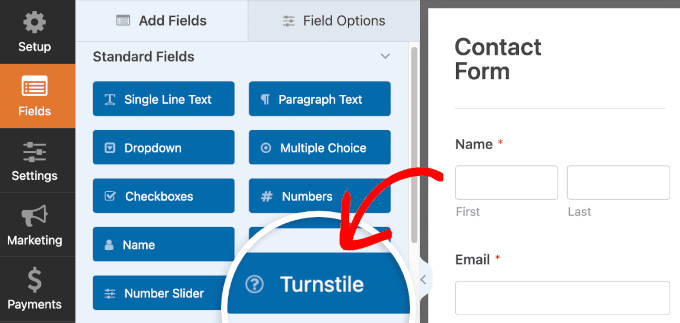
For a full walkthrough, see our guide on how to add Cloudflare Turnstile CAPTCHA in WordPress.
Google reCAPTCHA is also selectable on that same WPForms » Settings » CAPTCHA screen. We default to Turnstile because it’s free without limits, but reCAPTCHA still works if you prefer it.
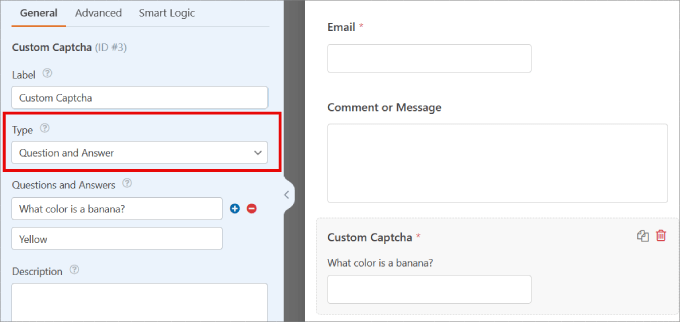
If you’d rather not send visitor data to Google or Cloudflare, then WPForms’ Custom Captcha field (available on any paid plan) builds the challenge on your own server instead.
Add the field, then set it to a random math problem or your own question and answer.
Use Time-Based Behavioral Checks to Stop Contact Form Spam
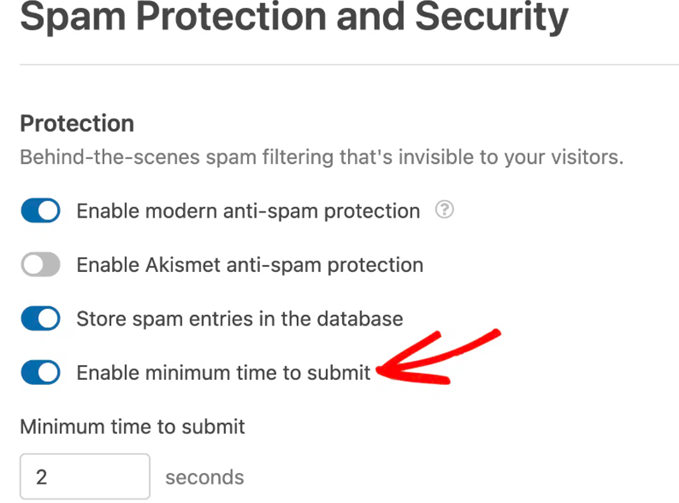
A real person needs several seconds to read a question and fill out a form, while a bot submits in a fraction of a second. Time-based checks flag those impossibly fast submissions without changing anything the visitor sees.
With WPForms, the ‘Enable minimum time to submit’ option is enabled by default with a minimum time to submit of 2 seconds. However, you can update the minimum time to any value you like.
Block Form Submission by Country, IP, Email Address, and More
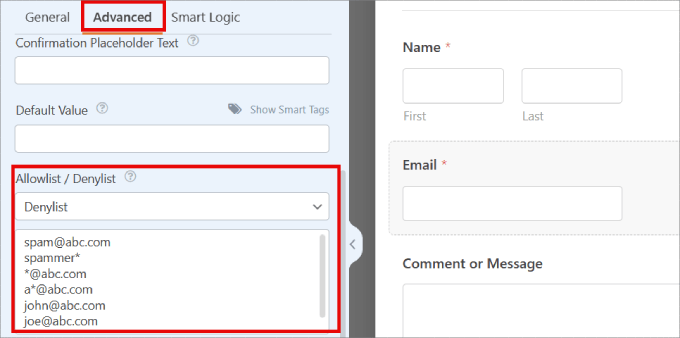
Some spam form submissions still gets through unless you screen the content itself. In the Pro version, WPForms lets you block entries by specific email address, by keyword, and by country or IP address.
To block a sender, open your form, select the Email field, open the Advanced tab, choose Denylist, and enter the addresses or domains to ban. A wildcard like *@example.com blocks an entire domain.
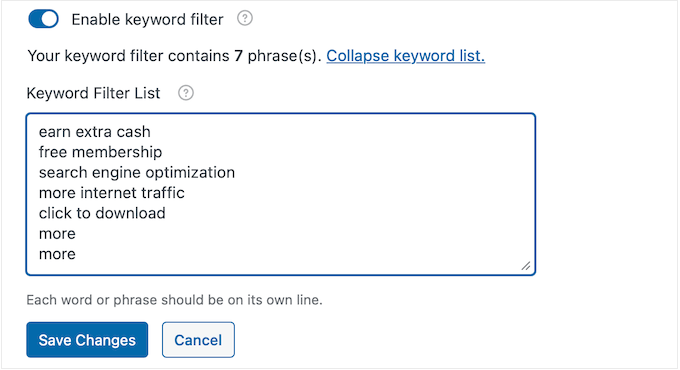
To block spammy phrases, go to Settings » Spam Protection and Security.
Turn on ‘Enable keyword filter’, open ‘Edit keyword list’, and add each term on its own line.
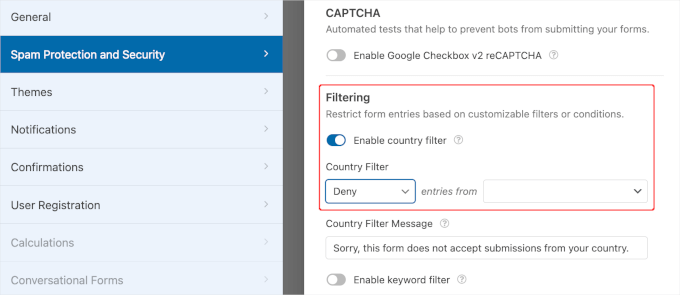
And if you only serve certain regions, turn on ‘Enable country filter’ on the same screen to allow or deny locations.
Alternatively if your WordPress form solution doesn’t have this option, you can also block IP addresses in WordPress.
5. Stopping Spam User Registrations in WordPress (Best Practices)
On a membership site or WooCommerce store, spam registrations are more than a nuisance. Fake accounts clog your user database and skew your customer and email metrics.
Here’s what you can do to prevent spam user registrations in WordPress.
Turn Registration Off When You Do Not Need It
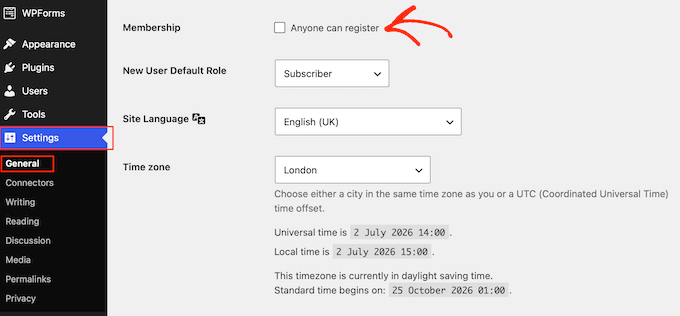
If you’re not running a membership site or an eCommerce store, then you likely don’t need to allow user registration. The easiest thing to prevent user registration spam there is to turn it off.
Simply go to Settings » General in your WordPress admin area, and uncheck the ‘Anyone can register’ box.
Require Email Confirmation Before an Account Activates
If you do need open registration, then the goal is to let only real people in while keeping spam bots out. The setting that stops the most fake signups is requiring a confirmed email address, or a manual review, before an account goes live.
Where that control lives depends on what plugin you’re using to manage user registration in WordPress. You will want to start with your platform’s default setting instead of bolting a general form plugin onto a system that already handles this.
If you run a WooCommerce store, then go to WooCommerce » Settings » Accounts & Privacy. This is where you decide whether shoppers can create an account at all, limit account creation to checkout, or keep guest checkout on so no account creation is needed.
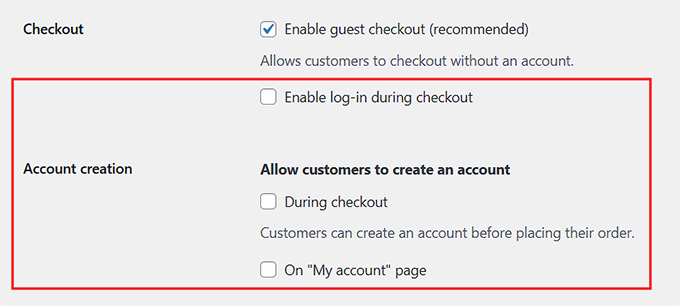
WooCommerce core doesn’t add a separate email-confirmation step on its own. If you want one, then you’ll need a custom email verification extension or the custom signup form covered below.
Other membership and course platforms handle account verification in their own settings, so start there:
- MemberPress: WordPress creates the account on registration, so pair it with the free User Verification plugin to keep the account inactive until the person confirms their email. See MemberPress’ documentation for the full details.
- BuddyPress and BuddyBoss: email activation is built in, so new members stay inactive until they click the activation link. Enable registration under Settings » General (BuddyPress) or BuddyBoss » Settings » Login & Registration. See BuddyPress documentation and BuddyBoss documentation for more details.
- LearnDash: registration runs on WordPress’s own user system, so there’s no native email-confirmation step. An account goes live the moment someone signs up. To hold new accounts until the email is verified, add that check at the WordPress or form level, using a user verification plugin or the custom WPForms registration form covered below.
If you’re building a custom registration form rather than using one of the systems above, then you can use WPForms User Registration addon which lets you turn on email activation under the form’s User Registration settings, with either an email confirmation link or manual admin approval.
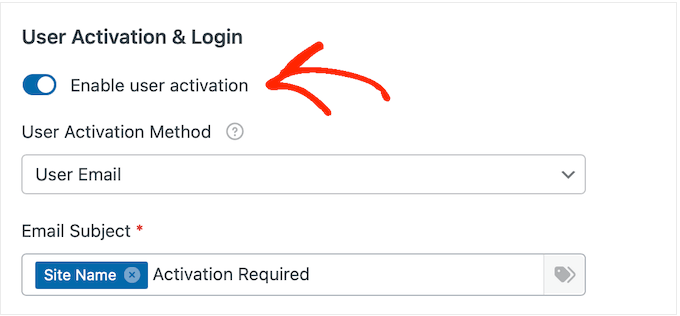
Similar options are available in Gravity Forms, WSForm, and other popular WordPress form plugins. For the full walkthrough, see our guide on how to moderate new user registrations.
Add CAPTCHA and Honeypot to WordPress Signup Form
The same tips that protect your WordPress contact forms also work on WordPress signup form. Since you already set up Cloudflare Turnstile earlier, you can switch it on for your registration form in a click.
For a dedicated walkthrough, see our guide on how to add a CAPTCHA to your login and registration forms.
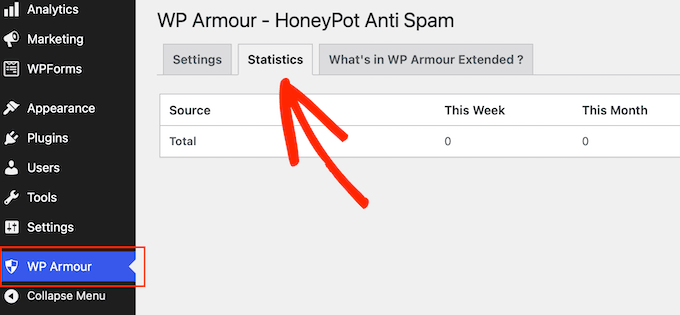
If you’re using the default WordPress registration page, then you can add hidden honeypot fields to your registration form with the free WP Armour plugin. The plugin logs every bot it blocks under WP Armour » Statistics.
Use AI-Powered Tools for Blocking WordPress Registration Spam
Honeypots and CAPTCHAs stop obvious bots, but they can’t spot someone signing up with a throwaway email or from a known-bad IP address.
That’s where automated detection helps. It screens each new signup against live reputation data and blocks the ones that look fraudulent.
ActiveLayer and CleanTalk both offer this for WordPress registrations, and you can switch it on for your signup form the same way you did for your contact forms.
6. Add a Site-Wide WordPress Firewall
A Web Application Firewall (WAF) screens every visitor and blocks malicious requests before they reach your site. Since most form spam is automated, a good firewall can stop a lot of it at the perimeter.
We recommend a DNS-level firewall, which filters traffic on the provider’s network before it touches your server.
On WPBeginner, we use Cloudflare, which has a free plan with basic firewall protection (setup requires pointing your domain’s nameservers to Cloudflare).

Our guide on how to set up the free Cloudflare CDN and firewall walks through it.
Plus, our roundup of the best WordPress firewall plugins compares the other options if you want to weigh them up.
7. Cleanup WordPress Spam and Ongoing Monitoring
Stopping new spam is only half the job. If you’re like most websites, you already have a backlog of old junk that needs cleaning up.
A quick cleanup keeps your database tidy and helps your new tools run at their best.
🚨 Always create a complete WordPress backup before deleting anything in bulk. These actions permanently wipe data, with no undo button if you make a mistake.
Bulk-Delete Existing Spam Comments
WordPress spam filter flags junk comments but doesn’t delete them, so they can build up in your spam folder and take up database space until you clear them out.
In your dashboard, go to Comments, click the ‘Spam’ filter at the top, and hit ‘Empty Spam’ to permanently clear everything your filters caught.
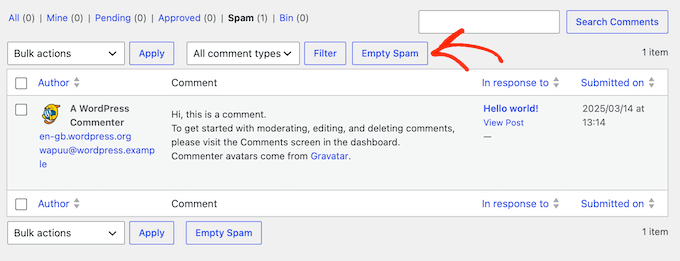
If you have thousands of junk comments, the dashboard can freeze or time out. A free plugin like WP Bulk Delete is faster and more reliable for big backlogs.
For other methods, see our guide on how to bulk delete WordPress comments.
Clean Out Existing Fake User Accounts
Leaving bot profiles in your database is a security risk and skews your analytics. That’s why it’s important to clean out these fake accounts.
For a handful, go to Users » All Users, click the ‘Subscriber’ user role filter (the role almost all registration bots use), select the fake accounts, and choose Delete from the ‘Bulk actions’ menu.
⚠️ Be very careful to select only fake Subscriber accounts, and never an Administrator account.
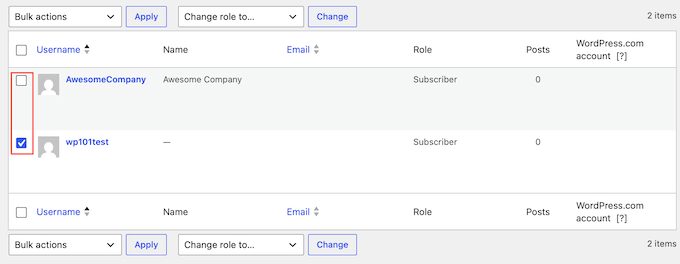
For thousands of accounts, the free WP Bulk Delete plugin can remove users by role, inactivity, or registration date in one sweep.
For more information, see our guide on how to bulk delete WordPress users by role.
Handle False Positives
No filter is perfect, so never auto-delete your spam folder without a quick glance first.
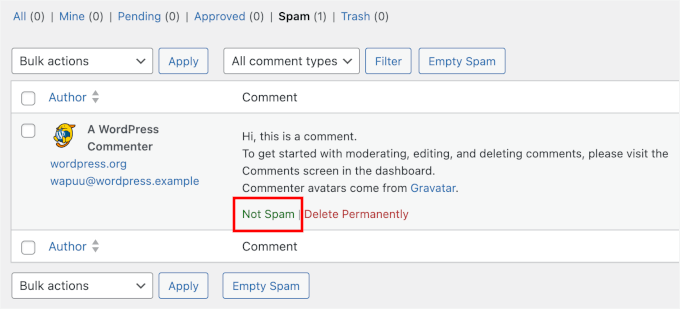
In Comments » Spam, hover over a legitimate comment and click ‘Not Spam’. That also teaches your filter to recognize similar comments as safe in the future.
Set a Monthly Anti-Spam Review Routine
A few minutes each month keeps spam from piling back up. Add these three checks to your maintenance routine:
- Scan for false positives: skim your spam comment folder and form entries so no real messages were caught by accident.
- Empty your spam folders: once you’ve rescued anything real, clear them to keep your database lean.
- Check your user list: glance at new registrations for gibberish usernames or suspicious email domains that slipped through.
Key Takeaways
Here is a summary of the best practices we have covered to completely protect your WordPress website from spam:
- Start with free WordPress settings: turn on comment moderation, tighten your link limits, build a comment blocklist, and disable trackbacks. These cost nothing and clear out the easiest spam.
- Use automated, invisible filtering: a server-side tool like ActiveLayer, Akismet, or CleanTalk blocks bots in the background without making real visitors solve puzzles.
- Layer your contact form defenses: honeypots alone no longer stop modern bots, so combine them with timing checks, token validation, and an automated filter.
- Secure your registrations: require email confirmation for new accounts and screen every signup with an automated tool.
- Add a site-wide firewall: a DNS-level firewall like Cloudflare blocks a lot of automated spam at the perimeter, before it ever reaches your forms.
- Run regular cleanup: bulk-delete old spam comments and fake accounts, then spend a few minutes each month checking for false positives.
Frequently Asked Questions About WordPress Spam Protection
Is free Akismet-style filtering enough, or do I need more?
For a small personal blog with only comment spam, a single free filter like Akismet is usually enough. Once you add contact forms, signup forms, or user registration, you’ll want a service that protects those too, like ActiveLayer or CleanTalk.
Will adding a CAPTCHA hurt my form conversions?
It can. The extra step causes some real visitors to give up on the form. This is why we prefer invisible, server-side detection that blocks bots without asking anyone to solve a puzzle.
Why am I still getting spam after installing an anti-spam plugin?
Usually because the plugin only guards one entry point. If it protects your comments but not your signup or contact forms, bots just move to those instead, and older tricks like basic honeypots no longer stop modern bots. The fix is a layered setup: your built-in WordPress settings, an automated filter, and a firewall working together.
How do I stop fake user registrations without turning off signups completely?
Turn on email confirmation so new accounts stay inactive until the person clicks a link in their inbox, which bots can’t do. Pair it with a honeypot and an automated filter, and real people can still sign up freely.
Can spam actually hurt my SEO or get my site blacklisted?
It can, but it depends on where the spam is. Comment spam sitting in your moderation queue is never published, so search engines never see it and your SEO stays safe.
Published spam is the real risk, because it can slowly pull down your rankings. WordPress does tag comment links as nofollow, which limits the damage.
We hope this article helped you learn how to protect your WordPress website against spam. You may also want to check out our ultimate WordPress security guide to improve your website security.
If you liked this article, then please subscribe to our YouTube Channel for WordPress video tutorials. You can also find us on Twitter and Facebook.


Have a question or suggestion? Please leave a comment to start the discussion.